

Ancient Bronze Arrowhead Display with Broadhead and Swallow-Wing Forms | Circa Circa 1400 – 1000 BCE
Couldn't load pickup availability


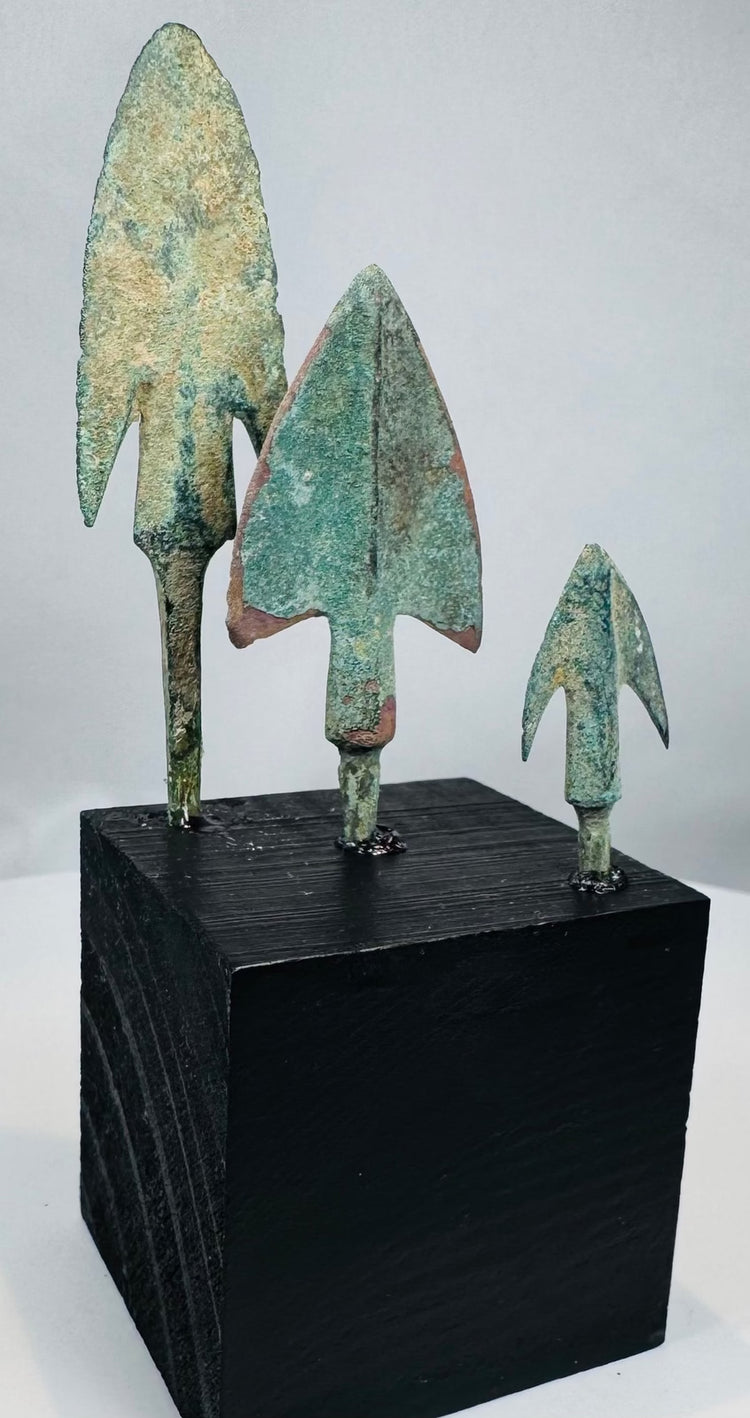
Ancient Bronze Arrowhead Display with Broadhead and Swallow-Wing Forms | Circa Circa 1400 – 1000 BCE
Description
More
Less
Historical Context & Origin
Region: Western Asia, likely Iranian Plateau
Material: Cast bronze / copper alloy
Period: Late Bronze Age–Early Iron Age, circa 14th–10th Century BCE
Description
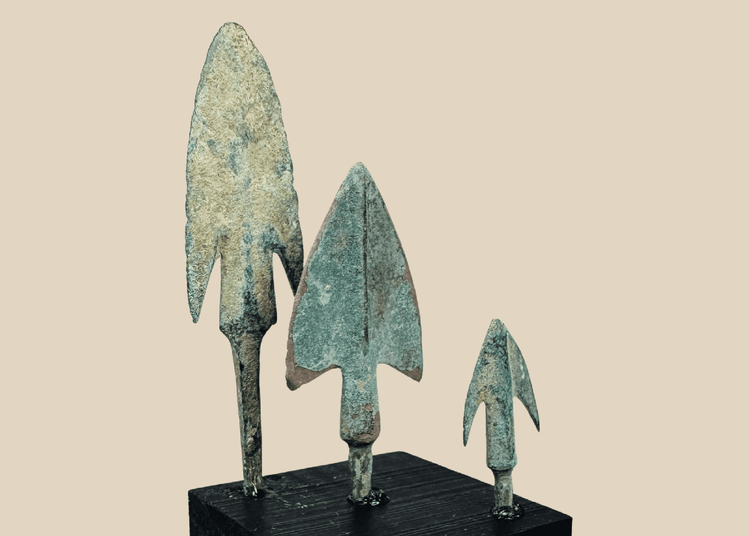
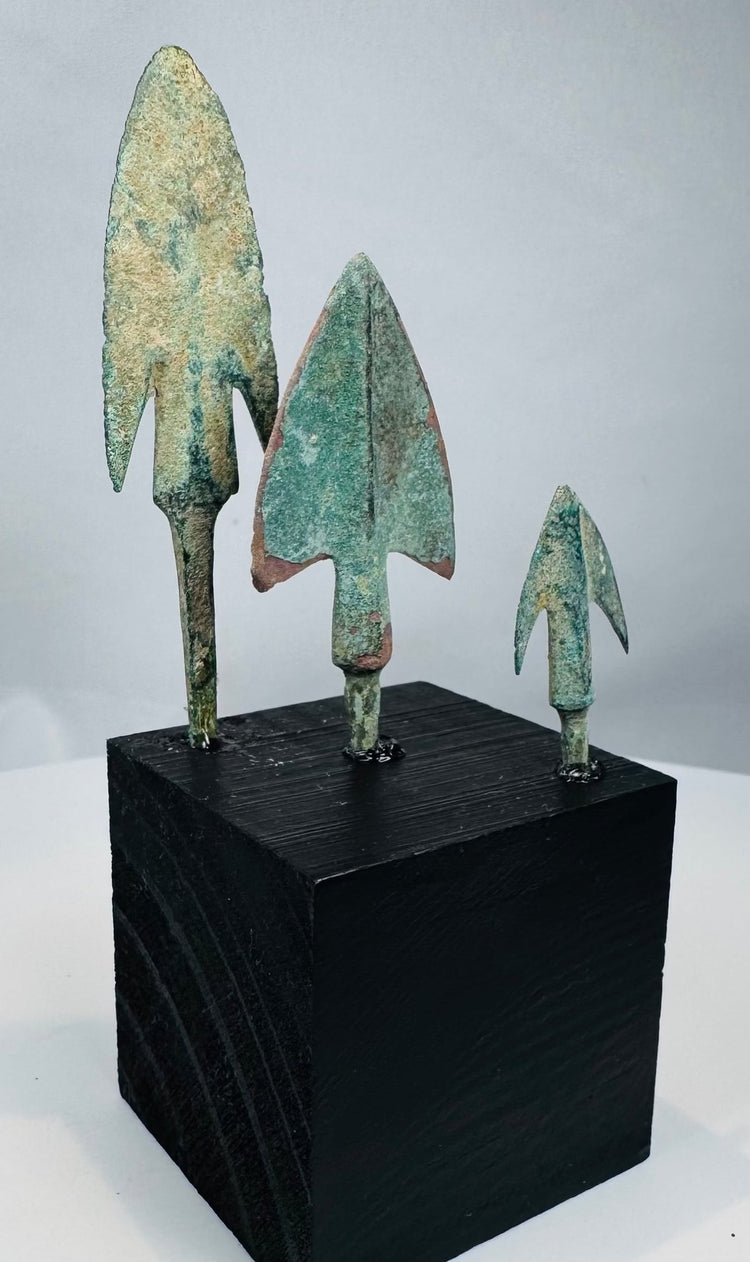
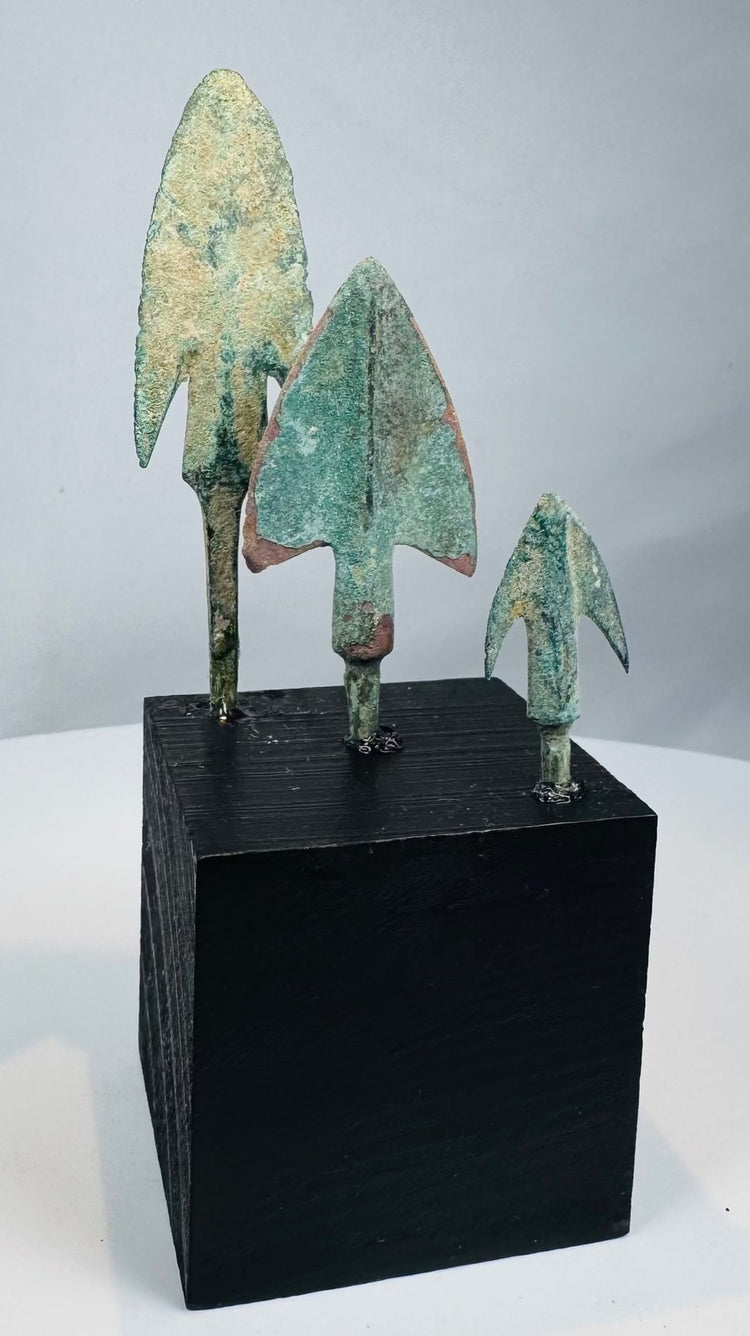
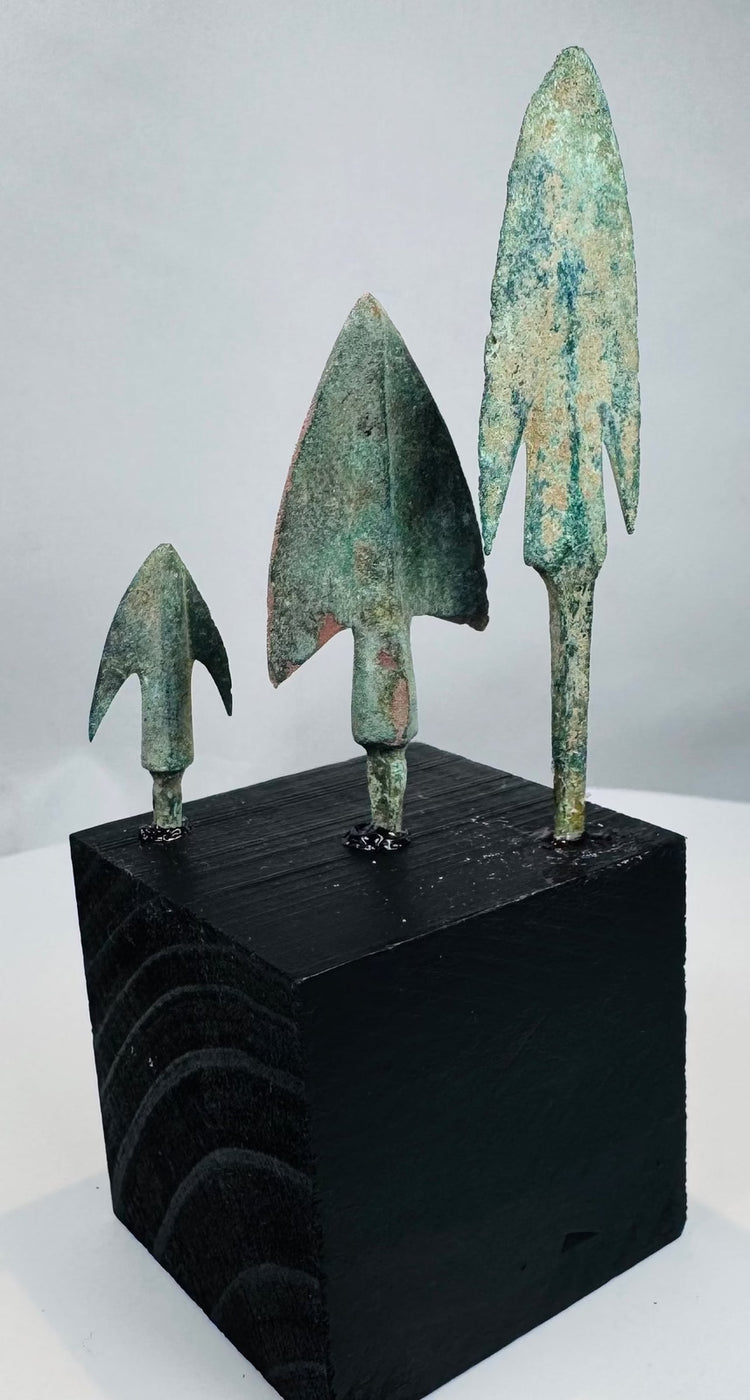
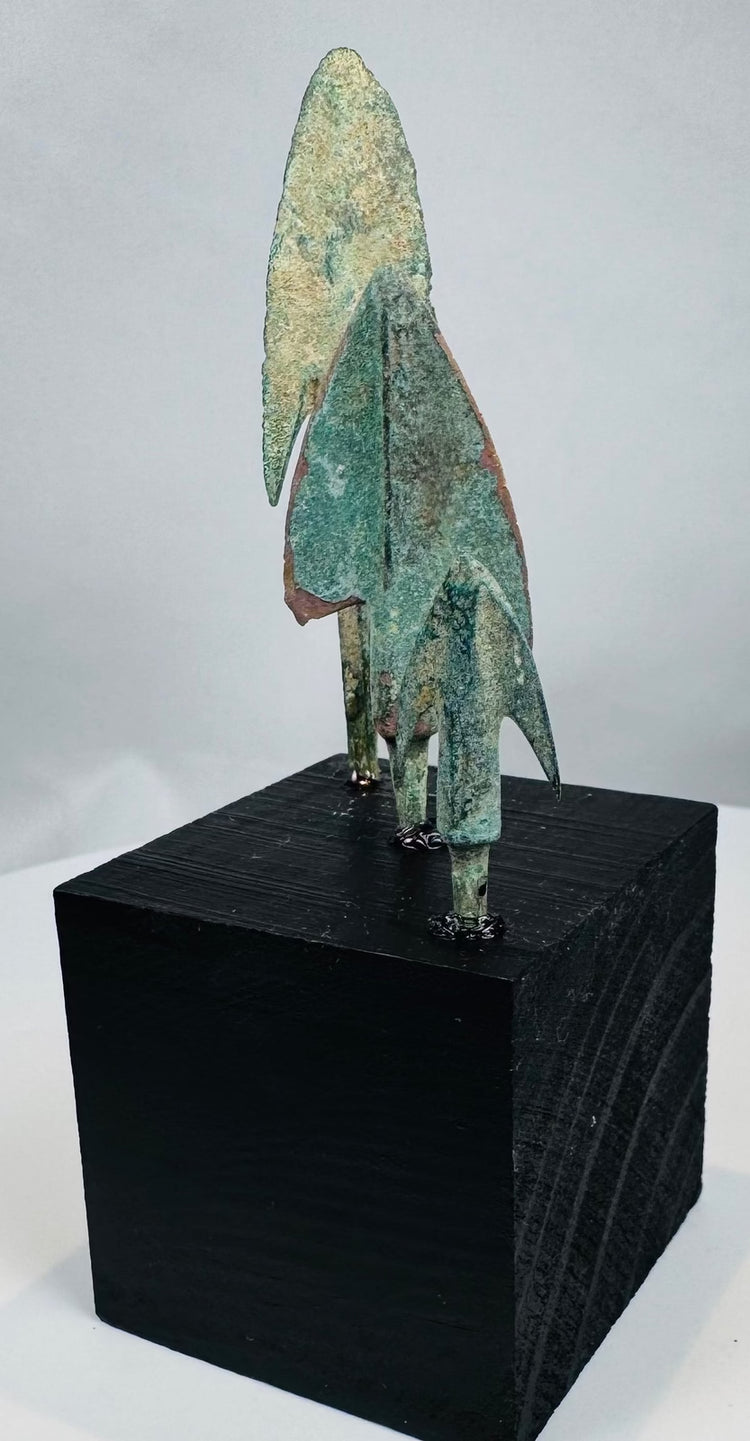
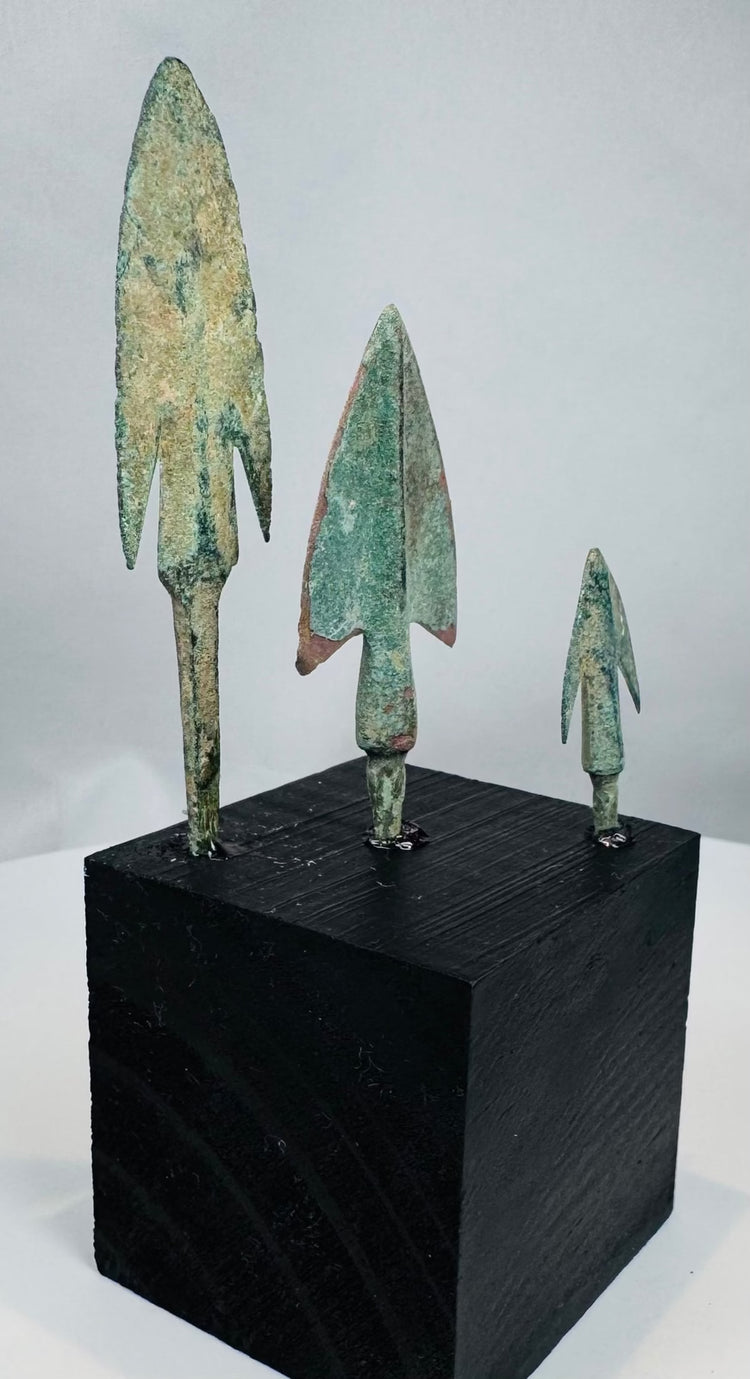
This mounted collection comprises three ancient Western Asiatic bronze projectile points dating broadly from the Late Bronze Age through the Early Iron Age. The group includes one elongated barbed point, one broad triangular point with pronounced shoulders and a central rib, and one smaller compact barbed arrowhead. Each retains a surviving tang and has been mounted individually on a modern black wooden display base.
The largest example is formed with an elongated leaf-shaped blade terminating in a rounded point. Two long, sharply recessed barbs extend downward on either side of the central tang, giving the point a distinctive harpoon-like profile. Its broad blade and projecting barbs would have created a substantial wound and made the projectile difficult to remove after impact. The long surviving tang was originally inserted into a wooden shaft and secured using binding, natural adhesive, or pressure fitting.
The central example displays a broad triangular blade with pronounced lateral shoulders and a clearly visible raised central rib. This rib strengthened the blade while reducing unnecessary weight and helped maintain rigidity during impact. The lower portion narrows into a rectangular stem and attachment tang. Its substantial proportions suggest that it may have functioned as a heavy arrowhead, light javelin point, or compact spearhead.
The smallest example is a compact triangular arrowhead with deeply recessed shoulders forming two sharply projecting barbs. A raised central ridge extends along the blade and continues into the lower stem, strengthening the point while preserving a relatively light profile. Its small size and aerodynamic form are consistent with an arrowhead intended for hunting or warfare.
These points belong to a distinctive family of ancient Western Asiatic projectile weapons with pronounced winged or barbed shoulders. Their silhouettes have often been compared to stylized birds in flight, particularly swallows with outstretched wings. Comparable forms are associated with the Iranian Plateau and surrounding regions and are discussed within the Khorasani classification of ancient Iranian arms.
Features
- Cast from bronze or copper alloy
- Includes elongated, broad triangular, and compact barbed forms
- Largest example with long downward-projecting barbs
- Central example with broad shoulders and pronounced strengthening rib
- Smallest example with sharply recessed swallow-wing profile
- Surviving tangs originally intended for insertion into wooden shafts
- Associated with ancient hunting, warfare, and personal defence
- Green, blue-green, brown, and pale mineral patination throughout
- Mounted together on a modern black wooden display base
Cultural Significance
Bronze arrowheads and related projectile points were essential components of warfare and hunting throughout ancient Western Asia. Their varied shapes reflect specialized approaches to penetration, cutting ability, flight stability, and resistance to removal after impact.
Barbed arrowheads were particularly effective because the projecting wings could lodge within the target, making extraction difficult and increasing the severity of the wound. Broad triangular forms offered a substantial cutting surface, while raised central ribs strengthened the blade and helped prevent bending during use.
The distinctive bird-like profile of many Western Asiatic arrowheads is one of the defining features of ancient Iranian projectile technology. These winged points are often associated with the Late Bronze Age and Early Iron Age cultures of the Iranian Plateau, where metalworkers produced an extensive range of weapons using established casting and finishing traditions.
Bronze continued to be used for military equipment even as iron became increasingly common. The material was well suited to casting complex barbed forms and allowed ancient craftsmen to produce repeatable designs with strong edges, ribs, and attachment tangs.
Condition
The three projectile points remain in good archaeological condition and display extensive age-related surface alteration. Each exhibits mineral encrustation, pitting, surface deposits, edge wear, casting irregularities, discoloration, and localized losses consistent with ancient burial and long-term preservation.
The largest example retains its elongated blade and pronounced barbs but displays surface erosion, edge irregularity, mineral buildup, and minor losses. The central point remains substantially complete, with visible wear and localized losses around the shoulders, edges, and lower stem. Its raised central rib remains clearly defined.
The smallest arrowhead retains its compact barbed profile but exhibits oxidation, pitting, chipping, and minor irregularities to the projecting wings. Green and blue-green patination appears throughout the group, with areas of pale earthen deposits and exposed reddish-brown metal.
The objects have been permanently secured to a modern black wooden display base with visible mounting material. The base displays minor scratches, handling wear, and surface irregularities.
Dimensions (Approximate)
Overall Display Height: 5 in
Age (Approximate)
3,025–3,425 years old
Provenance
Formerly part of a private London, United Kingdom collection assembled during the 1990s.
Learn More
View a related ancient bronze arrowhead in the collection of The Metropolitan Museum of Art
Explore our curated Collection of Arms, Armour & Historical Weaponry
Description
Historical Context & Origin
Region: Western Asia, likely Iranian Plateau
Material: Cast bronze / copper alloy
Period: Late Bronze Age–Early Iron Age, circa 14th–10th Century BCE
Description
This mounted collection comprises three ancient Western Asiatic bronze projectile points dating broadly from the Late Bronze Age through the Early Iron Age. The group includes one elongated barbed point, one broad triangular point with pronounced shoulders and a central rib, and one smaller compact barbed arrowhead. Each retains a surviving tang and has been mounted individually on a modern black wooden display base.
The largest example is formed with an elongated leaf-shaped blade terminating in a rounded point. Two long, sharply recessed barbs extend downward on either side of the central tang, giving the point a distinctive harpoon-like profile. Its broad blade and projecting barbs would have created a substantial wound and made the projectile difficult to remove after impact. The long surviving tang was originally inserted into a wooden shaft and secured using binding, natural adhesive, or pressure fitting.
The central example displays a broad triangular blade with pronounced lateral shoulders and a clearly visible raised central rib. This rib strengthened the blade while reducing unnecessary weight and helped maintain rigidity during impact. The lower portion narrows into a rectangular stem and attachment tang. Its substantial proportions suggest that it may have functioned as a heavy arrowhead, light javelin point, or compact spearhead.
The smallest example is a compact triangular arrowhead with deeply recessed shoulders forming two sharply projecting barbs. A raised central ridge extends along the blade and continues into the lower stem, strengthening the point while preserving a relatively light profile. Its small size and aerodynamic form are consistent with an arrowhead intended for hunting or warfare.
These points belong to a distinctive family of ancient Western Asiatic projectile weapons with pronounced winged or barbed shoulders. Their silhouettes have often been compared to stylized birds in flight, particularly swallows with outstretched wings. Comparable forms are associated with the Iranian Plateau and surrounding regions and are discussed within the Khorasani classification of ancient Iranian arms.
Features
- Cast from bronze or copper alloy
- Includes elongated, broad triangular, and compact barbed forms
- Largest example with long downward-projecting barbs
- Central example with broad shoulders and pronounced strengthening rib
- Smallest example with sharply recessed swallow-wing profile
- Surviving tangs originally intended for insertion into wooden shafts
- Associated with ancient hunting, warfare, and personal defence
- Green, blue-green, brown, and pale mineral patination throughout
- Mounted together on a modern black wooden display base
Cultural Significance
Bronze arrowheads and related projectile points were essential components of warfare and hunting throughout ancient Western Asia. Their varied shapes reflect specialized approaches to penetration, cutting ability, flight stability, and resistance to removal after impact.
Barbed arrowheads were particularly effective because the projecting wings could lodge within the target, making extraction difficult and increasing the severity of the wound. Broad triangular forms offered a substantial cutting surface, while raised central ribs strengthened the blade and helped prevent bending during use.
The distinctive bird-like profile of many Western Asiatic arrowheads is one of the defining features of ancient Iranian projectile technology. These winged points are often associated with the Late Bronze Age and Early Iron Age cultures of the Iranian Plateau, where metalworkers produced an extensive range of weapons using established casting and finishing traditions.
Bronze continued to be used for military equipment even as iron became increasingly common. The material was well suited to casting complex barbed forms and allowed ancient craftsmen to produce repeatable designs with strong edges, ribs, and attachment tangs.
Condition
The three projectile points remain in good archaeological condition and display extensive age-related surface alteration. Each exhibits mineral encrustation, pitting, surface deposits, edge wear, casting irregularities, discoloration, and localized losses consistent with ancient burial and long-term preservation.
The largest example retains its elongated blade and pronounced barbs but displays surface erosion, edge irregularity, mineral buildup, and minor losses. The central point remains substantially complete, with visible wear and localized losses around the shoulders, edges, and lower stem. Its raised central rib remains clearly defined.
The smallest arrowhead retains its compact barbed profile but exhibits oxidation, pitting, chipping, and minor irregularities to the projecting wings. Green and blue-green patination appears throughout the group, with areas of pale earthen deposits and exposed reddish-brown metal.
The objects have been permanently secured to a modern black wooden display base with visible mounting material. The base displays minor scratches, handling wear, and surface irregularities.
Dimensions (Approximate)
Overall Display Height: 5 in
Age (Approximate)
3,025–3,425 years old
Provenance
Formerly part of a private London, United Kingdom collection assembled during the 1990s.
Learn More
View a related ancient bronze arrowhead in the collection of The Metropolitan Museum of Art
Explore our curated Collection of Arms, Armour & Historical Weaponry
You May Also Like
