



Ancient Greek Boeotian Terracotta Horse and Rider Figure | Detailed Provenance | Circa 6th Century BCE
Couldn't load pickup availability





Ancient Greek Boeotian Terracotta Horse and Rider Figure | Detailed Provenance | Circa 6th Century BCE
Description
More
Less
Historical Context & Origin
Region: Boeotia, Ancient Greece
Material: Hand-modelled terracotta with traces of red-brown pigment
Period: Archaic Period, 6th Century BCE
Description
This ancient Greek terracotta horse-and-rider figurine originates from Boeotia, a region renowned for its distinctive tradition of terracotta production during the Archaic period. Horse-and-rider figures of this type were produced in Boeotia and are known from both sanctuary and funerary contexts, where they could be dedicated as votive offerings or deposited in graves.
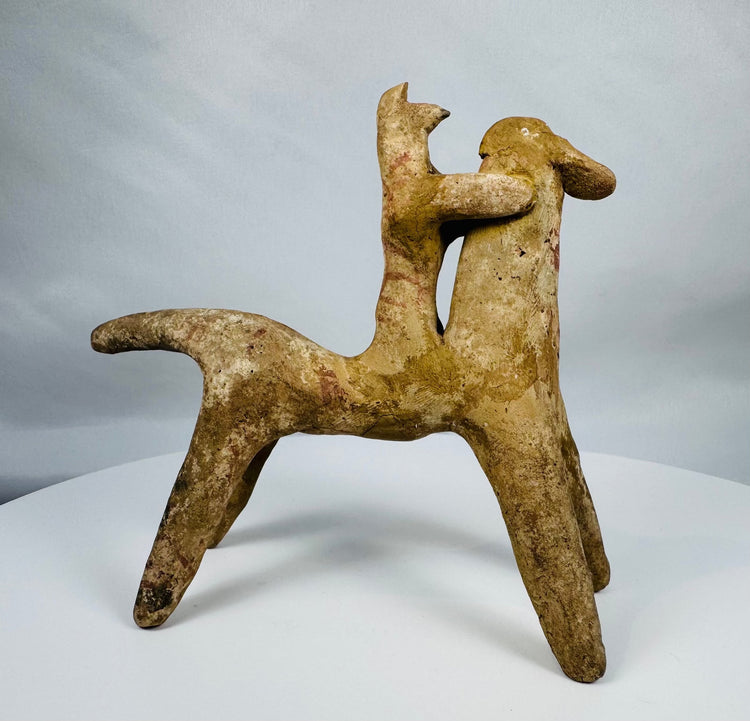
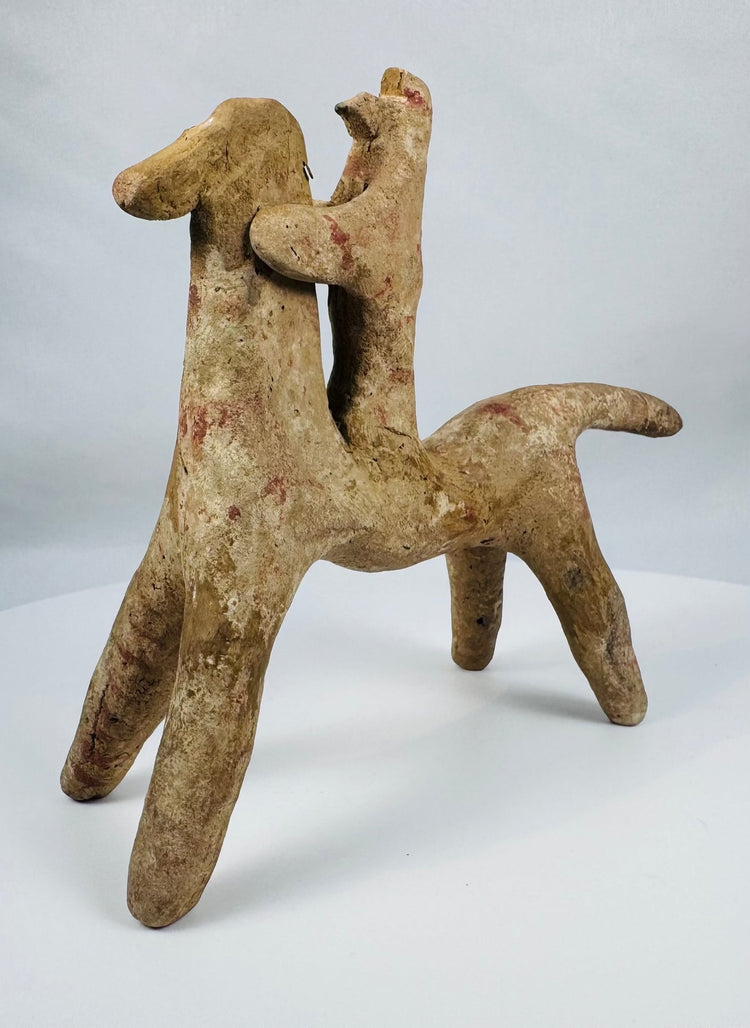
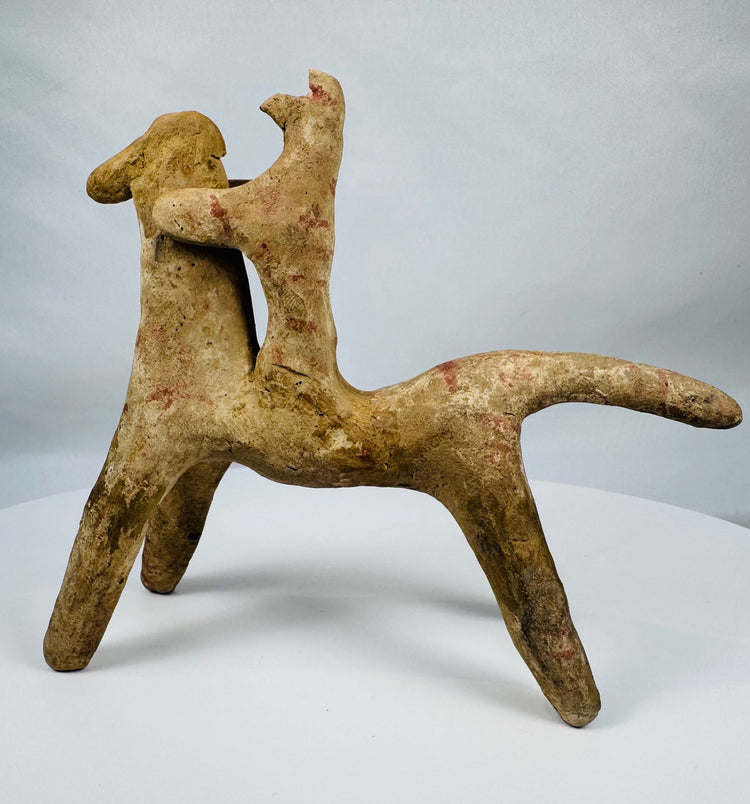
Hand-modelled from buff-coloured clay, the figure depicts a stylized rider seated upon a horse. The horse stands on four tubular legs and features a long neck, a flat-topped head with a projecting snout, and a tail that sweeps upward and backward. The rider has a tall, columnar body and a pinched, beak-like face, with both elongated arms carried forward around the horse's neck.
Traces of the original red-brown painted decoration remain visible on portions of the rider, the horse's neck and body, and the tail. These surviving pigments provide an important glimpse into the figure's original appearance and decorative treatment.
Features
- Hand-modelled from buff-coloured terracotta
- Retains traces of original red-brown pigment
- Horse formed with distinctive tubular legs and elongated neck
- Flat-topped head with projecting snout
- Rider with tall columnar body and stylized beak-like facial features
- Elongated arms extending around the horse's neck
- Characteristic schematic modelling associated with Boeotian workshops
- Comparable figure types are known from sanctuary and funerary contexts
Cultural Significance
Horse-and-rider figurines represent a recognizable category of Boeotian terracotta production. Examples of this type have been found in both sanctuaries and graves, reflecting their role within the religious and funerary traditions of ancient Greece.
The deliberately simplified modelling and distinctive construction techniques seen in this example are characteristic of Boeotian craftsmanship during the Archaic period and provide insight into the regional artistic traditions of mainland Greece during the 6th century BCE.
Condition
Good ancient condition overall, with surface wear consistent with age. The surface exhibits whitish deposits, areas of abrasion, and surviving traces of original red-brown pigment. A fine crack runs across the middle of the body, as noted in the specialist examination. Additional minor surface irregularities and age-related wear are present throughout. The figure remains structurally recognizable and displays well.
Dimensions (Approximate)
Height: 5.25 in
Width: 5.5 in
Length: 2.25 in
Age (Approximate)
2,500 years old
Provenance
Purchased from Roussos Antiques Shop, Athens, Greece, on September 19, 1980. Accompanied by the original purchase receipt, export documentation, and an original period photograph showing the piece in the collection shortly after acquisition. Subsequently held in a private Minnesota, USA collection for more than four decades.
Expert Assessment: Examined by Luca Salvaggio, an Italian archaeologist specializing in Greek, Roman, Near Eastern, and Cypriot material, with a Postgraduate Diploma from the Italian Archaeological School at Athens (IASA) and accreditation from the Italian Ministry of Culture (MiC). He attributed the terracotta horse-and-rider figurine to a Boeotian workshop of the Archaic Period, 6th century BCE. His signed specialist report accompanies the piece and is included with the purchase.
Learn More
Gain insight into the significance of ancient Greek horse and rider votive figures through the University of Colorado Boulder Department of Classics
Description
Historical Context & Origin
Region: Boeotia, Ancient Greece
Material: Hand-modelled terracotta with traces of red-brown pigment
Period: Archaic Period, 6th Century BCE
Description
This ancient Greek terracotta horse-and-rider figurine originates from Boeotia, a region renowned for its distinctive tradition of terracotta production during the Archaic period. Horse-and-rider figures of this type were produced in Boeotia and are known from both sanctuary and funerary contexts, where they could be dedicated as votive offerings or deposited in graves.
Hand-modelled from buff-coloured clay, the figure depicts a stylized rider seated upon a horse. The horse stands on four tubular legs and features a long neck, a flat-topped head with a projecting snout, and a tail that sweeps upward and backward. The rider has a tall, columnar body and a pinched, beak-like face, with both elongated arms carried forward around the horse's neck.
Traces of the original red-brown painted decoration remain visible on portions of the rider, the horse's neck and body, and the tail. These surviving pigments provide an important glimpse into the figure's original appearance and decorative treatment.
Features
- Hand-modelled from buff-coloured terracotta
- Retains traces of original red-brown pigment
- Horse formed with distinctive tubular legs and elongated neck
- Flat-topped head with projecting snout
- Rider with tall columnar body and stylized beak-like facial features
- Elongated arms extending around the horse's neck
- Characteristic schematic modelling associated with Boeotian workshops
- Comparable figure types are known from sanctuary and funerary contexts
Cultural Significance
Horse-and-rider figurines represent a recognizable category of Boeotian terracotta production. Examples of this type have been found in both sanctuaries and graves, reflecting their role within the religious and funerary traditions of ancient Greece.
The deliberately simplified modelling and distinctive construction techniques seen in this example are characteristic of Boeotian craftsmanship during the Archaic period and provide insight into the regional artistic traditions of mainland Greece during the 6th century BCE.
Condition
Good ancient condition overall, with surface wear consistent with age. The surface exhibits whitish deposits, areas of abrasion, and surviving traces of original red-brown pigment. A fine crack runs across the middle of the body, as noted in the specialist examination. Additional minor surface irregularities and age-related wear are present throughout. The figure remains structurally recognizable and displays well.
Dimensions (Approximate)
Height: 5.25 in
Width: 5.5 in
Length: 2.25 in
Age (Approximate)
2,500 years old
Provenance
Purchased from Roussos Antiques Shop, Athens, Greece, on September 19, 1980. Accompanied by the original purchase receipt, export documentation, and an original period photograph showing the piece in the collection shortly after acquisition. Subsequently held in a private Minnesota, USA collection for more than four decades.
Expert Assessment: Examined by Luca Salvaggio, an Italian archaeologist specializing in Greek, Roman, Near Eastern, and Cypriot material, with a Postgraduate Diploma from the Italian Archaeological School at Athens (IASA) and accreditation from the Italian Ministry of Culture (MiC). He attributed the terracotta horse-and-rider figurine to a Boeotian workshop of the Archaic Period, 6th century BCE. His signed specialist report accompanies the piece and is included with the purchase.
Learn More
Gain insight into the significance of ancient Greek horse and rider votive figures through the University of Colorado Boulder Department of Classics
You May Also Like
