



Ancient Greek Terracotta Brazier Fragment with Bearded Male Face | 3rd Century BCE
Couldn't load pickup availability


Ancient Greek Terracotta Brazier Fragment with Bearded Male Face | 3rd Century BCE
Description
More
Less
Historical Context & Origin
Region: Ancient Greece
Material: Mould-made terracotta with traces of red pigment
Period: Hellenistic Period, 3rd Century BCE
Description
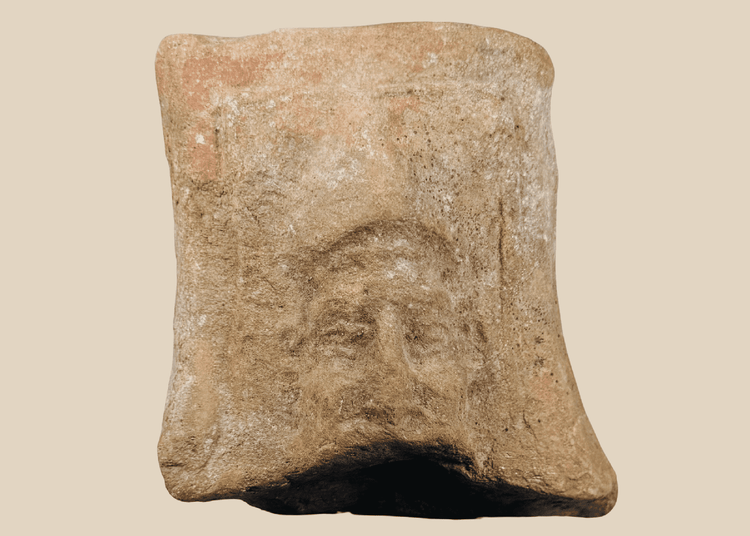
This ancient Greek terracotta brazier fragment dates to the 3rd century BCE and originally formed part of the decorated wall of a larger brazier.
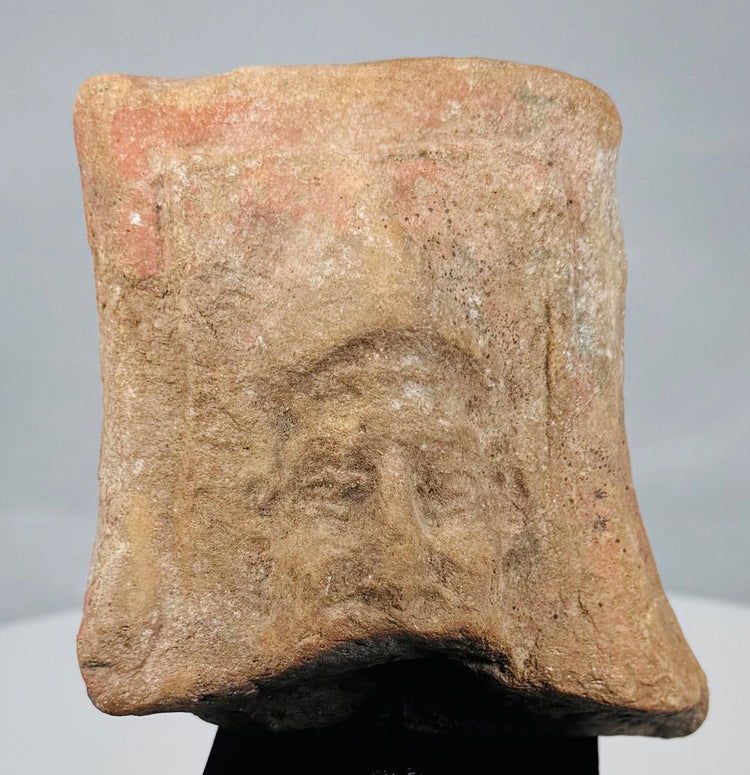
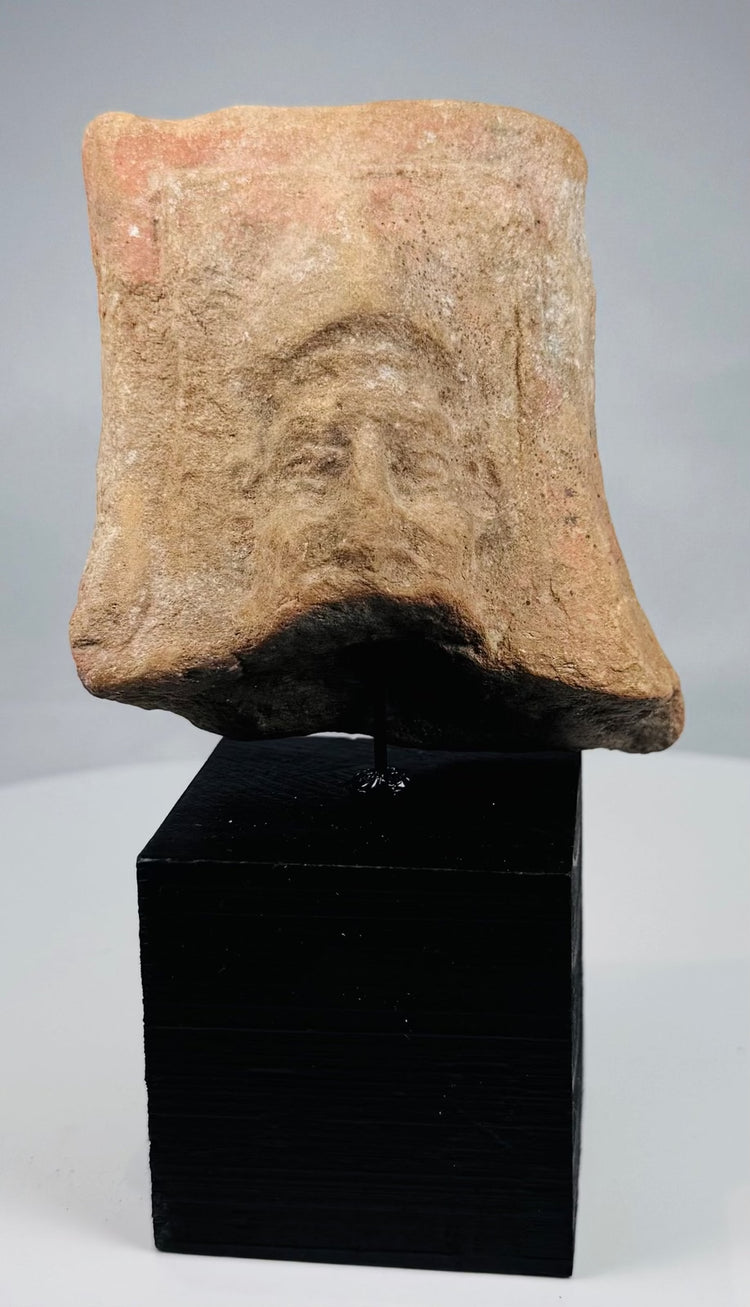
Mould-made in terracotta, the surviving fragment depicts a frontal bearded male face in shallow relief. The figure is characterized by deep-set eyes, a broad nose, prominent moustache, and full beard. The face is positioned within a recessed rectangular panel framed by raised borders.
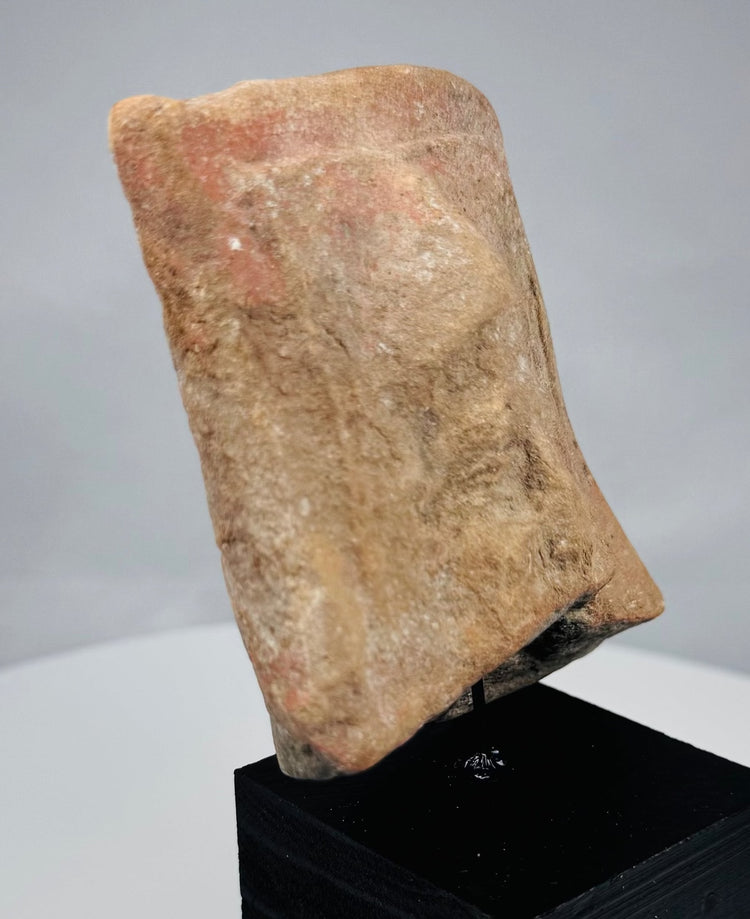
The lower edge of the surviving panel is broken around an arch-shaped opening, reflecting its original integration into the brazier structure. Faint traces of red pigment remain visible near the edges, providing evidence of the object's original painted decoration.
Despite considerable age-related wear, the facial features remain recognizable and preserve an evocative example of Hellenistic Greek decorative ceramic production.
Features
- Mould-made construction
- Frontal bearded male face in shallow relief
- Deep-set eyes and broad nose
- Prominent moustache and beard
- Recessed rectangular decorative panel
- Raised framing borders
- Arch-shaped opening at the lower edge
- Surviving traces of ancient red pigment
- Mounted on a modern display stand
Cultural Significance
Decorated terracotta braziers formed part of the domestic material culture of the Hellenistic Greek world. Mould-made decoration allowed functional ceramic objects to incorporate figural and ornamental imagery.
The bearded male face preserved on this fragment demonstrates how sculptural imagery could be incorporated into utilitarian vessels. Without additional identifying attributes, the precise identity of the figure cannot be established with certainty.
Condition
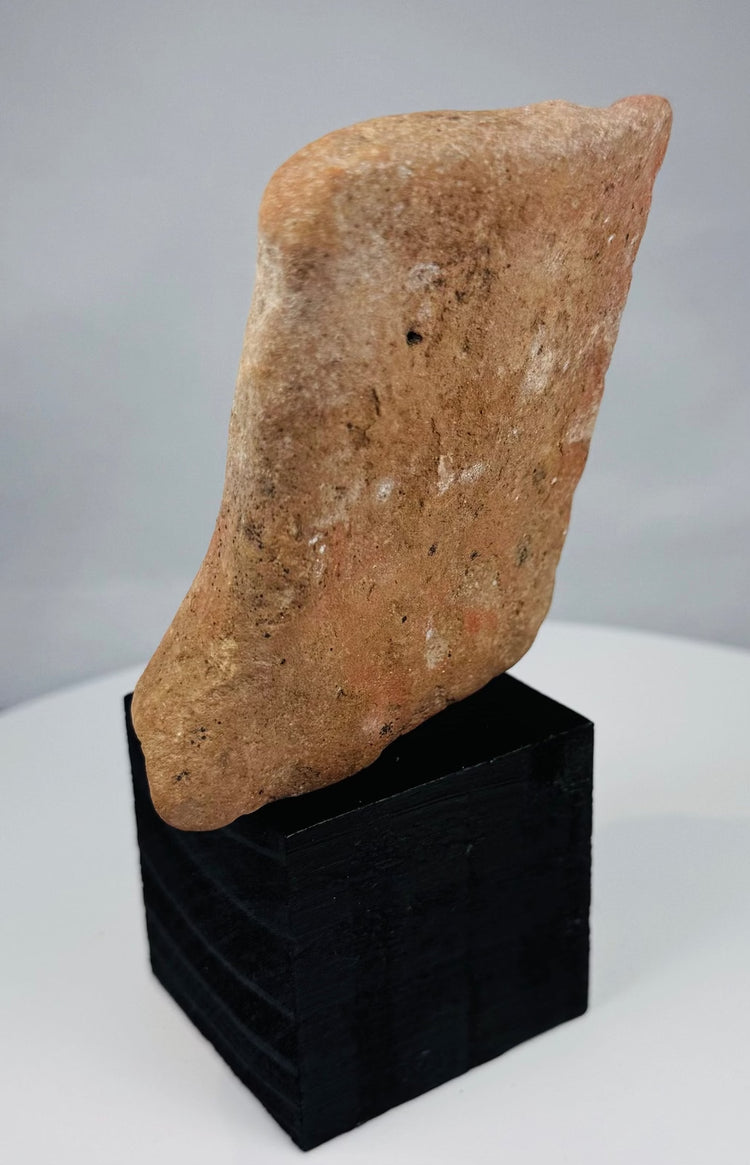
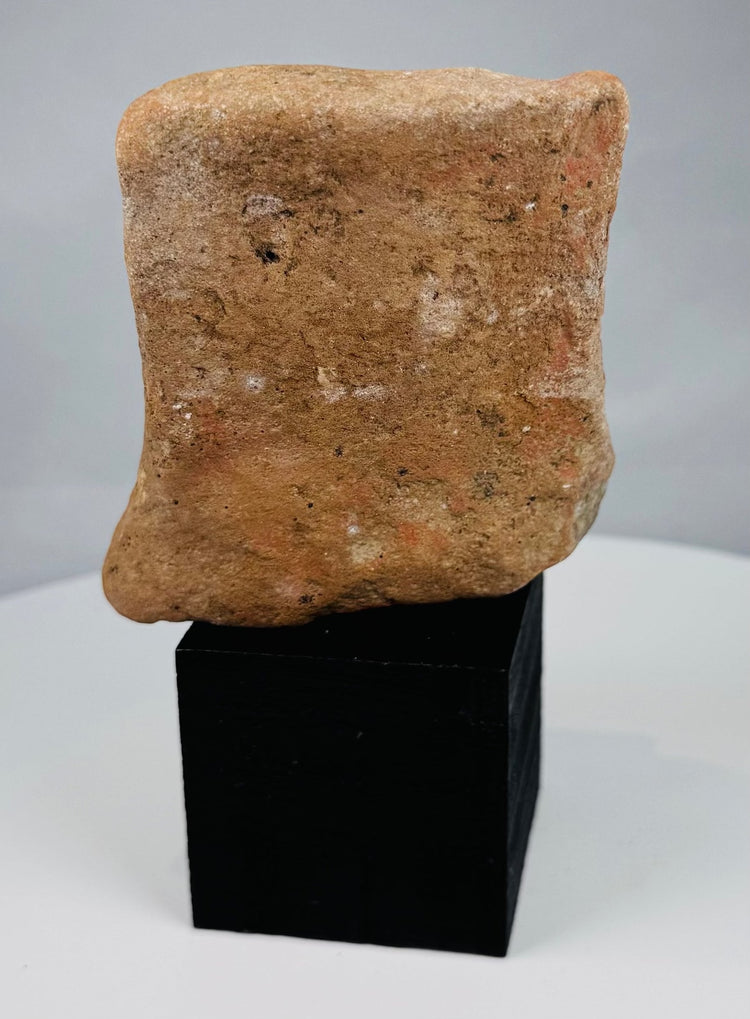
Ancient fragmentary condition with loss to the lower portion, together with substantial surface wear, abrasion, mineral deposits, pitting, and softening of the moulded details. Faint traces of original red pigment remain visible near portions of the edges.
The principal facial features and rectangular framing remain clearly recognizable. Mounted on a modern custom display stand.
Dimensions (Approximate)
Height: 5.5 in
Width: 3.5 in
Depth: 2 in
Age (Approximate)
2,200–2,300 years old
Provenance
Formerly in the collection of Jack Guevrekian, Manhasset, New York, a noted New York numismatist and collector with a particular interest in Armenian coinage, antiquities, and ancient material. Guevrekian assembled an extensive collection over several decades, a significant portion of which was publicly offered as The Jack Guevrekian Collection by the Numismatic & Antiquarian Service Corporation of America in New York in 1977.
Subsequently held in a private New York City collection.
Later handled by the Howard S. Rose Gallery / Arte Primitivo in New York, a longstanding specialist gallery and auction house dealing in Pre-Columbian, Classical, Egyptian, Asian, and ethnographic antiquities and works of art. The gallery has conducted specialist auctions, exhibitions, and private sales from its New York premises.
Subsequently handled by Artemis Fine Arts / Artemis Gallery, a Colorado-based specialist in antiquities, ancient art, ethnographic material, and fine art that has been active in the field since 1993.
Then entered a private collection in Toronto, Ontario, Canada.
The piece was later examined by Luca Salvaggio, an Italian archaeologist and specialist in ancient Mediterranean material. He holds a Postgraduate Diploma from the Italian Archaeological School at Athens (IASA) and is accredited for preventive archaeology by the Italian Ministry of Culture (MiC). Salvaggio identified the object as a Greek mould-made terracotta brazier fragment dating to the 3rd century BCE, based on its frontal bearded male face in shallow relief, recessed rectangular panel, raised borders, arch-shaped lower opening, and surviving traces of red pigment.
Learn More
View a related ancient terracotta relief in the collection of The Metropolitan Museum of Art
Explore our curated Collection of Ceramics, Pottery & Ancient Heritage Art
Description
Historical Context & Origin
Region: Ancient Greece
Material: Mould-made terracotta with traces of red pigment
Period: Hellenistic Period, 3rd Century BCE
Description
This ancient Greek terracotta brazier fragment dates to the 3rd century BCE and originally formed part of the decorated wall of a larger brazier.
Mould-made in terracotta, the surviving fragment depicts a frontal bearded male face in shallow relief. The figure is characterized by deep-set eyes, a broad nose, prominent moustache, and full beard. The face is positioned within a recessed rectangular panel framed by raised borders.
The lower edge of the surviving panel is broken around an arch-shaped opening, reflecting its original integration into the brazier structure. Faint traces of red pigment remain visible near the edges, providing evidence of the object's original painted decoration.
Despite considerable age-related wear, the facial features remain recognizable and preserve an evocative example of Hellenistic Greek decorative ceramic production.
Features
- Mould-made construction
- Frontal bearded male face in shallow relief
- Deep-set eyes and broad nose
- Prominent moustache and beard
- Recessed rectangular decorative panel
- Raised framing borders
- Arch-shaped opening at the lower edge
- Surviving traces of ancient red pigment
- Mounted on a modern display stand
Cultural Significance
Decorated terracotta braziers formed part of the domestic material culture of the Hellenistic Greek world. Mould-made decoration allowed functional ceramic objects to incorporate figural and ornamental imagery.
The bearded male face preserved on this fragment demonstrates how sculptural imagery could be incorporated into utilitarian vessels. Without additional identifying attributes, the precise identity of the figure cannot be established with certainty.
Condition
Ancient fragmentary condition with loss to the lower portion, together with substantial surface wear, abrasion, mineral deposits, pitting, and softening of the moulded details. Faint traces of original red pigment remain visible near portions of the edges.
The principal facial features and rectangular framing remain clearly recognizable. Mounted on a modern custom display stand.
Dimensions (Approximate)
Height: 5.5 in
Width: 3.5 in
Depth: 2 in
Age (Approximate)
2,200–2,300 years old
Provenance
Formerly in the collection of Jack Guevrekian, Manhasset, New York, a noted New York numismatist and collector with a particular interest in Armenian coinage, antiquities, and ancient material. Guevrekian assembled an extensive collection over several decades, a significant portion of which was publicly offered as The Jack Guevrekian Collection by the Numismatic & Antiquarian Service Corporation of America in New York in 1977.
Subsequently held in a private New York City collection.
Later handled by the Howard S. Rose Gallery / Arte Primitivo in New York, a longstanding specialist gallery and auction house dealing in Pre-Columbian, Classical, Egyptian, Asian, and ethnographic antiquities and works of art. The gallery has conducted specialist auctions, exhibitions, and private sales from its New York premises.
Subsequently handled by Artemis Fine Arts / Artemis Gallery, a Colorado-based specialist in antiquities, ancient art, ethnographic material, and fine art that has been active in the field since 1993.
Then entered a private collection in Toronto, Ontario, Canada.
The piece was later examined by Luca Salvaggio, an Italian archaeologist and specialist in ancient Mediterranean material. He holds a Postgraduate Diploma from the Italian Archaeological School at Athens (IASA) and is accredited for preventive archaeology by the Italian Ministry of Culture (MiC). Salvaggio identified the object as a Greek mould-made terracotta brazier fragment dating to the 3rd century BCE, based on its frontal bearded male face in shallow relief, recessed rectangular panel, raised borders, arch-shaped lower opening, and surviving traces of red pigment.
Learn More
View a related ancient terracotta relief in the collection of The Metropolitan Museum of Art
Explore our curated Collection of Ceramics, Pottery & Ancient Heritage Art
You May Also Like
