



Ancient Greek Black-Figure Oil Vessel | Circa 6th – 5th Century BCE
Couldn't load pickup availability


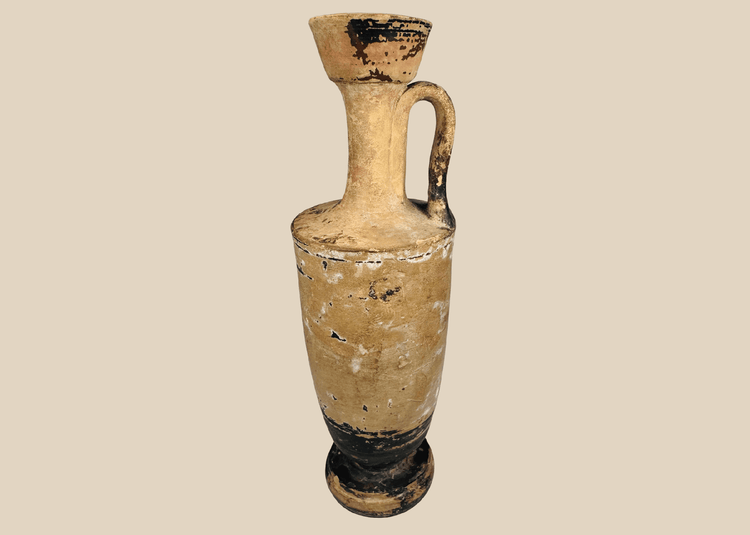


Ancient Greek Black-Figure Oil Vessel | Circa 6th – 5th Century BCE
Description
More
Less
Historical Context & Origin
Region: Ancient Greece, likely Attic or broader Greek world
Material: Wheel-thrown terracotta with surviving painted and slipped decoration
Period: Classical Greek Period, circa 5th–4th Century BCE
Description
This ancient Greek terracotta vessel is a lekythos, a distinctive form of narrow-necked flask traditionally associated with the storage and dispensing of olive oil, perfumed oils, and other precious liquids.
The vessel displays the characteristic elongated form of the lekythos, with a tall cylindrical body rising from a rounded disk foot, a broad horizontal shoulder, narrow columnar neck, flaring trumpet-shaped mouth, and a single vertical strap handle connecting the neck to the shoulder.
Lekythoi became one of the most recognizable forms within ancient Greek ceramic production. Surviving examples are known from both everyday and funerary contexts, and the Metropolitan Museum of Art identifies the form specifically as an oil flask.
This example retains an attractive warm buff and ochre ceramic surface, with remnants of dark brown to black painted or slipped decoration visible around the mouth, neck, shoulder, lower body, and foot.
Much of the original principal painted decoration has been lost through age and surface wear. Irregular surviving areas indicate that the vessel was originally considerably more extensively decorated than its present appearance suggests.
Dark concentric bands remain particularly visible around the lower body and foot, while additional traces survive around the flaring mouth and upper neck. Scattered reddish-brown pigmentation remains across the shoulder and neck.
The broad, nearly horizontal shoulder provides a dramatic transition from the elongated body to the slender neck. The substantial looping handle was formed separately and joined between the neck and shoulder before firing.
The vessel is wheel-thrown, with manufacturing lines and irregularities remaining visible throughout the ceramic body.
Features
- Tall elongated cylindrical body
- Broad flattened shoulder
- Narrow columnar neck
- Flared trumpet-shaped mouth
- Single vertical strap handle
- Raised circular foot
- Surviving black and reddish-brown painted decoration
- Concentric decorative bands around the lower body
- Considerable surviving ancient surface character
Cultural Significance
Lekythoi occupied an important position within ancient Greek material culture and were particularly associated with the storage and application of oils.
Oil played a significant role in Greek daily life. It could be used for grooming, bathing, athletic activity, perfume, religious offerings, and funerary practices.
Lekythoi also became strongly associated with burial customs, particularly in Classical Athens. Numerous examples were deposited in tombs or used during ceremonies honouring the deceased, and some highly specialized examples were decorated specifically with funerary imagery.
The form was produced in numerous decorative traditions, including black-figure, red-figure, white-ground, and more simply ornamented examples. The Metropolitan Museum preserves Attic lekythoi dating from both the Archaic and Classical periods, illustrating the long development and importance of the vessel type.
Although much of the painted decoration on this example has disappeared, the remaining dark bands and traces of pigment provide an evocative glimpse of its original appearance and the ceramic traditions of the ancient Greek world.
Condition
The vessel remains substantially intact and displays extensive wear consistent with considerable age.
There is significant loss to the original painted decoration, together with widespread abrasions, scratches, gouges, surface erosion, discoloration, deposits, staining, small chips, edge wear, and scattered losses. These condition characteristics are also recorded in the vessel’s previous auction catalogue description. Dark painted or slipped decoration survives intermittently around the mouth, neck, shoulder, lower body, and foot, with reddish-brown traces elsewhere.
The handle remains present, with visible age-related wear around its junctions with the neck and shoulder. The rim and foot exhibit expected abrasions and small irregularities. The interior contains deposits and darkened areas consistent with age and previous use or burial.
Dimensions (Approximate)
Height: 7.75 in
Width: 2.5 in
Age (Approximate)
2,300–2,500 years old
Provenance
Purchased from E. Gazarossian & E. Vitali in the early 1970s. E. Vitali is independently documented by the Corpus Vasorum Antiquorum of the Academy of Athens as an antiquarian and collector. At least two Attic black-figure lekythoi from her collection entered the National Archaeological Museum in Athens as gifts, where they are recorded under inventory nos. 19664 and 19665. This provides important institutional documentation of Vitali's involvement with ancient Greek pottery and the antiquities market.
The vessel was subsequently held in a private collection in Virginia, USA. It was later offered by Quinn’s Auction Galleries in Falls Church, Virginia in 2026.
Learn More
Study a closely related 5th-century BCE Attic pattern lekythos preserved by the Spurlock Museum of World Cultures.
Browse our Collection of Roman and Greek Artifacts and Ancient Relics.
Description
Historical Context & Origin
Region: Ancient Greece, likely Attic or broader Greek world
Material: Wheel-thrown terracotta with surviving painted and slipped decoration
Period: Classical Greek Period, circa 5th–4th Century BCE
Description
This ancient Greek terracotta vessel is a lekythos, a distinctive form of narrow-necked flask traditionally associated with the storage and dispensing of olive oil, perfumed oils, and other precious liquids.
The vessel displays the characteristic elongated form of the lekythos, with a tall cylindrical body rising from a rounded disk foot, a broad horizontal shoulder, narrow columnar neck, flaring trumpet-shaped mouth, and a single vertical strap handle connecting the neck to the shoulder.
Lekythoi became one of the most recognizable forms within ancient Greek ceramic production. Surviving examples are known from both everyday and funerary contexts, and the Metropolitan Museum of Art identifies the form specifically as an oil flask.
This example retains an attractive warm buff and ochre ceramic surface, with remnants of dark brown to black painted or slipped decoration visible around the mouth, neck, shoulder, lower body, and foot.
Much of the original principal painted decoration has been lost through age and surface wear. Irregular surviving areas indicate that the vessel was originally considerably more extensively decorated than its present appearance suggests.
Dark concentric bands remain particularly visible around the lower body and foot, while additional traces survive around the flaring mouth and upper neck. Scattered reddish-brown pigmentation remains across the shoulder and neck.
The broad, nearly horizontal shoulder provides a dramatic transition from the elongated body to the slender neck. The substantial looping handle was formed separately and joined between the neck and shoulder before firing.
The vessel is wheel-thrown, with manufacturing lines and irregularities remaining visible throughout the ceramic body.
Features
- Tall elongated cylindrical body
- Broad flattened shoulder
- Narrow columnar neck
- Flared trumpet-shaped mouth
- Single vertical strap handle
- Raised circular foot
- Surviving black and reddish-brown painted decoration
- Concentric decorative bands around the lower body
- Considerable surviving ancient surface character
Cultural Significance
Lekythoi occupied an important position within ancient Greek material culture and were particularly associated with the storage and application of oils.
Oil played a significant role in Greek daily life. It could be used for grooming, bathing, athletic activity, perfume, religious offerings, and funerary practices.
Lekythoi also became strongly associated with burial customs, particularly in Classical Athens. Numerous examples were deposited in tombs or used during ceremonies honouring the deceased, and some highly specialized examples were decorated specifically with funerary imagery.
The form was produced in numerous decorative traditions, including black-figure, red-figure, white-ground, and more simply ornamented examples. The Metropolitan Museum preserves Attic lekythoi dating from both the Archaic and Classical periods, illustrating the long development and importance of the vessel type.
Although much of the painted decoration on this example has disappeared, the remaining dark bands and traces of pigment provide an evocative glimpse of its original appearance and the ceramic traditions of the ancient Greek world.
Condition
The vessel remains substantially intact and displays extensive wear consistent with considerable age.
There is significant loss to the original painted decoration, together with widespread abrasions, scratches, gouges, surface erosion, discoloration, deposits, staining, small chips, edge wear, and scattered losses. These condition characteristics are also recorded in the vessel’s previous auction catalogue description. Dark painted or slipped decoration survives intermittently around the mouth, neck, shoulder, lower body, and foot, with reddish-brown traces elsewhere.
The handle remains present, with visible age-related wear around its junctions with the neck and shoulder. The rim and foot exhibit expected abrasions and small irregularities. The interior contains deposits and darkened areas consistent with age and previous use or burial.
Dimensions (Approximate)
Height: 7.75 in
Width: 2.5 in
Age (Approximate)
2,300–2,500 years old
Provenance
Purchased from E. Gazarossian & E. Vitali in the early 1970s. E. Vitali is independently documented by the Corpus Vasorum Antiquorum of the Academy of Athens as an antiquarian and collector. At least two Attic black-figure lekythoi from her collection entered the National Archaeological Museum in Athens as gifts, where they are recorded under inventory nos. 19664 and 19665. This provides important institutional documentation of Vitali's involvement with ancient Greek pottery and the antiquities market.
The vessel was subsequently held in a private collection in Virginia, USA. It was later offered by Quinn’s Auction Galleries in Falls Church, Virginia in 2026.
Learn More
Study a closely related 5th-century BCE Attic pattern lekythos preserved by the Spurlock Museum of World Cultures.
Browse our Collection of Roman and Greek Artifacts and Ancient Relics.
You May Also Like
