



Large Chinese | Terracotta Seated Flute Musician | Han Dynasty | Circa 206 BCE – 220 CE
Couldn't load pickup availability


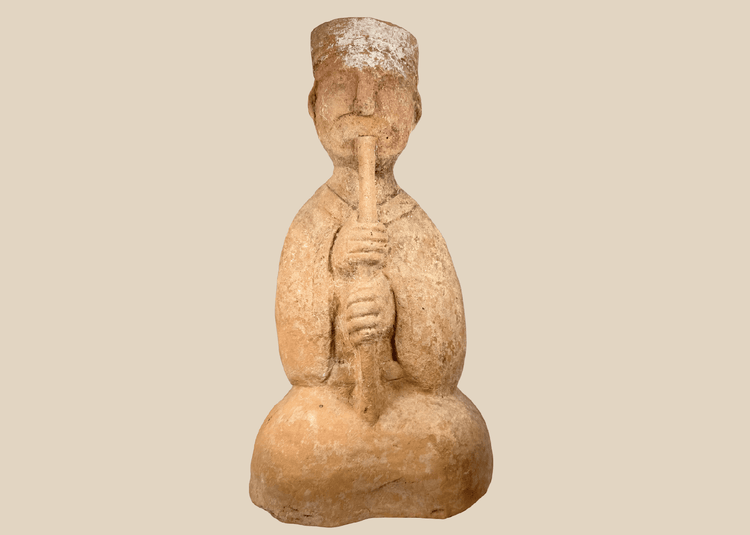


Large Chinese | Terracotta Seated Flute Musician | Han Dynasty | Circa 206 BCE – 220 CE
Description
More
Less
Historical Context & Origin
Region: China
Material: Terracotta with surviving pigment
Period: Han Dynasty, circa 206 BCE–220 CE
Description
This substantial ancient Chinese terracotta figure depicts a seated male musician playing a long wind instrument, created during the Han Dynasty (206 BCE–220 CE).
The figure is modelled seated cross-legged, holding a slender flute or pipe vertically in front of the body with both hands while bringing its upper end to the mouth. The carefully articulated playing posture provides a particularly engaging representation of musical performance in ancient China.
The musician wears a long robe with broad sleeves that envelop the arms and body. His hands emerge at the centre to grasp the instrument, with individually modelled fingers arranged around its shaft. The elongated neck supports a characterful face with defined eyes, nose, mouth, and ears. A tall headdress or cap crowns the head, contributing considerable verticality to the composition and likely reflecting the figure's occupational or social role. The long instrument extends from the musician's mouth toward the lap. Although its precise ancient instrument type cannot be determined with certainty from the surviving form alone, it is clearly represented as a wind instrument and may have depicted a flute or pipe used in musical performance.
The warm buff-to-orange terracotta surface retains darker deposits and traces of surface decoration in several areas. Han funerary ceramics were frequently painted after firing, although much of their original pigmentation has been lost through burial and the passage of approximately two millennia.
The underside reveals the figure's hollow ceramic construction, a characteristic method used in the manufacture of larger Han Dynasty funerary sculptures. Hollow construction reduced both the amount of clay required and the risk of damage during firing.
Features
- Hand-modelled and moulded terracotta construction
- Musician shown actively playing a wind instrument
- Long flute- or pipe-like instrument held vertically
- Carefully modelled hands and fingers
- Cross-legged seated posture
- Broad-sleeved robe
- Distinctive tall headdress
- Expressively modelled facial features
- Surviving traces of surface pigment and decoration
- Hollow ceramic construction visible from the underside
- Substantial approximately 14-inch height
Cultural Significance
During the Han Dynasty, elaborate tombs were furnished with ceramic representations of people, animals, buildings, vessels, and objects associated with everyday life. Collectively known as mingqi, or spirit objects, these works were intended to accompany and provision the deceased in the afterlife.
Musicians, entertainers, servants, officials, soldiers, and attendants appear among surviving Han funerary assemblages, creating a remarkable ceramic record of the social and cultural environment of ancient China.
Music occupied an important position in Han society and was associated with ritual, court ceremony, banqueting, entertainment, and social gatherings. Representations of musicians within tombs helped recreate the pleasures, ceremonies, and status enjoyed by the deceased during earthly life.
The extraordinary expansion of funerary sculpture during the Han period also reflected changing burial customs. Ceramic figures increasingly served as symbolic substitutes for the people, animals, and possessions considered necessary for the deceased's continued existence.
The present figure is particularly evocative because the musician is represented actively performing rather than simply seated as an attendant, preserving a vivid image of musical practice from approximately two thousand years ago.
Condition
The figure remains in archaeological condition with extensive surface wear, mineral deposits, encrustation, discoloration, abrasions, scratches, small chips, losses, and areas of erosion consistent with considerable age and burial. Traces of darker surface material and decoration remain across the face, headdress, garment, instrument, and body. There are scattered scratches and marks throughout, together with small areas of loss and wear to projecting elements and raised details. The flute or pipe remains substantially intact and clearly identifiable, as do the musician's hands and seated posture.
Dimensions (Approximate)
Height: 13 in
Width: 7 in
Depth: 5.75 in
Age (Approximate)
1,800–2,200 years old
Provenance
Acquired in 1997 from Castle of Antiquities Co. Ltd., Hong Kong. Castle of Antiquities Co. Ltd. was an established Hong Kong dealer specializing in Chinese works of art. Its managing director, Lee Man Shing, was documented as having worked in the antiques trade since 1980 and as a consultant to the TT Tsui Museums internationally. Castle of Antiquities is also documented in the provenance of Chinese works subsequently offered by major international auction houses, including Christie’s and Bonhams.
The figure subsequently formed part of a private collection in Philadelphia, Pennsylvania, USA.
Learn More
Study a related Chinese seated flute musician preserved by the Metropolitan Museum of Art.
Browse our Collection of Ancient Chinese Artifacts and Imperial Relics.
Description
Historical Context & Origin
Region: China
Material: Terracotta with surviving pigment
Period: Han Dynasty, circa 206 BCE–220 CE
Description
This substantial ancient Chinese terracotta figure depicts a seated male musician playing a long wind instrument, created during the Han Dynasty (206 BCE–220 CE).
The figure is modelled seated cross-legged, holding a slender flute or pipe vertically in front of the body with both hands while bringing its upper end to the mouth. The carefully articulated playing posture provides a particularly engaging representation of musical performance in ancient China.
The musician wears a long robe with broad sleeves that envelop the arms and body. His hands emerge at the centre to grasp the instrument, with individually modelled fingers arranged around its shaft. The elongated neck supports a characterful face with defined eyes, nose, mouth, and ears. A tall headdress or cap crowns the head, contributing considerable verticality to the composition and likely reflecting the figure's occupational or social role. The long instrument extends from the musician's mouth toward the lap. Although its precise ancient instrument type cannot be determined with certainty from the surviving form alone, it is clearly represented as a wind instrument and may have depicted a flute or pipe used in musical performance.
The warm buff-to-orange terracotta surface retains darker deposits and traces of surface decoration in several areas. Han funerary ceramics were frequently painted after firing, although much of their original pigmentation has been lost through burial and the passage of approximately two millennia.
The underside reveals the figure's hollow ceramic construction, a characteristic method used in the manufacture of larger Han Dynasty funerary sculptures. Hollow construction reduced both the amount of clay required and the risk of damage during firing.
Features
- Hand-modelled and moulded terracotta construction
- Musician shown actively playing a wind instrument
- Long flute- or pipe-like instrument held vertically
- Carefully modelled hands and fingers
- Cross-legged seated posture
- Broad-sleeved robe
- Distinctive tall headdress
- Expressively modelled facial features
- Surviving traces of surface pigment and decoration
- Hollow ceramic construction visible from the underside
- Substantial approximately 14-inch height
Cultural Significance
During the Han Dynasty, elaborate tombs were furnished with ceramic representations of people, animals, buildings, vessels, and objects associated with everyday life. Collectively known as mingqi, or spirit objects, these works were intended to accompany and provision the deceased in the afterlife.
Musicians, entertainers, servants, officials, soldiers, and attendants appear among surviving Han funerary assemblages, creating a remarkable ceramic record of the social and cultural environment of ancient China.
Music occupied an important position in Han society and was associated with ritual, court ceremony, banqueting, entertainment, and social gatherings. Representations of musicians within tombs helped recreate the pleasures, ceremonies, and status enjoyed by the deceased during earthly life.
The extraordinary expansion of funerary sculpture during the Han period also reflected changing burial customs. Ceramic figures increasingly served as symbolic substitutes for the people, animals, and possessions considered necessary for the deceased's continued existence.
The present figure is particularly evocative because the musician is represented actively performing rather than simply seated as an attendant, preserving a vivid image of musical practice from approximately two thousand years ago.
Condition
The figure remains in archaeological condition with extensive surface wear, mineral deposits, encrustation, discoloration, abrasions, scratches, small chips, losses, and areas of erosion consistent with considerable age and burial. Traces of darker surface material and decoration remain across the face, headdress, garment, instrument, and body. There are scattered scratches and marks throughout, together with small areas of loss and wear to projecting elements and raised details. The flute or pipe remains substantially intact and clearly identifiable, as do the musician's hands and seated posture.
Dimensions (Approximate)
Height: 13 in
Width: 7 in
Depth: 5.75 in
Age (Approximate)
1,800–2,200 years old
Provenance
Acquired in 1997 from Castle of Antiquities Co. Ltd., Hong Kong. Castle of Antiquities Co. Ltd. was an established Hong Kong dealer specializing in Chinese works of art. Its managing director, Lee Man Shing, was documented as having worked in the antiques trade since 1980 and as a consultant to the TT Tsui Museums internationally. Castle of Antiquities is also documented in the provenance of Chinese works subsequently offered by major international auction houses, including Christie’s and Bonhams.
The figure subsequently formed part of a private collection in Philadelphia, Pennsylvania, USA.
Learn More
Study a related Chinese seated flute musician preserved by the Metropolitan Museum of Art.
Browse our Collection of Ancient Chinese Artifacts and Imperial Relics.
You May Also Like
