


Ancient Near Eastern Grayware Spindle Jar | Likely Iranian Iron Age | Circa 1000 – 600 BCE
Couldn't load pickup availability


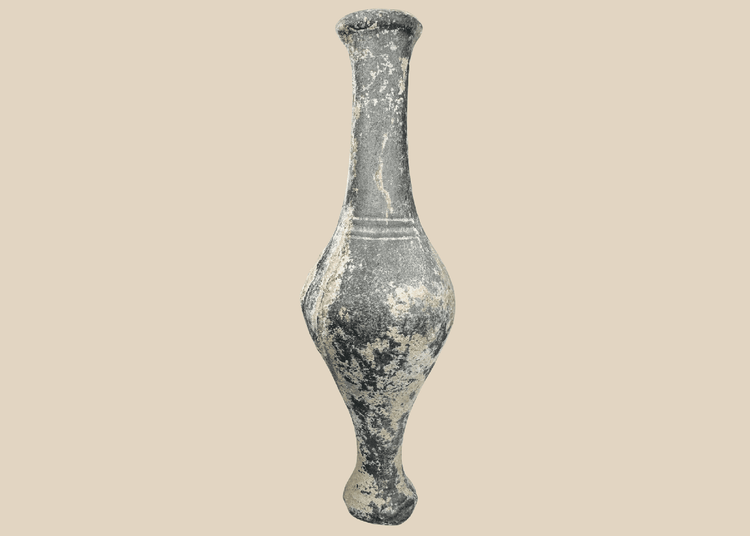
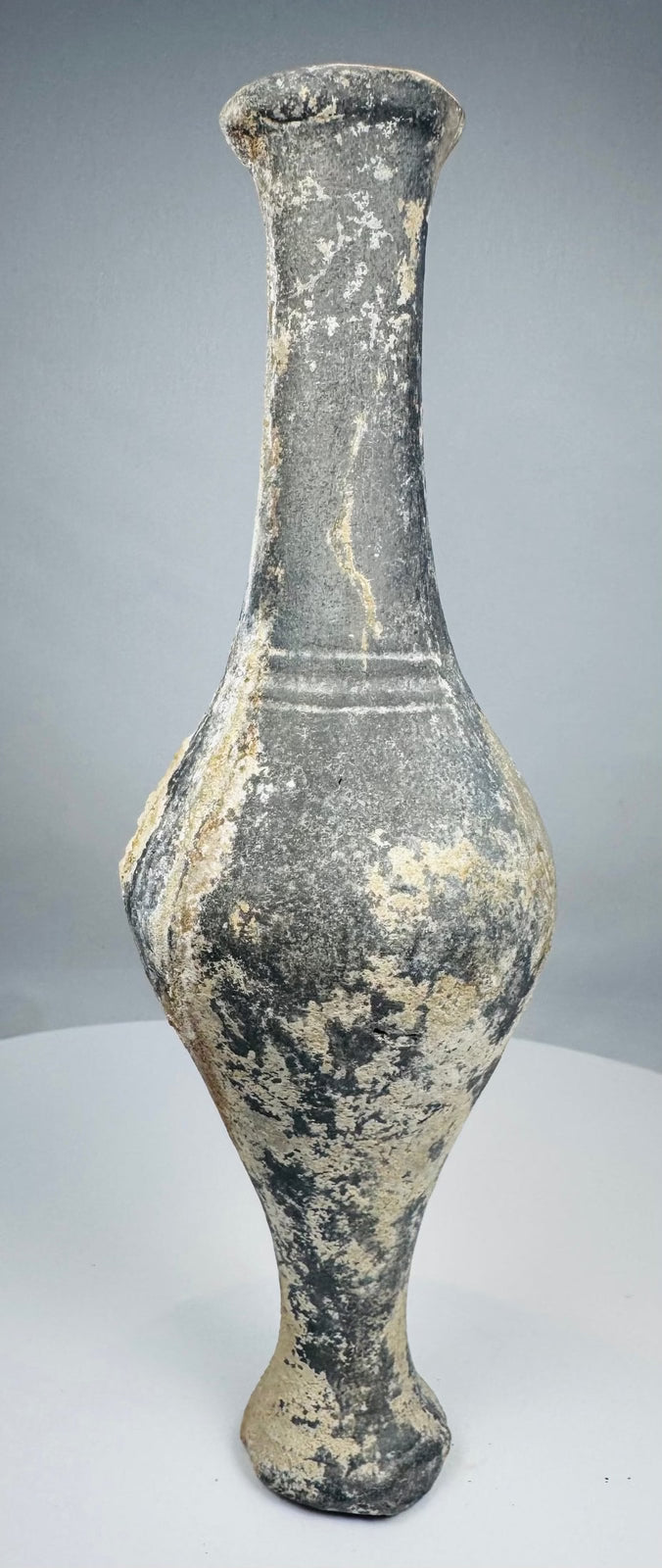
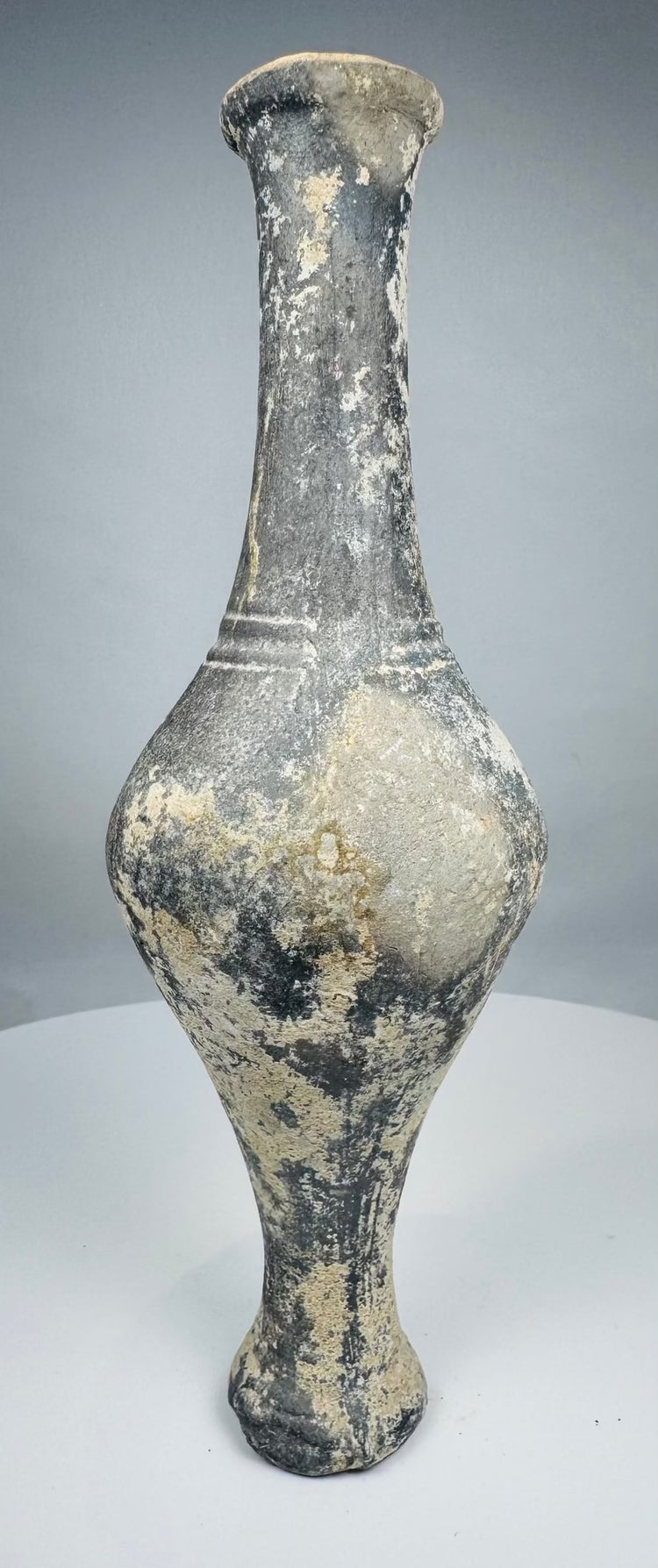
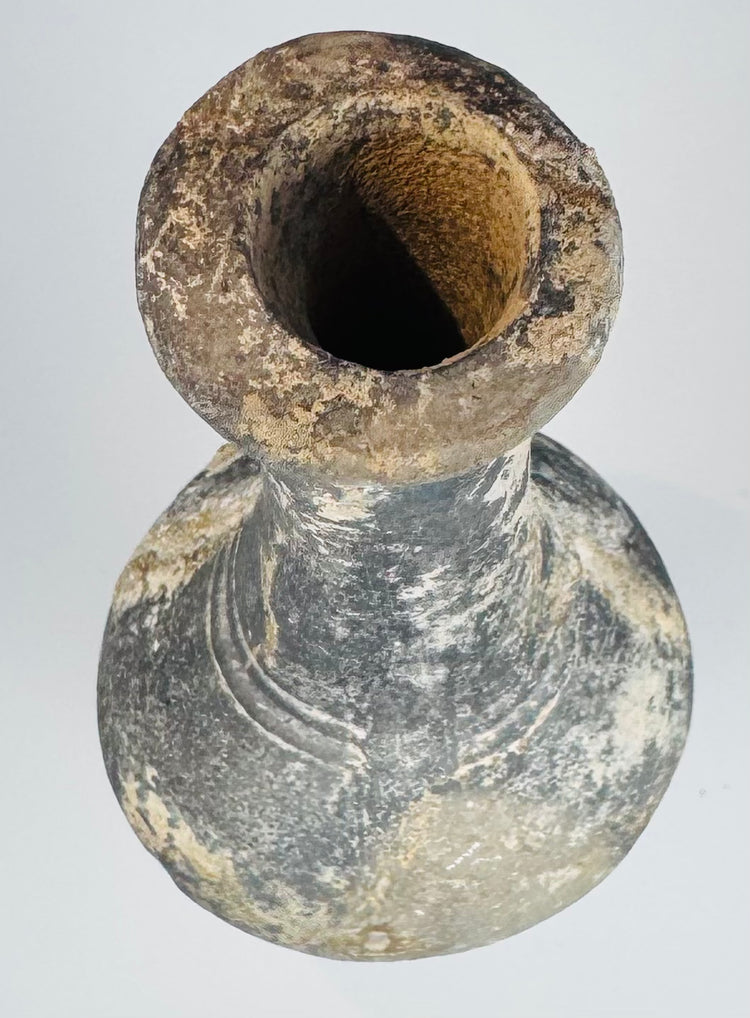
Ancient Near Eastern Grayware Spindle Jar | Likely Iranian Iron Age | Circa 1000 – 600 BCE
Description
More
Less
Historical Context & Origin
Region: Ancient Near East, likely the Iranian Plateau
Material: Wheel-made grayware terracotta with dark burnished surface and mineral accretions
Period: Iron Age, early First Millennium BCE, circa 1000–600 BCE
Description
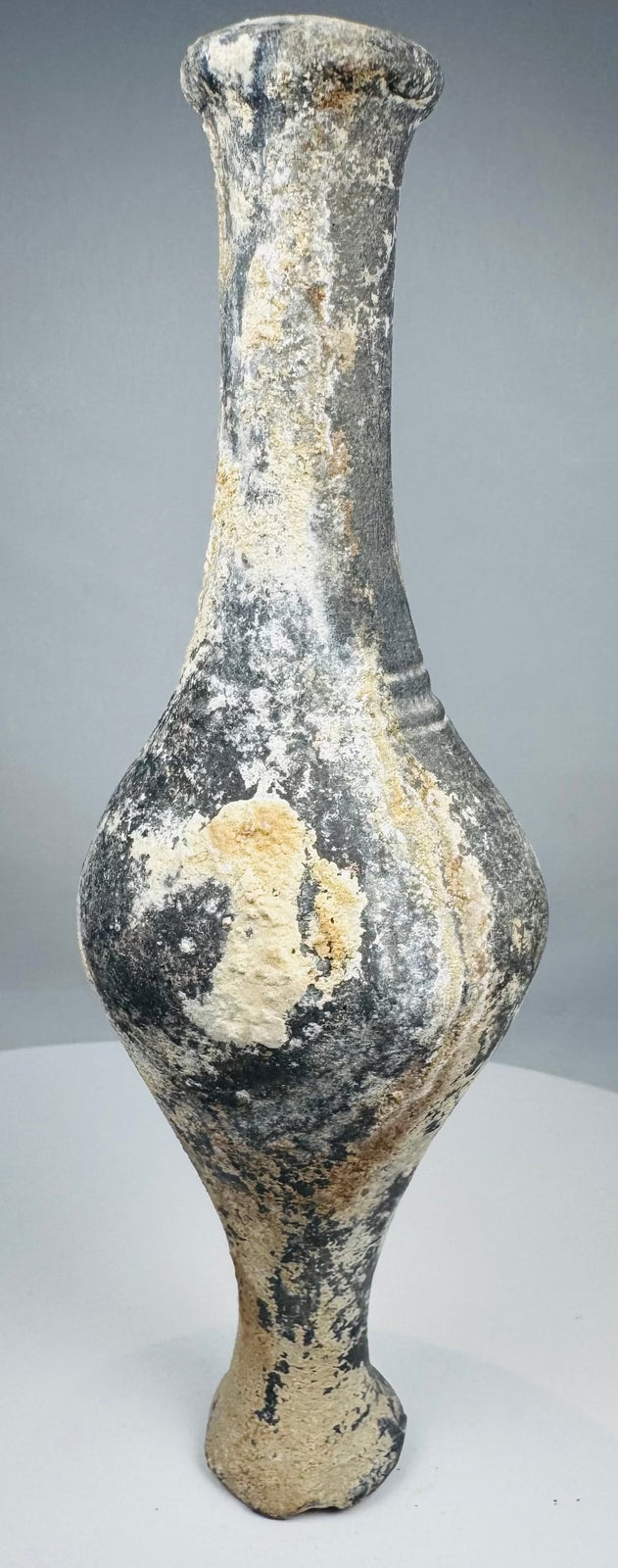
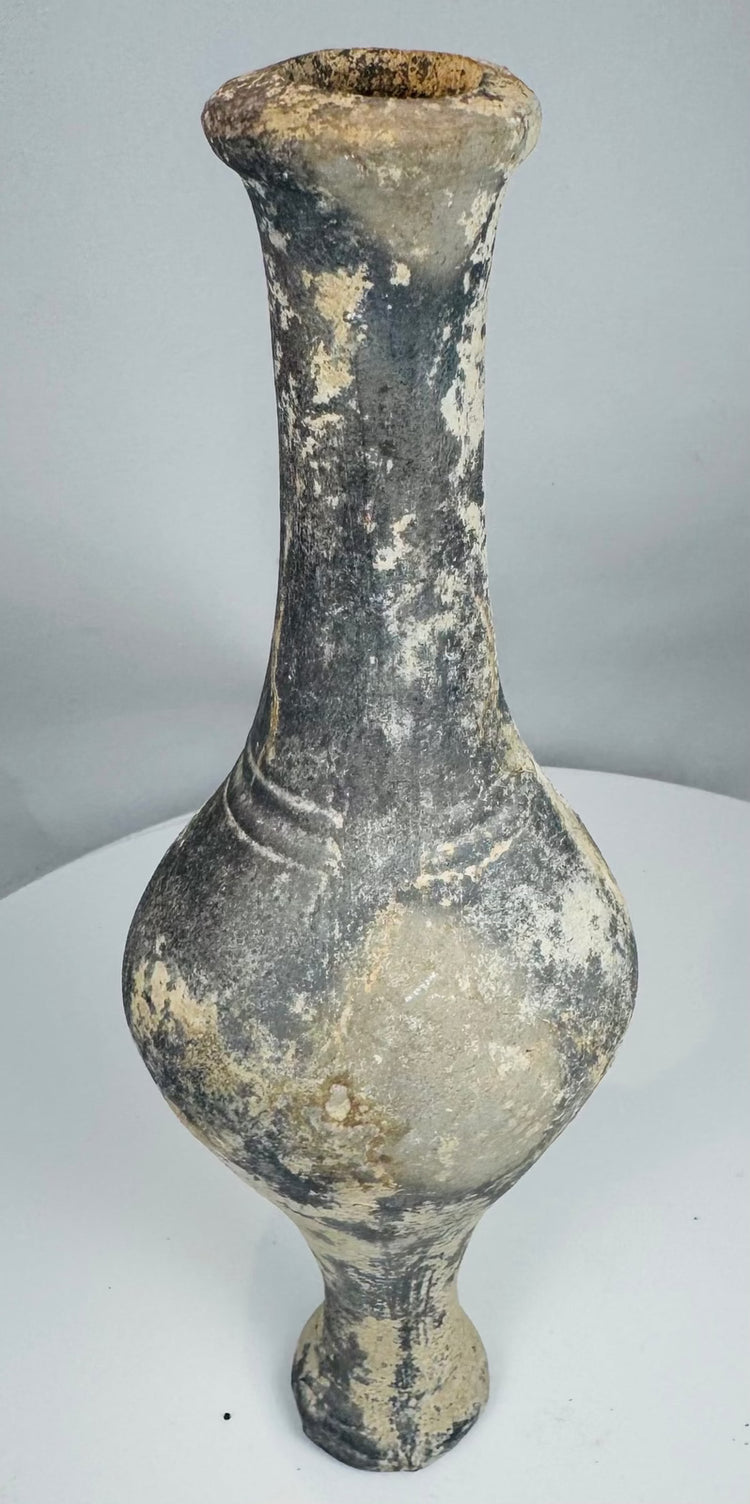
This ancient grayware pottery vessel is a finely proportioned spindle-form jar or bottle dating to the early first millennium BCE.
The vessel features a rounded, almost globular central body that narrows sharply toward both ends, producing an elegant elongated silhouette.
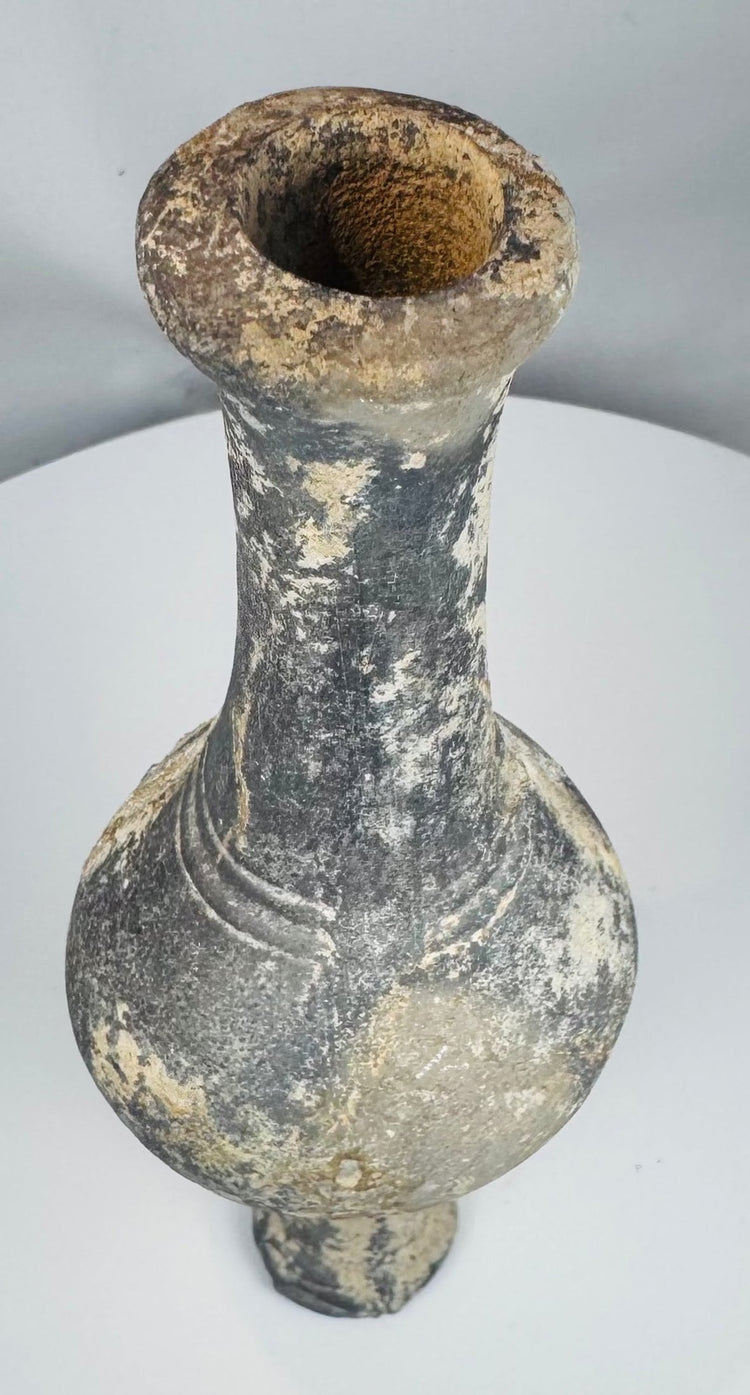
The upper body rises into a tall, slender neck terminating in a thickened, outward-flaring rim surrounding a relatively narrow opening. Two shallow horizontal ridges encircle the junction between the neck and shoulder, subtly emphasizing the transition into the swollen body.
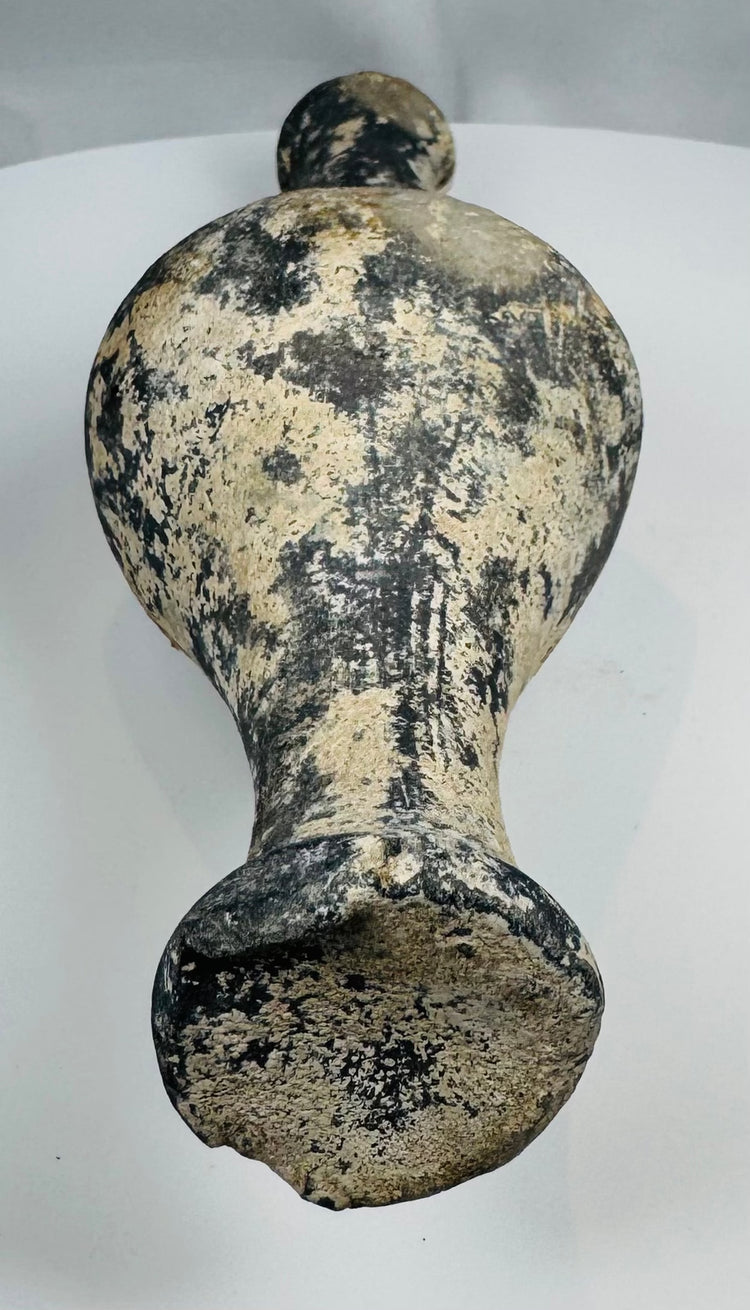
Below, the body contracts into a narrow lower stem before expanding into a small circular pedestal foot. This tall-footed construction elevates the vessel and creates the spindle-like profile from which the descriptive name derives.
The vessel was formed from gray-firing clay and retains extensive areas of a dark grey to nearly black surface, likely produced through controlled firing and subsequent burnishing.
Pale beige burial deposits and mineral accretions cover substantial portions of the body, creating a dramatic contrast with the surviving dark surface.
Its narrow opening and deep interior would have made the vessel suitable for storing and dispensing relatively valuable liquids or substances, potentially oils, perfumes, medicines, or ceremonial preparations. Its exact original function cannot be established without archaeological context.
Gray-burnished pottery was produced across several regions of ancient Iran during the later Bronze Age and Iron Age. Comparable wares are documented at sites including Hasanlu, Dinkha Tepe, Marlik, and cemeteries in northern Iran, although vessel forms and dates varied significantly between regions.
Features
- Early First Millennium BCE attribution
- Tall elongated spindle-form bottle
- Rounded globular central body
- Long narrow neck
- Thickened everted rim
- Twin horizontal ridges at the shoulder
- Narrow lower stem
- Raised circular pedestal foot
- Dark grey to black burnished surface
- Extensive pale mineral and burial accretions
Cultural Significance
Burnished grayware represents an important ceramic tradition of ancient Iran and neighbouring regions. These vessels were produced in numerous forms, including bowls, jugs, cups, pedestal vessels, and long-necked bottles, and are frequently encountered within funerary assemblages.
The controlled firing required to produce a grey or black ceramic surface demonstrates the technical skill of ancient potters. Burnishing compressed and polished the clay surface before firing, producing a smoother finish that could resemble stone or metal.
The refined proportions of this vessel suggest that it may have served a more specialized purpose than ordinary bulk storage. Its narrow mouth would have restricted evaporation and allowed its contents to be dispensed in controlled quantities.
Condition
The vessel remains substantially intact and structurally stable.
Expected age-related wear includes extensive pale mineral deposits, burial accretions, discoloration, scratches, abrasions, pitting, and widespread losses to the dark burnished surface.
The rim exhibits minor chips, abrasions, and natural irregularity, while the pedestal foot displays edge wear and small losses.
Subtle wheel-forming marks, firing irregularities, and uneven contours are visible throughout.
Dimensions (Approximate)
Height: 8 in
Diameter: 3 in
Age (Approximate)
2,600–3,000 years old
Provenance
Formerly in the collection of Jack Guevrekian, Manhasset, New York, a noted New York numismatist and collector with a particular interest in Armenian coinage, antiquities, and ancient material. Guevrekian assembled an extensive collection over several decades, a significant portion of which was publicly offered as The Jack Guevrekian Collection by the Numismatic & Antiquarian Service Corporation of America in New York in 1977.
Subsequently held in a private New York City collection.
Later handled by the Howard S. Rose Gallery / Arte Primitivo in New York, a longstanding specialist gallery and auction house dealing in Pre-Columbian, Classical, Egyptian, Asian, and ethnographic antiquities and works of art. The gallery has conducted specialist auctions, exhibitions, and private sales from its New York premises.
Subsequently handled by Artemis Fine Arts / Artemis Gallery, a Colorado-based specialist in antiquities, ancient art, ethnographic material, and fine art that has been active in the field since 1993.
Then entered a private collection in Toronto, Ontario, Canada.
Learn More
View a related Iron Age ceramic bottle from Iran in the collection of The Metropolitan Museum of Art
Explore our curated Collection of Ceramics, Pottery & Ancient Heritage Art
Description
Historical Context & Origin
Region: Ancient Near East, likely the Iranian Plateau
Material: Wheel-made grayware terracotta with dark burnished surface and mineral accretions
Period: Iron Age, early First Millennium BCE, circa 1000–600 BCE
Description
This ancient grayware pottery vessel is a finely proportioned spindle-form jar or bottle dating to the early first millennium BCE.
The vessel features a rounded, almost globular central body that narrows sharply toward both ends, producing an elegant elongated silhouette.
The upper body rises into a tall, slender neck terminating in a thickened, outward-flaring rim surrounding a relatively narrow opening. Two shallow horizontal ridges encircle the junction between the neck and shoulder, subtly emphasizing the transition into the swollen body.
Below, the body contracts into a narrow lower stem before expanding into a small circular pedestal foot. This tall-footed construction elevates the vessel and creates the spindle-like profile from which the descriptive name derives.
The vessel was formed from gray-firing clay and retains extensive areas of a dark grey to nearly black surface, likely produced through controlled firing and subsequent burnishing.
Pale beige burial deposits and mineral accretions cover substantial portions of the body, creating a dramatic contrast with the surviving dark surface.
Its narrow opening and deep interior would have made the vessel suitable for storing and dispensing relatively valuable liquids or substances, potentially oils, perfumes, medicines, or ceremonial preparations. Its exact original function cannot be established without archaeological context.
Gray-burnished pottery was produced across several regions of ancient Iran during the later Bronze Age and Iron Age. Comparable wares are documented at sites including Hasanlu, Dinkha Tepe, Marlik, and cemeteries in northern Iran, although vessel forms and dates varied significantly between regions.
Features
- Early First Millennium BCE attribution
- Tall elongated spindle-form bottle
- Rounded globular central body
- Long narrow neck
- Thickened everted rim
- Twin horizontal ridges at the shoulder
- Narrow lower stem
- Raised circular pedestal foot
- Dark grey to black burnished surface
- Extensive pale mineral and burial accretions
Cultural Significance
Burnished grayware represents an important ceramic tradition of ancient Iran and neighbouring regions. These vessels were produced in numerous forms, including bowls, jugs, cups, pedestal vessels, and long-necked bottles, and are frequently encountered within funerary assemblages.
The controlled firing required to produce a grey or black ceramic surface demonstrates the technical skill of ancient potters. Burnishing compressed and polished the clay surface before firing, producing a smoother finish that could resemble stone or metal.
The refined proportions of this vessel suggest that it may have served a more specialized purpose than ordinary bulk storage. Its narrow mouth would have restricted evaporation and allowed its contents to be dispensed in controlled quantities.
Condition
The vessel remains substantially intact and structurally stable.
Expected age-related wear includes extensive pale mineral deposits, burial accretions, discoloration, scratches, abrasions, pitting, and widespread losses to the dark burnished surface.
The rim exhibits minor chips, abrasions, and natural irregularity, while the pedestal foot displays edge wear and small losses.
Subtle wheel-forming marks, firing irregularities, and uneven contours are visible throughout.
Dimensions (Approximate)
Height: 8 in
Diameter: 3 in
Age (Approximate)
2,600–3,000 years old
Provenance
Formerly in the collection of Jack Guevrekian, Manhasset, New York, a noted New York numismatist and collector with a particular interest in Armenian coinage, antiquities, and ancient material. Guevrekian assembled an extensive collection over several decades, a significant portion of which was publicly offered as The Jack Guevrekian Collection by the Numismatic & Antiquarian Service Corporation of America in New York in 1977.
Subsequently held in a private New York City collection.
Later handled by the Howard S. Rose Gallery / Arte Primitivo in New York, a longstanding specialist gallery and auction house dealing in Pre-Columbian, Classical, Egyptian, Asian, and ethnographic antiquities and works of art. The gallery has conducted specialist auctions, exhibitions, and private sales from its New York premises.
Subsequently handled by Artemis Fine Arts / Artemis Gallery, a Colorado-based specialist in antiquities, ancient art, ethnographic material, and fine art that has been active in the field since 1993.
Then entered a private collection in Toronto, Ontario, Canada.
Learn More
View a related Iron Age ceramic bottle from Iran in the collection of The Metropolitan Museum of Art
Explore our curated Collection of Ceramics, Pottery & Ancient Heritage Art
You May Also Like
