



Ancient Roman Cast Bronze Bell | 1st Century CE
Couldn't load pickup availability


Ancient Roman Cast Bronze Bell | 1st Century CE
Description
More
Less
Historical Context & Origin
Region: Roman Empire
Material: Cast bronze
Period: 1st Century CE
Description
This ancient Roman cast bronze bell dates to the 1st century CE and belongs to a type known from Roman sites including Pompeii and Herculaneum.
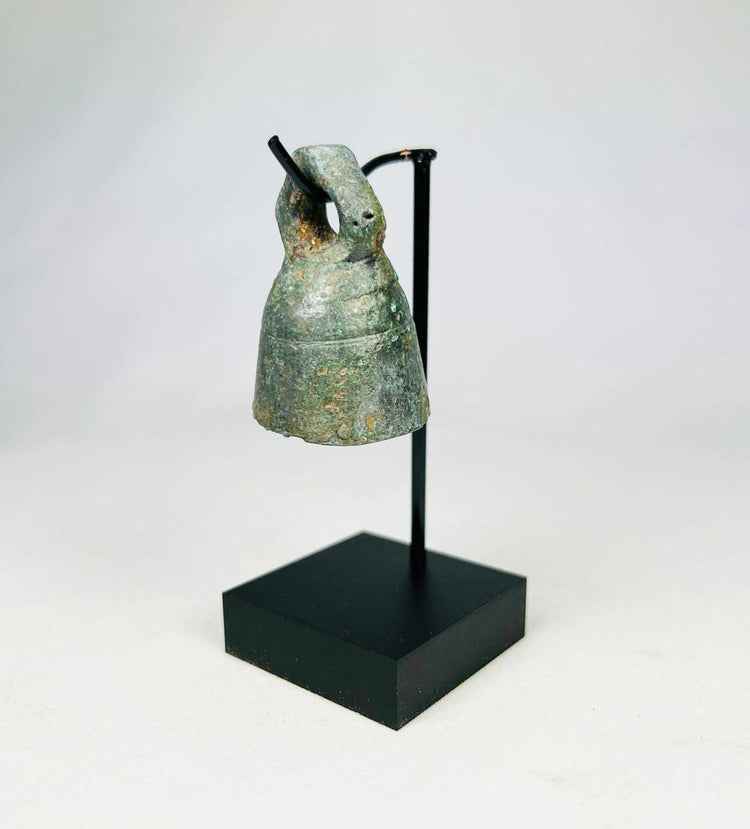
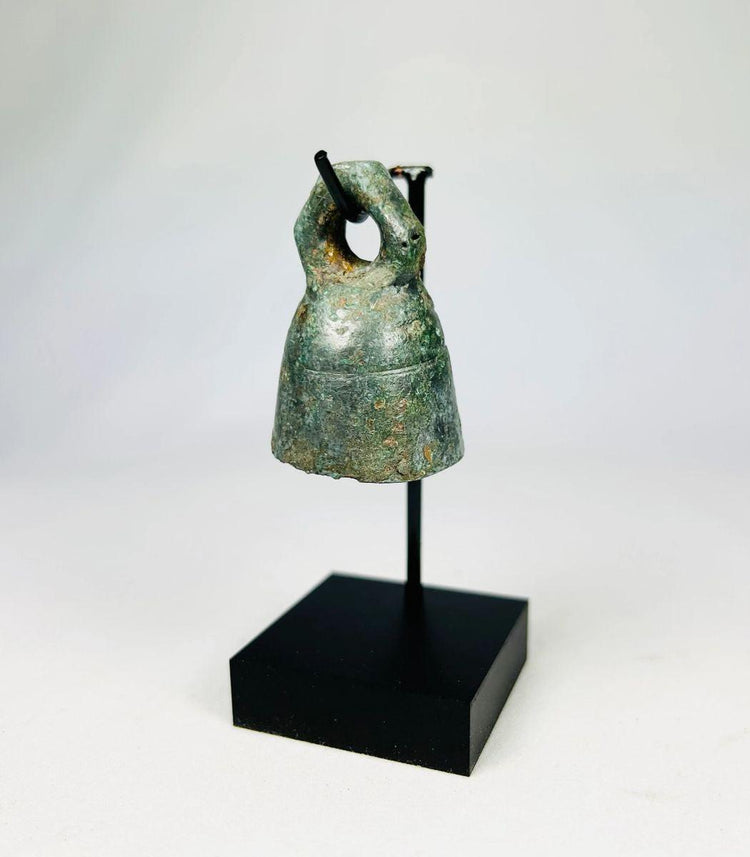
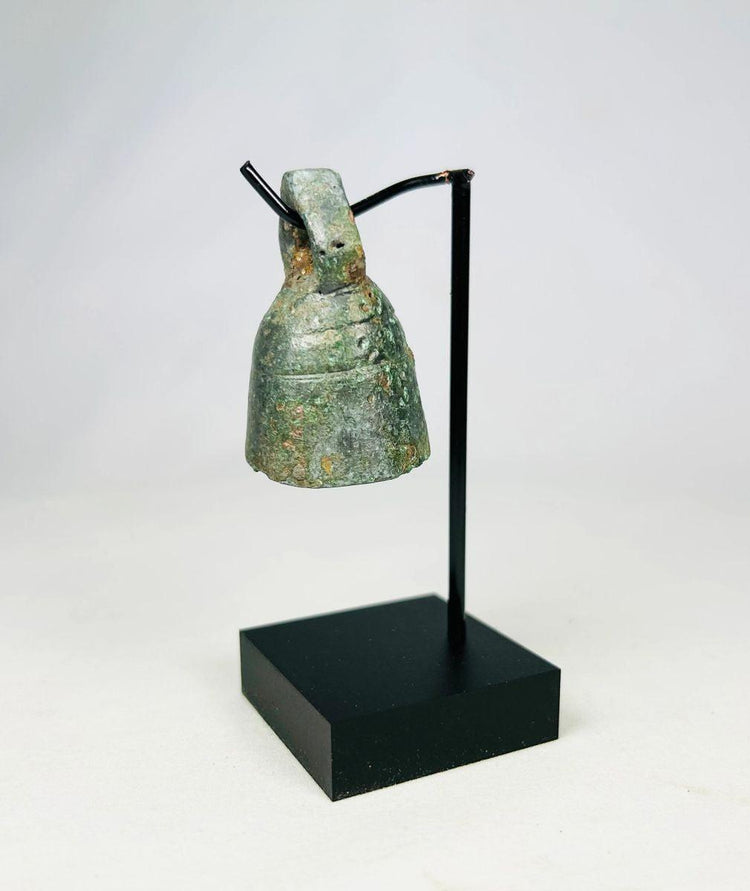
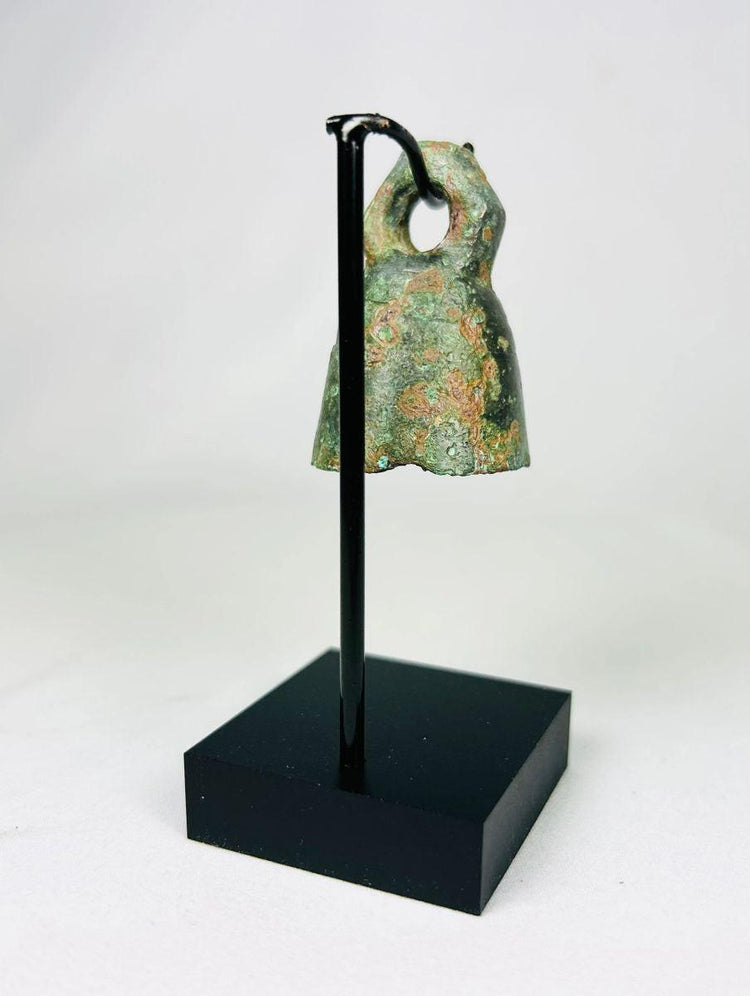
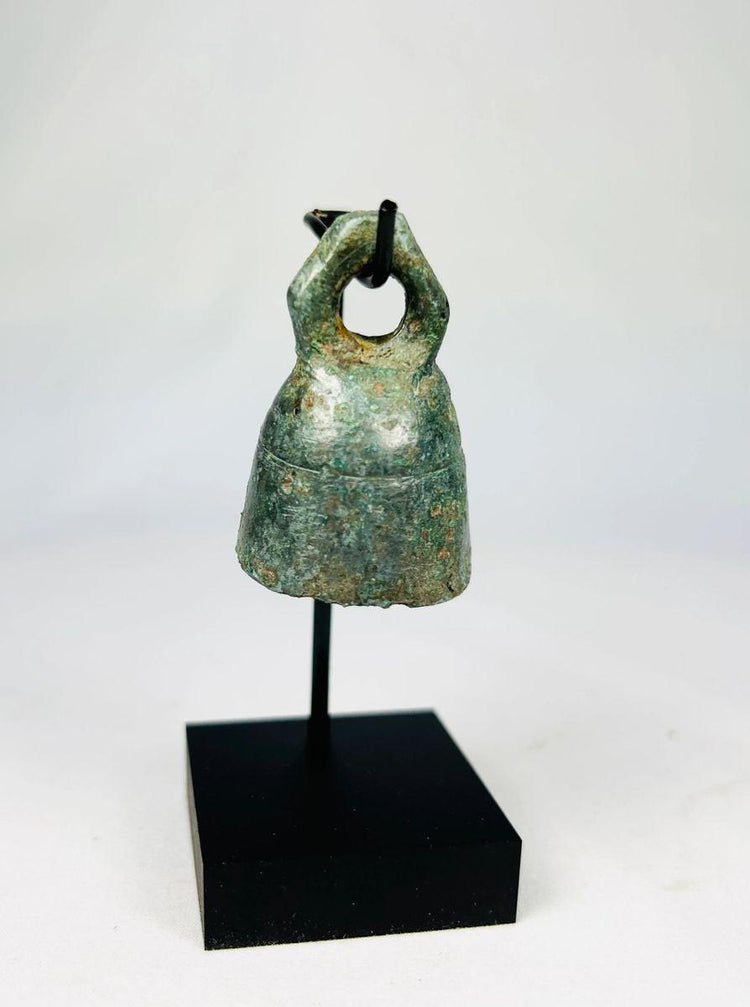
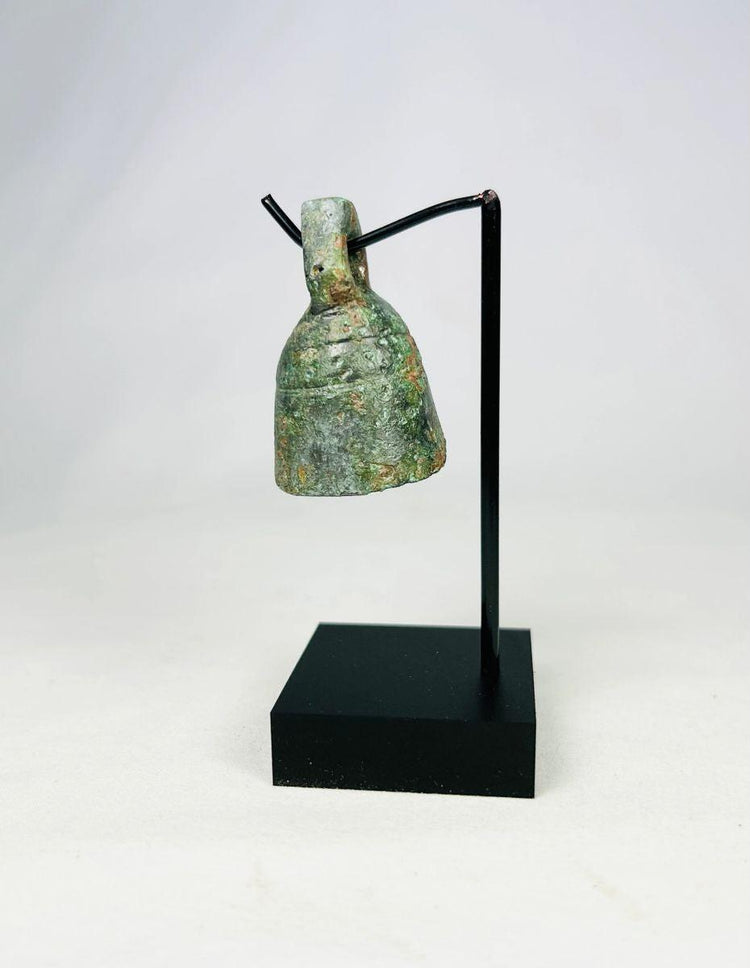
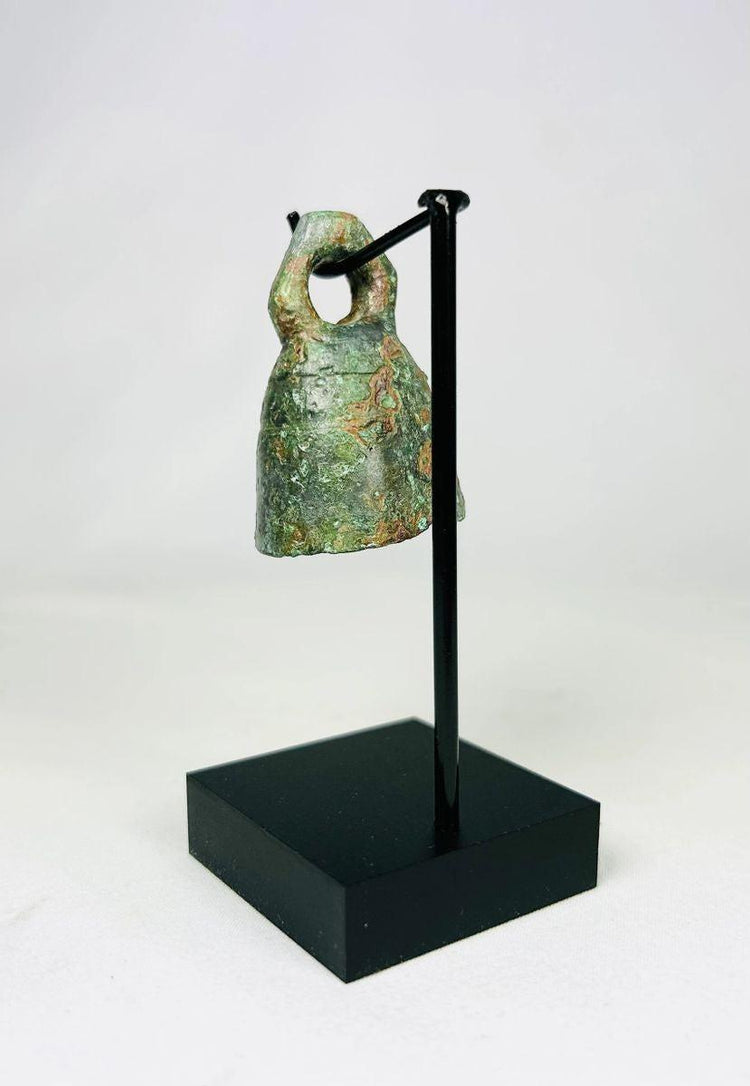
The bell has a compact conical body, divided by a horizontal groove into a rounded upper section and a flaring lower portion. At the top is a distinctive hexagonal-outline suspension loop with a circular opening, allowing the bell to be hung or attached.
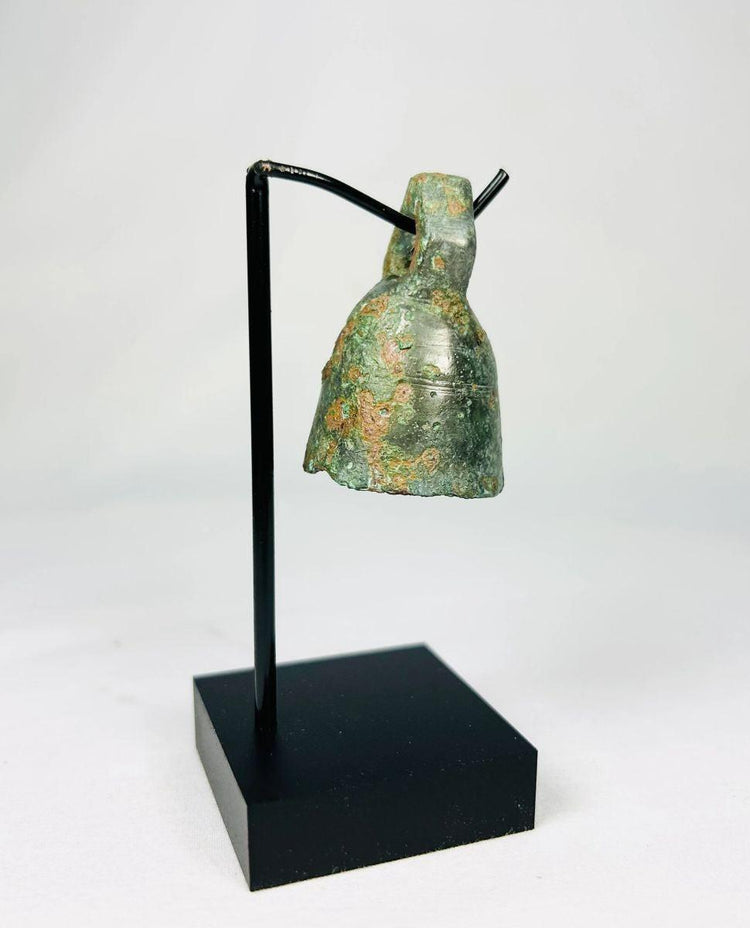
The bronze surface displays a naturally developed green-brown patina with areas of orange and light-green corrosion, reflecting its considerable antiquity.
Features
- Conical body with flaring lower section
- Horizontal groove dividing the body
- Hexagonal suspension loop
- Circular suspension hole
- Green-brown archaeological patina
- Orange and light-green corrosion deposits
- Mounted on a modern display stand
Cultural Significance
Small bronze bells were used in a variety of contexts throughout the Roman world and could be suspended from objects, fittings, harnesses, or other attachments.
Examples of this general form are known from Roman archaeological contexts, including Pompeii and Herculaneum, providing useful parallels for the form and 1st-century CE dating of this example. Without a documented excavation context, its precise original use cannot be determined with certainty.
Condition
The bell remains substantially intact, with the suspension loop well preserved. The surface exhibits green-brown patination with orange and light-green corrosion. Minor corrosion and small losses along the lip are present, consistent with age and archaeological preservation.
Dimensions (Approximate)
Height: 1.75 in
Width: 1.5 in
Age (Approximate)
1,900–2,000 years old
Provenance
Formerly part of the private collection of David Van Vleck Jr., Brooklyn, New York, USA, a longtime collector whose holdings included classical antiquities, ancient coins, and small works in bronze. Acquired by the collector during the 1990s and subsequently handled by Palmyra Heritage Gallery, New York, New York, USA. The piece later entered a private collection in North York, Ontario, Canada.
Expert Assessment: Examined by Luca Salvaggio, an Italian archaeologist specializing in ancient Mediterranean and Near Eastern material, with a Postgraduate Diploma from the Italian Archaeological School at Athens (IASA) and accreditation from the Italian Ministry of Culture (MiC). He identified the object as a Roman cast bronze bell dating to the 1st century CE, based on its conical body, horizontal groove, flaring lower section, hexagonal suspension loop, circular opening, and characteristic green-brown patina. He further noted that its form is comparable to bells found at Pompeii and Herculaneum.
Learn More
Explore a related 1st-century CE Roman bronze bell in the collection of The Metropolitan Museum of Art.
Browse our collection of Roman & Greek Artifacts & Ancient Relics.
Description
Historical Context & Origin
Region: Roman Empire
Material: Cast bronze
Period: 1st Century CE
Description
This ancient Roman cast bronze bell dates to the 1st century CE and belongs to a type known from Roman sites including Pompeii and Herculaneum.
The bell has a compact conical body, divided by a horizontal groove into a rounded upper section and a flaring lower portion. At the top is a distinctive hexagonal-outline suspension loop with a circular opening, allowing the bell to be hung or attached.
The bronze surface displays a naturally developed green-brown patina with areas of orange and light-green corrosion, reflecting its considerable antiquity.
Features
- Conical body with flaring lower section
- Horizontal groove dividing the body
- Hexagonal suspension loop
- Circular suspension hole
- Green-brown archaeological patina
- Orange and light-green corrosion deposits
- Mounted on a modern display stand
Cultural Significance
Small bronze bells were used in a variety of contexts throughout the Roman world and could be suspended from objects, fittings, harnesses, or other attachments.
Examples of this general form are known from Roman archaeological contexts, including Pompeii and Herculaneum, providing useful parallels for the form and 1st-century CE dating of this example. Without a documented excavation context, its precise original use cannot be determined with certainty.
Condition
The bell remains substantially intact, with the suspension loop well preserved. The surface exhibits green-brown patination with orange and light-green corrosion. Minor corrosion and small losses along the lip are present, consistent with age and archaeological preservation.
Dimensions (Approximate)
Height: 1.75 in
Width: 1.5 in
Age (Approximate)
1,900–2,000 years old
Provenance
Formerly part of the private collection of David Van Vleck Jr., Brooklyn, New York, USA, a longtime collector whose holdings included classical antiquities, ancient coins, and small works in bronze. Acquired by the collector during the 1990s and subsequently handled by Palmyra Heritage Gallery, New York, New York, USA. The piece later entered a private collection in North York, Ontario, Canada.
Expert Assessment: Examined by Luca Salvaggio, an Italian archaeologist specializing in ancient Mediterranean and Near Eastern material, with a Postgraduate Diploma from the Italian Archaeological School at Athens (IASA) and accreditation from the Italian Ministry of Culture (MiC). He identified the object as a Roman cast bronze bell dating to the 1st century CE, based on its conical body, horizontal groove, flaring lower section, hexagonal suspension loop, circular opening, and characteristic green-brown patina. He further noted that its form is comparable to bells found at Pompeii and Herculaneum.
Learn More
Explore a related 1st-century CE Roman bronze bell in the collection of The Metropolitan Museum of Art.
Browse our collection of Roman & Greek Artifacts & Ancient Relics.
You May Also Like
