
Ancient Roman Bronze Finger-Ring Key | Circa 3rd–4th Century CE
Couldn't load pickup availability




Ancient Roman Bronze Finger-Ring Key | Circa 3rd–4th Century CE
Description
More
Less
Historical Context & Origin
Region: Roman Empire
Material: Cast bronze
Period: Roman Period, circa 3rd–4th Century CE
Description
This ancient Roman bronze ring key is an intriguing example of functional personal equipment dating to approximately the 3rd–4th century CE. Designed to combine the portability of a finger ring with the practical function of a small key, objects of this type represent a distinctive category of Roman personal accessories.
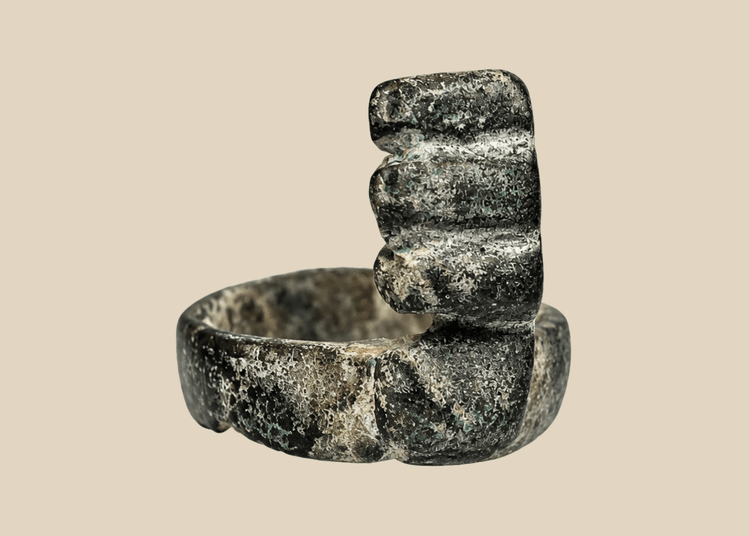
The ring consists of a substantial bronze hoop fitted with an integral projecting key element. Viewed from the side, the raised terminal displays a short shaft with multiple stepped projections or teeth intended to engage with the internal mechanism of a small lock. A remarkably close Roman bronze ring key preserved by the Metropolitan Museum of Art is similarly constructed with a compact ring handle, short shaft, and ten teeth.
Ring keys were particularly suited to securing smaller personal possessions such as boxes, caskets, chests, cupboards, and containers. Incorporating the key directly into a wearable ring provided a convenient means of keeping access to valued possessions close at hand.
The present example retains a dark green-brown archaeological patina with areas of earthen and mineral encrustation throughout. The projecting key element remains clearly visible, giving the object an immediately recognizable profile when displayed from the side.
Features
- Cast bronze construction
- Integral projecting key bit
- Short shaft with multiple stepped teeth
- Substantial circular finger hoop
- Dark green and brown archaeological patina
- Mineral and earthen surface deposits
Cultural Significance
Roman ring keys represent a practical intersection between jewelry, personal security, and everyday material culture. Their compact design allowed an individual to carry a key directly on the hand rather than as a separate object, reducing the likelihood of its loss while maintaining immediate access to a secured container or compartment.
Surviving Roman examples demonstrate considerable variation in size and construction. The Metropolitan Museum of Art preserves a closely comparable Roman bronze ring key dating to the 3rd–4th century CE, similarly combining a compact ring handle with a short shaft and ten teeth.
Objects such as this provide a particularly personal connection to Roman daily life, reflecting concerns surrounding privacy, ownership, valuables, and domestic security approximately sixteen to eighteen centuries ago.
Condition
Ancient condition with extensive age-related patination, oxidation, mineral deposits, surface encrustation, abrasions, and wear throughout. The bronze displays a predominantly dark green-brown surface with lighter areas of mineralization.
The ring hoop remains substantially intact, and the projecting key element retains its recognizable stepped profile. Surface details have softened through burial and age. No attempt has been made to clean or mechanically restore the archaeological patina.
Dimensions (Approximate)
Ring Size: US 6
Age (Approximate)
Approximately 1,625–1,825 years old
Provenance
Formerly in a private California collection, acquired in Germany approximately 25 years ago.
Subsequently handled by Palmyra Heritage Gallery, New York. Established in New York in 1995, Palmyra Heritage specializes in ancient coins and antiquities, including material from the Greek, Roman, Byzantine, Egyptian, Pre-Columbian, and Islamic worlds.
Learn More
Compare this Roman bronze ring key with a closely related example preserved by the Metropolitan Museum of Art.
Discover our Collection of Roman and Greek Artifacts and Ancient Relics.
Description
Historical Context & Origin
Region: Roman Empire
Material: Cast bronze
Period: Roman Period, circa 3rd–4th Century CE
Description
This ancient Roman bronze ring key is an intriguing example of functional personal equipment dating to approximately the 3rd–4th century CE. Designed to combine the portability of a finger ring with the practical function of a small key, objects of this type represent a distinctive category of Roman personal accessories.
The ring consists of a substantial bronze hoop fitted with an integral projecting key element. Viewed from the side, the raised terminal displays a short shaft with multiple stepped projections or teeth intended to engage with the internal mechanism of a small lock. A remarkably close Roman bronze ring key preserved by the Metropolitan Museum of Art is similarly constructed with a compact ring handle, short shaft, and ten teeth.
Ring keys were particularly suited to securing smaller personal possessions such as boxes, caskets, chests, cupboards, and containers. Incorporating the key directly into a wearable ring provided a convenient means of keeping access to valued possessions close at hand.
The present example retains a dark green-brown archaeological patina with areas of earthen and mineral encrustation throughout. The projecting key element remains clearly visible, giving the object an immediately recognizable profile when displayed from the side.
Features
- Cast bronze construction
- Integral projecting key bit
- Short shaft with multiple stepped teeth
- Substantial circular finger hoop
- Dark green and brown archaeological patina
- Mineral and earthen surface deposits
Cultural Significance
Roman ring keys represent a practical intersection between jewelry, personal security, and everyday material culture. Their compact design allowed an individual to carry a key directly on the hand rather than as a separate object, reducing the likelihood of its loss while maintaining immediate access to a secured container or compartment.
Surviving Roman examples demonstrate considerable variation in size and construction. The Metropolitan Museum of Art preserves a closely comparable Roman bronze ring key dating to the 3rd–4th century CE, similarly combining a compact ring handle with a short shaft and ten teeth.
Objects such as this provide a particularly personal connection to Roman daily life, reflecting concerns surrounding privacy, ownership, valuables, and domestic security approximately sixteen to eighteen centuries ago.
Condition
Ancient condition with extensive age-related patination, oxidation, mineral deposits, surface encrustation, abrasions, and wear throughout. The bronze displays a predominantly dark green-brown surface with lighter areas of mineralization.
The ring hoop remains substantially intact, and the projecting key element retains its recognizable stepped profile. Surface details have softened through burial and age. No attempt has been made to clean or mechanically restore the archaeological patina.
Dimensions (Approximate)
Ring Size: US 6
Age (Approximate)
Approximately 1,625–1,825 years old
Provenance
Formerly in a private California collection, acquired in Germany approximately 25 years ago.
Subsequently handled by Palmyra Heritage Gallery, New York. Established in New York in 1995, Palmyra Heritage specializes in ancient coins and antiquities, including material from the Greek, Roman, Byzantine, Egyptian, Pre-Columbian, and Islamic worlds.
Learn More
Compare this Roman bronze ring key with a closely related example preserved by the Metropolitan Museum of Art.
Discover our Collection of Roman and Greek Artifacts and Ancient Relics.
You May Also Like
