

Ancient Roman Bronze Simpulum Ladle with Long Handle | Imperial Period | Circa 1st – 3rd Century CE
Couldn't load pickup availability


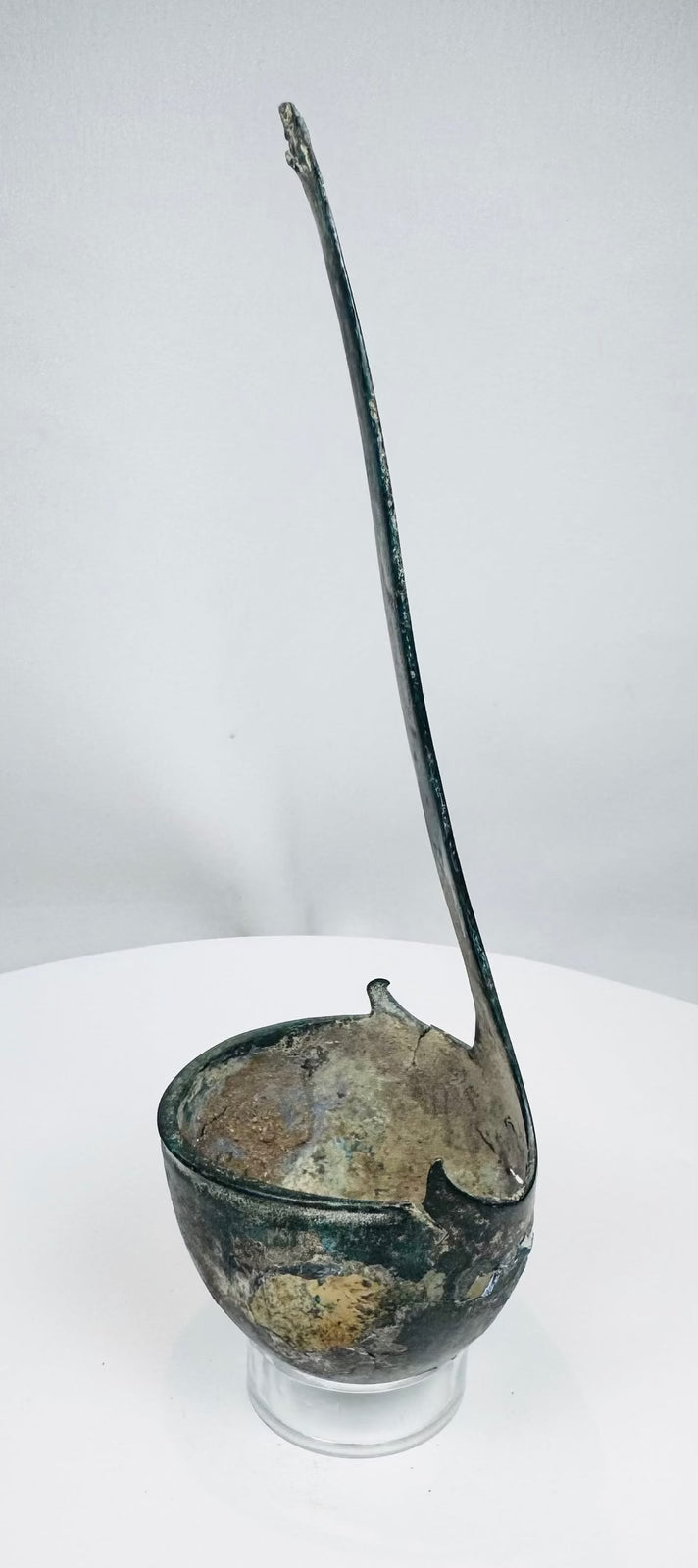
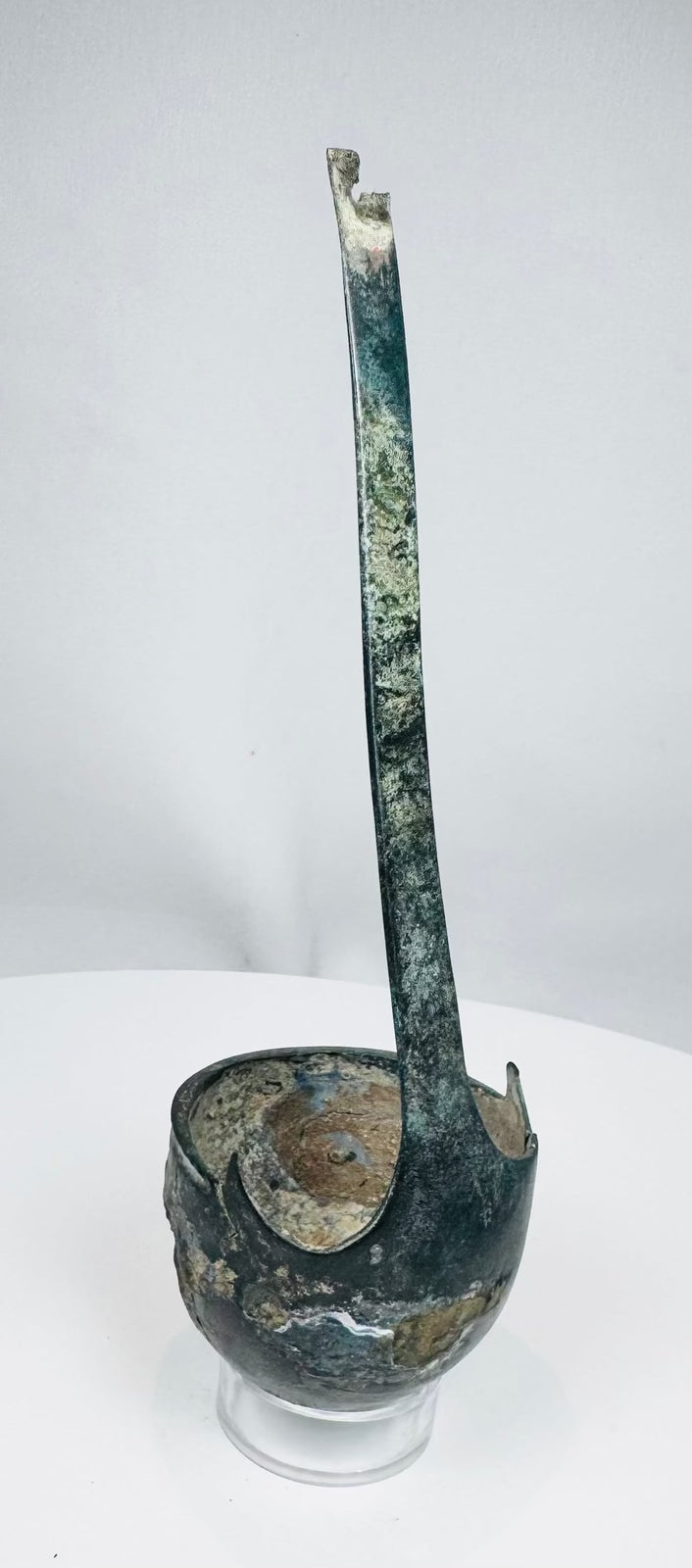
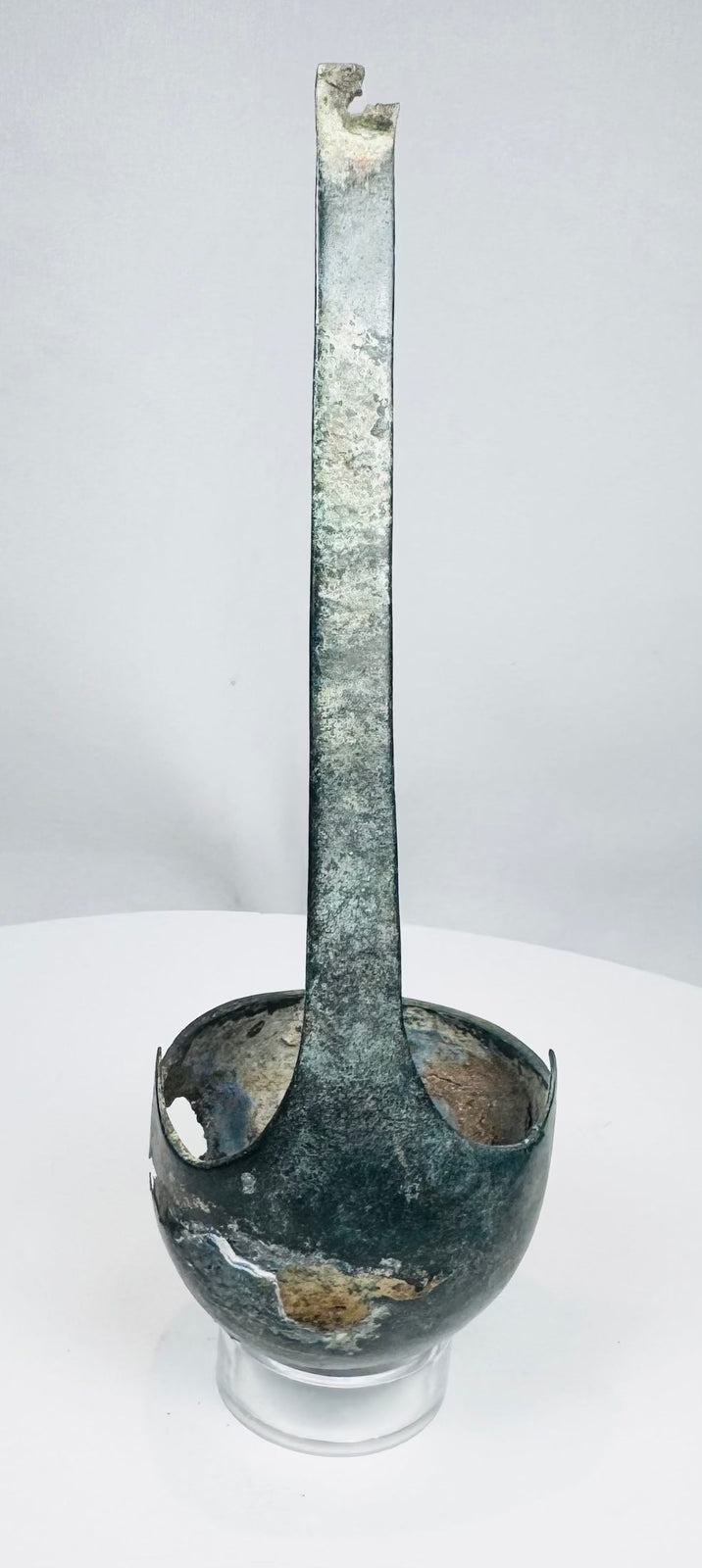
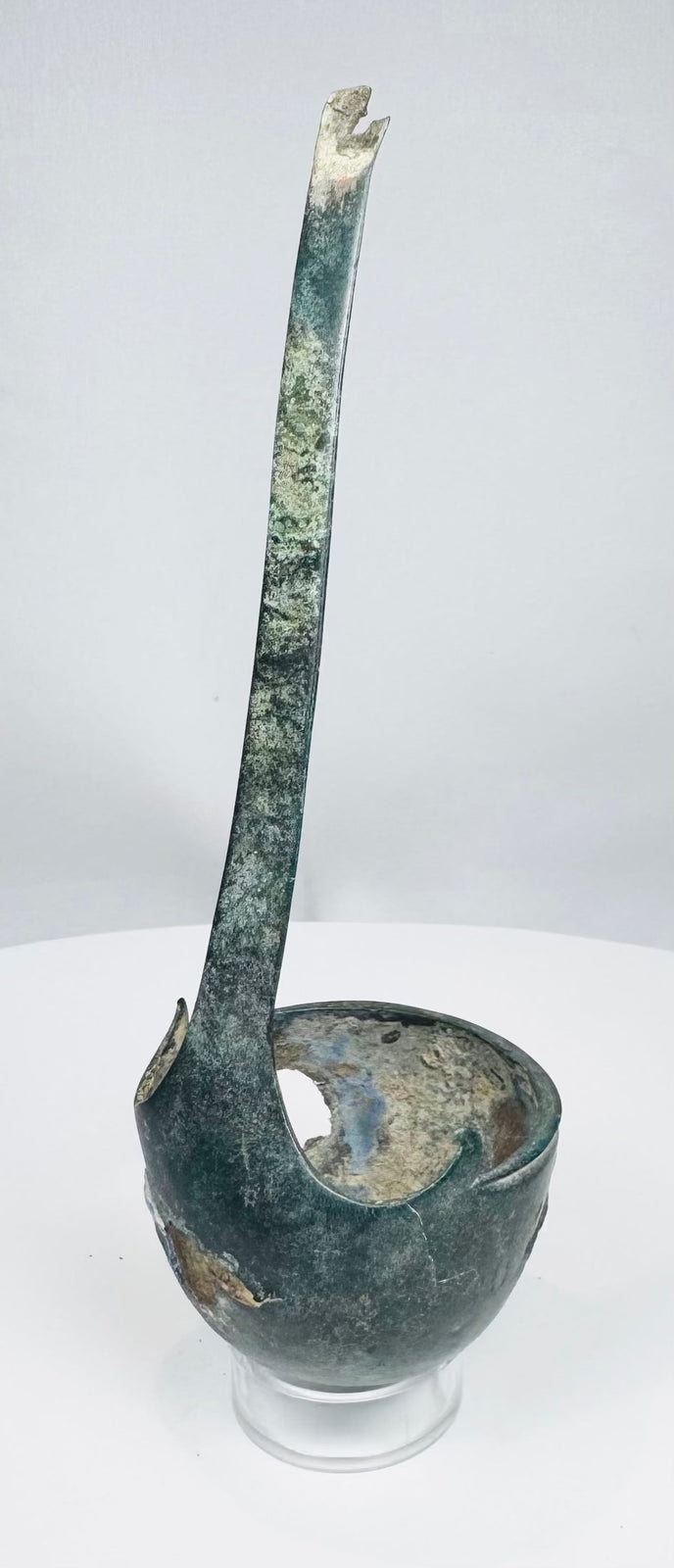
Ancient Roman Bronze Simpulum Ladle with Long Handle | Imperial Period | Circa 1st – 3rd Century CE
Description
More
Less
Historical Context & Origin
Region: Roman Empire, Mediterranean region
Material: Bronze or copper alloy with blue-green patina and mineral accretions
Period: Roman Imperial Period, circa 1st–3rd Century CE
Description
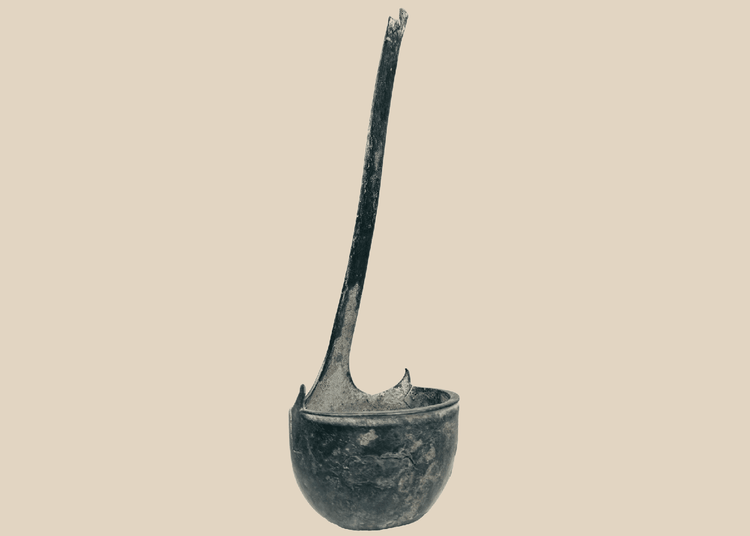
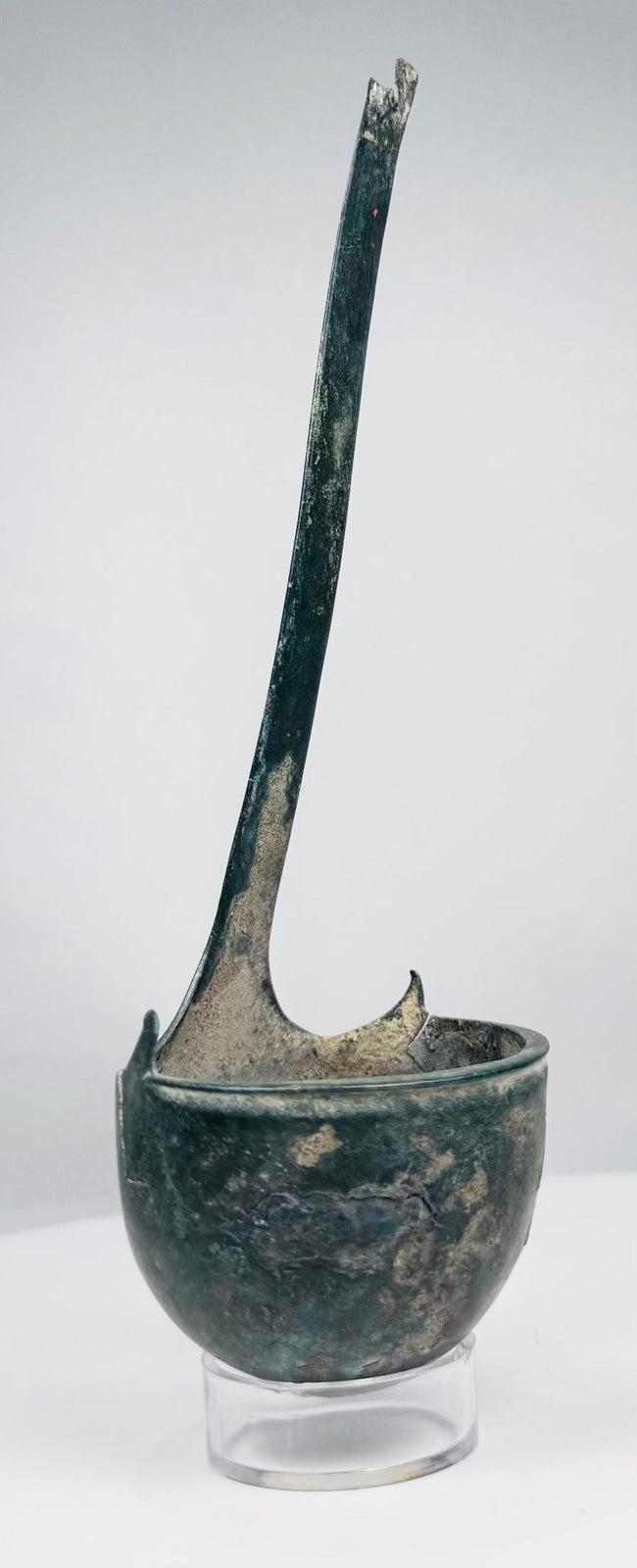
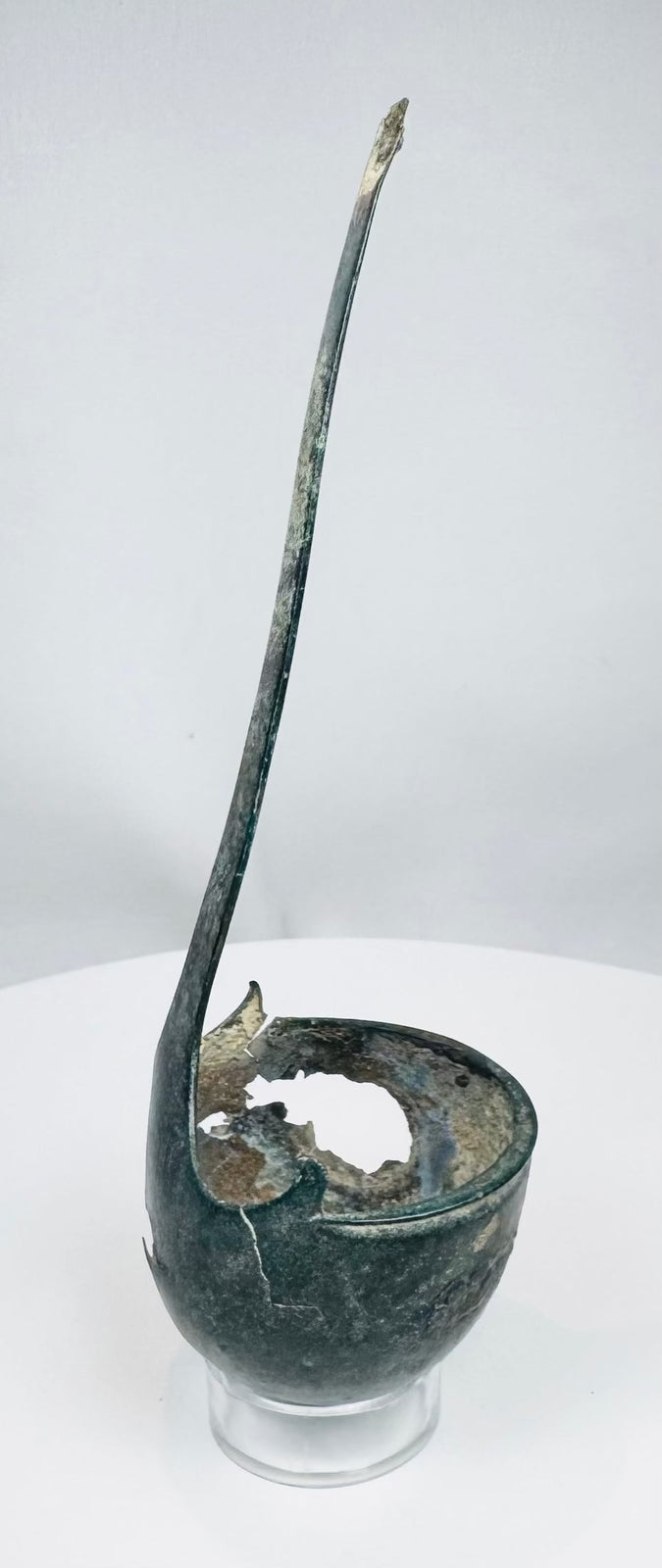
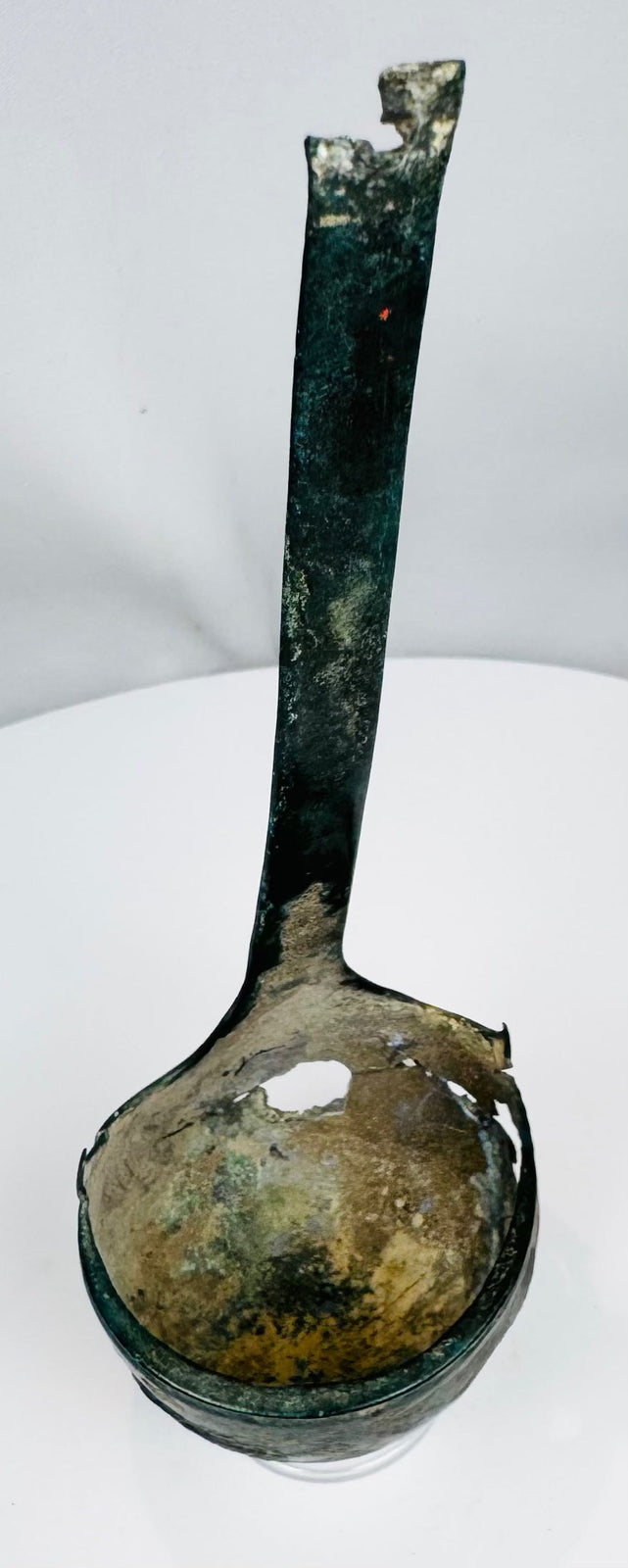
This ancient Roman bronze ladle, traditionally known as a simpulum, features a deep hemispherical bowl surmounted by an exceptionally long, slightly curving flat-section handle.
The rounded bowl was fashioned with a defined rim and deep interior suitable for collecting and transferring relatively small quantities of liquid.
Rising from the rear of the bowl is a broad triangular attachment plate that transitions smoothly into the narrow elongated handle. Two upward-curving, spur-like projections flank the base of the handle, adding a distinctive decorative profile to the vessel.
The handle extends vertically above the bowl with a gently curved silhouette and flattened rectangular cross-section. Its upper terminal is incomplete.
The original end may have incorporated a suspension opening, loop, or decorative terminal, but this portion has suffered significant ancient or later loss and its original configuration cannot now be determined with certainty.
Roman ladles were manufactured in numerous forms, ranging from short-handled serving vessels to long-handled examples intended to reach into deeper containers. Comparable Roman simpula frequently feature deep or rounded bowls and elongated handles.
The surface displays a varied dark green and blue-green patina with areas of pale mineral accretion, exposed metal, and archaeological encrustation. These natural surface variations emphasize the object’s considerable age and excavated character.
Features
- Deep hemispherical bowl
- Long flat-section handle
- Broad triangular handle attachment
- Two raised spur or volute-like projections along the rim
- Dark blue-green archaeological patina
- Extensive mineral and burial accretions
- Incomplete upper handle terminal
- Roman domestic or ceremonial utensil form
Cultural Significance
The simpulum was a familiar utensil within Roman domestic, dining, and religious life. At Roman banquets, ladles were used to transfer measured quantities of wine into drinking vessels, particularly after wine had been mixed with water.
Simpula were also associated with religious libations and Roman priestly ceremonies. Their recognizable shape appeared alongside other ritual implements in Roman art and coinage, demonstrating that the form carried both practical and ceremonial associations.
It is not possible to determine whether this particular ladle served primarily in a domestic, dining, or ritual setting. Nevertheless, its deep bowl and long handle would have made it particularly useful for retrieving wine, oil, or another liquid from a comparatively deep vessel.
Condition
The ladle survives in substantially fragmentary archaeological condition.
The bowl retains much of its original hemispherical form but exhibits extensive corrosion, thinning, cracks, edge losses, and a large irregular perforation through one side of the interior.
Additional smaller holes, surface losses, dents, and areas of delamination are visible throughout the bowl.
The long handle remains substantially preserved but displays bending, edge wear, corrosion, mineral accretions, and scattered losses.
The upper terminal is broken and incomplete, with the original suspension hole or decorative ending no longer fully preserved.
The raised projections beside the handle remain visible, although both exhibit wear and minor losses. The entire surface displays extensive blue-green patination, pale accretions, oxidation, abrasions, and exposed areas consistent with prolonged burial.
Dimensions (Approximate)
Overall Height: 6.5 in
Bowl Diameter: 2 in
Age (Approximate)
1,700–2,000 years old
Provenance
Formerly in the collection of Jack Guevrekian, Manhasset, New York, a noted New York numismatist and collector with a particular interest in Armenian coinage, antiquities, and ancient material. Guevrekian assembled an extensive collection over several decades, a significant portion of which was publicly offered as The Jack Guevrekian Collection by the Numismatic & Antiquarian Service Corporation of America in New York in 1977.
Subsequently held in a private New York City collection.
Later handled by the Howard S. Rose Gallery / Arte Primitivo in New York, a longstanding specialist gallery and auction house dealing in Pre-Columbian, Classical, Egyptian, Asian, and ethnographic antiquities and works of art. The gallery has conducted specialist auctions, exhibitions, and private sales from its New York premises.
Subsequently handled by Artemis Fine Arts / Artemis Gallery, a Colorado-based specialist in antiquities, ancient art, ethnographic material, and fine art that has been active in the field since 1993.
Then entered a private collection in Toronto, Ontario, Canada.
Learn More
View a related ancient Roman bronze simpulum in the collection of The Metropolitan Museum of Art
Explore our curated Collection of Roman & Greek Artifacts and Ancient Relics
Description
Historical Context & Origin
Region: Roman Empire, Mediterranean region
Material: Bronze or copper alloy with blue-green patina and mineral accretions
Period: Roman Imperial Period, circa 1st–3rd Century CE
Description
This ancient Roman bronze ladle, traditionally known as a simpulum, features a deep hemispherical bowl surmounted by an exceptionally long, slightly curving flat-section handle.
The rounded bowl was fashioned with a defined rim and deep interior suitable for collecting and transferring relatively small quantities of liquid.
Rising from the rear of the bowl is a broad triangular attachment plate that transitions smoothly into the narrow elongated handle. Two upward-curving, spur-like projections flank the base of the handle, adding a distinctive decorative profile to the vessel.
The handle extends vertically above the bowl with a gently curved silhouette and flattened rectangular cross-section. Its upper terminal is incomplete.
The original end may have incorporated a suspension opening, loop, or decorative terminal, but this portion has suffered significant ancient or later loss and its original configuration cannot now be determined with certainty.
Roman ladles were manufactured in numerous forms, ranging from short-handled serving vessels to long-handled examples intended to reach into deeper containers. Comparable Roman simpula frequently feature deep or rounded bowls and elongated handles.
The surface displays a varied dark green and blue-green patina with areas of pale mineral accretion, exposed metal, and archaeological encrustation. These natural surface variations emphasize the object’s considerable age and excavated character.
Features
- Deep hemispherical bowl
- Long flat-section handle
- Broad triangular handle attachment
- Two raised spur or volute-like projections along the rim
- Dark blue-green archaeological patina
- Extensive mineral and burial accretions
- Incomplete upper handle terminal
- Roman domestic or ceremonial utensil form
Cultural Significance
The simpulum was a familiar utensil within Roman domestic, dining, and religious life. At Roman banquets, ladles were used to transfer measured quantities of wine into drinking vessels, particularly after wine had been mixed with water.
Simpula were also associated with religious libations and Roman priestly ceremonies. Their recognizable shape appeared alongside other ritual implements in Roman art and coinage, demonstrating that the form carried both practical and ceremonial associations.
It is not possible to determine whether this particular ladle served primarily in a domestic, dining, or ritual setting. Nevertheless, its deep bowl and long handle would have made it particularly useful for retrieving wine, oil, or another liquid from a comparatively deep vessel.
Condition
The ladle survives in substantially fragmentary archaeological condition.
The bowl retains much of its original hemispherical form but exhibits extensive corrosion, thinning, cracks, edge losses, and a large irregular perforation through one side of the interior.
Additional smaller holes, surface losses, dents, and areas of delamination are visible throughout the bowl.
The long handle remains substantially preserved but displays bending, edge wear, corrosion, mineral accretions, and scattered losses.
The upper terminal is broken and incomplete, with the original suspension hole or decorative ending no longer fully preserved.
The raised projections beside the handle remain visible, although both exhibit wear and minor losses. The entire surface displays extensive blue-green patination, pale accretions, oxidation, abrasions, and exposed areas consistent with prolonged burial.
Dimensions (Approximate)
Overall Height: 6.5 in
Bowl Diameter: 2 in
Age (Approximate)
1,700–2,000 years old
Provenance
Formerly in the collection of Jack Guevrekian, Manhasset, New York, a noted New York numismatist and collector with a particular interest in Armenian coinage, antiquities, and ancient material. Guevrekian assembled an extensive collection over several decades, a significant portion of which was publicly offered as The Jack Guevrekian Collection by the Numismatic & Antiquarian Service Corporation of America in New York in 1977.
Subsequently held in a private New York City collection.
Later handled by the Howard S. Rose Gallery / Arte Primitivo in New York, a longstanding specialist gallery and auction house dealing in Pre-Columbian, Classical, Egyptian, Asian, and ethnographic antiquities and works of art. The gallery has conducted specialist auctions, exhibitions, and private sales from its New York premises.
Subsequently handled by Artemis Fine Arts / Artemis Gallery, a Colorado-based specialist in antiquities, ancient art, ethnographic material, and fine art that has been active in the field since 1993.
Then entered a private collection in Toronto, Ontario, Canada.
Learn More
View a related ancient Roman bronze simpulum in the collection of The Metropolitan Museum of Art
Explore our curated Collection of Roman & Greek Artifacts and Ancient Relics
You May Also Like
