



Ancient Roman Blue Glass Candlestick Unguentarium | Circa 1st–3rd Century AD
Couldn't load pickup availability


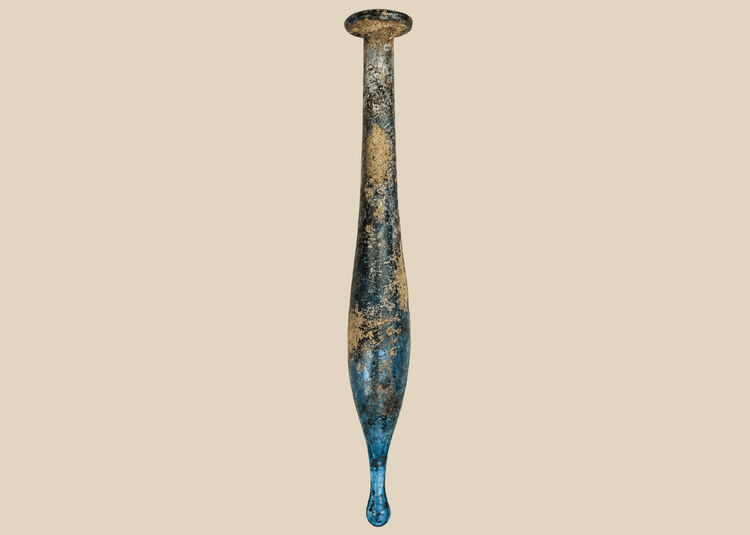


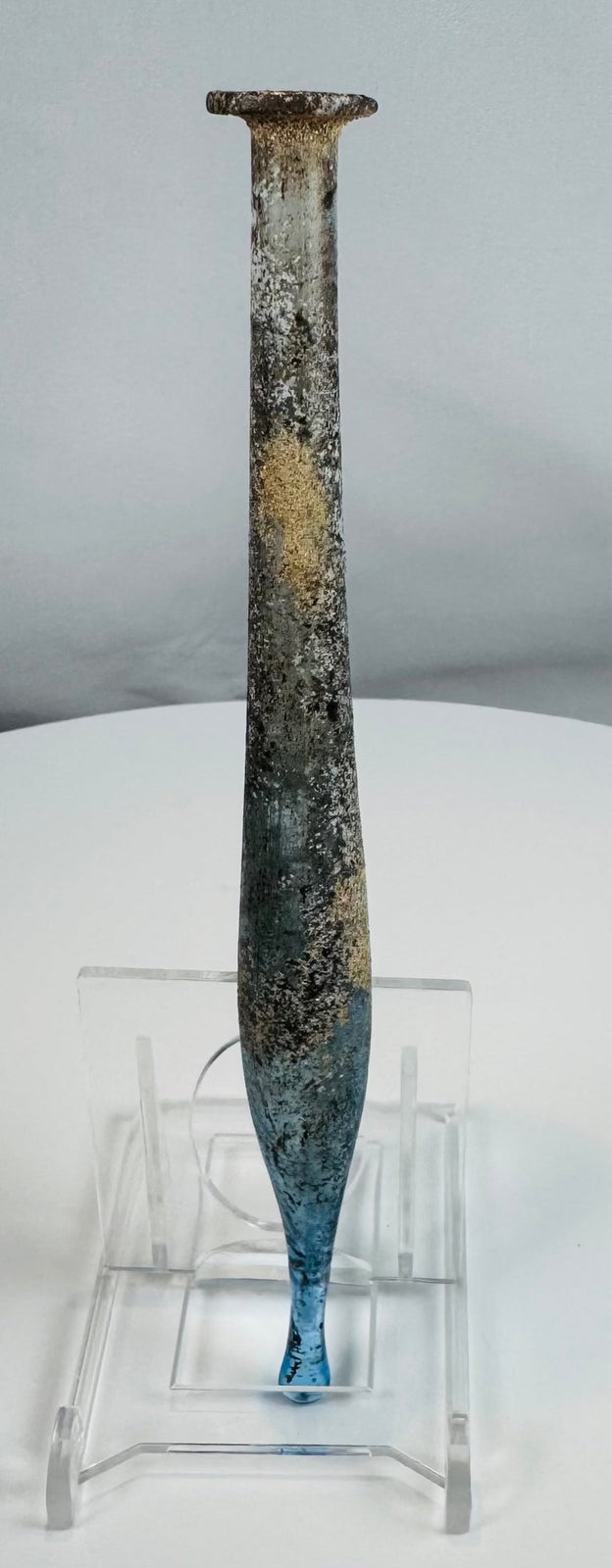
Ancient Roman Blue Glass Candlestick Unguentarium | Circa 1st–3rd Century AD
Description
More
Less
Historical Context & Origin
Region: Eastern Mediterranean / Roman Empire
Material: Free-Blown Blue Glass
Period: Roman Imperial Period, Circa 1st–3rd Century AD
Description
This authentic ancient Roman candlestick unguentarium is a striking example of the elegant personal vessels used throughout the Roman Empire for storing perfumes, aromatic oils, medicinal preparations, and cosmetic substances. Characterized by its elongated fusiform (spindle-shaped) body, narrow tubular neck, and flared rim, this vessel represents one of the most distinctive and recognizable forms of Roman glassware.
Often referred to as a "tear bottle" or "lachrymatory" in the antiquities trade, vessels of this type were commonly found in domestic, funerary, and ceremonial contexts throughout the Roman world. Modern scholarship generally identifies these vessels as unguentaria intended for valuable liquids rather than literal tear collectors, reflecting their practical role in everyday life and personal care.
Crafted using the revolutionary free-blown glassmaking technique introduced during the late Hellenistic and early Roman periods, this example exhibits a beautiful pale blue coloration enhanced by centuries of burial. Similar candlestick unguentaria have been recovered from archaeological sites throughout the Roman Empire and are represented in museum collections, illustrating the widespread use of specialized glass containers for perfumes, oils, and luxury preparations during the Imperial period.
Extensive iridescence, mineral encrustation, and archaeological weathering have developed across the surface, creating the distinctive appearance highly prized by collectors of ancient glass. Its elegant proportions and remarkable state of preservation make it an exceptional example of Roman craftsmanship and technological innovation.
Features
- Authentic ancient Roman candlestick unguentarium
- Elegant elongated fusiform (spindle-shaped) body
- Beautiful pale blue glass coloration
- Free-blown glass construction
- Flared rim and narrow tubular neck
- Displays desirable archaeological weathering and mineral deposits
- Traditionally associated with perfumes, oils, cosmetics, and medicinal preparations
- Exceptional collector's example of Roman glassmaking
Cultural Significance
The invention of glassblowing transformed production throughout the Roman Empire, allowing glass vessels to become more accessible and widely distributed than ever before. Unguentaria such as this played an important role in daily life, serving as containers for perfumes, scented oils, cosmetics, medicines, and other valuable substances. Their widespread use reflects the sophistication of Roman commerce, personal grooming practices, and luxury consumption throughout the ancient Mediterranean world, while their survival provides valuable insight into the technological achievements of Roman glassmakers.
Condition
Ancient condition with expected archaeological weathering, mineral accretions, iridescence, surface encrustation, manufacturing irregularities, and age-related wear. The vessel remains intact and highly displayable. Please review photographs carefully for condition details.
Dimensions (Approximate)
Length: 6.5 in
Age (Approximate)
1,700–2,000 years old
Provenance
From a private collection in Montreal, Quebec, Canada, specializing in ancient Roman artifacts and antiquities.
Expert Assessment: Examined by Luca Salvaggio, an Italian archaeologist specializing in ancient Mediterranean and Near Eastern material, with a Postgraduate Diploma from the Italian Archaeological School at Athens (IASA) and accreditation from the Italian Ministry of Culture (MiC). He identified the vessel as a Roman free-blown blue glass candlestick unguentarium, comparable to Isings Form 82, dating to the 1st century CE, based on its tall cylindrical neck, flat outward-folded rim, elongated spindle-shaped body, and small rounded drop-shaped tip. He also noted the surviving blue coloration, particularly visible at the lower end, together with the whitish and brown weathering crust and natural iridescence.
Learn More
Explore a related 1st-century CE Roman blue glass unguentarium in the collection of the Princeton University Art Museum
Browse our collection of Roman & Greek Artifacts & Ancient Relics
Description
Historical Context & Origin
Region: Eastern Mediterranean / Roman Empire
Material: Free-Blown Blue Glass
Period: Roman Imperial Period, Circa 1st–3rd Century AD
Description
This authentic ancient Roman candlestick unguentarium is a striking example of the elegant personal vessels used throughout the Roman Empire for storing perfumes, aromatic oils, medicinal preparations, and cosmetic substances. Characterized by its elongated fusiform (spindle-shaped) body, narrow tubular neck, and flared rim, this vessel represents one of the most distinctive and recognizable forms of Roman glassware.
Often referred to as a "tear bottle" or "lachrymatory" in the antiquities trade, vessels of this type were commonly found in domestic, funerary, and ceremonial contexts throughout the Roman world. Modern scholarship generally identifies these vessels as unguentaria intended for valuable liquids rather than literal tear collectors, reflecting their practical role in everyday life and personal care.
Crafted using the revolutionary free-blown glassmaking technique introduced during the late Hellenistic and early Roman periods, this example exhibits a beautiful pale blue coloration enhanced by centuries of burial. Similar candlestick unguentaria have been recovered from archaeological sites throughout the Roman Empire and are represented in museum collections, illustrating the widespread use of specialized glass containers for perfumes, oils, and luxury preparations during the Imperial period.
Extensive iridescence, mineral encrustation, and archaeological weathering have developed across the surface, creating the distinctive appearance highly prized by collectors of ancient glass. Its elegant proportions and remarkable state of preservation make it an exceptional example of Roman craftsmanship and technological innovation.
Features
- Authentic ancient Roman candlestick unguentarium
- Elegant elongated fusiform (spindle-shaped) body
- Beautiful pale blue glass coloration
- Free-blown glass construction
- Flared rim and narrow tubular neck
- Displays desirable archaeological weathering and mineral deposits
- Traditionally associated with perfumes, oils, cosmetics, and medicinal preparations
- Exceptional collector's example of Roman glassmaking
Cultural Significance
The invention of glassblowing transformed production throughout the Roman Empire, allowing glass vessels to become more accessible and widely distributed than ever before. Unguentaria such as this played an important role in daily life, serving as containers for perfumes, scented oils, cosmetics, medicines, and other valuable substances. Their widespread use reflects the sophistication of Roman commerce, personal grooming practices, and luxury consumption throughout the ancient Mediterranean world, while their survival provides valuable insight into the technological achievements of Roman glassmakers.
Condition
Ancient condition with expected archaeological weathering, mineral accretions, iridescence, surface encrustation, manufacturing irregularities, and age-related wear. The vessel remains intact and highly displayable. Please review photographs carefully for condition details.
Dimensions (Approximate)
Length: 6.5 in
Age (Approximate)
1,700–2,000 years old
Provenance
From a private collection in Montreal, Quebec, Canada, specializing in ancient Roman artifacts and antiquities.
Expert Assessment: Examined by Luca Salvaggio, an Italian archaeologist specializing in ancient Mediterranean and Near Eastern material, with a Postgraduate Diploma from the Italian Archaeological School at Athens (IASA) and accreditation from the Italian Ministry of Culture (MiC). He identified the vessel as a Roman free-blown blue glass candlestick unguentarium, comparable to Isings Form 82, dating to the 1st century CE, based on its tall cylindrical neck, flat outward-folded rim, elongated spindle-shaped body, and small rounded drop-shaped tip. He also noted the surviving blue coloration, particularly visible at the lower end, together with the whitish and brown weathering crust and natural iridescence.
Learn More
Explore a related 1st-century CE Roman blue glass unguentarium in the collection of the Princeton University Art Museum
Browse our collection of Roman & Greek Artifacts & Ancient Relics
You May Also Like
