



Ancient Roman Glass Tear Bottle | Israel Region | 2nd Century CE
Couldn't load pickup availability




Ancient Roman Glass Tear Bottle | Israel Region | 2nd Century CE
Description
More
Less
Historical Context & Origin
Region: Roman Empire, Israel Region
Material: Blown pale green glass
Period: 2nd Century CE
Description
This ancient Roman blown-glass tear bottle dates to the 2nd century CE and is attributed to the Israel region of the Roman Empire.
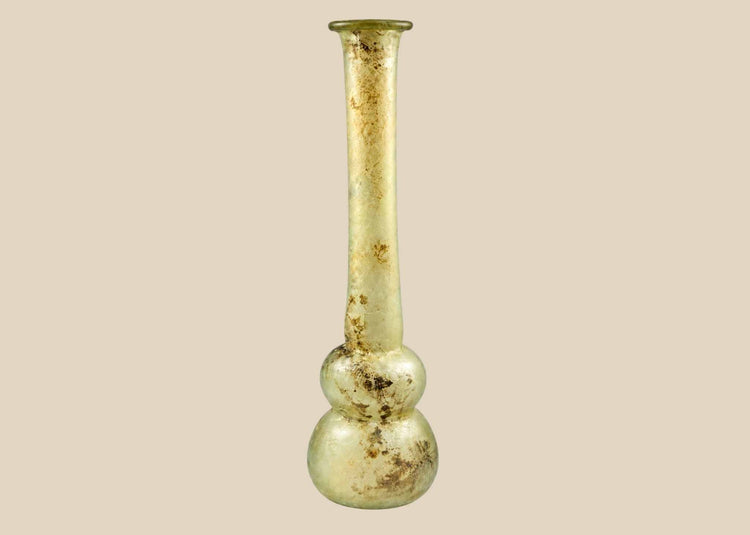
The vessel has a distinctive elongated form, with a very tall cylindrical neck that widens slightly toward a folded, flared rim. The body is formed from two rounded bulbs, with the upper bulb smaller than the lower, joined by a narrow waist.
The pale green glass has developed areas of attractive golden iridescence through prolonged burial, together with scattered brown mineral deposits and surface weathering.
Features
- Ancient Roman blown-glass tear bottle
- Israel region
- Pale green glass
- Very tall cylindrical neck
- Folded, slightly flared rim
- Double-bulb body
- Smaller upper bulb joined to larger lower bulb by a narrow waist
- Naturally developed golden iridescence
- Scattered brown burial deposits
- No modern repairs observed
- Presented in an acrylic display case
Cultural Significance
Small glass bottles were widely used throughout the Roman world for holding and dispensing valued liquids such as perfumes, oils, cosmetics, medicines, and other preparations.
The elongated neck and compact multi-bulb body of this example reflect the sophisticated glassblowing traditions of the Roman Eastern Mediterranean. Its precise original contents cannot be determined without archaeological context, so it is best described conservatively as a tear bottle or small cosmetic/perfume vessel rather than assigning it a single specific function.
Condition
Ancient condition with expected surface wear and weathering. The pale green glass exhibits naturally developed golden iridescence and scattered brown mineral deposits consistent with long-term burial. The vessel remains substantially intact, and no modern repairs are evident.
Dimensions (Approximate)
Height: 9.5 in
Width: 4 in
Age (Approximate)
1,800–1,900 years old
Provenance
Offered by Waddington’s Auctioneers & Appraisers, Toronto, Ontario, in its Cabinet of Curiosities auction of December 14, 2023, as Lot 642. Following the auction, the piece entered a prominent private collection in Toronto, Ontario, Canada.
The piece was later examined by Luca Salvaggio, an Italian archaeologist and specialist in ancient Mediterranean material. He holds a Postgraduate Diploma from the Italian Archaeological School at Athens (IASA) and is accredited for preventive archaeology by the Italian Ministry of Culture (MiC). Salvaggio identified the vessel as a Roman blown-glass tear bottle from the Israel region, dating to the 2nd century CE, based on its pale green glass, very tall cylindrical neck, folded flared rim, distinctive double-bulb body with narrow waist, and naturally developed golden iridescence.
Learn More
Study the use of Roman Cosmetic Glass Vessels and Ancient Beauty Rituals
Browse our Collection of Roman and Greek Artifacts
Description
Historical Context & Origin
Region: Roman Empire, Israel Region
Material: Blown pale green glass
Period: 2nd Century CE
Description
This ancient Roman blown-glass tear bottle dates to the 2nd century CE and is attributed to the Israel region of the Roman Empire.
The vessel has a distinctive elongated form, with a very tall cylindrical neck that widens slightly toward a folded, flared rim. The body is formed from two rounded bulbs, with the upper bulb smaller than the lower, joined by a narrow waist.
The pale green glass has developed areas of attractive golden iridescence through prolonged burial, together with scattered brown mineral deposits and surface weathering.
Features
- Ancient Roman blown-glass tear bottle
- Israel region
- Pale green glass
- Very tall cylindrical neck
- Folded, slightly flared rim
- Double-bulb body
- Smaller upper bulb joined to larger lower bulb by a narrow waist
- Naturally developed golden iridescence
- Scattered brown burial deposits
- No modern repairs observed
- Presented in an acrylic display case
Cultural Significance
Small glass bottles were widely used throughout the Roman world for holding and dispensing valued liquids such as perfumes, oils, cosmetics, medicines, and other preparations.
The elongated neck and compact multi-bulb body of this example reflect the sophisticated glassblowing traditions of the Roman Eastern Mediterranean. Its precise original contents cannot be determined without archaeological context, so it is best described conservatively as a tear bottle or small cosmetic/perfume vessel rather than assigning it a single specific function.
Condition
Ancient condition with expected surface wear and weathering. The pale green glass exhibits naturally developed golden iridescence and scattered brown mineral deposits consistent with long-term burial. The vessel remains substantially intact, and no modern repairs are evident.
Dimensions (Approximate)
Height: 9.5 in
Width: 4 in
Age (Approximate)
1,800–1,900 years old
Provenance
Offered by Waddington’s Auctioneers & Appraisers, Toronto, Ontario, in its Cabinet of Curiosities auction of December 14, 2023, as Lot 642. Following the auction, the piece entered a prominent private collection in Toronto, Ontario, Canada.
The piece was later examined by Luca Salvaggio, an Italian archaeologist and specialist in ancient Mediterranean material. He holds a Postgraduate Diploma from the Italian Archaeological School at Athens (IASA) and is accredited for preventive archaeology by the Italian Ministry of Culture (MiC). Salvaggio identified the vessel as a Roman blown-glass tear bottle from the Israel region, dating to the 2nd century CE, based on its pale green glass, very tall cylindrical neck, folded flared rim, distinctive double-bulb body with narrow waist, and naturally developed golden iridescence.
Learn More
Study the use of Roman Cosmetic Glass Vessels and Ancient Beauty Rituals
Browse our Collection of Roman and Greek Artifacts
You May Also Like
