

Roman Legionary Iron Projectile Group | Circa 1st – 3rd Century CE
Couldn't load pickup availability




Roman Legionary Iron Projectile Group | Circa 1st – 3rd Century CE
Description
More
Less
Historical Context & Origin
Region: Roman Empire, likely the Eastern Mediterranean
Material: Hand-forged iron
Period: Roman Period, circa 1st–3rd Century CE
Description
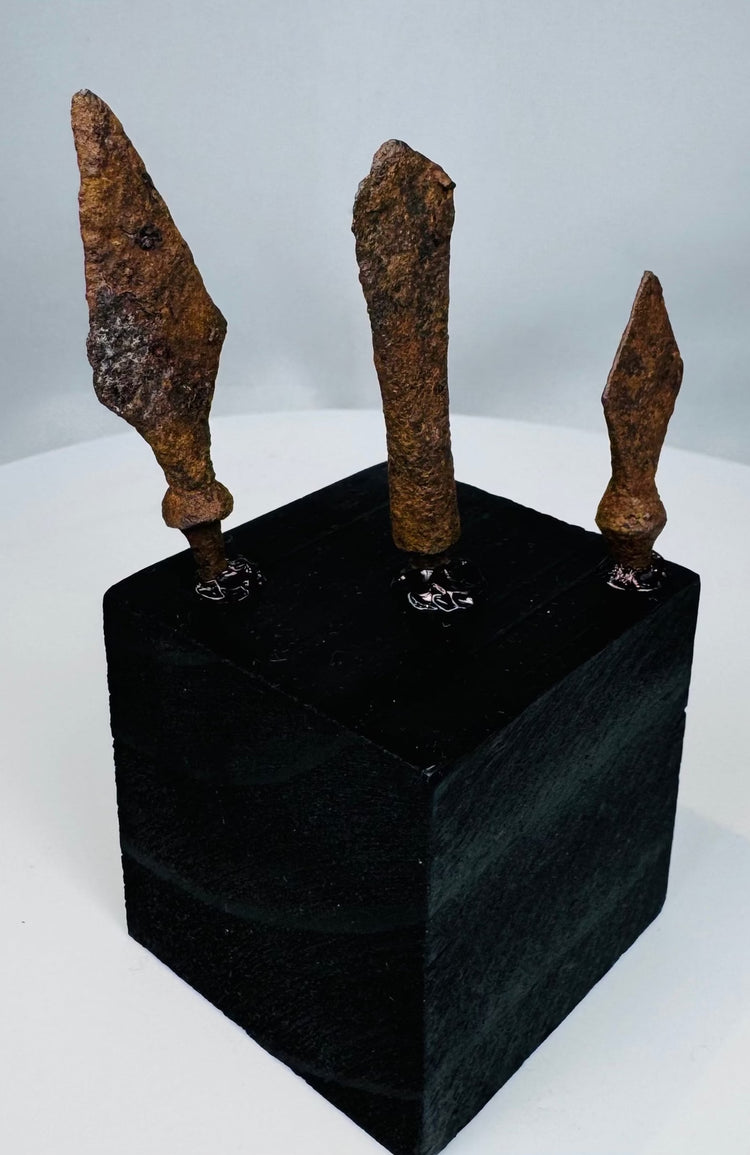
This mounted collection comprises three ancient iron projectile points displaying three distinct blade forms and proportions.
Each example was individually hand forged with an integral tang that would originally have been inserted into a prepared wooden shaft and secured with binding, adhesive, or pressure fitting.
The group includes two broader leaf-shaped or lanceolate examples of differing proportions together with one elongated narrow point. The surviving profiles range from a wide, angular blade to a more slender tapering form, illustrating the variety of projectile heads used during the Roman period for military, hunting, and defensive purposes.
Comparable tanged iron arrowheads, javelin points, and light spearheads have been recovered from Roman archaeological contexts throughout the Mediterranean and frontier provinces.
Centuries of burial and oxidation have produced richly textured surfaces with areas of brown, ochre, grey, and dark mineral accretion.
Features
- Collection of three Roman-period iron projectile points
- Two broad leaf-shaped or lanceolate forms and one elongated narrow form
- Individually hand forged from iron
- Integral tangs for attachment to wooden shafts
- Likely intended for arrows, javelins, or light spears
- Extensive mineral accretion and archaeological patination
- Mounted on a modern black wooden display block
- Likely Eastern Mediterranean origin
Cultural Significance
Projectile points such as these formed an essential component of Roman warfare, hunting, and personal defence. Iron arrowheads, javelin points, and spearheads equipped soldiers stationed throughout the empire, from Britain and Germania to Egypt and the Levant.
Variations in size, profile, and construction reflect differing military roles, regional production traditions, intended targets, and tactical requirements.
Broader leaf-shaped heads provided a wider cutting surface, while long narrow points concentrated impact into a smaller area. Differences in blade width and taper also reflect the varied functions of Roman projectile weapons.
Condition
The projectile points remain in archaeological condition with extensive oxidation, pitting, mineral encrustation, surface deposits, edge wear, and losses to the original forged profiles. The tips and edges display varying degrees of thinning, rounding, irregularity, and corrosion consistent with prolonged burial and considerable age. The iron elements have been permanently secured to a modern black wooden display base with visible mounting material.
Dimensions (Approximate)
Overall Display: 4.5 in
Age (Approximate)
1,700–1,900 years old
Provenance
Formerly offered through the German art market during the 2000s, where the group entered the modern European antiquities trade. Subsequently acquired from a European Union collector residing in London, England, who maintained a private collection of ancient and medieval artifacts. Later held in the private collection of a gentleman in Surrey, United Kingdom.
Learn More
Study a Roman-period tanged, leaf-shaped iron arrowhead preserved by the British Museum.
Browse our Collection of Ancient Roman and Greek Artifacts.
Description
Historical Context & Origin
Region: Roman Empire, likely the Eastern Mediterranean
Material: Hand-forged iron
Period: Roman Period, circa 1st–3rd Century CE
Description
This mounted collection comprises three ancient iron projectile points displaying three distinct blade forms and proportions.
Each example was individually hand forged with an integral tang that would originally have been inserted into a prepared wooden shaft and secured with binding, adhesive, or pressure fitting.
The group includes two broader leaf-shaped or lanceolate examples of differing proportions together with one elongated narrow point. The surviving profiles range from a wide, angular blade to a more slender tapering form, illustrating the variety of projectile heads used during the Roman period for military, hunting, and defensive purposes.
Comparable tanged iron arrowheads, javelin points, and light spearheads have been recovered from Roman archaeological contexts throughout the Mediterranean and frontier provinces.
Centuries of burial and oxidation have produced richly textured surfaces with areas of brown, ochre, grey, and dark mineral accretion.
Features
- Collection of three Roman-period iron projectile points
- Two broad leaf-shaped or lanceolate forms and one elongated narrow form
- Individually hand forged from iron
- Integral tangs for attachment to wooden shafts
- Likely intended for arrows, javelins, or light spears
- Extensive mineral accretion and archaeological patination
- Mounted on a modern black wooden display block
- Likely Eastern Mediterranean origin
Cultural Significance
Projectile points such as these formed an essential component of Roman warfare, hunting, and personal defence. Iron arrowheads, javelin points, and spearheads equipped soldiers stationed throughout the empire, from Britain and Germania to Egypt and the Levant.
Variations in size, profile, and construction reflect differing military roles, regional production traditions, intended targets, and tactical requirements.
Broader leaf-shaped heads provided a wider cutting surface, while long narrow points concentrated impact into a smaller area. Differences in blade width and taper also reflect the varied functions of Roman projectile weapons.
Condition
The projectile points remain in archaeological condition with extensive oxidation, pitting, mineral encrustation, surface deposits, edge wear, and losses to the original forged profiles. The tips and edges display varying degrees of thinning, rounding, irregularity, and corrosion consistent with prolonged burial and considerable age. The iron elements have been permanently secured to a modern black wooden display base with visible mounting material.
Dimensions (Approximate)
Overall Display: 4.5 in
Age (Approximate)
1,700–1,900 years old
Provenance
Formerly offered through the German art market during the 2000s, where the group entered the modern European antiquities trade. Subsequently acquired from a European Union collector residing in London, England, who maintained a private collection of ancient and medieval artifacts. Later held in the private collection of a gentleman in Surrey, United Kingdom.
Learn More
Study a Roman-period tanged, leaf-shaped iron arrowhead preserved by the British Museum.
Browse our Collection of Ancient Roman and Greek Artifacts.
You May Also Like
