

Ancient Roman–Late Antique Terracotta Juglet | Circa 2nd – 5th Century CE
Couldn't load pickup availability




Ancient Roman–Late Antique Terracotta Juglet | Circa 2nd – 5th Century CE
Description
More
Less
Historical Context & Origin
Region: Eastern Mediterranean / Roman world
Material: Wheel-made terracotta / earthenware
Period: Roman–Late Antique period, circa 2nd–5th century CE
Description
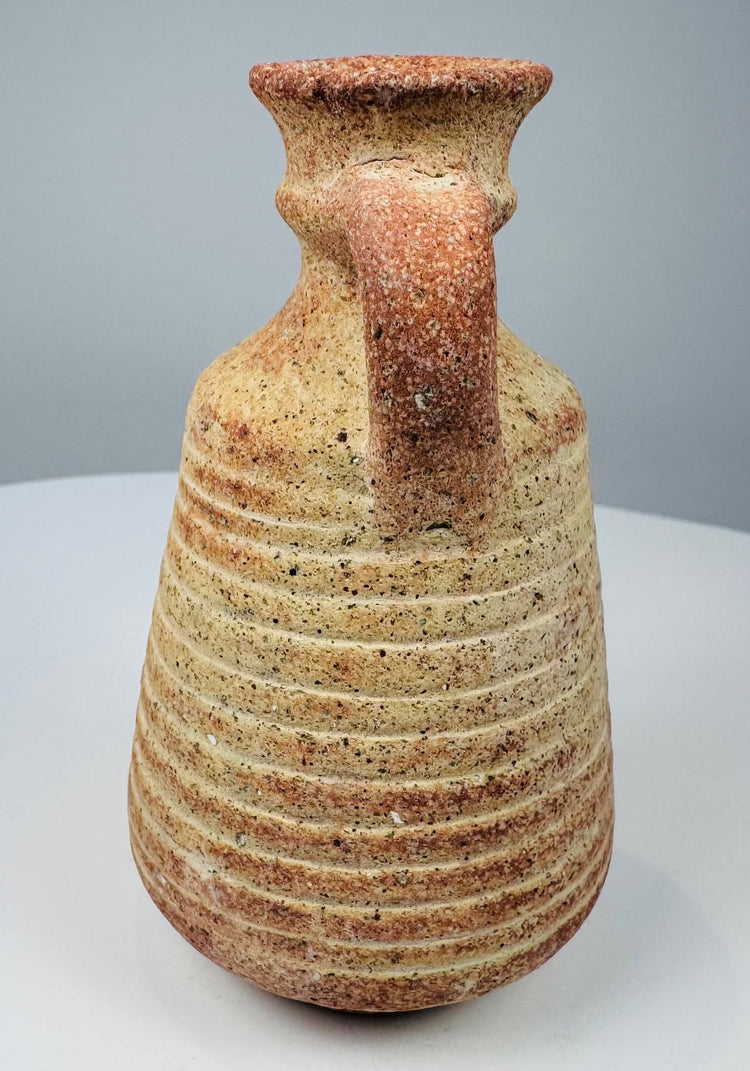
This small ancient pottery vessel is a wheel-made terracotta jug or juglet dating broadly to the Roman through Late Antique period, approximately the 2nd–5th century CE.
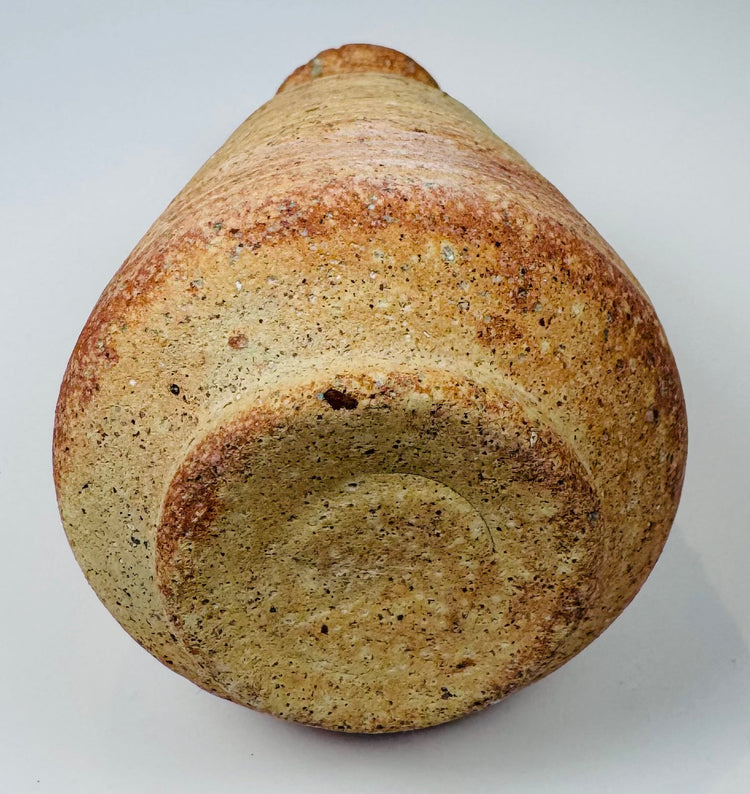
The vessel is formed with a compact, elongated body that expands gently through the shoulder before tapering toward a recessed circular base. Numerous closely spaced horizontal ridges encircle the lower body, preserving clear evidence of its manufacture on a potter’s wheel and giving the vessel a distinctive textured appearance.
Above the shoulder, the body contracts into a short neck terminating in a pronounced outward-flaring rim surrounding a relatively narrow opening. A single rounded loop handle rises from the shoulder and joins the upper neck immediately beneath the mouth, providing a practical means of holding and pouring from the vessel.
The pottery has a coarse buff to pale reddish fabric containing visible mineral inclusions. Areas of reddish coloration remain around the rim, handle, shoulder, and lower body and may represent surviving surface treatment, firing variation, or natural alteration accumulated during burial.
Small handled vessels of this general form were widely produced throughout the Roman and Late Antique Mediterranean. Wheel-made pottery formed an essential part of everyday life, with juglets serving for the storage, serving, and transport of relatively small quantities of liquids such as oil, wine, sauces, medicines, or other household substances. Roman and Late Antique archaeological collections preserve numerous variations of the basic one-handled jug form.
Features
- Ancient wheel-made terracotta construction
- Single applied loop handle
- Pronounced outward-flaring rim
- Narrow neck and rounded shoulder
- Closely spaced horizontal wheel ridges around the body
- Recessed circular base
- Coarse buff and reddish clay fabric with visible mineral inclusions
- Surviving surface deposits and age-related coloration
- Compact and substantially complete form
- Probable Roman to Late Antique Eastern Mediterranean origin
Cultural Significance
Pottery vessels were among the most common and indispensable objects of everyday life throughout the Roman world. Unlike highly decorated ceremonial ceramics, utilitarian vessels such as this were produced for practical household use and offer a particularly direct connection to ordinary life in antiquity.
The continued use of simple wheel-made jugs into the Late Antique period makes precise dating from form alone difficult. A broad Roman–Late Antique attribution is therefore more appropriate than assigning the vessel to a narrowly defined century without archaeological find context. British Museum examples demonstrate that wheel-made buff pottery jugs with flaring mouths continued into the Late Antique centuries.
Condition
The vessel is substantially complete and presents well for its age. Surface wear, mineral deposits, discoloration, firing irregularities, small abrasions, and minor edge wear are visible throughout, consistent with considerable age and burial history. The handle survives intact, as does the flared mouth and principal body profile. Horizontal wheel marks remain especially clear across the lower body.
Dimensions (Approximate)
Height: 4 in
Diameter: 2.25 in
Age (Approximate)
1,600–1,800 years old
Provenance
Formerly part of a private Brooklyn, New York, USA collection of antiquities and archaeological objects, assembled over many years with a particular interest in ancient Mediterranean material culture.
Learn More
Discover a related ancient ceramic ribbed juglet in the collection of The Metropolitan Museum of Art
Explore our Collection of Roman and Greek Artifacts
Description
Historical Context & Origin
Region: Eastern Mediterranean / Roman world
Material: Wheel-made terracotta / earthenware
Period: Roman–Late Antique period, circa 2nd–5th century CE
Description
This small ancient pottery vessel is a wheel-made terracotta jug or juglet dating broadly to the Roman through Late Antique period, approximately the 2nd–5th century CE.
The vessel is formed with a compact, elongated body that expands gently through the shoulder before tapering toward a recessed circular base. Numerous closely spaced horizontal ridges encircle the lower body, preserving clear evidence of its manufacture on a potter’s wheel and giving the vessel a distinctive textured appearance.
Above the shoulder, the body contracts into a short neck terminating in a pronounced outward-flaring rim surrounding a relatively narrow opening. A single rounded loop handle rises from the shoulder and joins the upper neck immediately beneath the mouth, providing a practical means of holding and pouring from the vessel.
The pottery has a coarse buff to pale reddish fabric containing visible mineral inclusions. Areas of reddish coloration remain around the rim, handle, shoulder, and lower body and may represent surviving surface treatment, firing variation, or natural alteration accumulated during burial.
Small handled vessels of this general form were widely produced throughout the Roman and Late Antique Mediterranean. Wheel-made pottery formed an essential part of everyday life, with juglets serving for the storage, serving, and transport of relatively small quantities of liquids such as oil, wine, sauces, medicines, or other household substances. Roman and Late Antique archaeological collections preserve numerous variations of the basic one-handled jug form.
Features
- Ancient wheel-made terracotta construction
- Single applied loop handle
- Pronounced outward-flaring rim
- Narrow neck and rounded shoulder
- Closely spaced horizontal wheel ridges around the body
- Recessed circular base
- Coarse buff and reddish clay fabric with visible mineral inclusions
- Surviving surface deposits and age-related coloration
- Compact and substantially complete form
- Probable Roman to Late Antique Eastern Mediterranean origin
Cultural Significance
Pottery vessels were among the most common and indispensable objects of everyday life throughout the Roman world. Unlike highly decorated ceremonial ceramics, utilitarian vessels such as this were produced for practical household use and offer a particularly direct connection to ordinary life in antiquity.
The continued use of simple wheel-made jugs into the Late Antique period makes precise dating from form alone difficult. A broad Roman–Late Antique attribution is therefore more appropriate than assigning the vessel to a narrowly defined century without archaeological find context. British Museum examples demonstrate that wheel-made buff pottery jugs with flaring mouths continued into the Late Antique centuries.
Condition
The vessel is substantially complete and presents well for its age. Surface wear, mineral deposits, discoloration, firing irregularities, small abrasions, and minor edge wear are visible throughout, consistent with considerable age and burial history. The handle survives intact, as does the flared mouth and principal body profile. Horizontal wheel marks remain especially clear across the lower body.
Dimensions (Approximate)
Height: 4 in
Diameter: 2.25 in
Age (Approximate)
1,600–1,800 years old
Provenance
Formerly part of a private Brooklyn, New York, USA collection of antiquities and archaeological objects, assembled over many years with a particular interest in ancient Mediterranean material culture.
Learn More
Discover a related ancient ceramic ribbed juglet in the collection of The Metropolitan Museum of Art
Explore our Collection of Roman and Greek Artifacts
You May Also Like
