



Ancient Sasanian Terracotta Bowl | Ancient Persia | Detailed Provenance | Circa 3rd–7th Century CE
Couldn't load pickup availability




Ancient Sasanian Terracotta Bowl | Ancient Persia | Detailed Provenance | Circa 3rd–7th Century CE
Description
More
Less
Historical Context & Origin
Region: Sasanian Empire, Ancient Persia
Material: Coarse terracotta
Period: Sasanian Period, circa 3rd–7th Century CE
Description
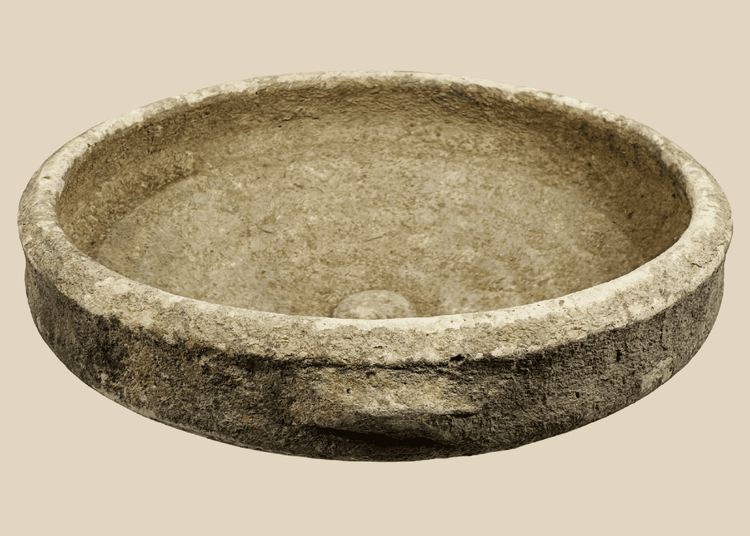
This ancient Sasanian terracotta bowl dates to approximately the 3rd–7th century CE and represents the utilitarian ceramic traditions of the Sasanian world.
The vessel has a broad, shallow form with steep walls and a substantial thickened rim. A small horizontal lug projects from one side, while the interior features a distinctive slightly raised central boss.
Made from coarse terracotta, the bowl retains extensive surface weathering and mineral deposits consistent with considerable age and archaeological preservation. Its simple, robust construction reflects the practical ceramic forms produced during the Sasanian period.
Features
- Broad shallow vessel form
- Thickened rim
- Steep-sided walls
- Small horizontal side lug
- Slightly raised central boss to the interior
- Coarse terracotta construction
- Archaeological mineral deposits and surface weathering
- No major restoration observed
Cultural Significance
The Sasanian Empire was one of the major powers of Late Antiquity, ruling much of ancient Persia and surrounding regions from the 3rd through 7th centuries CE.
Alongside the empire's celebrated metalwork, architecture, and luxury arts, ceramic vessels formed an essential part of everyday material culture. Plain terracotta bowls such as this provide insight into the practical pottery traditions used by communities throughout the Sasanian world.
The vessel's broad form, heavy rim, side lug, and raised interior boss support its attribution to the Sasanian period.
Condition
Good ancient condition with extensive surface weathering, mineral deposits, abrasions, and minor losses consistent with age. The thickened rim, side lug, and raised central boss remain clearly identifiable.
Dimensions (Approximate)
Height: 2.25 in
Diameter: 7 in
Age (Approximate)
1,300–1,700 years old
Provenance
Purchased in Tunisia in 1982 and subsequently retained in the McMillan Collection, Minnesota, USA, for over four decades.
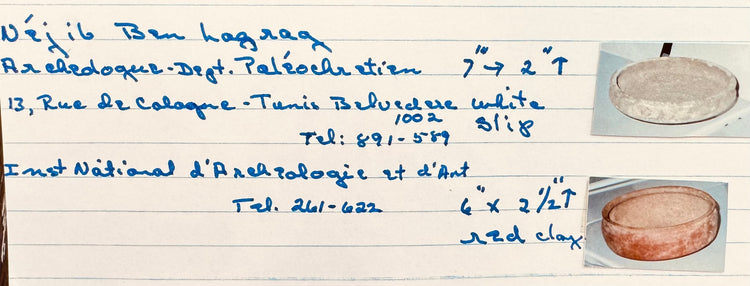
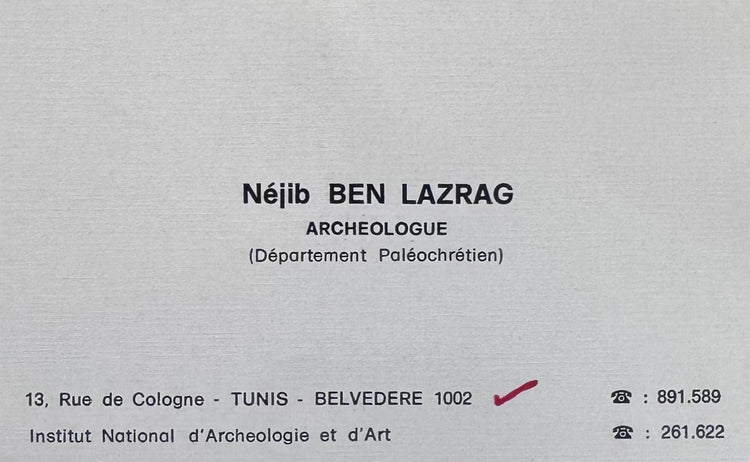
The vessel was acquired from archaeologist Néjib Ben Lazrag, formerly associated with the Institut National d'Archéologie et d'Art in Tunis. Accompanying collection records identify the object and there is a period photograph documenting the bowl.
Additional accompanying documentation includes the original archaeologist's business card, handwritten collection inventory records, and period collection photographs showing the vessel as it appeared in the collection during the early 1980s.
The McMillan Collection was assembled over several decades and contained an extensive range of antiquities acquired directly from dealers, archaeologists, galleries, and antique sources throughout Europe, North Africa, the Near East, and the Mediterranean.
The piece was later examined by Luca Salvaggio, an Italian archaeologist and specialist in ancient Mediterranean and Near Eastern material. He holds a Postgraduate Diploma from the Italian Archaeological School at Athens (IASA) and is accredited for preventive archaeology by the Italian Ministry of Culture (MiC). Salvaggio identified the vessel as a Sasanian terracotta bowl dating to circa the 3rd–7th century CE, based on its broad shallow form, thickened rim, steep walls, small horizontal side lug, raised central interior boss, and coarse terracotta construction.
Learn More
Discover the history of Roman North Africa and its importance within the Roman Empire.
Browse Our Collection of Ancient Ceramics & Pottery
Description
Historical Context & Origin
Region: Sasanian Empire, Ancient Persia
Material: Coarse terracotta
Period: Sasanian Period, circa 3rd–7th Century CE
Description
This ancient Sasanian terracotta bowl dates to approximately the 3rd–7th century CE and represents the utilitarian ceramic traditions of the Sasanian world.
The vessel has a broad, shallow form with steep walls and a substantial thickened rim. A small horizontal lug projects from one side, while the interior features a distinctive slightly raised central boss.
Made from coarse terracotta, the bowl retains extensive surface weathering and mineral deposits consistent with considerable age and archaeological preservation. Its simple, robust construction reflects the practical ceramic forms produced during the Sasanian period.
Features
- Broad shallow vessel form
- Thickened rim
- Steep-sided walls
- Small horizontal side lug
- Slightly raised central boss to the interior
- Coarse terracotta construction
- Archaeological mineral deposits and surface weathering
- No major restoration observed
Cultural Significance
The Sasanian Empire was one of the major powers of Late Antiquity, ruling much of ancient Persia and surrounding regions from the 3rd through 7th centuries CE.
Alongside the empire's celebrated metalwork, architecture, and luxury arts, ceramic vessels formed an essential part of everyday material culture. Plain terracotta bowls such as this provide insight into the practical pottery traditions used by communities throughout the Sasanian world.
The vessel's broad form, heavy rim, side lug, and raised interior boss support its attribution to the Sasanian period.
Condition
Good ancient condition with extensive surface weathering, mineral deposits, abrasions, and minor losses consistent with age. The thickened rim, side lug, and raised central boss remain clearly identifiable.
Dimensions (Approximate)
Height: 2.25 in
Diameter: 7 in
Age (Approximate)
1,300–1,700 years old
Provenance
Purchased in Tunisia in 1982 and subsequently retained in the McMillan Collection, Minnesota, USA, for over four decades.
The vessel was acquired from archaeologist Néjib Ben Lazrag, formerly associated with the Institut National d'Archéologie et d'Art in Tunis. Accompanying collection records identify the object and there is a period photograph documenting the bowl.
Additional accompanying documentation includes the original archaeologist's business card, handwritten collection inventory records, and period collection photographs showing the vessel as it appeared in the collection during the early 1980s.
The McMillan Collection was assembled over several decades and contained an extensive range of antiquities acquired directly from dealers, archaeologists, galleries, and antique sources throughout Europe, North Africa, the Near East, and the Mediterranean.
The piece was later examined by Luca Salvaggio, an Italian archaeologist and specialist in ancient Mediterranean and Near Eastern material. He holds a Postgraduate Diploma from the Italian Archaeological School at Athens (IASA) and is accredited for preventive archaeology by the Italian Ministry of Culture (MiC). Salvaggio identified the vessel as a Sasanian terracotta bowl dating to circa the 3rd–7th century CE, based on its broad shallow form, thickened rim, steep walls, small horizontal side lug, raised central interior boss, and coarse terracotta construction.
Learn More
Discover the history of Roman North Africa and its importance within the Roman Empire.
Browse Our Collection of Ancient Ceramics & Pottery
You May Also Like
