


Ancient Terracotta Architectural or Effigy Fragment | Stylized Face | Culture Undetermined | Circa 200 BCE – 900 CE
Couldn't load pickup availability




Ancient Terracotta Architectural or Effigy Fragment | Stylized Face | Culture Undetermined | Circa 200 BCE – 900 CE
Description
More
Less
Historical Context & Origin
Region: Possibly Mesoamerica or the Ancient Americas
Material: Terracotta with traces of pigment
Period: Circa 200 BCE – 900 CE (attribution uncertain)
Description
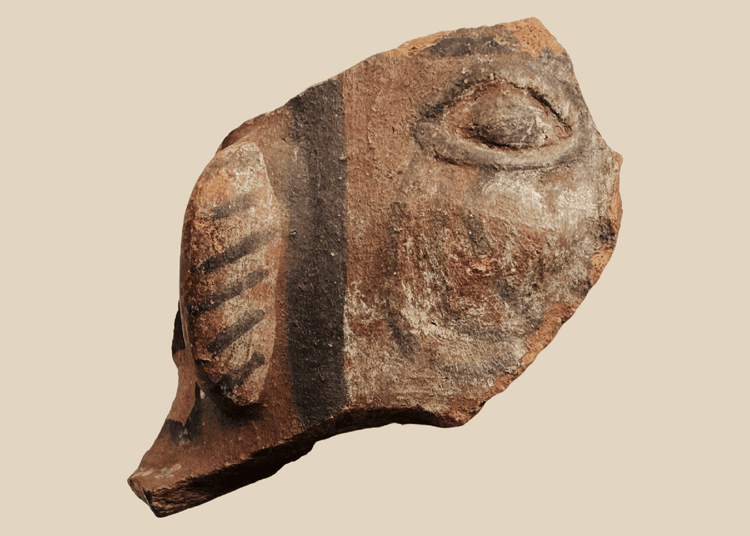
This ancient terracotta figural fragment preserves a portion of a stylized face featuring a prominent almond-shaped eye, pronounced cheek, and a large circular ear ornament decorated with painted linear motifs. The fragment was originally part of a larger sculptural composition, architectural element, ceremonial vessel, or effigy figure.
The surviving ear ornament displays traces of black painted decoration against a reddish terracotta surface, while areas of darker pigment remain visible across the facial plane. Such painted embellishments were commonly employed throughout numerous ancient cultures to enhance the visual impact of ceramic figures and ceremonial objects.
Although the precise cultural origin remains uncertain, the fragment exhibits characteristics associated with ancient figural ceramic traditions, including stylized anatomical features, bold geometric forms, and applied ornamentation. The substantial size of the preserved section suggests it once formed part of a larger and visually impressive object.
The reverse retains historic collection markings applied by a previous owner or collector, providing evidence of its long-term presence within private collections. Mounted on a custom display stand, the fragment presents as an intriguing example of ancient ceramic artistry and craftsmanship.
Features
- Ancient terracotta figural fragment
- Stylized almond-shaped eye rendered in relief
- Large applied ear ornament with painted decoration
- Traces of original black and red pigment
- Originally part of a larger sculptural or ceremonial object
- Historic collection markings present on the reverse
- Mounted on a custom display stand
Cultural Significance
Large ceramic figures and architectural embellishments served important ceremonial, decorative, and symbolic functions throughout the ancient world. Fragments such as this provide valuable insight into ancient artistic practices, preserving evidence of sculptural techniques, pigment application, and the visual language employed by past cultures to represent human or supernatural forms.
Condition
Fragmentary condition as shown. Preserves a portion of a larger ceramic object with age-related surface wear, losses, pigment loss, mineral deposits, and weathering consistent with antiquity. Historic collection markings visible on the reverse. Mounted on a modern custom display stand for presentation.
Dimensions (Approximate)
Height: 5 in
Width: 3 in
Depth: 2.25 in
Age (Approximate)
1,100–2,200 years old
Provenance
From a private collection in Saint Paul, Minnesota, USA. Subsequently held in a private Midwestern collection before acquisition by the current owner. Retaining historic collection markings on the reverse.
Learn More
Discover the history and craftsmanship of ancient terracotta sculpture through the University of Michigan Kelsey Museum of Archaeology
Explore Our Collection of Ancient Ceramics & Pottery
Description
Historical Context & Origin
Region: Possibly Mesoamerica or the Ancient Americas
Material: Terracotta with traces of pigment
Period: Circa 200 BCE – 900 CE (attribution uncertain)
Description
This ancient terracotta figural fragment preserves a portion of a stylized face featuring a prominent almond-shaped eye, pronounced cheek, and a large circular ear ornament decorated with painted linear motifs. The fragment was originally part of a larger sculptural composition, architectural element, ceremonial vessel, or effigy figure.
The surviving ear ornament displays traces of black painted decoration against a reddish terracotta surface, while areas of darker pigment remain visible across the facial plane. Such painted embellishments were commonly employed throughout numerous ancient cultures to enhance the visual impact of ceramic figures and ceremonial objects.
Although the precise cultural origin remains uncertain, the fragment exhibits characteristics associated with ancient figural ceramic traditions, including stylized anatomical features, bold geometric forms, and applied ornamentation. The substantial size of the preserved section suggests it once formed part of a larger and visually impressive object.
The reverse retains historic collection markings applied by a previous owner or collector, providing evidence of its long-term presence within private collections. Mounted on a custom display stand, the fragment presents as an intriguing example of ancient ceramic artistry and craftsmanship.
Features
- Ancient terracotta figural fragment
- Stylized almond-shaped eye rendered in relief
- Large applied ear ornament with painted decoration
- Traces of original black and red pigment
- Originally part of a larger sculptural or ceremonial object
- Historic collection markings present on the reverse
- Mounted on a custom display stand
Cultural Significance
Large ceramic figures and architectural embellishments served important ceremonial, decorative, and symbolic functions throughout the ancient world. Fragments such as this provide valuable insight into ancient artistic practices, preserving evidence of sculptural techniques, pigment application, and the visual language employed by past cultures to represent human or supernatural forms.
Condition
Fragmentary condition as shown. Preserves a portion of a larger ceramic object with age-related surface wear, losses, pigment loss, mineral deposits, and weathering consistent with antiquity. Historic collection markings visible on the reverse. Mounted on a modern custom display stand for presentation.
Dimensions (Approximate)
Height: 5 in
Width: 3 in
Depth: 2.25 in
Age (Approximate)
1,100–2,200 years old
Provenance
From a private collection in Saint Paul, Minnesota, USA. Subsequently held in a private Midwestern collection before acquisition by the current owner. Retaining historic collection markings on the reverse.
Learn More
Discover the history and craftsmanship of ancient terracotta sculpture through the University of Michigan Kelsey Museum of Archaeology
Explore Our Collection of Ancient Ceramics & Pottery
You May Also Like
