

Antique Bentinck Family Carved Oak Heraldic Pediment | Craignez Honte | Circa 18th – 19th Century
Couldn't load pickup availability




Antique Bentinck Family Carved Oak Heraldic Pediment | Craignez Honte | Circa 18th – 19th Century
Description
More
Less
Historical Context & Origin
Region: Western Europe, likely England; associated with the Bentinck family and the Portland peerage
Material: Hand-carved oak with a dark stained surface
Period: 18th–19th century, circa 1700–1900
Description
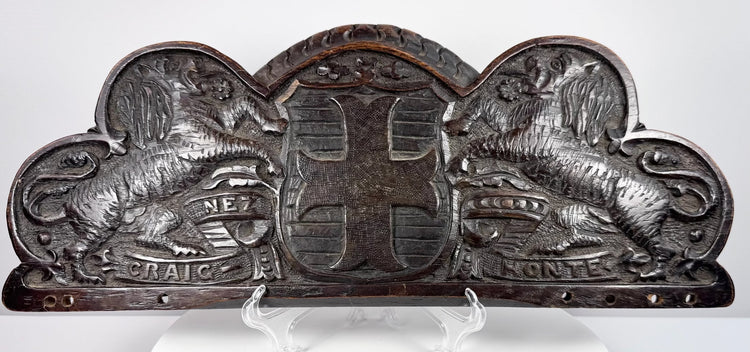
This impressive antique heraldic pediment or furniture cresting was hand-carved from solid oak and likely once formed the decorative crown of a cabinet, bookcase, overdoor, mantel, or section of interior woodwork. Its elongated architectural form, deeply carved surface, and row of old mounting holes along the lower edge confirm that it was originally created as an applied ornamental element.
The centre is dominated by a shield bearing a cross moline, recognizable by its split and curving terminals resembling the iron millrind of a traditional millstone. Horizontal hatching fills the surrounding field, the conventional heraldic indication for azure or blue, while the cross remains unhatched to represent argent or silver. This corresponds with the historic Bentinck arms: Azure, a cross moline Argent.
The shield is flanked by two stylized double-queued lions, corresponding with the heraldic supporters associated with the Bentinck family and the Earls and Dukes of Portland. The carver adapted the animals to the elongated proportions of the pediment, arranging them in confronting poses with expressive faces, textured manes, extended limbs, and scrolling paired tails.
Across the lower portion are carved scrolls bearing the French motto CRAIGNEZ HONTE. Literally translated as Fear shame and more conventionally rendered as Fear dishonour or Dread dishonour, the motto has long been associated with the Bentinck family. The family originated in the Netherlands, while its prominent British branch rose to the English peerage when William Bentinck was created Earl of Portland in 1689. The dukedom of Portland was subsequently created for his son Henry Bentinck in 1716.
The French inscription does not indicate that the pediment was necessarily made in France. French and Anglo-Norman language remained deeply embedded in British and European heraldic traditions, and French mottos were frequently adopted by prominent British families.
The dark surface retains a rich, time-developed patina with warm wear visible along the raised details and outer edges. Now separated from its original architectural or furniture setting, the pediment displays beautifully as a freestanding or wall-mounted example of historic heraldic carving.
Features
- Hand-carved from a substantial piece of solid oak
- Central shield bearing the historic Bentinck cross moline
- Horizontal heraldic hatching representing an azure or blue field
- Flanked by two stylized double-queued heraldic lions
- Inscribed with the French motto CRAIGNEZ HONTE
- Motto conventionally translated as Fear dishonour or Dread dishonour
- Old mounting holes confirming its original use as an applied architectural or furniture ornament
- Rich dark surface with naturally developed patina and wear
- Associated with the heraldic tradition of the Bentinck family and the Portland peerage
Cultural Significance
Armorial pediments were displayed on furniture, overdoors, mantels, wall panelling, and other prominent interior features to communicate family identity, ancestry, social standing, and inherited authority. Rather than serving as simple decoration, these carvings transformed a family’s heraldic emblems into permanent architectural statements.
The cross moline, paired lions, and motto Craignez Honte connect this carving with the Bentinck family, an influential European noble house with Dutch, British, and German branches. Members of the family served as diplomats, military officers, politicians, and statesmen, while the British branch held the Earldom and Dukedom of Portland. The pediment survives as a tangible expression of the heraldic culture that once shaped aristocratic residences and decorative arts throughout Europe.
Condition
Well preserved with a rich dark patina and surface wear consistent with age and previous architectural or furniture use. Age-related scratches, rubbed edges, small chips or losses, and areas of lighter exposed wood are present. Several old mounting holes remain along the lower edge, documenting its original installation.
Dimensions (Approximate)
Width: 17.5 in
Height: 7 in
Depth: 1.25 in
Age (Approximate)
125–325 years old
Provenance
Formerly in a private collection in Chevy Chase, Maryland, USA, specializing in Asian art and related religious objects.
Subsequently handled by Sloans & Kenyon Auctioneers and Appraisers, a longstanding Maryland auction house serving the greater Washington, D.C., region. Tracing its history to Sloan & Co., established in 1853, the firm conducts professionally catalogued auctions featuring fine art, antiques, and historical collectibles.
Lastly acquired by a private collection in Toronto, Ontario, Canada.
Learn More
Learn more about the Bentinck coats of arms and the motto Craignez Honte through Virtus: Journal of Nobility Studies
Explore more historic carvings in our Collection of Statues, Figures & Carvings
Description
Historical Context & Origin
Region: Western Europe, likely England; associated with the Bentinck family and the Portland peerage
Material: Hand-carved oak with a dark stained surface
Period: 18th–19th century, circa 1700–1900
Description
This impressive antique heraldic pediment or furniture cresting was hand-carved from solid oak and likely once formed the decorative crown of a cabinet, bookcase, overdoor, mantel, or section of interior woodwork. Its elongated architectural form, deeply carved surface, and row of old mounting holes along the lower edge confirm that it was originally created as an applied ornamental element.
The centre is dominated by a shield bearing a cross moline, recognizable by its split and curving terminals resembling the iron millrind of a traditional millstone. Horizontal hatching fills the surrounding field, the conventional heraldic indication for azure or blue, while the cross remains unhatched to represent argent or silver. This corresponds with the historic Bentinck arms: Azure, a cross moline Argent.
The shield is flanked by two stylized double-queued lions, corresponding with the heraldic supporters associated with the Bentinck family and the Earls and Dukes of Portland. The carver adapted the animals to the elongated proportions of the pediment, arranging them in confronting poses with expressive faces, textured manes, extended limbs, and scrolling paired tails.
Across the lower portion are carved scrolls bearing the French motto CRAIGNEZ HONTE. Literally translated as Fear shame and more conventionally rendered as Fear dishonour or Dread dishonour, the motto has long been associated with the Bentinck family. The family originated in the Netherlands, while its prominent British branch rose to the English peerage when William Bentinck was created Earl of Portland in 1689. The dukedom of Portland was subsequently created for his son Henry Bentinck in 1716.
The French inscription does not indicate that the pediment was necessarily made in France. French and Anglo-Norman language remained deeply embedded in British and European heraldic traditions, and French mottos were frequently adopted by prominent British families.
The dark surface retains a rich, time-developed patina with warm wear visible along the raised details and outer edges. Now separated from its original architectural or furniture setting, the pediment displays beautifully as a freestanding or wall-mounted example of historic heraldic carving.
Features
- Hand-carved from a substantial piece of solid oak
- Central shield bearing the historic Bentinck cross moline
- Horizontal heraldic hatching representing an azure or blue field
- Flanked by two stylized double-queued heraldic lions
- Inscribed with the French motto CRAIGNEZ HONTE
- Motto conventionally translated as Fear dishonour or Dread dishonour
- Old mounting holes confirming its original use as an applied architectural or furniture ornament
- Rich dark surface with naturally developed patina and wear
- Associated with the heraldic tradition of the Bentinck family and the Portland peerage
Cultural Significance
Armorial pediments were displayed on furniture, overdoors, mantels, wall panelling, and other prominent interior features to communicate family identity, ancestry, social standing, and inherited authority. Rather than serving as simple decoration, these carvings transformed a family’s heraldic emblems into permanent architectural statements.
The cross moline, paired lions, and motto Craignez Honte connect this carving with the Bentinck family, an influential European noble house with Dutch, British, and German branches. Members of the family served as diplomats, military officers, politicians, and statesmen, while the British branch held the Earldom and Dukedom of Portland. The pediment survives as a tangible expression of the heraldic culture that once shaped aristocratic residences and decorative arts throughout Europe.
Condition
Well preserved with a rich dark patina and surface wear consistent with age and previous architectural or furniture use. Age-related scratches, rubbed edges, small chips or losses, and areas of lighter exposed wood are present. Several old mounting holes remain along the lower edge, documenting its original installation.
Dimensions (Approximate)
Width: 17.5 in
Height: 7 in
Depth: 1.25 in
Age (Approximate)
125–325 years old
Provenance
Formerly in a private collection in Chevy Chase, Maryland, USA, specializing in Asian art and related religious objects.
Subsequently handled by Sloans & Kenyon Auctioneers and Appraisers, a longstanding Maryland auction house serving the greater Washington, D.C., region. Tracing its history to Sloan & Co., established in 1853, the firm conducts professionally catalogued auctions featuring fine art, antiques, and historical collectibles.
Lastly acquired by a private collection in Toronto, Ontario, Canada.
Learn More
Learn more about the Bentinck coats of arms and the motto Craignez Honte through Virtus: Journal of Nobility Studies
Explore more historic carvings in our Collection of Statues, Figures & Carvings
You May Also Like
