

Antique Chinese Forged Iron Stirrups | Qing Dynasty Equestrian Pair | Circa 18th–19th Century
Couldn't load pickup availability





Antique Chinese Forged Iron Stirrups | Qing Dynasty Equestrian Pair | Circa 18th–19th Century
Description
More
Less
Historical Context & Origin
Region: China
Material: Hand-forged iron
Period: Qing Dynasty or earlier, likely 18th–early 19th century CE
Description
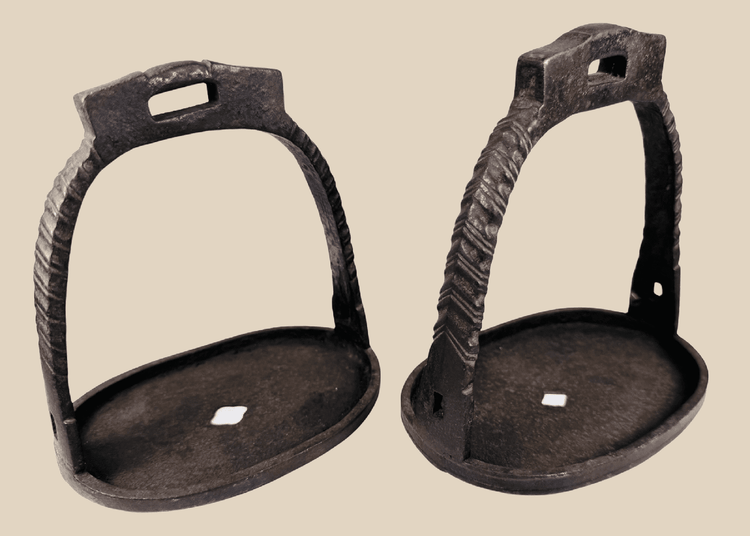
This impressive pair of hand-forged iron stirrups represents a traditional form of Chinese equestrian equipment dating to the Qing Dynasty or earlier. Crafted entirely from iron and displaying a deep, naturally developed patina, the stirrups exhibit the robust construction and understated elegance characteristic of Chinese military and riding accoutrements of the late imperial period.
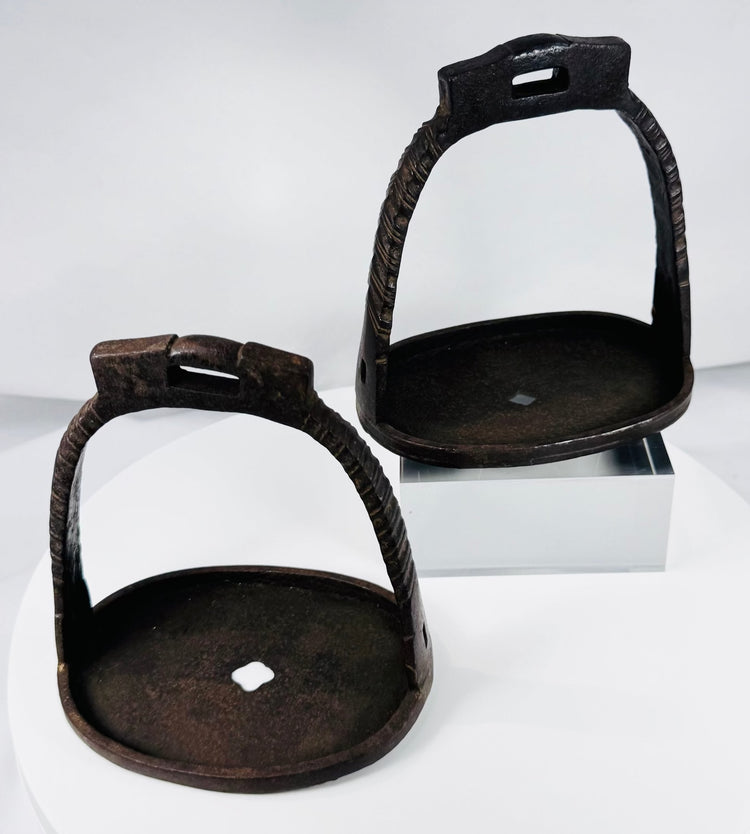
Each stirrup is formed with a broad oval tread plate pierced by a central drainage aperture and surmounted by a rectangular suspension loop designed to accommodate a leather stirrup strap. The gracefully arched sides are embellished with chiseled and incised decoration, including twisted and rope-like motifs executed directly into the iron, demonstrating the skill of the blacksmith responsible for their manufacture.
Unlike many Western stirrups of the same period, Chinese examples often featured broad footplates intended to provide greater stability and comfort during prolonged riding. Such stirrups were employed by military cavalrymen, mounted officials, merchants, and travelers throughout imperial China, where horsemanship remained essential to transportation, trade, and warfare.
Features
- Likely Qing Dynasty or earlier
- Hand-forged iron construction
- Broad oval tread plates with central pierced openings
- Rectangular suspension loops for leather straps
- Chiseled and incised decorative motifs
- Deep, naturally aged patina throughout
- Traditional equestrian equipment associated with imperial China
- Retains matching form and construction
Cultural Significance
Horsemanship occupied an important role throughout Chinese history, particularly under the Qing Dynasty, whose ruling Manchu elite maintained strong equestrian traditions. Stirrups such as these formed an essential component of military saddlery and civilian riding equipment, facilitating mounted combat, communication, and travel across vast regions of the empire.
Chinese stirrups evolved distinct regional forms that balanced practicality with decorative refinement. Hand-forged examples of this type embody centuries of metallurgical knowledge and remain tangible reminders of the central role horses played in imperial administration, commerce, and warfare.
Condition
The stirrups remain structurally sound and retain an attractive aged surface throughout. Expected wear, oxidation, pitting, and areas of surface irregularity are present, consistent with age and long-term use. The decorative chiseled details remain visible, while the iron surfaces display a rich, dark patina developed over many years.
Dimensions (Approximate)
Height: 6 in
Age (Approximate)
175–275 years old
Provenance
Formerly part of a private Cheyenne, Wyoming, USA collection specializing in antique arms, armour, equestrian equipment, and historical militaria. The collection was assembled over many years and included an extensive range of firearms, edged weapons, saddlery, and martial artifacts spanning numerous cultures and historical periods.
Learn More
View a comparable nineteenth-century pair of Chinese or Korean stirrups in the collection of The Metropolitan Museum of Art
Browse our curated Collection of Ancient Chinese Antiquities
Description
Historical Context & Origin
Region: China
Material: Hand-forged iron
Period: Qing Dynasty or earlier, likely 18th–early 19th century CE
Description
This impressive pair of hand-forged iron stirrups represents a traditional form of Chinese equestrian equipment dating to the Qing Dynasty or earlier. Crafted entirely from iron and displaying a deep, naturally developed patina, the stirrups exhibit the robust construction and understated elegance characteristic of Chinese military and riding accoutrements of the late imperial period.
Each stirrup is formed with a broad oval tread plate pierced by a central drainage aperture and surmounted by a rectangular suspension loop designed to accommodate a leather stirrup strap. The gracefully arched sides are embellished with chiseled and incised decoration, including twisted and rope-like motifs executed directly into the iron, demonstrating the skill of the blacksmith responsible for their manufacture.
Unlike many Western stirrups of the same period, Chinese examples often featured broad footplates intended to provide greater stability and comfort during prolonged riding. Such stirrups were employed by military cavalrymen, mounted officials, merchants, and travelers throughout imperial China, where horsemanship remained essential to transportation, trade, and warfare.
Features
- Likely Qing Dynasty or earlier
- Hand-forged iron construction
- Broad oval tread plates with central pierced openings
- Rectangular suspension loops for leather straps
- Chiseled and incised decorative motifs
- Deep, naturally aged patina throughout
- Traditional equestrian equipment associated with imperial China
- Retains matching form and construction
Cultural Significance
Horsemanship occupied an important role throughout Chinese history, particularly under the Qing Dynasty, whose ruling Manchu elite maintained strong equestrian traditions. Stirrups such as these formed an essential component of military saddlery and civilian riding equipment, facilitating mounted combat, communication, and travel across vast regions of the empire.
Chinese stirrups evolved distinct regional forms that balanced practicality with decorative refinement. Hand-forged examples of this type embody centuries of metallurgical knowledge and remain tangible reminders of the central role horses played in imperial administration, commerce, and warfare.
Condition
The stirrups remain structurally sound and retain an attractive aged surface throughout. Expected wear, oxidation, pitting, and areas of surface irregularity are present, consistent with age and long-term use. The decorative chiseled details remain visible, while the iron surfaces display a rich, dark patina developed over many years.
Dimensions (Approximate)
Height: 6 in
Age (Approximate)
175–275 years old
Provenance
Formerly part of a private Cheyenne, Wyoming, USA collection specializing in antique arms, armour, equestrian equipment, and historical militaria. The collection was assembled over many years and included an extensive range of firearms, edged weapons, saddlery, and martial artifacts spanning numerous cultures and historical periods.
Learn More
View a comparable nineteenth-century pair of Chinese or Korean stirrups in the collection of The Metropolitan Museum of Art
Browse our curated Collection of Ancient Chinese Antiquities
You May Also Like
