



Antique Delft Blue & White Tile | Depicting Mounted Cavalry Figure with Raised Sword | Circa Late 17th – Early 18th Century
Couldn't load pickup availability


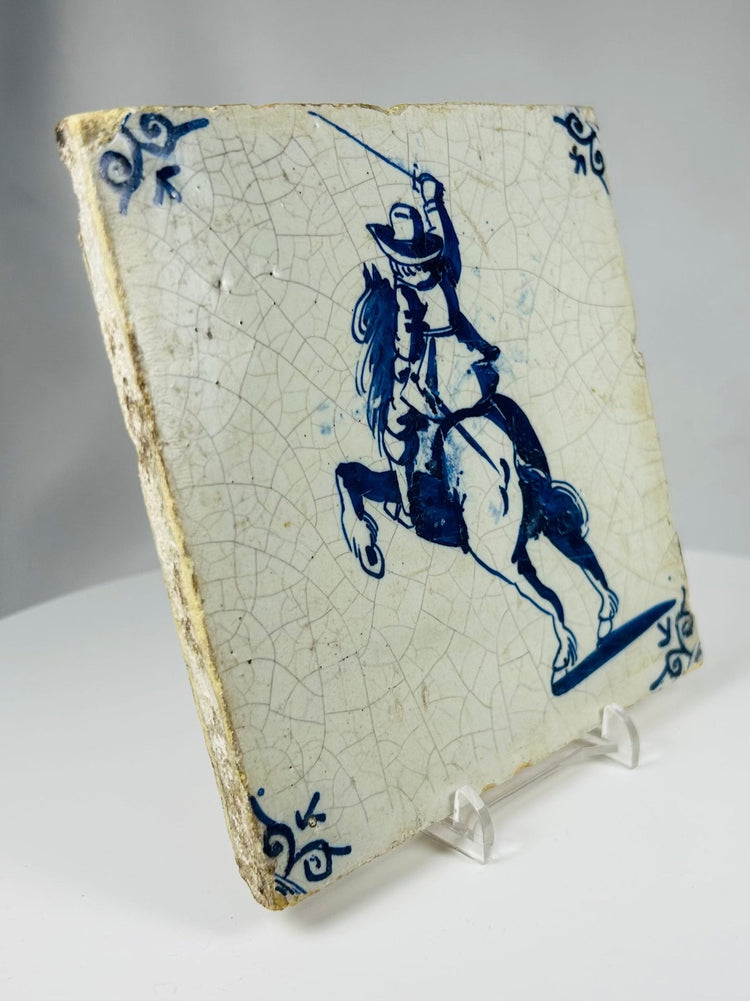
Antique Delft Blue & White Tile | Depicting Mounted Cavalry Figure with Raised Sword | Circa Late 17th – Early 18th Century
Description
More
Less
Historical Context & Origin
Region: Netherlands (Delft)
Material: Tin-glazed ceramic (Delftware)
Period: Late 17th – Early 18th Century
Description
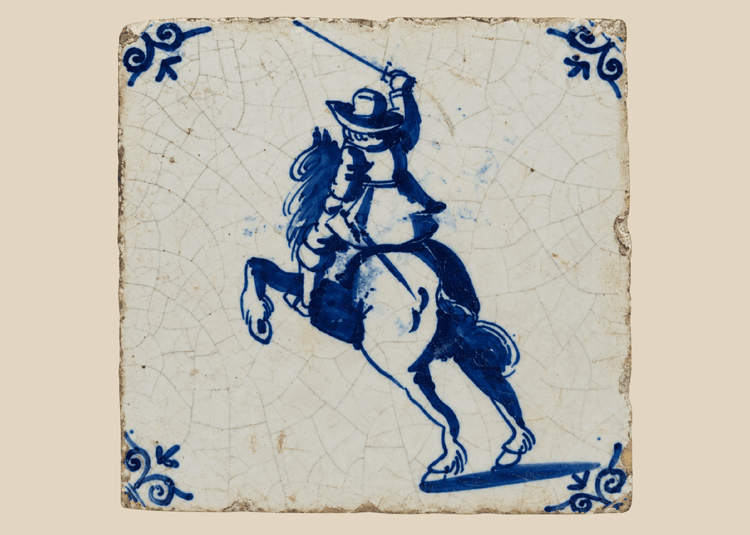
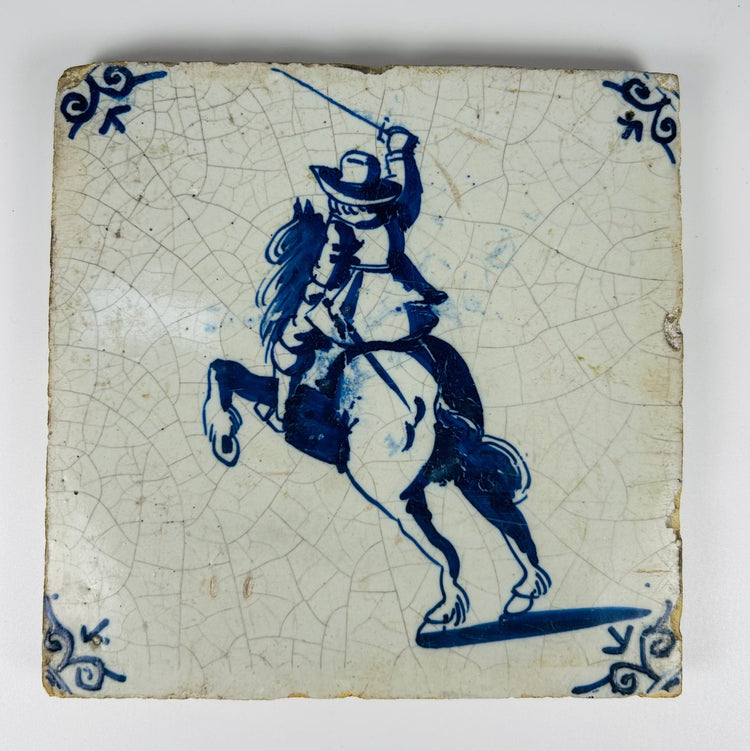
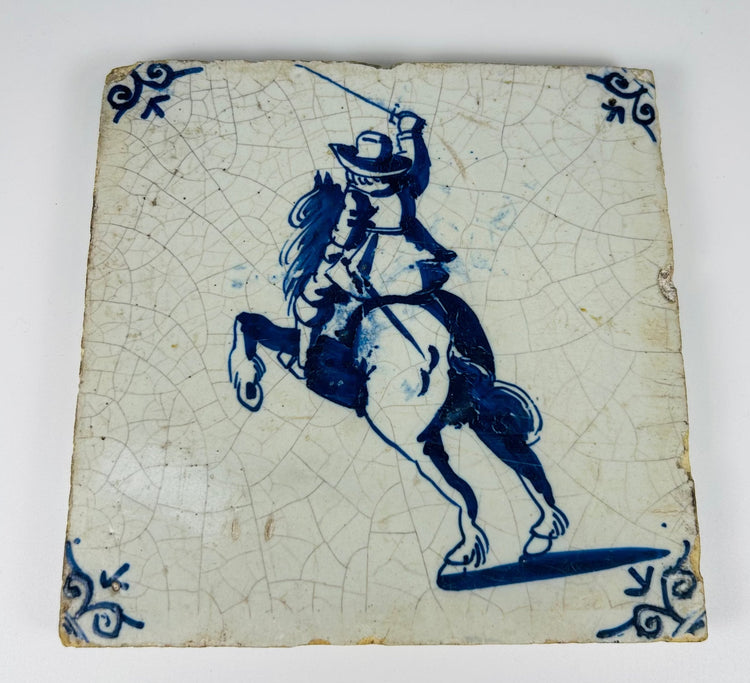
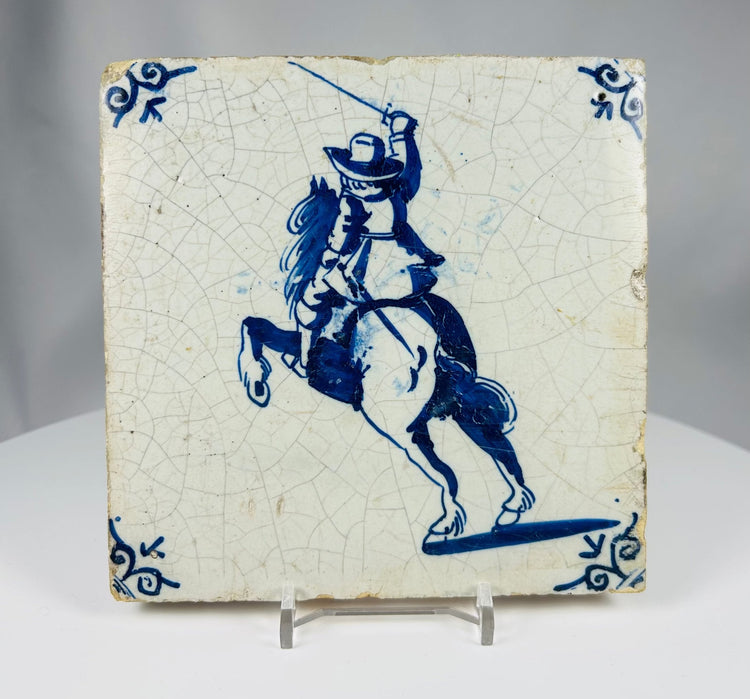
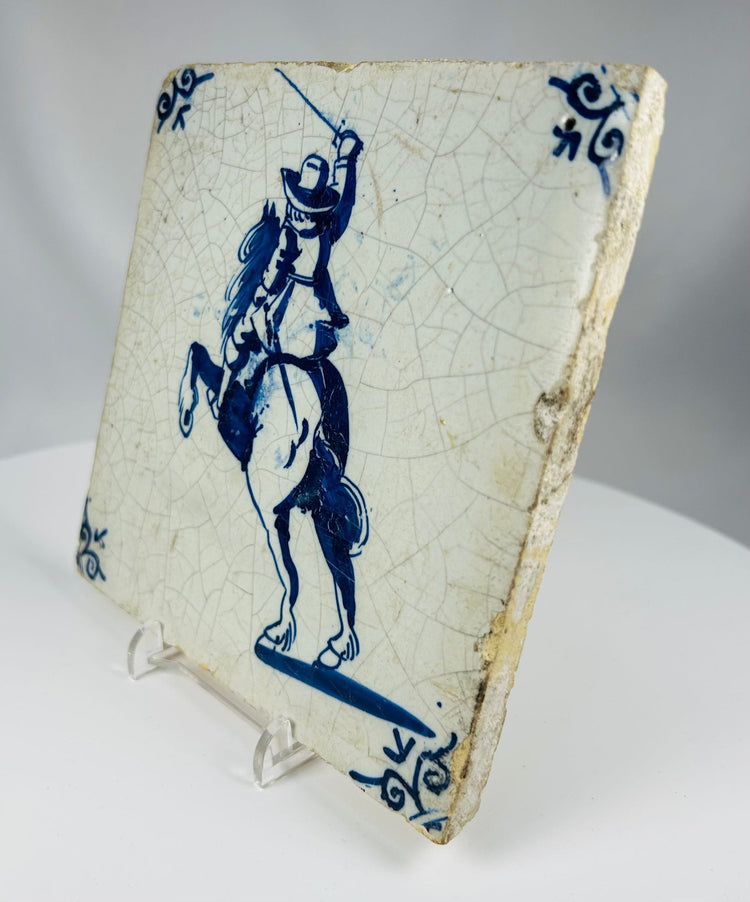
This striking antique Dutch Delft tile depicts a mounted rider raising a sword while his horse rears dramatically beneath him. The scene is rendered in deep cobalt blue against a pale tin-glazed ground, capturing a strong sense of movement through expressive brushwork and bold contrast.
The composition is characteristic of Dutch Delft tiles produced during the late 17th and early 18th centuries, when tile painters frequently drew inspiration from contemporary engravings and popular imagery depicting soldiers, cavalrymen, animals, ships, and scenes of everyday life. The rider’s raised sword and the animated pose of the horse give the composition an especially dynamic character.
Traditional cobalt corner ornaments frame the central image, while the glazed surface displays an extensive natural network of fine craquelure consistent with considerable age. Minor edge losses and surface wear further reflect the tile’s long history of use.
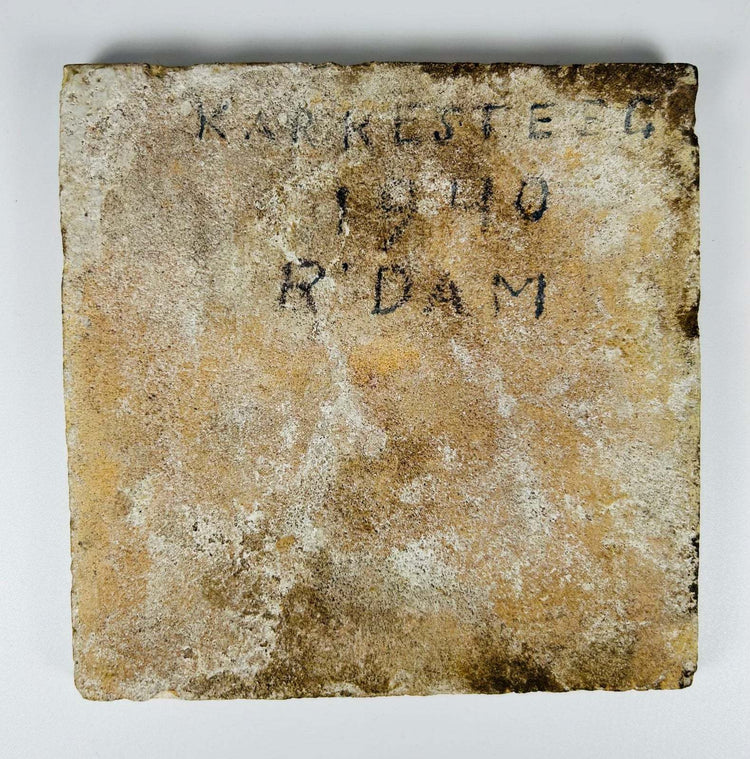
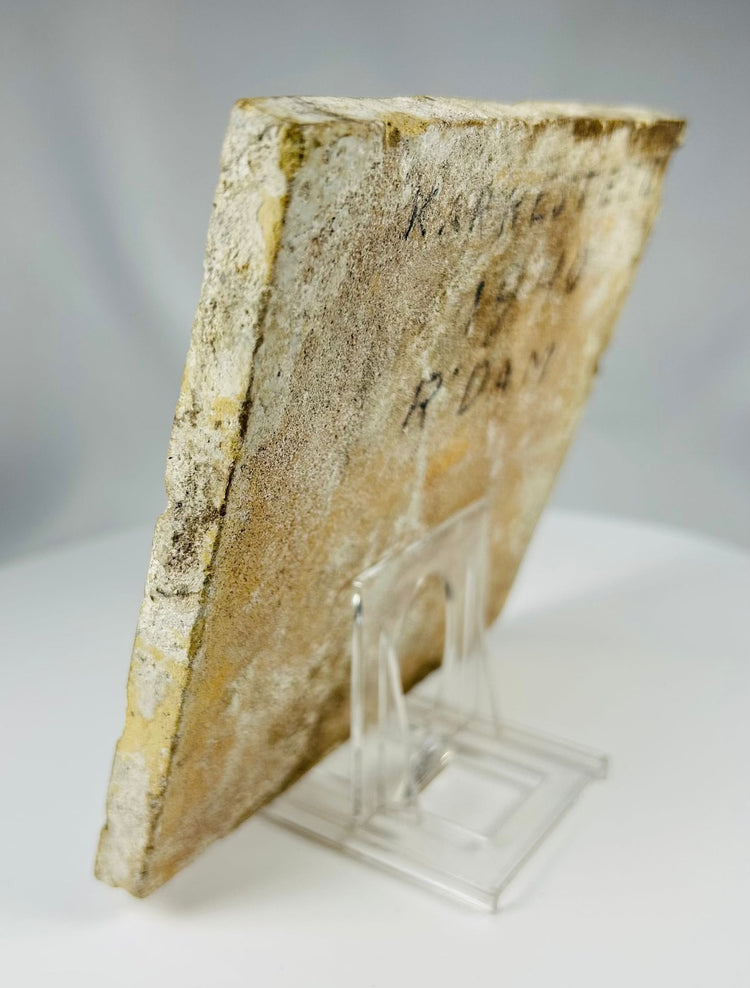
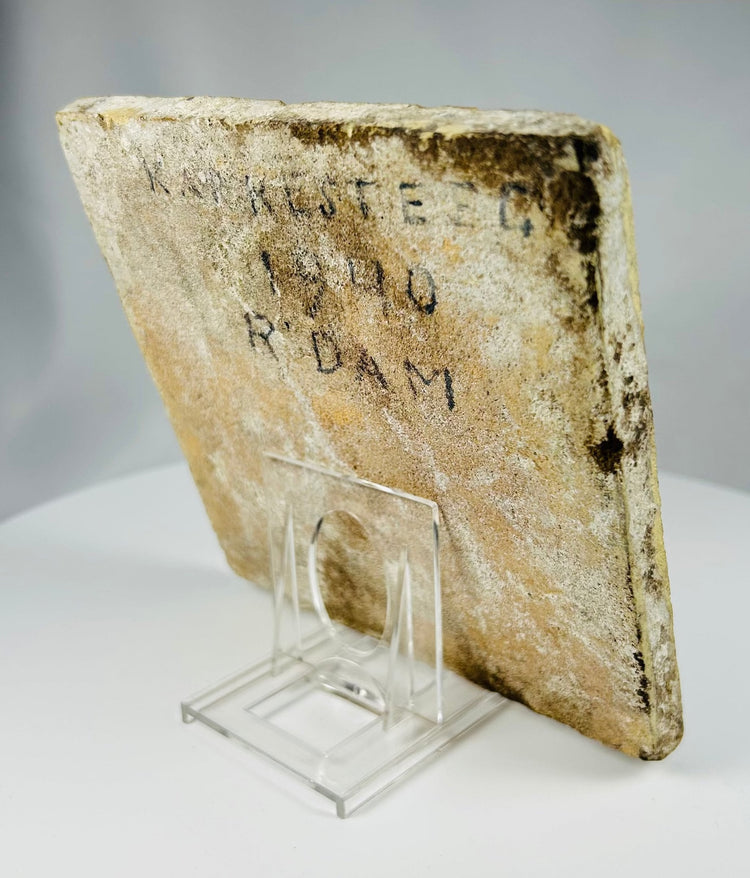
Of particular interest is the handwritten inscription preserved on the reverse. The notation appears to read “Karresteeg,” “1940,” and “R’Dam,” the latter being a common abbreviation for Rotterdam. Karresteeg was a street in central Rotterdam, giving the tile a potentially significant geographic association.
The date 1940 is especially noteworthy, as Rotterdam suffered catastrophic destruction during the German bombing of the city on 14 May 1940. Large sections of the historic centre were subsequently destroyed, cleared, or rebuilt. It is therefore possible that this tile was removed or salvaged from a Rotterdam building during the destruction, clearance, or redevelopment associated with that period. While the precise circumstances cannot presently be confirmed, the inscription provides an intriguing historical association and may represent a later collector, salvage, or location record connected with the tile.
Features
- Authentic Dutch Delft blue-and-white tile
- Hand-painted cobalt decoration
- Mounted cavalry figure with raised sword
- Traditional decorative corner flourishes
- Extensive natural craquelure to the glaze
- Historic earthen ceramic backing
- Handwritten reverse inscription referencing Karresteeg, Rotterdam
- Dated 1940 on the reverse
- Possible association with wartime salvage or redevelopment in Rotterdam
Cultural Significance
During the Dutch Golden Age and the centuries that followed, Delft tiles became an important decorative element in Dutch and European interiors. They were commonly installed around fireplaces, kitchens, stairways, and wall panels, and depicted subjects ranging from landscapes and maritime scenes to animals, biblical subjects, tradesmen, soldiers, and mounted riders.
Because each tile was individually painted, subtle variations in brushwork make every surviving example unique. Tiles retaining old handwritten location or collection information are particularly interesting because such markings can preserve details about their later history long after their original architectural setting has disappeared.
The reverse inscription on this example potentially connects it with Karresteeg in Rotterdam during 1940, adding an additional layer of 20th-century history to a ceramic object already more than two centuries old.
Condition
Age-appropriate wear throughout, including extensive glaze crazing, minor edge losses, small chips, surface marks, and discoloration consistent with centuries of use and handling. The cobalt decoration remains clear and visually striking. Historic handwritten notation is visible on the reverse.
Dimensions (Approximate)
Height: 5.2 in
Width: 5.2 in
Age (Approximate)
250–325 years old
Provenance
Offered by Medusa Auctioneers, the Netherlands, in its Antiques, Asian Arts and Silver auction on February 24, 2026, as Lot 1415. The piece subsequently entered a private collection in Toronto, Ontario, Canada.
Learn More
Learn about the history of Dutch Delft tiles and their decorative use in European interiors
Browse our Ceramics & Pottery: Ancient Heritage Art Collection.
Description
Historical Context & Origin
Region: Netherlands (Delft)
Material: Tin-glazed ceramic (Delftware)
Period: Late 17th – Early 18th Century
Description
This striking antique Dutch Delft tile depicts a mounted rider raising a sword while his horse rears dramatically beneath him. The scene is rendered in deep cobalt blue against a pale tin-glazed ground, capturing a strong sense of movement through expressive brushwork and bold contrast.
The composition is characteristic of Dutch Delft tiles produced during the late 17th and early 18th centuries, when tile painters frequently drew inspiration from contemporary engravings and popular imagery depicting soldiers, cavalrymen, animals, ships, and scenes of everyday life. The rider’s raised sword and the animated pose of the horse give the composition an especially dynamic character.
Traditional cobalt corner ornaments frame the central image, while the glazed surface displays an extensive natural network of fine craquelure consistent with considerable age. Minor edge losses and surface wear further reflect the tile’s long history of use.
Of particular interest is the handwritten inscription preserved on the reverse. The notation appears to read “Karresteeg,” “1940,” and “R’Dam,” the latter being a common abbreviation for Rotterdam. Karresteeg was a street in central Rotterdam, giving the tile a potentially significant geographic association.
The date 1940 is especially noteworthy, as Rotterdam suffered catastrophic destruction during the German bombing of the city on 14 May 1940. Large sections of the historic centre were subsequently destroyed, cleared, or rebuilt. It is therefore possible that this tile was removed or salvaged from a Rotterdam building during the destruction, clearance, or redevelopment associated with that period. While the precise circumstances cannot presently be confirmed, the inscription provides an intriguing historical association and may represent a later collector, salvage, or location record connected with the tile.
Features
- Authentic Dutch Delft blue-and-white tile
- Hand-painted cobalt decoration
- Mounted cavalry figure with raised sword
- Traditional decorative corner flourishes
- Extensive natural craquelure to the glaze
- Historic earthen ceramic backing
- Handwritten reverse inscription referencing Karresteeg, Rotterdam
- Dated 1940 on the reverse
- Possible association with wartime salvage or redevelopment in Rotterdam
Cultural Significance
During the Dutch Golden Age and the centuries that followed, Delft tiles became an important decorative element in Dutch and European interiors. They were commonly installed around fireplaces, kitchens, stairways, and wall panels, and depicted subjects ranging from landscapes and maritime scenes to animals, biblical subjects, tradesmen, soldiers, and mounted riders.
Because each tile was individually painted, subtle variations in brushwork make every surviving example unique. Tiles retaining old handwritten location or collection information are particularly interesting because such markings can preserve details about their later history long after their original architectural setting has disappeared.
The reverse inscription on this example potentially connects it with Karresteeg in Rotterdam during 1940, adding an additional layer of 20th-century history to a ceramic object already more than two centuries old.
Condition
Age-appropriate wear throughout, including extensive glaze crazing, minor edge losses, small chips, surface marks, and discoloration consistent with centuries of use and handling. The cobalt decoration remains clear and visually striking. Historic handwritten notation is visible on the reverse.
Dimensions (Approximate)
Height: 5.2 in
Width: 5.2 in
Age (Approximate)
250–325 years old
Provenance
Offered by Medusa Auctioneers, the Netherlands, in its Antiques, Asian Arts and Silver auction on February 24, 2026, as Lot 1415. The piece subsequently entered a private collection in Toronto, Ontario, Canada.
Learn More
Learn about the history of Dutch Delft tiles and their decorative use in European interiors
Browse our Ceramics & Pottery: Ancient Heritage Art Collection.
You May Also Like
