


European Iron Sliding Hasp Lock with Original Key | Circa 18th Century
Couldn't load pickup availability




European Iron Sliding Hasp Lock with Original Key | Circa 18th Century
Description
More
Less
Historical Context & Origin
Region: Europe
Material: Hand-forged wrought iron
Period: Likely 18th Century, circa 1700–1800
Description
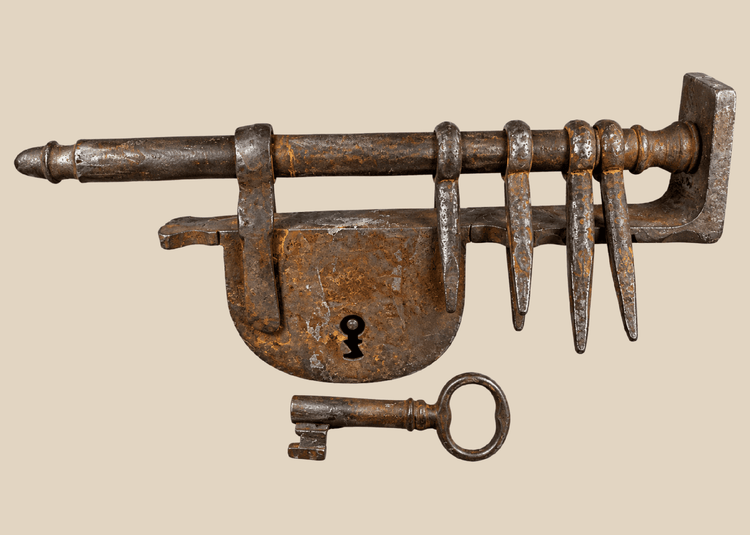
This substantial antique wrought-iron locking assembly is an early sliding hasp gate or door lock, a form used to secure heavy wooden doors, gates, outbuildings and other important architectural entrances before the widespread adoption of modern integrated door-lock mechanisms.
The lock is constructed around a long horizontal sliding bar terminating in a shaped finial at one end and a heavy angular stop or bracket at the opposite end. Suspended from the bar is the substantial lock body, formed from thick iron plate with a rounded lower edge and traditional keyhole opening.
A hinged iron hasp connects the lock body to the upper sliding bar. When secured, the internal locking mechanism prevents the hasp from being released. Turning the accompanying key withdraws the internal bolt, allowing the locking components to disengage and the bar to be removed from its mounting points. This general method of operation is documented on comparable sliding hasp locks.
Three separate wrought-iron staples or eyes remain fitted around the sliding bar. These tapered fittings were intended to be driven or secured into the timber of a door, gate, jamb or adjoining pair of doors. The long bar would pass through these fittings, physically binding the architectural elements together before being locked in position. Comparable locks were specifically intended for use across a single door and jamb or between paired doors.
Particularly noteworthy is the surviving original-style iron key. The key features a large oval bow, tubular shaft and substantial stepped bit designed to engage the internal wards and locking mechanism.
The entire assembly is now presented on a custom-made wooden display stand.
Features
- Hand-forged wrought-iron construction
- Early sliding-bar locking mechanism
- Large suspended lock body
- Hinged locking hasp
- Long horizontal iron security bar
- Three surviving tapered staples or mounting eyes
- Large period-style warded iron key
- Naturally aged dark brown and iron-grey patina
- Visible forging irregularities and historic surface wear
- Presented on a custom wooden display stand
- Highly decorative example of early architectural security hardware
Cultural Significance
Before mechanically standardized locks became commonplace, blacksmiths and specialist locksmiths produced substantial iron security devices individually for doors, gates, chests and architectural installations. Their construction relied upon forged bars, staples, hasps, wards and internally operated bolts, combining relatively straightforward mechanical principles with considerable physical strength.
The sliding hasp system was particularly suited to heavy timber architecture. Rather than relying solely upon a small latch within the edge of a door, the long iron bar could physically span several attachment points, effectively binding the door to its frame or securing two doors together.
Surviving wrought-iron locks from the 17th and 18th centuries demonstrate the considerable variety employed by European locksmiths during the period. Museum collections preserve wrought-iron locking mechanisms and keys from this era, illustrating the importance of individually forged security hardware before industrial production transformed lock manufacture during the 19th century.
The irregular surfaces, substantial iron sections and individually worked components of the present example retain the visual character associated with traditional blacksmith manufacture. Its large scale and unusually complete arrangement make it particularly effective both as a historic architectural object and as a study piece illustrating early mechanical security.
Condition
The lock remains in good antique condition consistent with considerable age and historical use. The wrought-iron surfaces display oxidation, patination, discoloration, scratches, abrasions, minor pitting and general surface wear throughout.
The individual components show irregularities associated with hand forging and prolonged use. The key exhibits corresponding age-related patination and wear. No attempt has been made to remove the historic surface character.
Dimensions (Approximate)
Length: 12 in
Width: 4 in
Height: 7 in
Age (Approximate)
225–325 years old
Provenance
From a private collection in Dallas, Texas, USA, assembled with a particular focus on antique and early locking mechanisms, keys, and historical security devices.
Learn More
Study a related mid-18th-century wrought-iron lock preserved by the Science Museum Group
Browse our Collection of Functional Tools, Ancient Implements and Craft
Description
Historical Context & Origin
Region: Europe
Material: Hand-forged wrought iron
Period: Likely 18th Century, circa 1700–1800
Description
This substantial antique wrought-iron locking assembly is an early sliding hasp gate or door lock, a form used to secure heavy wooden doors, gates, outbuildings and other important architectural entrances before the widespread adoption of modern integrated door-lock mechanisms.
The lock is constructed around a long horizontal sliding bar terminating in a shaped finial at one end and a heavy angular stop or bracket at the opposite end. Suspended from the bar is the substantial lock body, formed from thick iron plate with a rounded lower edge and traditional keyhole opening.
A hinged iron hasp connects the lock body to the upper sliding bar. When secured, the internal locking mechanism prevents the hasp from being released. Turning the accompanying key withdraws the internal bolt, allowing the locking components to disengage and the bar to be removed from its mounting points. This general method of operation is documented on comparable sliding hasp locks.
Three separate wrought-iron staples or eyes remain fitted around the sliding bar. These tapered fittings were intended to be driven or secured into the timber of a door, gate, jamb or adjoining pair of doors. The long bar would pass through these fittings, physically binding the architectural elements together before being locked in position. Comparable locks were specifically intended for use across a single door and jamb or between paired doors.
Particularly noteworthy is the surviving original-style iron key. The key features a large oval bow, tubular shaft and substantial stepped bit designed to engage the internal wards and locking mechanism.
The entire assembly is now presented on a custom-made wooden display stand.
Features
- Hand-forged wrought-iron construction
- Early sliding-bar locking mechanism
- Large suspended lock body
- Hinged locking hasp
- Long horizontal iron security bar
- Three surviving tapered staples or mounting eyes
- Large period-style warded iron key
- Naturally aged dark brown and iron-grey patina
- Visible forging irregularities and historic surface wear
- Presented on a custom wooden display stand
- Highly decorative example of early architectural security hardware
Cultural Significance
Before mechanically standardized locks became commonplace, blacksmiths and specialist locksmiths produced substantial iron security devices individually for doors, gates, chests and architectural installations. Their construction relied upon forged bars, staples, hasps, wards and internally operated bolts, combining relatively straightforward mechanical principles with considerable physical strength.
The sliding hasp system was particularly suited to heavy timber architecture. Rather than relying solely upon a small latch within the edge of a door, the long iron bar could physically span several attachment points, effectively binding the door to its frame or securing two doors together.
Surviving wrought-iron locks from the 17th and 18th centuries demonstrate the considerable variety employed by European locksmiths during the period. Museum collections preserve wrought-iron locking mechanisms and keys from this era, illustrating the importance of individually forged security hardware before industrial production transformed lock manufacture during the 19th century.
The irregular surfaces, substantial iron sections and individually worked components of the present example retain the visual character associated with traditional blacksmith manufacture. Its large scale and unusually complete arrangement make it particularly effective both as a historic architectural object and as a study piece illustrating early mechanical security.
Condition
The lock remains in good antique condition consistent with considerable age and historical use. The wrought-iron surfaces display oxidation, patination, discoloration, scratches, abrasions, minor pitting and general surface wear throughout.
The individual components show irregularities associated with hand forging and prolonged use. The key exhibits corresponding age-related patination and wear. No attempt has been made to remove the historic surface character.
Dimensions (Approximate)
Length: 12 in
Width: 4 in
Height: 7 in
Age (Approximate)
225–325 years old
Provenance
From a private collection in Dallas, Texas, USA, assembled with a particular focus on antique and early locking mechanisms, keys, and historical security devices.
Learn More
Study a related mid-18th-century wrought-iron lock preserved by the Science Museum Group
Browse our Collection of Functional Tools, Ancient Implements and Craft
You May Also Like
