

Antique French Beveled Glass Jewelry Casket | Circa 1870–1900
Couldn't load pickup availability


Antique French Beveled Glass Jewelry Casket | Circa 1870–1900
Description
More
Less
Historical Context & Origin
Region: France
Material: Patinated metal body with raised figural decoration, brass-toned mounts, beveled glass lid, and silk textile interior
Period: Late 19th Century, circa 1870–1900
Description
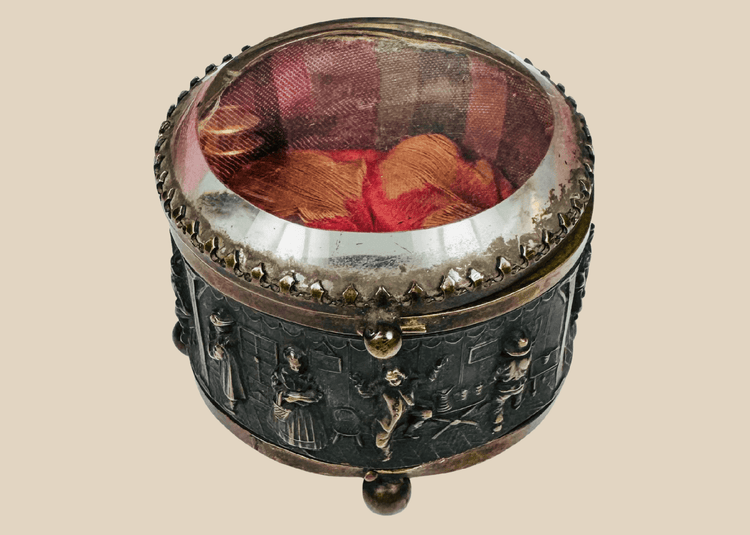
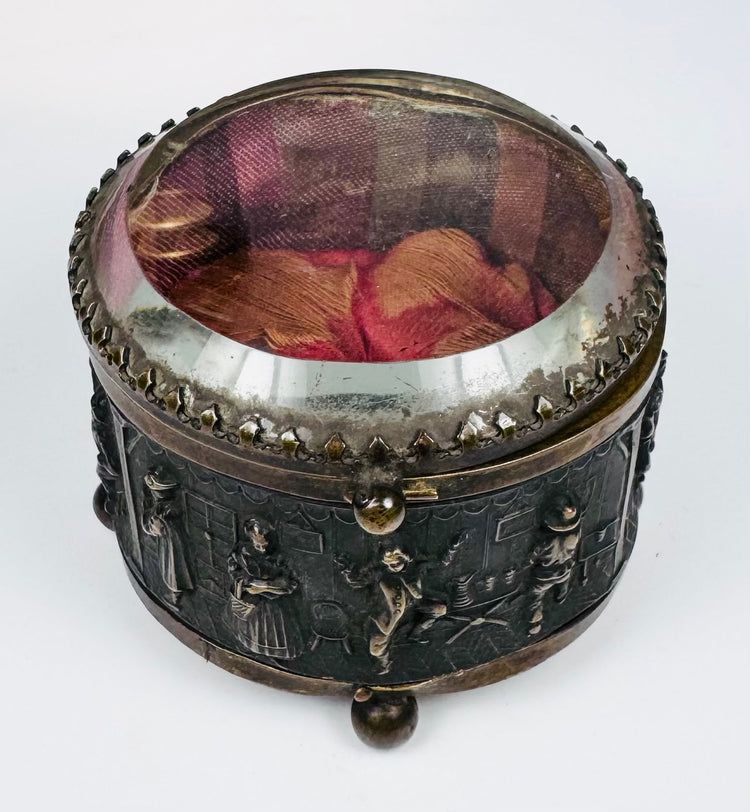
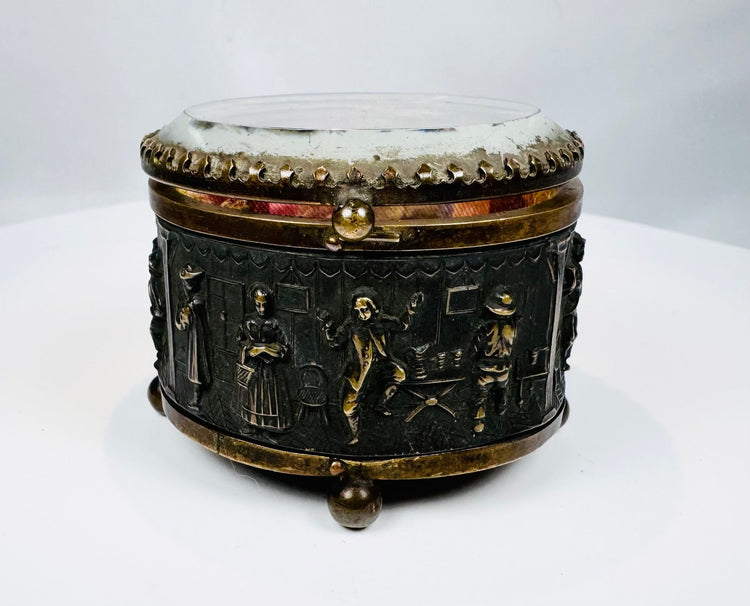
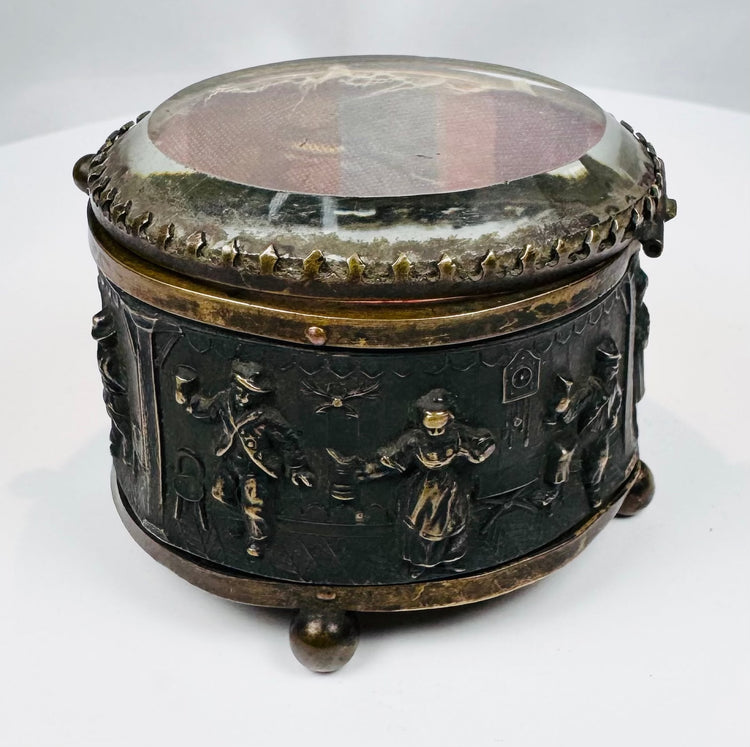
This antique French jewelry casket is a finely detailed late 19th-century decorative box featuring a continuous bas-relief genre scene, a substantial beveled glass lid, and its surviving period textile interior.
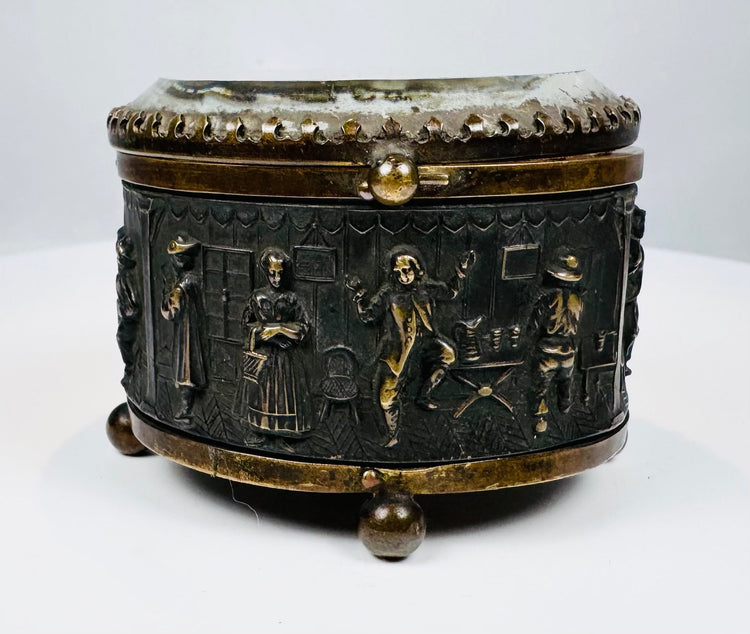
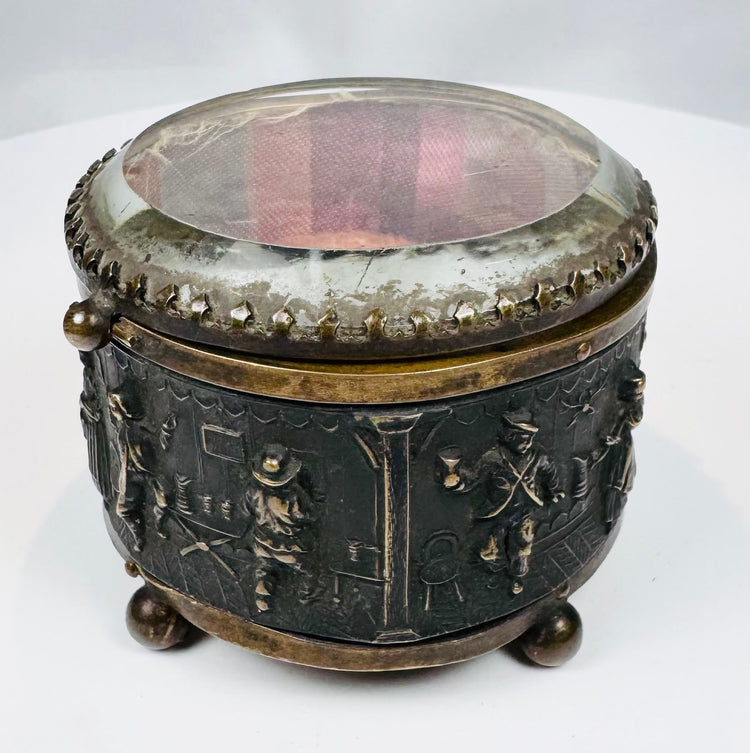
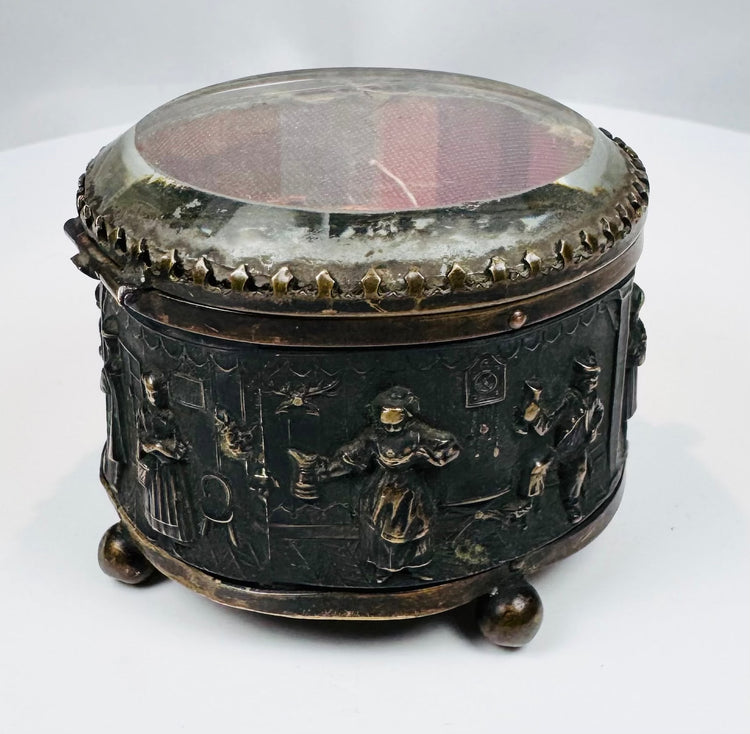
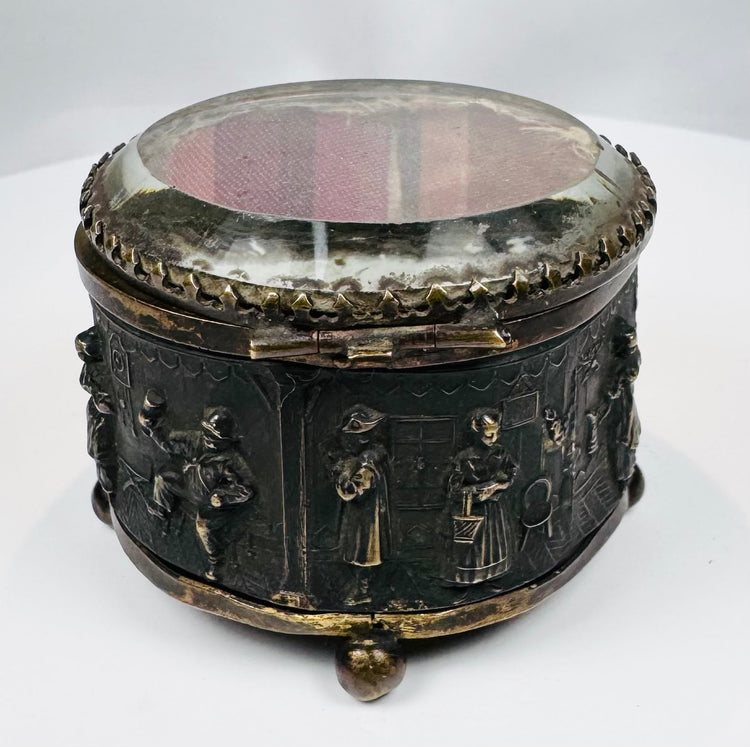
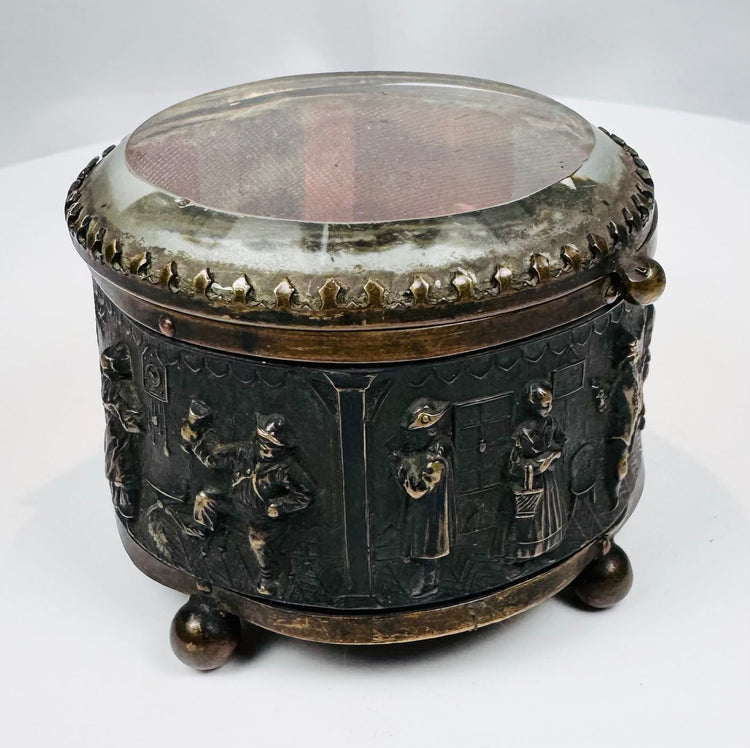
The cylindrical body is wrapped with an elaborate raised narrative composition depicting figures gathered within what appears to be a European tavern, inn, or domestic social interior. Men and women appear throughout the scene in period-inspired dress, accompanied by tables, chairs, vessels, architectural columns, doors, and other interior details.
Rather than relying solely on engraved decoration, the figures and architectural elements project from the darkened metal surface in pronounced relief. Select raised areas have acquired lighter golden highlights through age and handling, creating a striking contrast against the darker patinated background.
Scenes of convivial life, tavern interiors, musicians, card players, and figures in historical costume were popular decorative subjects during the 19th century. French decorative arts frequently drew inspiration from romanticized images of earlier European life, particularly 17th- and 18th-century genre painting.
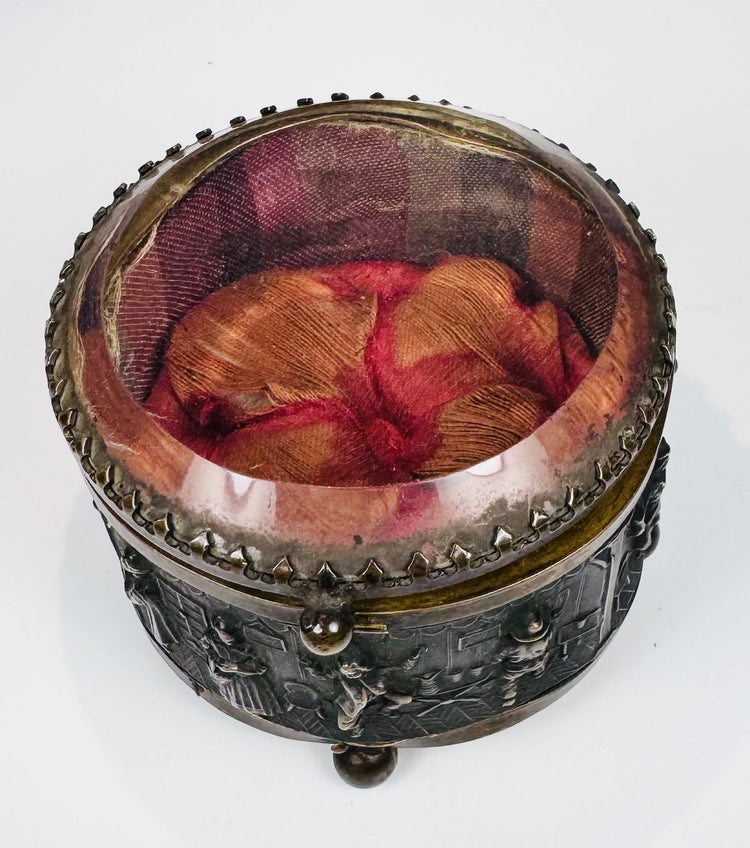
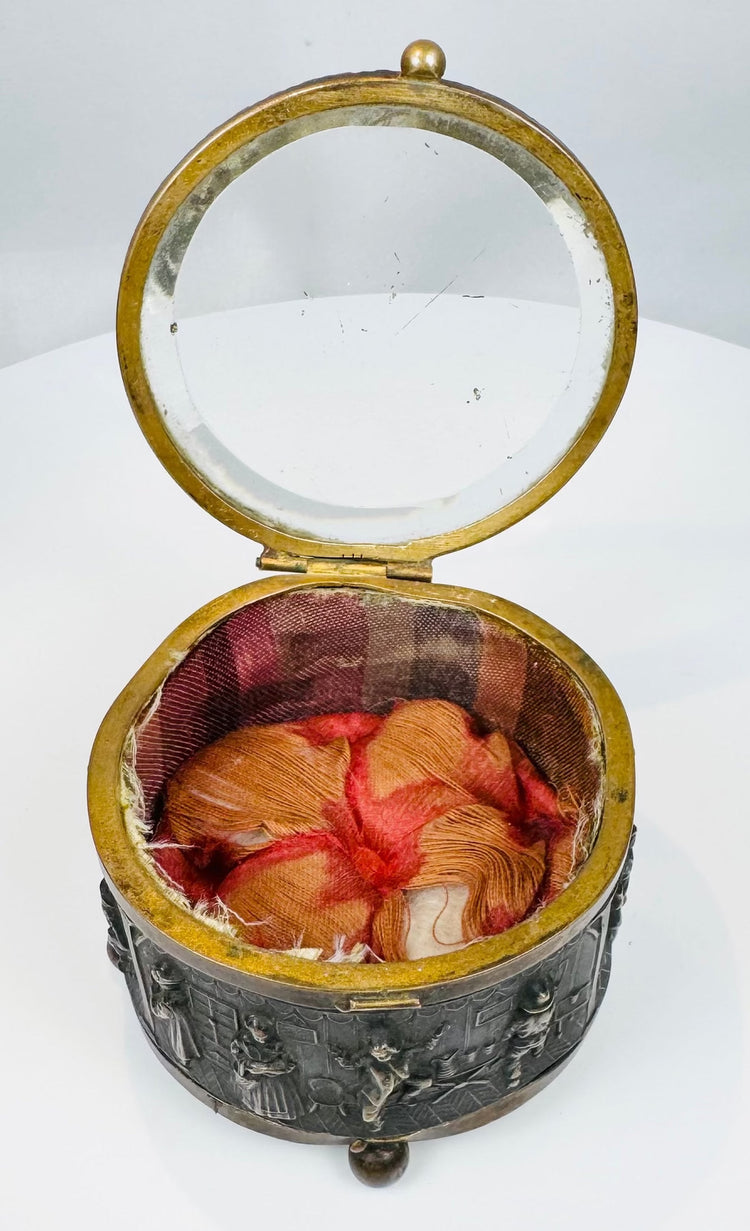
The hinged lid is particularly attractive, incorporating a thick circular pane of beveled glass. Its broad polished bevel creates a magnifying and refractive effect when viewed from different angles while allowing the interior to remain visible when the casket is closed. The glass is retained within a metal surround ornamented along its outer edge with a repeating pointed or fleur-de-lis-like border. A small spherical clasp at the front secures the lid.
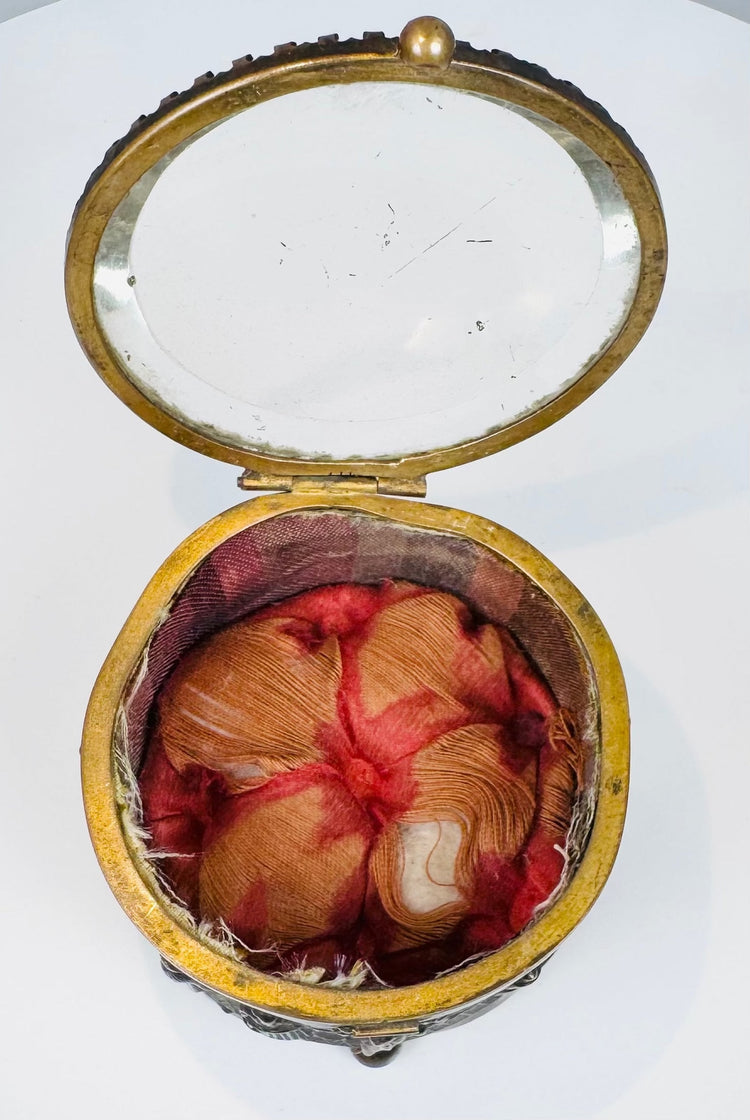
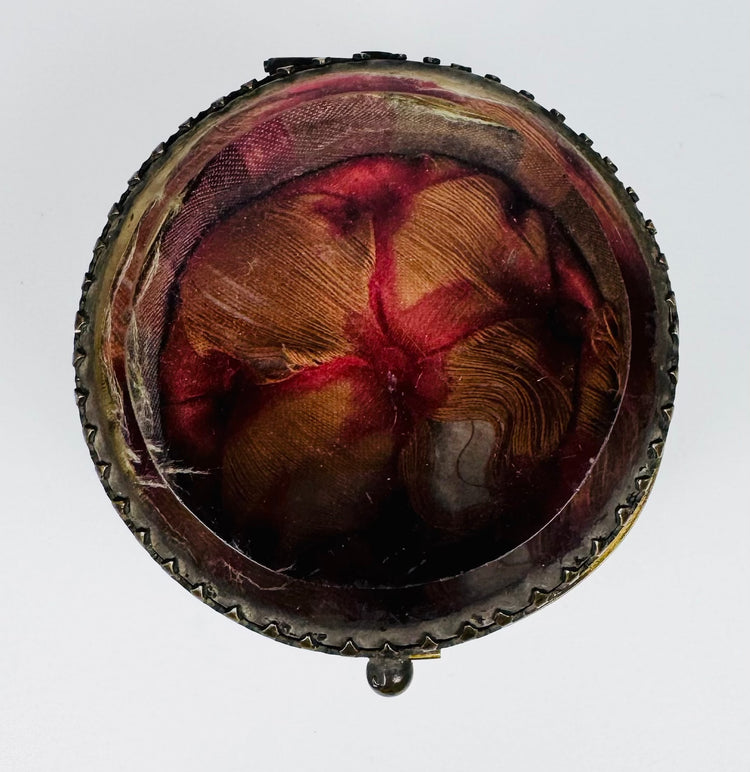
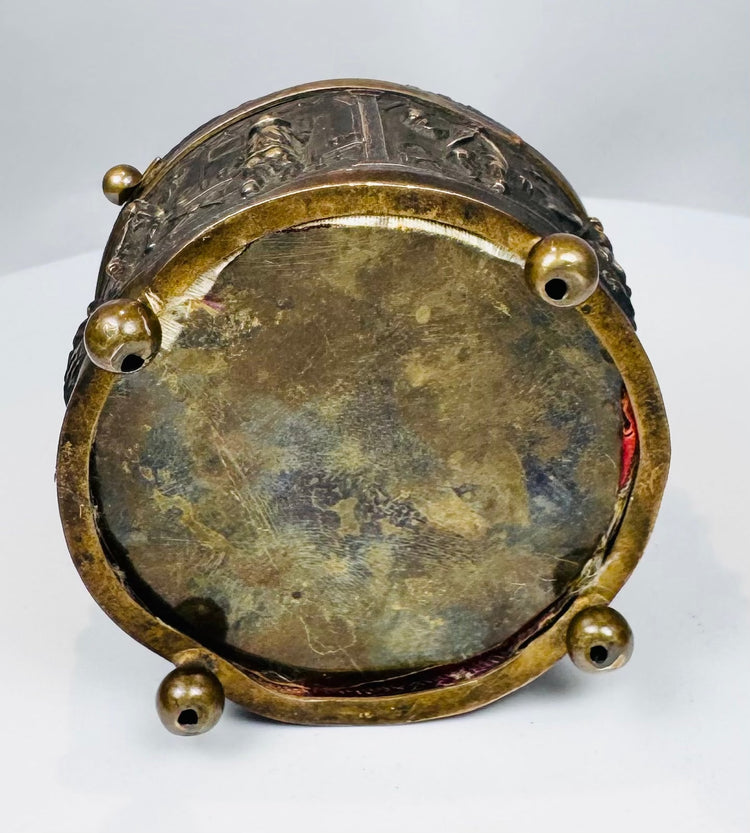
Opening the casket reveals a surviving red, burgundy, and golden-orange textile interior. The walls are lined with patterned fabric, while the base contains a stuffed silk cushion divided into padded sections intended to receive rings, brooches, earrings, or other small pieces of jewelry. The casket stands upon four small spherical feet, elevating the body slightly above the surface and completing its characteristic Victorian-era presentation.
Although often broadly described as Victorian jewelry boxes in the modern antiques market, the construction and decorative vocabulary are consistent with French late 19th-century bijouterie and decorative caskets produced for dressing tables and domestic interiors.
Features
- Cylindrical metal body with dark aged patina
- Continuous raised bas-relief narrative scene
- Tavern, inn, or domestic genre imagery
- Numerous individually modelled figures in historical costume
- Architectural columns, furniture, vessels, and interior details
- Thick beveled glass viewing panel
- Decorative repeating border surrounding the glass
- Small spherical front clasp
- Original or period red and golden-orange textile interior
- Stuffed sectional jewelry cushion
Cultural Significance
Small decorative jewelry caskets became increasingly popular during the second half of the 19th century as dressing tables and personal interiors developed into important displays of fashion, status, and domestic taste.
French manufacturers produced an enormous variety of ornamental boxes in bronze, brass, spelter, glass, porcelain, and combinations of these materials. Elaborately cast historical and genre scenes allowed relatively small functional objects to incorporate the visual language of sculpture and narrative painting.
The tavern-style imagery seen around this casket belongs to the 19th-century fascination with romanticized European history. Scenes of musicians, drinkers, card players, soldiers, merchants, and domestic interiors were frequently adapted from earlier Dutch and Flemish genre traditions and reproduced across European decorative arts.
The beveled glass lid served both decorative and practical purposes, allowing jewelry to be viewed while the casket remained closed. Combined with its richly colored textile interior, the transparent lid would have made the casket an attractive dressing-table object in its own right. The survival of the interior cushion is especially appealing, as textile components were frequently removed, replaced, or heavily deteriorated through more than a century of use.
Condition
The casket remains in good antique condition overall, displaying wear consistent with its age and use. The metal exterior exhibits substantial natural patination, oxidation, tarnishing, discoloration, rubbing, scratches, and areas where the raised decoration has worn to a lighter brass or golden tone.
The beveled glass lid remains present and displays surface scratches, marks, small abrasions, and age-related wear. No major break is apparent in the supplied photographs. The interior textile lining survives but displays significant age-related deterioration. The padded cushion is worn and tatty, with fading, discoloration, fraying, loose threads, exposed underlying material, and areas of separation and loss.
The interior has intentionally been left in its aged state rather than replaced, preserving the casket's historical character.
Dimensions (Approximate)
Height: 2 in
Width / Diameter: 2.5 in
Age (Approximate)
125–155 years old
Provenance
Formerly part of a private Montreal, Quebec, Canada collection of antiques and decorative objects.
Learn More
Study a French jewel casket made in 1867 and preserved by the Los Angeles County Museum of Art
Browse our Collection of 19th-Century Artifacts and Decorative Objects.
Description
Historical Context & Origin
Region: France
Material: Patinated metal body with raised figural decoration, brass-toned mounts, beveled glass lid, and silk textile interior
Period: Late 19th Century, circa 1870–1900
Description
This antique French jewelry casket is a finely detailed late 19th-century decorative box featuring a continuous bas-relief genre scene, a substantial beveled glass lid, and its surviving period textile interior.
The cylindrical body is wrapped with an elaborate raised narrative composition depicting figures gathered within what appears to be a European tavern, inn, or domestic social interior. Men and women appear throughout the scene in period-inspired dress, accompanied by tables, chairs, vessels, architectural columns, doors, and other interior details.
Rather than relying solely on engraved decoration, the figures and architectural elements project from the darkened metal surface in pronounced relief. Select raised areas have acquired lighter golden highlights through age and handling, creating a striking contrast against the darker patinated background.
Scenes of convivial life, tavern interiors, musicians, card players, and figures in historical costume were popular decorative subjects during the 19th century. French decorative arts frequently drew inspiration from romanticized images of earlier European life, particularly 17th- and 18th-century genre painting.
The hinged lid is particularly attractive, incorporating a thick circular pane of beveled glass. Its broad polished bevel creates a magnifying and refractive effect when viewed from different angles while allowing the interior to remain visible when the casket is closed. The glass is retained within a metal surround ornamented along its outer edge with a repeating pointed or fleur-de-lis-like border. A small spherical clasp at the front secures the lid.
Opening the casket reveals a surviving red, burgundy, and golden-orange textile interior. The walls are lined with patterned fabric, while the base contains a stuffed silk cushion divided into padded sections intended to receive rings, brooches, earrings, or other small pieces of jewelry. The casket stands upon four small spherical feet, elevating the body slightly above the surface and completing its characteristic Victorian-era presentation.
Although often broadly described as Victorian jewelry boxes in the modern antiques market, the construction and decorative vocabulary are consistent with French late 19th-century bijouterie and decorative caskets produced for dressing tables and domestic interiors.
Features
- Cylindrical metal body with dark aged patina
- Continuous raised bas-relief narrative scene
- Tavern, inn, or domestic genre imagery
- Numerous individually modelled figures in historical costume
- Architectural columns, furniture, vessels, and interior details
- Thick beveled glass viewing panel
- Decorative repeating border surrounding the glass
- Small spherical front clasp
- Original or period red and golden-orange textile interior
- Stuffed sectional jewelry cushion
Cultural Significance
Small decorative jewelry caskets became increasingly popular during the second half of the 19th century as dressing tables and personal interiors developed into important displays of fashion, status, and domestic taste.
French manufacturers produced an enormous variety of ornamental boxes in bronze, brass, spelter, glass, porcelain, and combinations of these materials. Elaborately cast historical and genre scenes allowed relatively small functional objects to incorporate the visual language of sculpture and narrative painting.
The tavern-style imagery seen around this casket belongs to the 19th-century fascination with romanticized European history. Scenes of musicians, drinkers, card players, soldiers, merchants, and domestic interiors were frequently adapted from earlier Dutch and Flemish genre traditions and reproduced across European decorative arts.
The beveled glass lid served both decorative and practical purposes, allowing jewelry to be viewed while the casket remained closed. Combined with its richly colored textile interior, the transparent lid would have made the casket an attractive dressing-table object in its own right. The survival of the interior cushion is especially appealing, as textile components were frequently removed, replaced, or heavily deteriorated through more than a century of use.
Condition
The casket remains in good antique condition overall, displaying wear consistent with its age and use. The metal exterior exhibits substantial natural patination, oxidation, tarnishing, discoloration, rubbing, scratches, and areas where the raised decoration has worn to a lighter brass or golden tone.
The beveled glass lid remains present and displays surface scratches, marks, small abrasions, and age-related wear. No major break is apparent in the supplied photographs. The interior textile lining survives but displays significant age-related deterioration. The padded cushion is worn and tatty, with fading, discoloration, fraying, loose threads, exposed underlying material, and areas of separation and loss.
The interior has intentionally been left in its aged state rather than replaced, preserving the casket's historical character.
Dimensions (Approximate)
Height: 2 in
Width / Diameter: 2.5 in
Age (Approximate)
125–155 years old
Provenance
Formerly part of a private Montreal, Quebec, Canada collection of antiques and decorative objects.
Learn More
Study a French jewel casket made in 1867 and preserved by the Los Angeles County Museum of Art
Browse our Collection of 19th-Century Artifacts and Decorative Objects.
You May Also Like
