



Antique Georgian Hairwork & Bone Toothpick Case | Circa 1790 – 1820
Couldn't load pickup availability




Antique Georgian Hairwork & Bone Toothpick Case | Circa 1790 – 1820
Description
More
Less
Historical Context & Origin
Region: England, likely British
Material: Carved natural material, likely bone, with metal mounts, glazed hairwork panel, and fitted interior
Period: Late Georgian, circa 1790–1820
Description
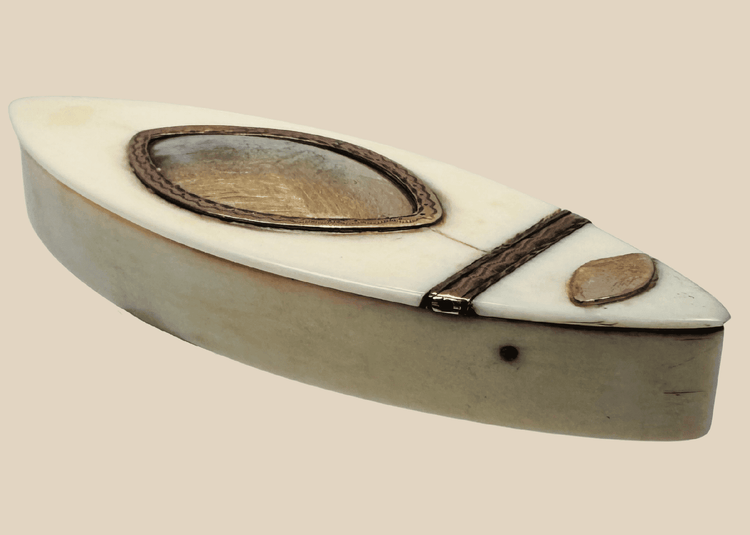
An elegant late Georgian personal toothpick case of elongated navette or boat-shaped form, finely fashioned from a pale polished natural material and embellished with metal-mounted decorative details.
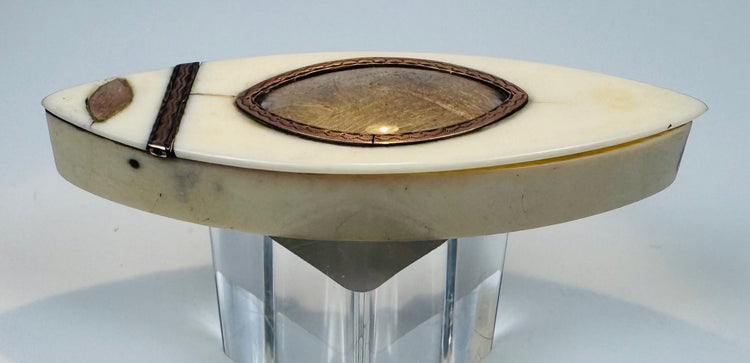
The fitted lid is dominated by an elongated oval panel framed by a finely patterned copper-toned or gilt-metal bezel. Beneath the transparent cover appears to be a preserved arrangement of human hair, creating an unusually intimate decorative element. Hairwork was incorporated into Georgian objects and jewellery as a tangible token of affection, remembrance, friendship, or mourning.
A narrow decorative metal band crosses the lid near the hinged end, accompanied by a smaller shield- or leaf-shaped metal inset. The case opens on a small hinge to reveal a shallow fitted compartment, originally intended to hold a personal toothpick or similar grooming implement. During the Georgian period, finely made toothpick cases could function as fashionable personal accessories and were produced in precious and exotic materials for affluent owners.
The slender pointed form, warm aged surface, restrained metal ornamentation, and preserved hairwork make this an especially evocative example of Georgian personal material culture.
Features
- Distinctive elongated navette or boat-shaped form
- Pale polished natural material, likely bone
- Central glazed panel containing what appears to be preserved human hair
- Decorative patterned metal bezel surrounding the hairwork
- Additional metal band and small decorative inset to the lid
- Hinged construction with shallow fitted interior
- Compact pocket-sized format
- Attractive natural age toning and surface patina
- Rare combination of personal grooming accessory and sentimental hairwork
Cultural Significance
Toothpick cases became fashionable personal accessories during the late 18th and early 19th centuries, when reusable toothpicks could be made from materials such as gold, silver, bone, or ivory and carried in purpose-made pocket cases.
The apparent hairwork adds another layer of historical interest. In Georgian Britain, preserved human hair could represent mourning, romantic attachment, friendship, or familial remembrance. Because hair endured physically after separation from its owner, it became a particularly powerful material for personal keepsakes.
Condition
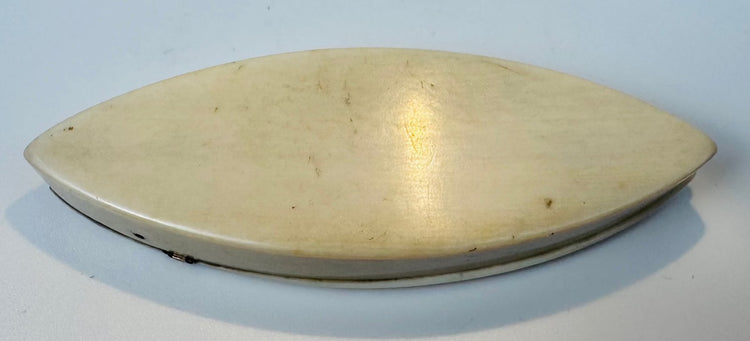
Good antique condition consistent with age and use. The case retains its hinged lid, decorative metal fittings, central glazed panel, and interior compartment. Visible age-related toning, fine surface marks, minor discoloration, and a fine line or age crack are present. The metal mounts show natural oxidation and wear. The material visible beneath the central glazing appears preserved, although the hairwork attribution has not been scientifically tested.
Dimensions (Approximate)
Length: 3.25 in
Width: 1 in
Height: 0.5 in
Age (Approximate)
205–235 years old
Provenance
Formerly held in a private collection in Richmond, Virginia, United States.
Subsequently handled by Quinn’s Auction Galleries, Falls Church, Virginia, an established auction house specializing in fine art, antiques, decorative arts, and significant estate and private collections.
Later acquired by a private collection in Toronto, Ontario, Canada.
Learn More
Discover a related English toothpick case in the collection of the Science Museum Group
Explore our Collection of Functional Tools, Ancient Implements and Historic Craft
Description
Historical Context & Origin
Region: England, likely British
Material: Carved natural material, likely bone, with metal mounts, glazed hairwork panel, and fitted interior
Period: Late Georgian, circa 1790–1820
Description
An elegant late Georgian personal toothpick case of elongated navette or boat-shaped form, finely fashioned from a pale polished natural material and embellished with metal-mounted decorative details.
The fitted lid is dominated by an elongated oval panel framed by a finely patterned copper-toned or gilt-metal bezel. Beneath the transparent cover appears to be a preserved arrangement of human hair, creating an unusually intimate decorative element. Hairwork was incorporated into Georgian objects and jewellery as a tangible token of affection, remembrance, friendship, or mourning.
A narrow decorative metal band crosses the lid near the hinged end, accompanied by a smaller shield- or leaf-shaped metal inset. The case opens on a small hinge to reveal a shallow fitted compartment, originally intended to hold a personal toothpick or similar grooming implement. During the Georgian period, finely made toothpick cases could function as fashionable personal accessories and were produced in precious and exotic materials for affluent owners.
The slender pointed form, warm aged surface, restrained metal ornamentation, and preserved hairwork make this an especially evocative example of Georgian personal material culture.
Features
- Distinctive elongated navette or boat-shaped form
- Pale polished natural material, likely bone
- Central glazed panel containing what appears to be preserved human hair
- Decorative patterned metal bezel surrounding the hairwork
- Additional metal band and small decorative inset to the lid
- Hinged construction with shallow fitted interior
- Compact pocket-sized format
- Attractive natural age toning and surface patina
- Rare combination of personal grooming accessory and sentimental hairwork
Cultural Significance
Toothpick cases became fashionable personal accessories during the late 18th and early 19th centuries, when reusable toothpicks could be made from materials such as gold, silver, bone, or ivory and carried in purpose-made pocket cases.
The apparent hairwork adds another layer of historical interest. In Georgian Britain, preserved human hair could represent mourning, romantic attachment, friendship, or familial remembrance. Because hair endured physically after separation from its owner, it became a particularly powerful material for personal keepsakes.
Condition
Good antique condition consistent with age and use. The case retains its hinged lid, decorative metal fittings, central glazed panel, and interior compartment. Visible age-related toning, fine surface marks, minor discoloration, and a fine line or age crack are present. The metal mounts show natural oxidation and wear. The material visible beneath the central glazing appears preserved, although the hairwork attribution has not been scientifically tested.
Dimensions (Approximate)
Length: 3.25 in
Width: 1 in
Height: 0.5 in
Age (Approximate)
205–235 years old
Provenance
Formerly held in a private collection in Richmond, Virginia, United States.
Subsequently handled by Quinn’s Auction Galleries, Falls Church, Virginia, an established auction house specializing in fine art, antiques, decorative arts, and significant estate and private collections.
Later acquired by a private collection in Toronto, Ontario, Canada.
Learn More
Discover a related English toothpick case in the collection of the Science Museum Group
Explore our Collection of Functional Tools, Ancient Implements and Historic Craft
You May Also Like
