



Antique Japanese Stag Antler Demon Face Carving | Meiji-Era | Circa 1850 – 1900
Couldn't load pickup availability


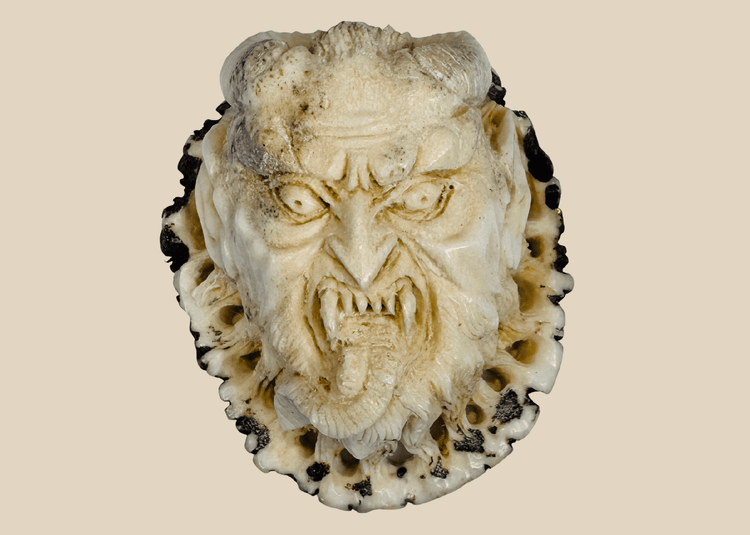


Antique Japanese Stag Antler Demon Face Carving | Meiji-Era | Circa 1850 – 1900
Description
More
Less
Historical Context & Origin
Region: East Asia, likely Japan
Material: Hand-carved natural stag antler / deer antler
Period: Likely 19th–early 20th Century, circa 1850–1920
Description
This striking hand-carved antler plaque depicts a fierce supernatural figure, most plausibly an oni or demon, rendered with dramatically exaggerated features and exceptional depth for an object of its compact size.
The face is dominated by intensely staring eyes beneath heavy furrowed brows, a sharply projecting nose, pointed ears, pronounced fangs, and an extended tongue emerging from the open mouth. A dense beard surrounds the lower face, while the upper head is crowned by prominent horn-like formations. Together, these features create an intentionally fearsome expression associated with traditional representations of demons and supernatural guardians.
The carving is executed in unusually deep relief, with substantial undercutting around the beard, ears, mouth, and surrounding openwork. The artist appears to have used the natural form of the antler as an integral part of the composition. Dark remnants of the outer antler surface remain around the perimeter, contrasting dramatically with the creamy interior and giving the piece considerable visual depth.
The reverse is largely flattened and reveals the naturally porous internal structure of the material. This construction strongly suggests that the piece was carved from a section of deer or stag antler, possibly near the burr or basal portion where the material broadens considerably.
Japanese decorative arts of the Edo and Meiji periods frequently incorporated stag antler alongside wood, ivory, and other natural materials. Oni—powerful supernatural beings recognizable by exaggerated faces, horns, fangs, and fierce expressions—were particularly well suited to the irregular texture and coloration of antler. Documented 19th-century Japanese examples demonstrate the established use of stag antler for oni imagery.
While the workmanship and subject are consistent with an East Asian, and quite possibly Japanese, carving, this attribution should presently be regarded as stylistic rather than definitive.
Features
- Hand-carved from what appears to be natural stag or deer antler
- Fierce demon or oni-like supernatural face
- Prominent fangs and extended carved tongue
- Deep-set staring eyes and strongly furrowed brow
- Horn-like formations above the forehead
- Elaborately carved beard and facial hair
- Extensive deep-relief and undercut carving
- Natural dark antler cortex retained around portions of the perimeter
- Porous natural antler structure visible on the reverse
Cultural Significance
Demonic and supernatural imagery occupies an important place in Japanese folklore, religion, theatre, and decorative arts. Oni are generally represented as powerful supernatural beings with exaggerated facial features, horns, fangs, and formidable expressions. Their meaning can vary considerably: while frequently associated with danger, punishment, and malevolent forces, oni imagery could also function symbolically as a means of confronting or warding away evil.
Antler was particularly suitable for small sculptural works because of its density, durability, natural coloration, and ability to accept detailed carving. Surviving Japanese stag-antler objects from the 19th century include miniature oni heads and related figural subjects, demonstrating the established combination of this material and supernatural imagery.
This example is particularly compelling for the way the carver incorporated the naturally contrasting exterior and interior of the antler into the finished composition, allowing the organic material itself to become part of the sculpture's character.
Condition
Good antique condition with age-related surface wear, natural discoloration, staining, abrasions, and areas of darker pigmentation throughout. The upper portion shows visible wear and losses to some of the raised carved detail, and minor losses and irregularities are present around the openwork perimeter. The reverse retains the naturally porous texture of the antler. These characteristics are consistent with the age and organic nature of the material and contribute considerably to its historic appearance.
Dimensions (Approximate)
Height: 2.6 in
Width: 2.25 in
Depth: 1.25 in
Age (Approximate)
100–175 years old
Provenance
Formerly held in a private collection in Selborne, United Kingdom, assembled with a particular focus on memento mori, funerary, and mortality-themed artifacts. The collection included objects exploring historical traditions surrounding remembrance, death, and the symbolic representation of human mortality.
Learn More
Study a related late 19th-century Japanese stag-antler demon-mask netsuke in the collection of the British Museum
Browse our Collection of Eastern Antiquities and Cultural Relics
Description
Historical Context & Origin
Region: East Asia, likely Japan
Material: Hand-carved natural stag antler / deer antler
Period: Likely 19th–early 20th Century, circa 1850–1920
Description
This striking hand-carved antler plaque depicts a fierce supernatural figure, most plausibly an oni or demon, rendered with dramatically exaggerated features and exceptional depth for an object of its compact size.
The face is dominated by intensely staring eyes beneath heavy furrowed brows, a sharply projecting nose, pointed ears, pronounced fangs, and an extended tongue emerging from the open mouth. A dense beard surrounds the lower face, while the upper head is crowned by prominent horn-like formations. Together, these features create an intentionally fearsome expression associated with traditional representations of demons and supernatural guardians.
The carving is executed in unusually deep relief, with substantial undercutting around the beard, ears, mouth, and surrounding openwork. The artist appears to have used the natural form of the antler as an integral part of the composition. Dark remnants of the outer antler surface remain around the perimeter, contrasting dramatically with the creamy interior and giving the piece considerable visual depth.
The reverse is largely flattened and reveals the naturally porous internal structure of the material. This construction strongly suggests that the piece was carved from a section of deer or stag antler, possibly near the burr or basal portion where the material broadens considerably.
Japanese decorative arts of the Edo and Meiji periods frequently incorporated stag antler alongside wood, ivory, and other natural materials. Oni—powerful supernatural beings recognizable by exaggerated faces, horns, fangs, and fierce expressions—were particularly well suited to the irregular texture and coloration of antler. Documented 19th-century Japanese examples demonstrate the established use of stag antler for oni imagery.
While the workmanship and subject are consistent with an East Asian, and quite possibly Japanese, carving, this attribution should presently be regarded as stylistic rather than definitive.
Features
- Hand-carved from what appears to be natural stag or deer antler
- Fierce demon or oni-like supernatural face
- Prominent fangs and extended carved tongue
- Deep-set staring eyes and strongly furrowed brow
- Horn-like formations above the forehead
- Elaborately carved beard and facial hair
- Extensive deep-relief and undercut carving
- Natural dark antler cortex retained around portions of the perimeter
- Porous natural antler structure visible on the reverse
Cultural Significance
Demonic and supernatural imagery occupies an important place in Japanese folklore, religion, theatre, and decorative arts. Oni are generally represented as powerful supernatural beings with exaggerated facial features, horns, fangs, and formidable expressions. Their meaning can vary considerably: while frequently associated with danger, punishment, and malevolent forces, oni imagery could also function symbolically as a means of confronting or warding away evil.
Antler was particularly suitable for small sculptural works because of its density, durability, natural coloration, and ability to accept detailed carving. Surviving Japanese stag-antler objects from the 19th century include miniature oni heads and related figural subjects, demonstrating the established combination of this material and supernatural imagery.
This example is particularly compelling for the way the carver incorporated the naturally contrasting exterior and interior of the antler into the finished composition, allowing the organic material itself to become part of the sculpture's character.
Condition
Good antique condition with age-related surface wear, natural discoloration, staining, abrasions, and areas of darker pigmentation throughout. The upper portion shows visible wear and losses to some of the raised carved detail, and minor losses and irregularities are present around the openwork perimeter. The reverse retains the naturally porous texture of the antler. These characteristics are consistent with the age and organic nature of the material and contribute considerably to its historic appearance.
Dimensions (Approximate)
Height: 2.6 in
Width: 2.25 in
Depth: 1.25 in
Age (Approximate)
100–175 years old
Provenance
Formerly held in a private collection in Selborne, United Kingdom, assembled with a particular focus on memento mori, funerary, and mortality-themed artifacts. The collection included objects exploring historical traditions surrounding remembrance, death, and the symbolic representation of human mortality.
Learn More
Study a related late 19th-century Japanese stag-antler demon-mask netsuke in the collection of the British Museum
Browse our Collection of Eastern Antiquities and Cultural Relics
You May Also Like
