


Naga Warrior Tooth & Brass Spiral Status Necklace | Late 19th – Early 20th Century
Couldn't load pickup availability


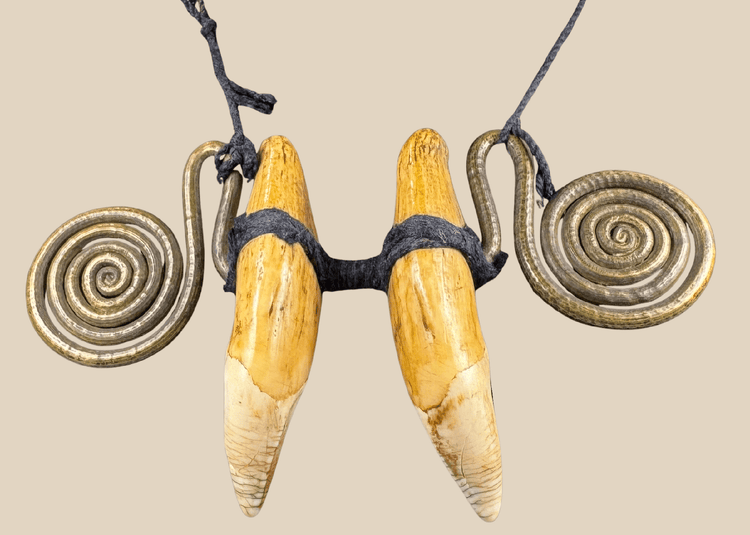
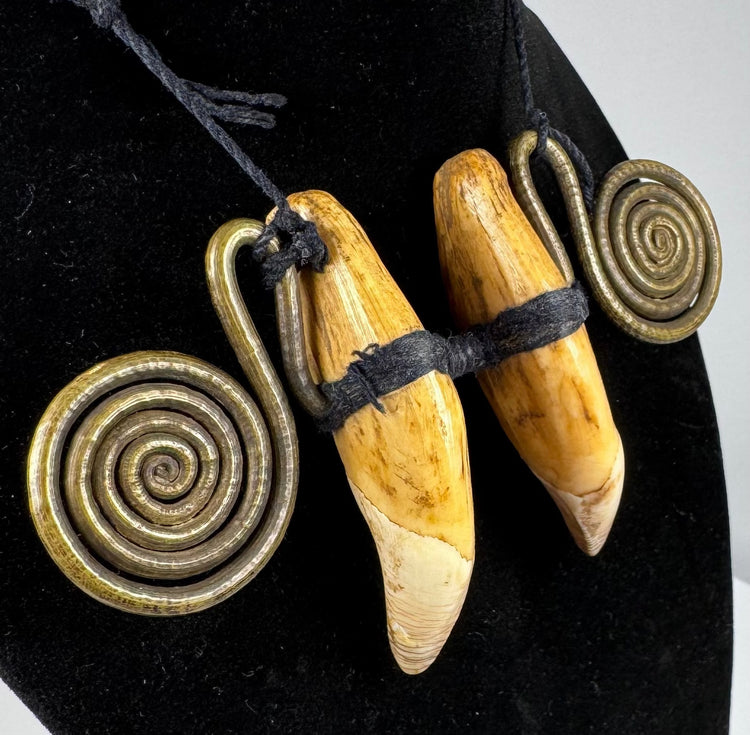
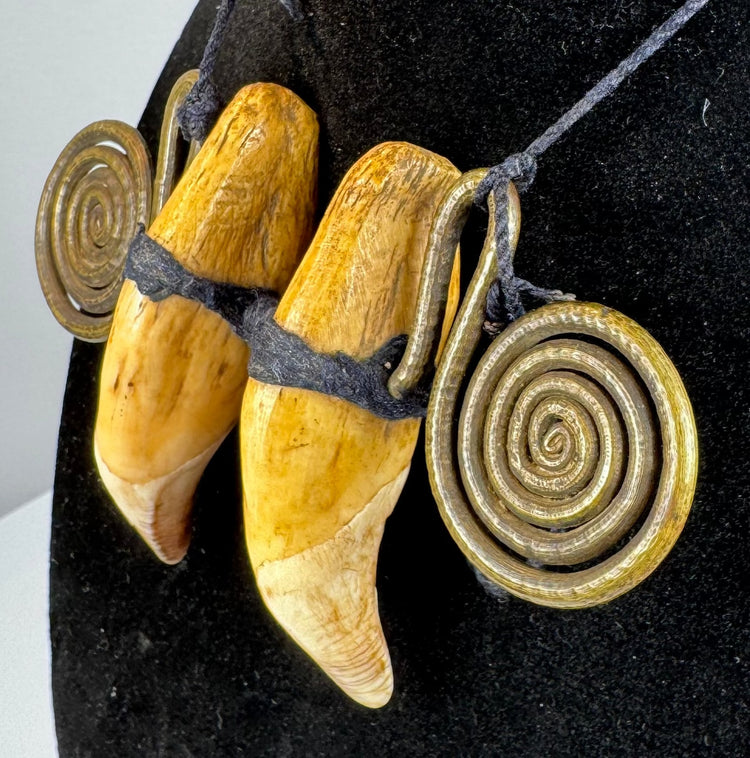
Naga Warrior Tooth & Brass Spiral Status Necklace | Late 19th – Early 20th Century
Description
More
Less
Historical Context & Origin
Region: Nagaland, Northeast India / Indo-Myanmar borderlands, attributed to the Chang Naga
Material: Animal (possibly tiger) teeth, brass, and woven textile cord
Period: Late 19th–Early 20th Century
Description
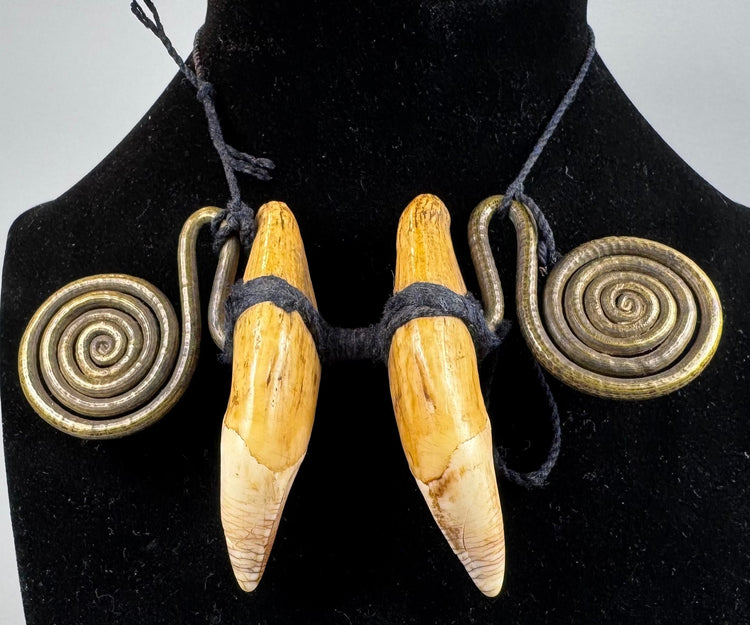
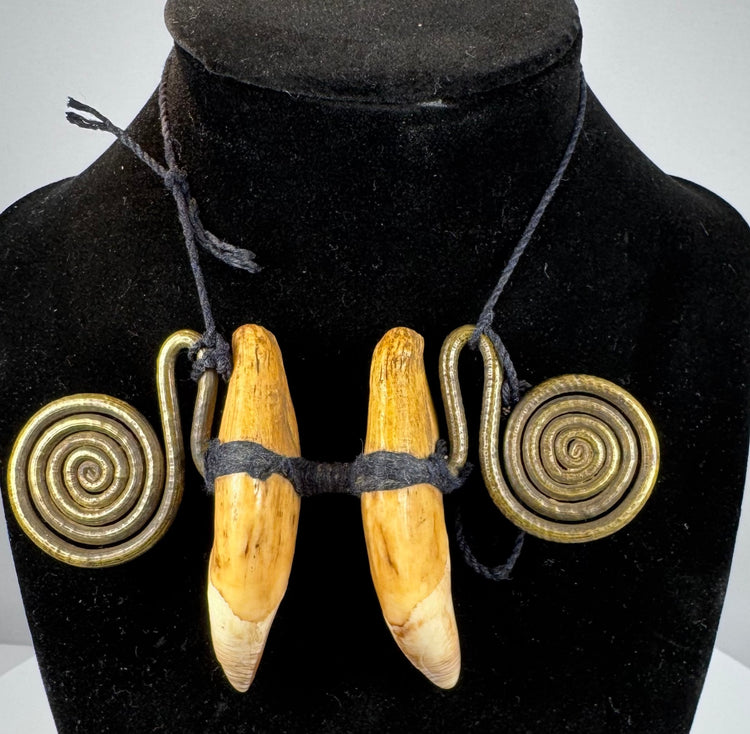
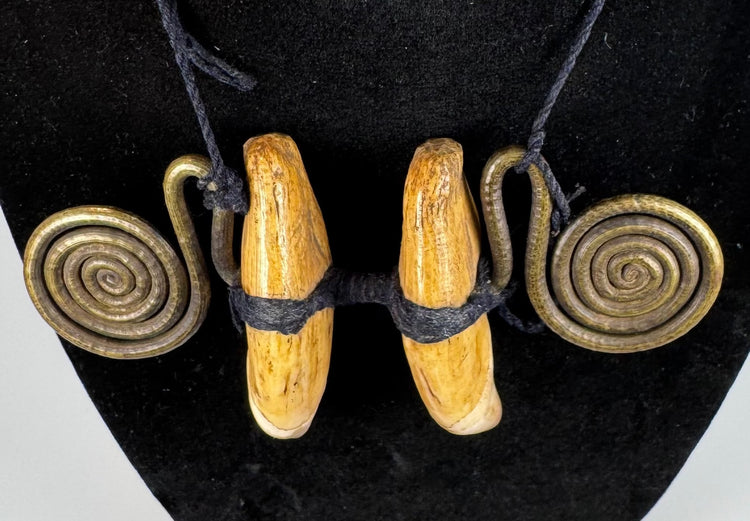
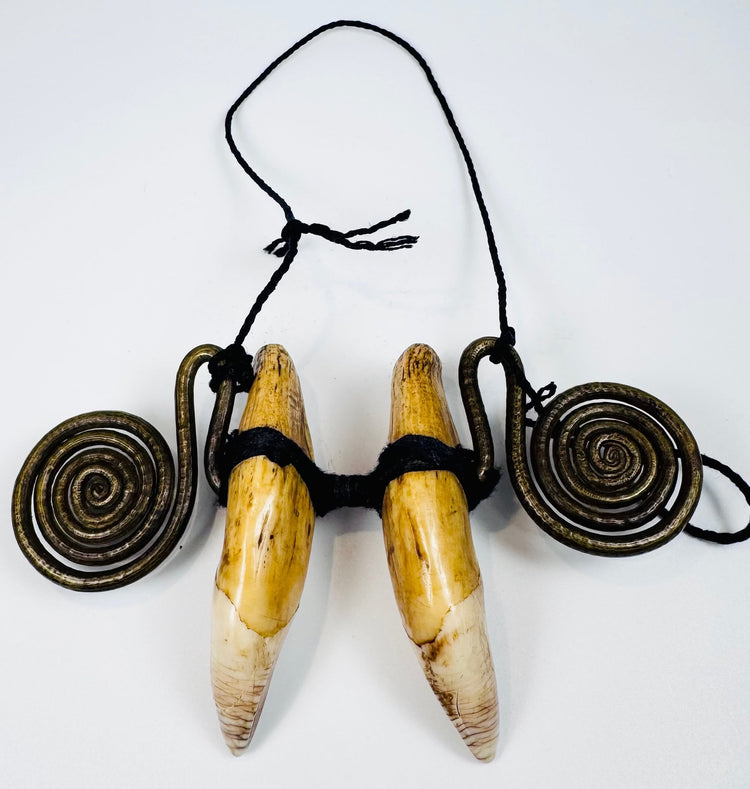
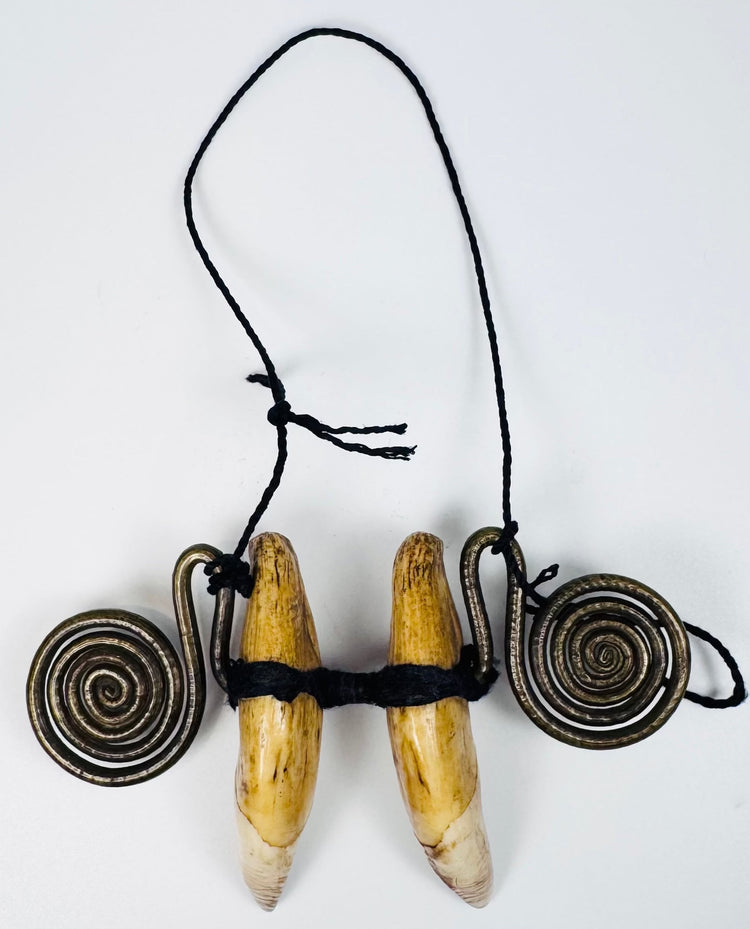
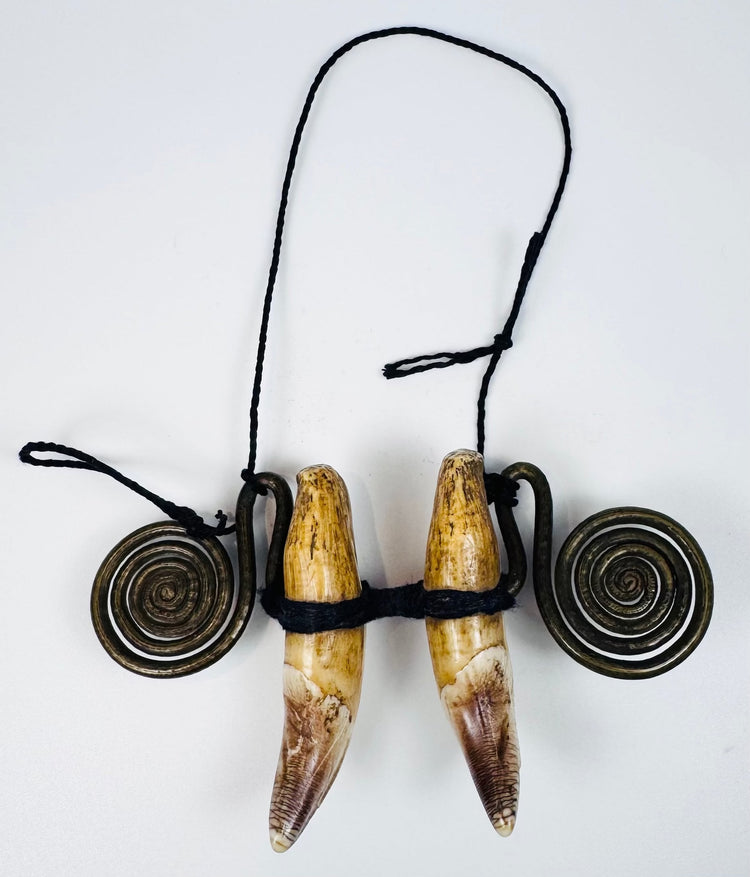
This striking Naga warrior’s status ornament consists of a matched pair of large animal (possibly tiger) canine teeth secured together with black textile binding and flanked by two substantial brass spiral ornaments.
Each tooth is elongated and naturally curved, displaying warm cream, ochre, and brown coloration developed through age and handling. The teeth are positioned vertically beside one another and tightly bound across their centres with dark woven cord. On either side, thick brass wire has been formed into large concentric spirals connected to elongated suspension loops, producing the dramatic symmetrical appearance characteristic of this form of Naga adornment.
Comparable Naga warrior ornaments combine paired teeth with large brass spirals and textile suspension. Historical examples are associated particularly with accomplished hunters and warriors, for whom animal teeth represented hunting prowess, courage, prestige, and social standing.
The surviving cord allows the ornament to be worn around the neck, although the principal visual element is the compact central pendant formed by the teeth and spirals.
Features
- Pair of large animal (possibly tiger) canine teeth
- Teeth retain natural cream, ochre, and brown coloration
- Two substantial hand-formed brass spiral ornaments
- Original-style black textile wrapping joining the central elements
- Large suspension loops incorporated into the brass work
- Powerful symmetrical composition
- Associated with warrior, hunting, prestige, and status traditions
Cultural Significance
Among several Naga communities, tiger teeth and other animal trophies carried meanings extending far beyond simple decoration. They were associated with strength, hunting accomplishment, prestige, and the perceived power of the animal itself. Historical research specifically records paired tiger-tooth ornaments decorated with brass spirals as particularly valued among the Chang, Yimchunger, Sangtam, Phom, and Khiamniungan Naga.
Comparable Naga necklaces were worn by accomplished hunters and warriors, with the tooth elements serving as visible indicators of prowess and achievement. The spiral brass components also became an immediately recognizable feature of this distinctive form of personal adornment.
Condition
Good condition for age. The two teeth remain substantially complete and display natural surface coloration, fine age lines, abrasions, staining, and minor losses consistent with age and historical handling. The brass spirals exhibit dark oxidation, patination, and surface wear. Textile bindings and suspension cord show expected wear and minor fraying. Overall, the ornament retains a strong and visually impressive presentation.
Dimensions (Approximate)
Width: 4.5 in
Height: 2.5 in
Age (Approximate)
100–150 years old
Provenance
Formerly held in a private collection in Philadelphia, Pennsylvania, United States, comprising ethnographic, tribal, and culturally significant objects.
Learn More
Discover a related late 19th–early 20th-century Naga necklace in the collection of The Metropolitan Museum of Art
Explore our Collection of Tribal and Indigenous Artifacts
Description
Historical Context & Origin
Region: Nagaland, Northeast India / Indo-Myanmar borderlands, attributed to the Chang Naga
Material: Animal (possibly tiger) teeth, brass, and woven textile cord
Period: Late 19th–Early 20th Century
Description
This striking Naga warrior’s status ornament consists of a matched pair of large animal (possibly tiger) canine teeth secured together with black textile binding and flanked by two substantial brass spiral ornaments.
Each tooth is elongated and naturally curved, displaying warm cream, ochre, and brown coloration developed through age and handling. The teeth are positioned vertically beside one another and tightly bound across their centres with dark woven cord. On either side, thick brass wire has been formed into large concentric spirals connected to elongated suspension loops, producing the dramatic symmetrical appearance characteristic of this form of Naga adornment.
Comparable Naga warrior ornaments combine paired teeth with large brass spirals and textile suspension. Historical examples are associated particularly with accomplished hunters and warriors, for whom animal teeth represented hunting prowess, courage, prestige, and social standing.
The surviving cord allows the ornament to be worn around the neck, although the principal visual element is the compact central pendant formed by the teeth and spirals.
Features
- Pair of large animal (possibly tiger) canine teeth
- Teeth retain natural cream, ochre, and brown coloration
- Two substantial hand-formed brass spiral ornaments
- Original-style black textile wrapping joining the central elements
- Large suspension loops incorporated into the brass work
- Powerful symmetrical composition
- Associated with warrior, hunting, prestige, and status traditions
Cultural Significance
Among several Naga communities, tiger teeth and other animal trophies carried meanings extending far beyond simple decoration. They were associated with strength, hunting accomplishment, prestige, and the perceived power of the animal itself. Historical research specifically records paired tiger-tooth ornaments decorated with brass spirals as particularly valued among the Chang, Yimchunger, Sangtam, Phom, and Khiamniungan Naga.
Comparable Naga necklaces were worn by accomplished hunters and warriors, with the tooth elements serving as visible indicators of prowess and achievement. The spiral brass components also became an immediately recognizable feature of this distinctive form of personal adornment.
Condition
Good condition for age. The two teeth remain substantially complete and display natural surface coloration, fine age lines, abrasions, staining, and minor losses consistent with age and historical handling. The brass spirals exhibit dark oxidation, patination, and surface wear. Textile bindings and suspension cord show expected wear and minor fraying. Overall, the ornament retains a strong and visually impressive presentation.
Dimensions (Approximate)
Width: 4.5 in
Height: 2.5 in
Age (Approximate)
100–150 years old
Provenance
Formerly held in a private collection in Philadelphia, Pennsylvania, United States, comprising ethnographic, tribal, and culturally significant objects.
Learn More
Discover a related late 19th–early 20th-century Naga necklace in the collection of The Metropolitan Museum of Art
Explore our Collection of Tribal and Indigenous Artifacts
You May Also Like
