

Antique Floral-Carved Wooden Storage Cabinet | Circa Late 19th to Early 20th Century
Couldn't load pickup availability




Antique Floral-Carved Wooden Storage Cabinet | Circa Late 19th to Early 20th Century
Description
More
Less
Historical Context & Origin
Region: South Asia, likely India
Material: Hand-carved wood with iron hardware
Period: Late 19th to early 20th century
Description
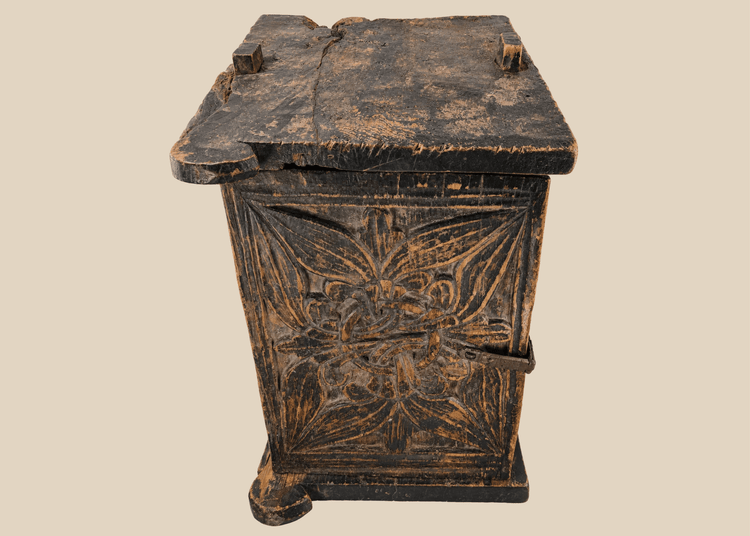
This substantial South Asian carved wooden chest or cabinet is a richly decorated example of traditional domestic furniture, constructed from thick wooden boards and embellished with extensive hand-carved floral and foliate ornamentation.
The front is dominated by a deeply carved panel filled with scrolling stems, broad leaves, blossoms, and interlacing botanical forms arranged across the entire surface. Areas of darkened finish remain within the recessed carving, contrasting strongly against the warmer exposed wood and emphasizing the depth and movement of the design.
An old iron strap latch is mounted along the edge of the front door, allowing the carved panel to open and reveal a simple, deep interior storage compartment. The ironwork itself displays extensive oxidation and wear consistent with the overall aged character of the chest.
The upper surface is formed from a substantial wooden plank with projecting ends and traditional joinery. The pronounced irregularities, hand-worked surfaces, thick construction, and surviving wooden pegs and joints give the piece a distinctly vernacular character.
Features
- Large deeply carved floral and foliate front panel
- Extensive scrolling vine and leaf decoration
- Original-style iron strap latch and hardware
- Thick plank construction
- Traditional wooden joinery and pegged elements
- Deep interior storage compartment
- Dark aged surface with exposed warm wood throughout
- Substantial historic wear and patina
Cultural Significance
Carved wooden storage furniture formed an important component of domestic material culture throughout South Asia. Chests and small cabinets served practical roles in storing textiles, valuables, household goods, and personal possessions while also providing craftspeople with large surfaces for decorative carving.
The dense botanical ornamentation seen across the front of this example reflects the longstanding prominence of floral, foliate, and scrolling decoration within South Asian woodworking traditions. The carving transforms an otherwise utilitarian storage object into an architectural and sculptural furnishing.
Condition
Good antique ethnographic condition with extensive age- and use-related wear throughout. The wood exhibits scratches, abrasions, surface losses, fading, discoloration, cracks, splitting, chips, edge losses, and areas of old deterioration.
The upper plank displays a substantial split and loss along one section, together with additional cracking and irregularity throughout. The front carved panel retains strong decorative definition despite extensive surface wear. The iron latch exhibits oxidation, corrosion, and surface wear.
The interior shows staining, surface wear, old holes, cracking, and natural variation associated with prolonged use and age. Construction irregularities, old repairs, losses, and evidence of traditional joinery remain visible throughout.
Dimensions (Approximate)
Height: 20 in
Width: 23 in
Depth: 14.5 in
Age (Approximate)
80–130 years old
Provenance
From the Estates of Raymond Bahor and Michael Mahoney. Raymond Bahor was the longtime partner of Michael Mahoney. Their lives and legacy were jointly commemorated by Trinity College following their passing, and National Gallery of Art annual reports also record Raymond Bahor and Michael R. T. Mahoney together in connection with the institution.
Michael Mahoney was a professor and Chair of the Fine Arts Department at Trinity College in Hartford, Connecticut, serving there until his retirement in 1991. Before his academic career at Trinity, Mahoney worked as a curator and editor at the National Gallery of Art in Washington, D.C.
Subsequently handled by Quinn’s Auction Galleries, Falls Church, Virginia, United States, a longstanding auction house specializing in fine art, antiques, decorative arts, furnishings, and private collections.
Later acquired by a private collection in Toronto, Ontario, Canada.
Learn More
Trace the artistic traditions of carved dowry chests through AramcoWorld
Browse our Collection of Art, Ceramics and Collectibles
Description
Historical Context & Origin
Region: South Asia, likely India
Material: Hand-carved wood with iron hardware
Period: Late 19th to early 20th century
Description
This substantial South Asian carved wooden chest or cabinet is a richly decorated example of traditional domestic furniture, constructed from thick wooden boards and embellished with extensive hand-carved floral and foliate ornamentation.
The front is dominated by a deeply carved panel filled with scrolling stems, broad leaves, blossoms, and interlacing botanical forms arranged across the entire surface. Areas of darkened finish remain within the recessed carving, contrasting strongly against the warmer exposed wood and emphasizing the depth and movement of the design.
An old iron strap latch is mounted along the edge of the front door, allowing the carved panel to open and reveal a simple, deep interior storage compartment. The ironwork itself displays extensive oxidation and wear consistent with the overall aged character of the chest.
The upper surface is formed from a substantial wooden plank with projecting ends and traditional joinery. The pronounced irregularities, hand-worked surfaces, thick construction, and surviving wooden pegs and joints give the piece a distinctly vernacular character.
Features
- Large deeply carved floral and foliate front panel
- Extensive scrolling vine and leaf decoration
- Original-style iron strap latch and hardware
- Thick plank construction
- Traditional wooden joinery and pegged elements
- Deep interior storage compartment
- Dark aged surface with exposed warm wood throughout
- Substantial historic wear and patina
Cultural Significance
Carved wooden storage furniture formed an important component of domestic material culture throughout South Asia. Chests and small cabinets served practical roles in storing textiles, valuables, household goods, and personal possessions while also providing craftspeople with large surfaces for decorative carving.
The dense botanical ornamentation seen across the front of this example reflects the longstanding prominence of floral, foliate, and scrolling decoration within South Asian woodworking traditions. The carving transforms an otherwise utilitarian storage object into an architectural and sculptural furnishing.
Condition
Good antique ethnographic condition with extensive age- and use-related wear throughout. The wood exhibits scratches, abrasions, surface losses, fading, discoloration, cracks, splitting, chips, edge losses, and areas of old deterioration.
The upper plank displays a substantial split and loss along one section, together with additional cracking and irregularity throughout. The front carved panel retains strong decorative definition despite extensive surface wear. The iron latch exhibits oxidation, corrosion, and surface wear.
The interior shows staining, surface wear, old holes, cracking, and natural variation associated with prolonged use and age. Construction irregularities, old repairs, losses, and evidence of traditional joinery remain visible throughout.
Dimensions (Approximate)
Height: 20 in
Width: 23 in
Depth: 14.5 in
Age (Approximate)
80–130 years old
Provenance
From the Estates of Raymond Bahor and Michael Mahoney. Raymond Bahor was the longtime partner of Michael Mahoney. Their lives and legacy were jointly commemorated by Trinity College following their passing, and National Gallery of Art annual reports also record Raymond Bahor and Michael R. T. Mahoney together in connection with the institution.
Michael Mahoney was a professor and Chair of the Fine Arts Department at Trinity College in Hartford, Connecticut, serving there until his retirement in 1991. Before his academic career at Trinity, Mahoney worked as a curator and editor at the National Gallery of Art in Washington, D.C.
Subsequently handled by Quinn’s Auction Galleries, Falls Church, Virginia, United States, a longstanding auction house specializing in fine art, antiques, decorative arts, furnishings, and private collections.
Later acquired by a private collection in Toronto, Ontario, Canada.
Learn More
Trace the artistic traditions of carved dowry chests through AramcoWorld
Browse our Collection of Art, Ceramics and Collectibles
You May Also Like
