



Antique Spencer Lens Company Compound Monocular Microscope with Mahogany Case & Accessories | Circa 1910–1920 CE
Couldn't load pickup availability


Antique Spencer Lens Company Compound Monocular Microscope with Mahogany Case & Accessories | Circa 1910–1920 CE
Description
More
Less
Historical Context & Origin
Region: Buffalo, New York, United States
Material: Black enamelled metal, nickel-plated brass, precision optical glass, cast iron, mahogany, and other hardwood components
Period: Early 20th Century, circa 1910–1920 CE
Description
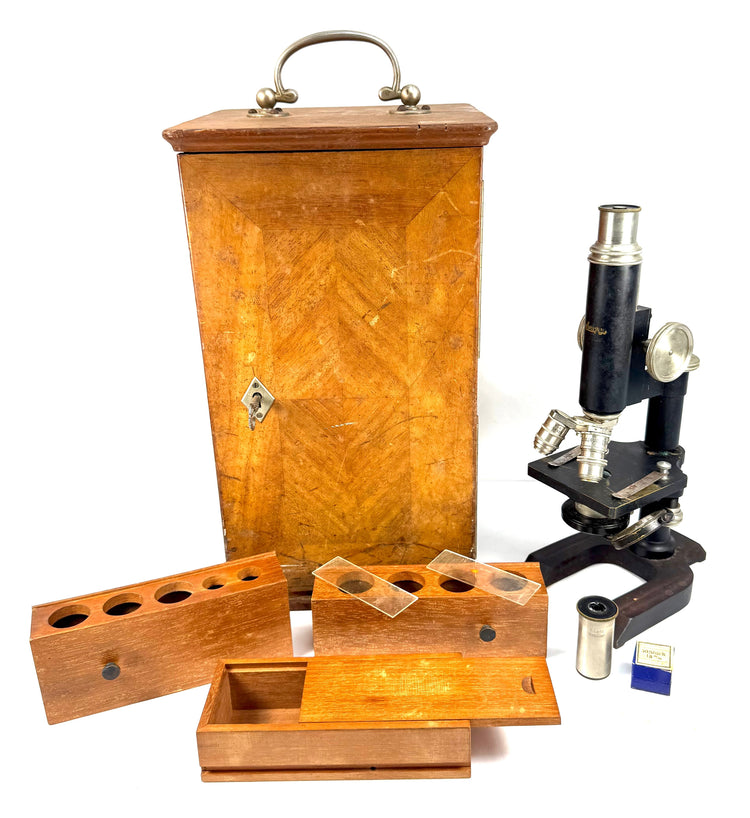
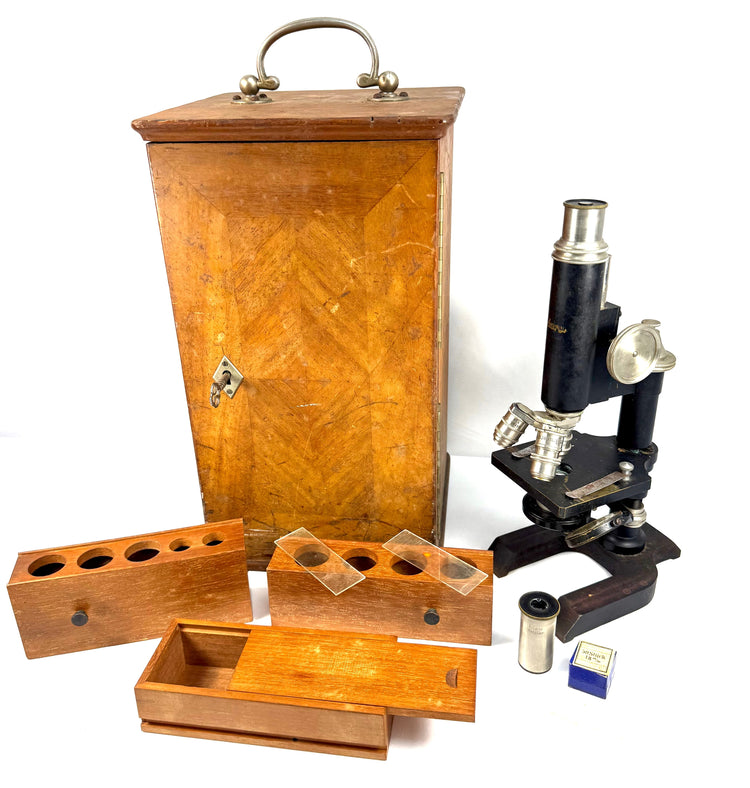
An impressive early 20th-century American compound monocular laboratory microscope manufactured by the renowned Spencer Lens Company of Buffalo, New York, dating to circa 1910–1920. This finely engineered scientific instrument retains its substantial horseshoe-shaped base, black enamelled cylindrical body, nickel-plated brass optical fittings, precision focusing mechanisms, and revolving triple-objective nosepiece. Accompanied by its period wooden carrying cabinet and an assortment of optical accessories, specimen slides, and fitted wooden storage components, this collection represents an important period in the development of American scientific instrumentation.
The Spencer Lens Company was established in Buffalo in 1895 under the technical direction of Herbert R. Spencer, continuing the pioneering optical manufacturing traditions established by his father, Charles A. Spencer (1813–1881). Charles Spencer was among America's earliest successful manufacturers of precision microscopes, helping establish an American optical industry at a time when European manufacturers dominated the scientific instrument market.
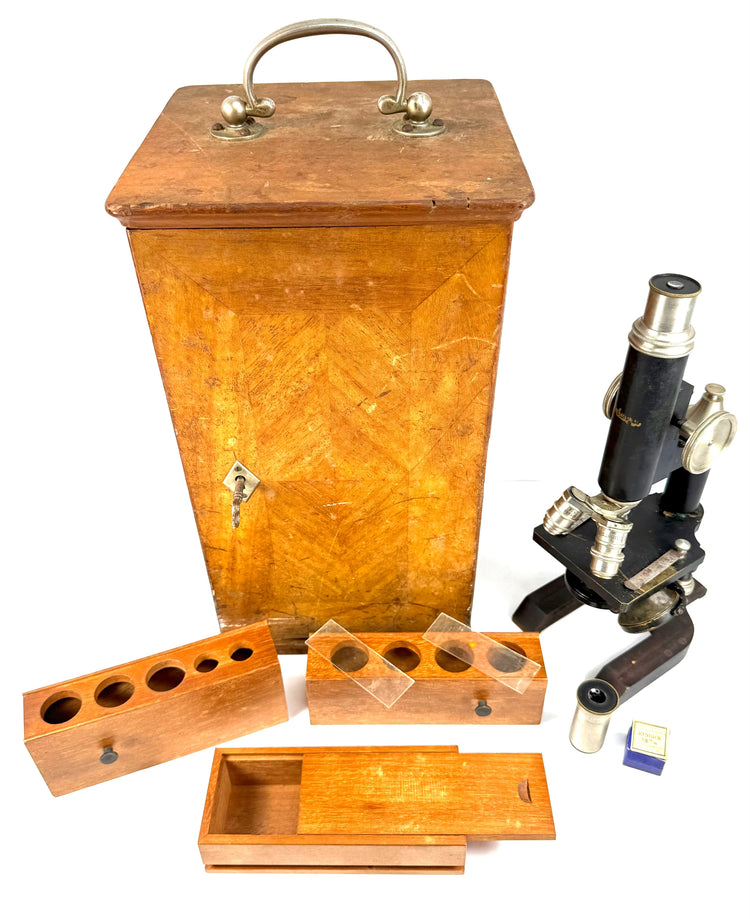
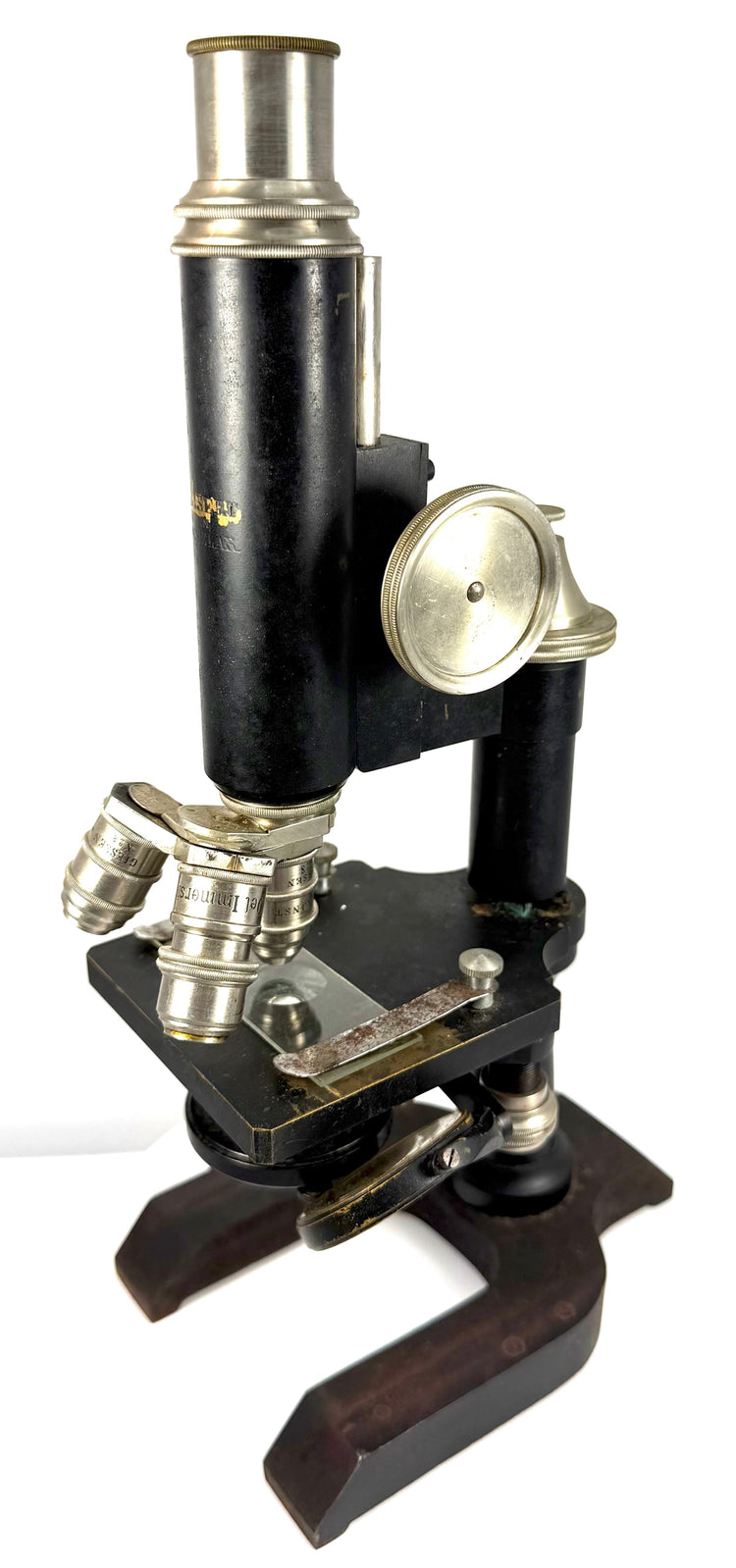
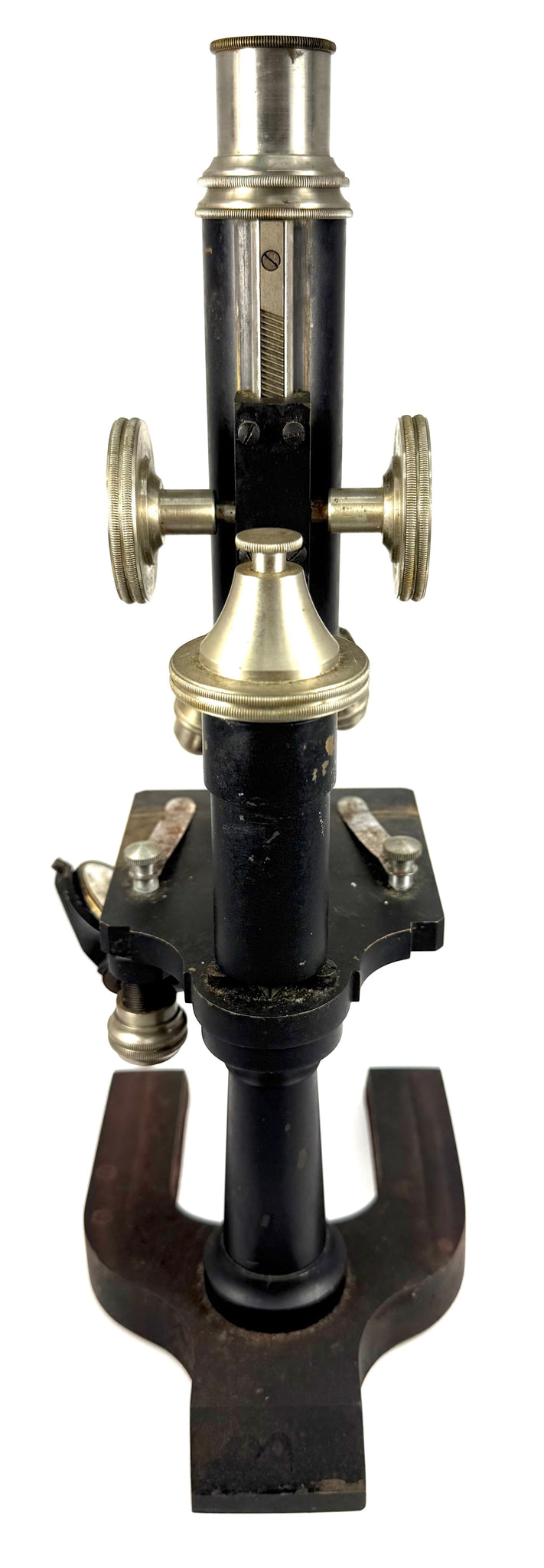
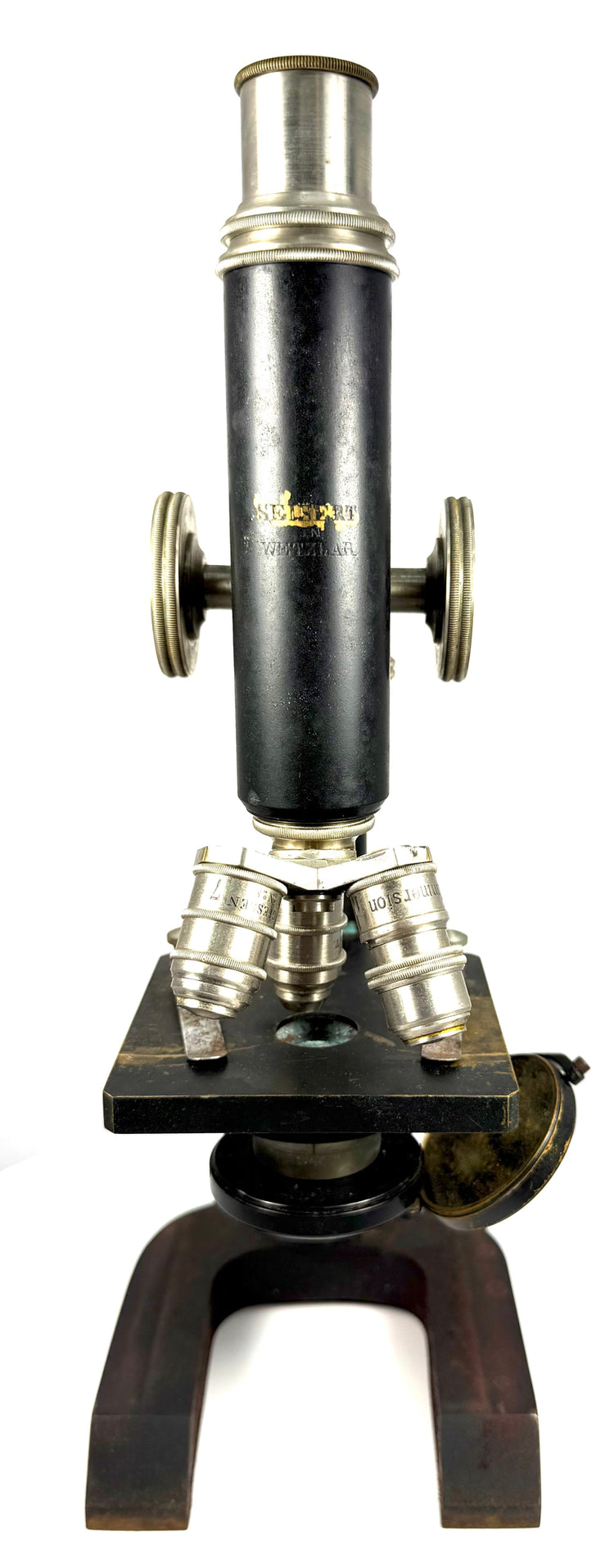
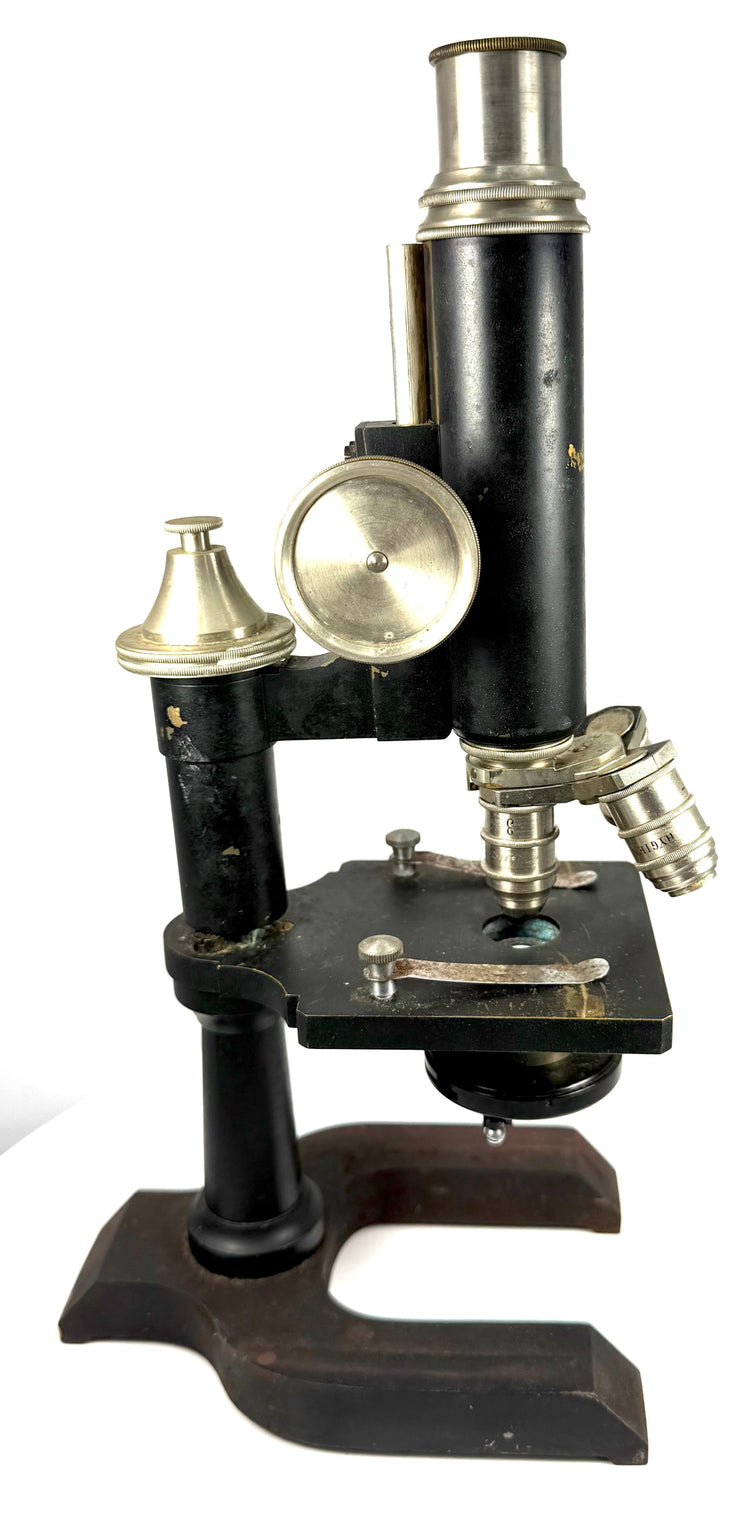
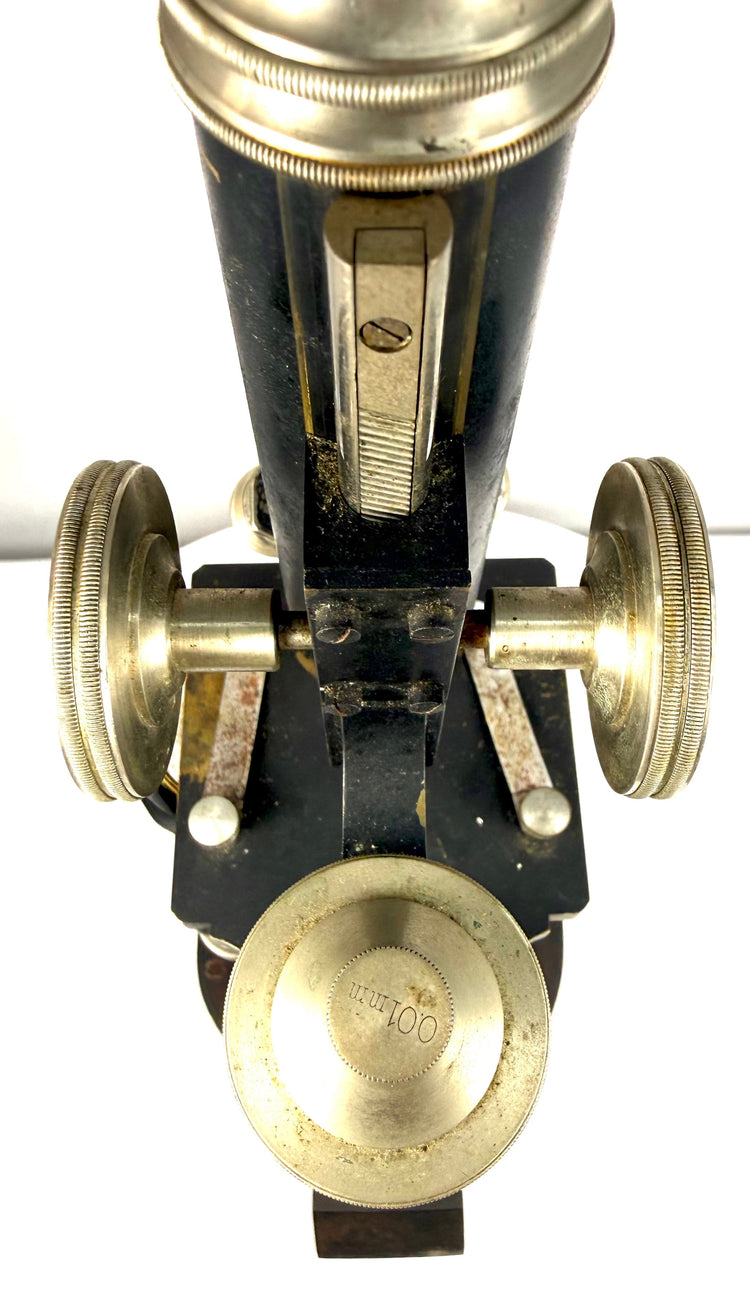
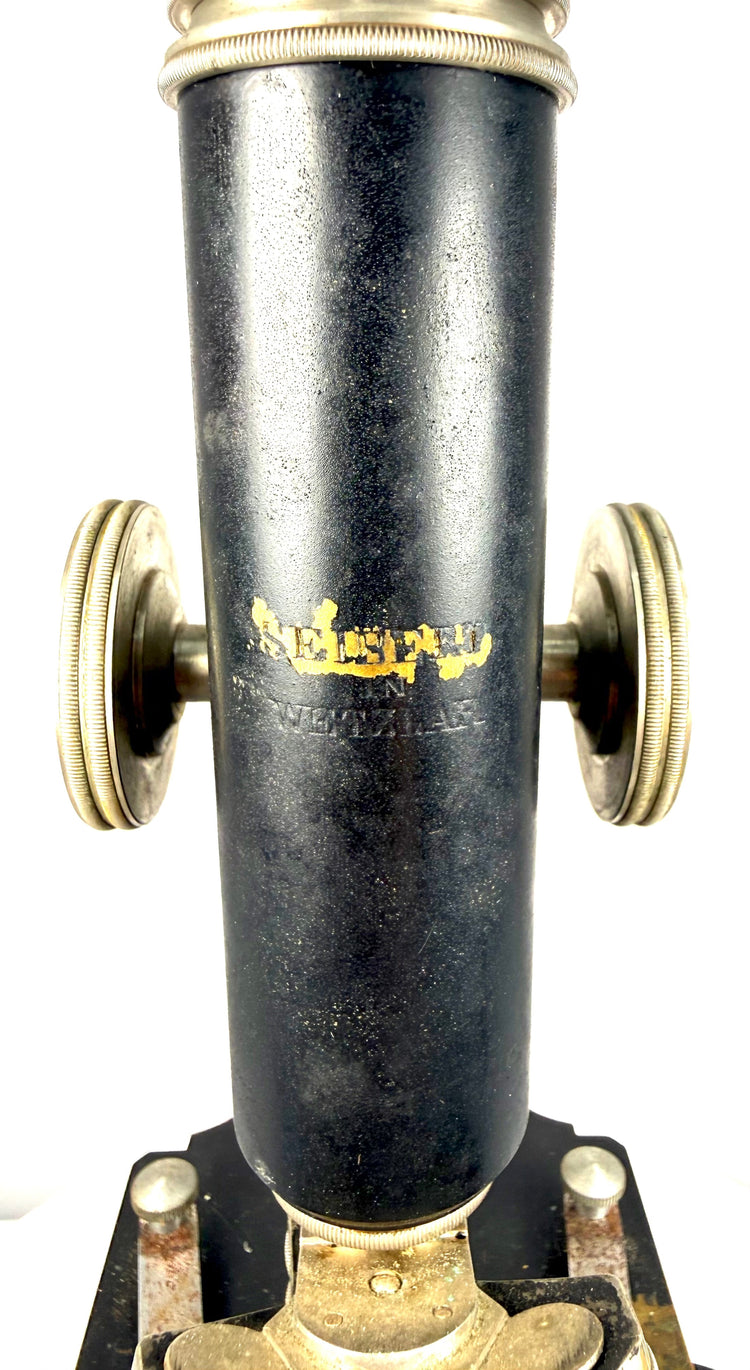
This example features a tall black enamelled monocular body retaining remnants of its original gilt Spencer manufacturer's marking. Its substantial cylindrical optical tube is mounted on a robust continental-pattern stand, supported by a heavy horseshoe-shaped metal base designed to provide stability during observation.
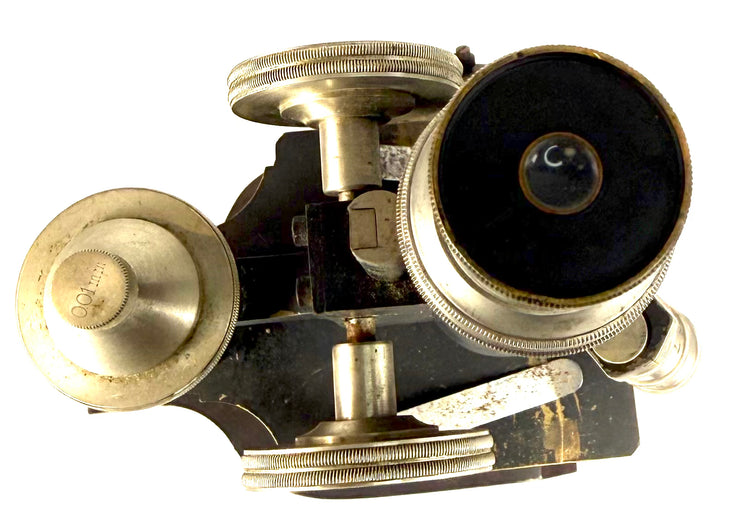
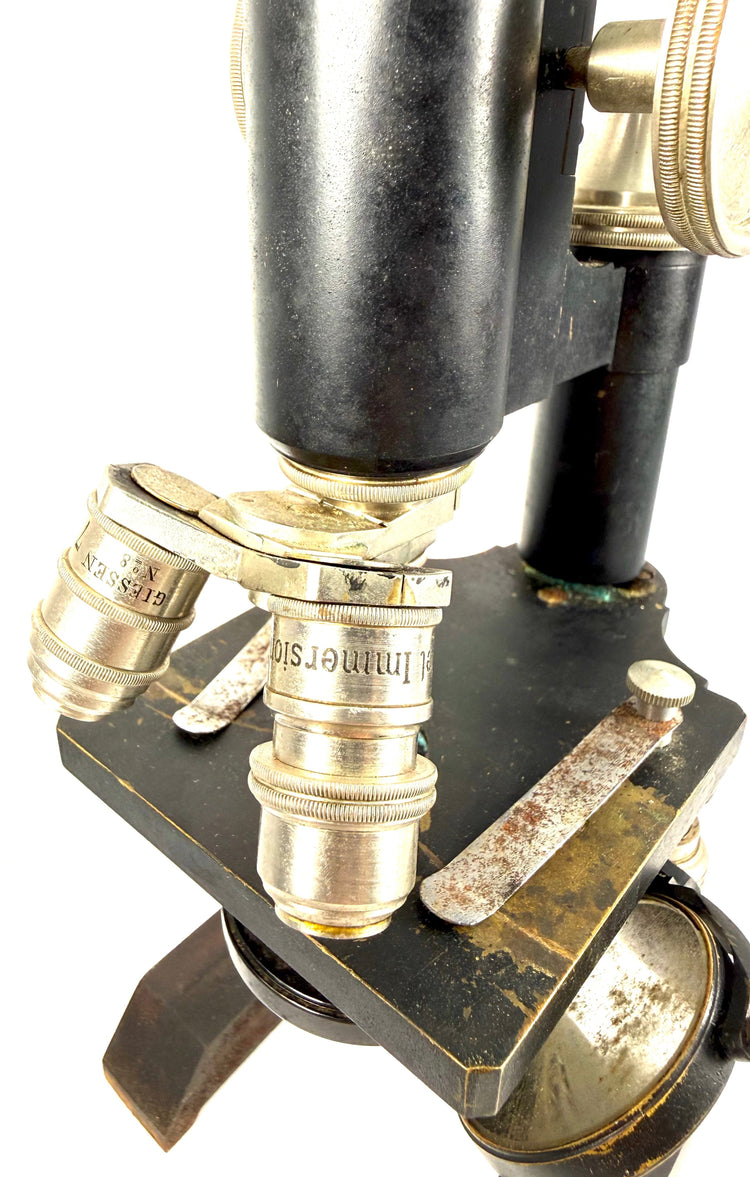
Large bilateral nickel-plated focusing wheels operate the rack-and-pinion coarse adjustment mechanism, while a separate calibrated fine-adjustment control permits precise positioning of the optical assembly. The instrument is fitted with a revolving triple-objective nosepiece, allowing the operator to select between three objective lenses for different levels of magnification. One objective is identified as an immersion objective, a specialized optical component traditionally used for high-magnification microscopic examination.
The rectangular specimen stage retains its metal slide-holding clips, while the adjustable substage assembly incorporates optical illumination components, including a condenser arrangement and pivoting mirror. These elements were essential features of professional laboratory microscopes before integrated electric illumination became commonplace.
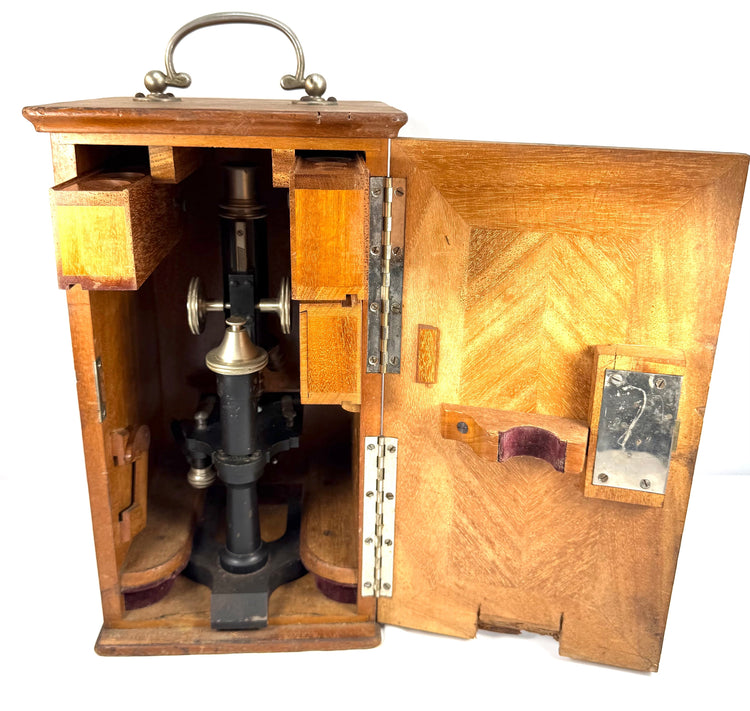
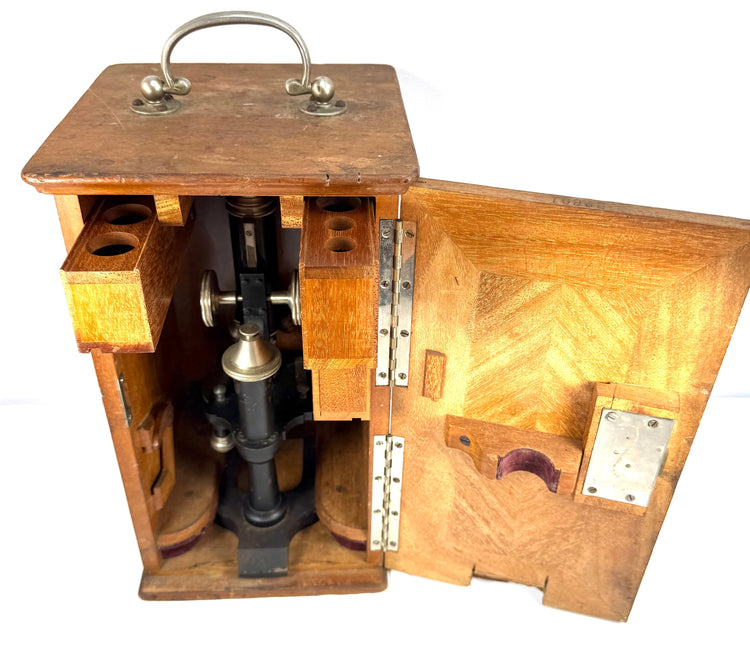
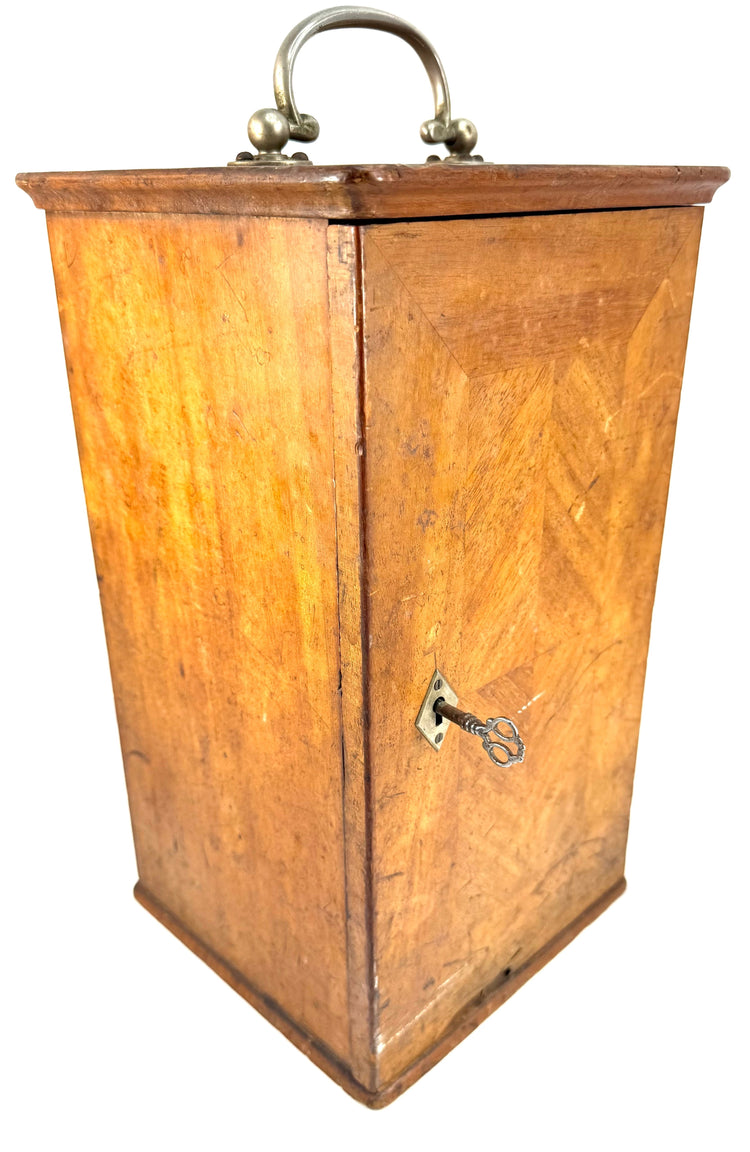
The instrument is accompanied by a tall, panelled wooden carrying cabinet displaying an attractive warm honey-brown finish and decorative geometric veneer arrangement across its front door. The cabinet retains its curved metal carrying handle, original-style locking hardware, and accompanying key. Such purpose-built cabinets were designed to protect delicate optical instruments from dust, accidental damage, and environmental exposure while allowing convenient transportation and storage.
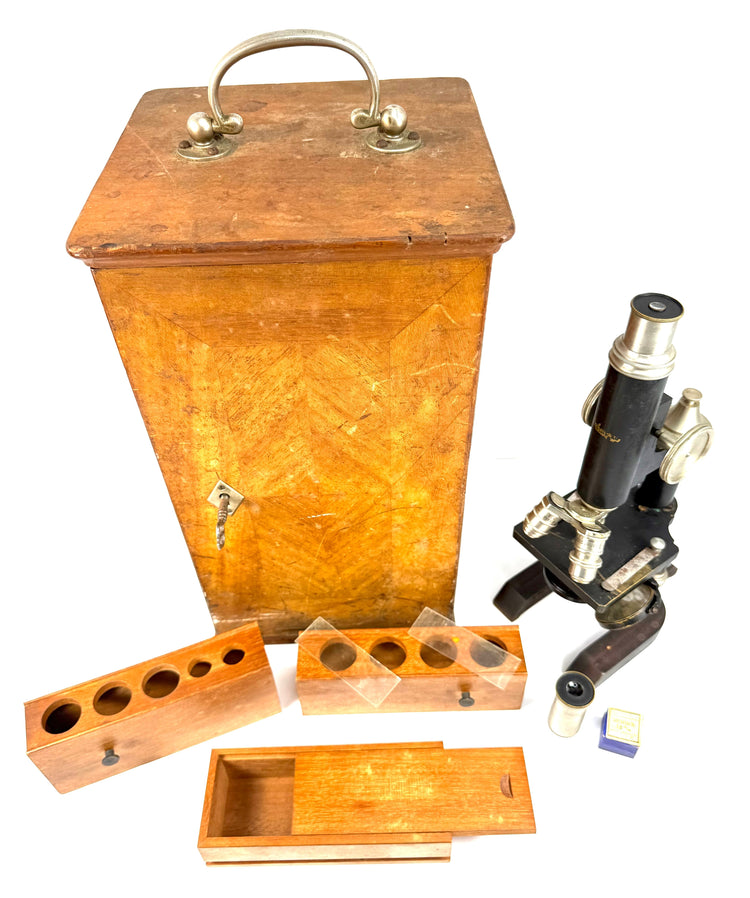
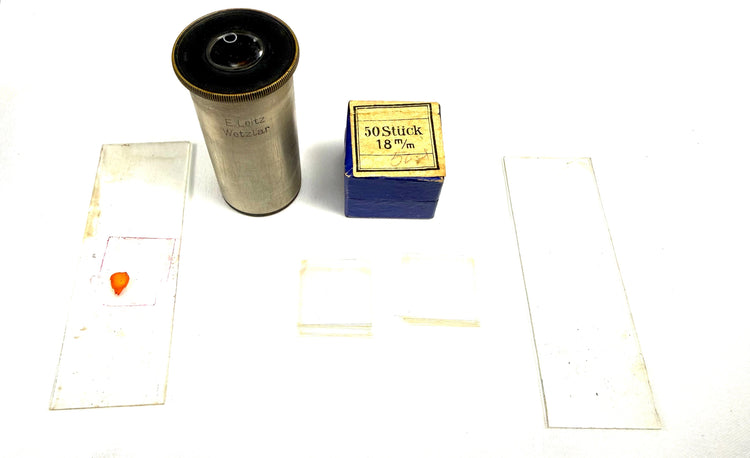
An assortment of additional scientific accessories accompanies the microscope, including two removable wooden objective or accessory racks, a rectangular wooden slide-storage box with sliding cover, several glass microscope slides, and a small period paper box labelled "50 Stück 18 m/m," indicating an original package designation of 50 pieces measuring 18 millimetres, consistent with microscope cover glasses.
Of particular interest is a separate metal optical component bearing the inscription "E. Leitz Wetzlar." This marking identifies the celebrated German optical manufacturer Ernst Leitz of Wetzlar, another important name in the history of precision microscope production.
Features
- Early 20th-century Spencer Lens Company compound monocular laboratory microscope
- Black enamelled cylindrical optical body retaining remnants of the original gilt Spencer manufacturer's marking
- Nickel-plated brass focusing wheels and optical fittings
- Substantial continental-pattern stand with horseshoe-shaped metal base
- Rack-and-pinion coarse focusing mechanism
- Separate calibrated fine-adjustment control
- Revolving triple-objective nosepiece
- Three fitted objective lenses, including an immersion objective
- Rectangular specimen stage with metal slide-holding clips
- Adjustable substage optical assembly with condenser and reflecting mirror
- Precision optical components characteristic of early laboratory instruments
- Period wooden carrying cabinet with decorative geometric veneer and honey-brown finish
- Curved metal carrying handle and locking door with accompanying key
- Two removable wooden objective or accessory storage racks
- Wooden slide-storage box with sliding lid
- Assorted glass microscope slides, including a prepared specimen slide
- Separate Ernst Leitz Wetzlar optical component
- Period paper box labelled "50 Stück 18 m/m," associated with microscope cover glasses
Cultural Significance
The development of the compound microscope transformed scientific understanding of the natural world, permitting researchers to investigate microscopic structures previously invisible to the human eye. By the beginning of the 20th century, microscopes had become indispensable instruments in medicine, bacteriology, pathology, botany, zoology, and the emerging fields of laboratory-based biological research.
The Spencer Lens Company played an important role in establishing the United States as a significant producer of professional optical instruments. Building upon the pioneering work of Charles A. Spencer during the 19th century, the company's microscopes helped supply American universities, hospitals, physicians, and scientific institutions with domestically manufactured equipment capable of meeting demanding professional requirements.
The triple-objective arrangement seen on this instrument reflects the growing sophistication of laboratory microscopy. By allowing researchers to change magnification without replacing the entire optical assembly, rotating objective turrets improved both efficiency and precision. The incorporation of fine focusing adjustments, condenser systems, and reflective illumination further enhanced the ability to examine biological specimens and other microscopic materials.
The accompanying wooden cabinet and accessories provide additional insight into the practical requirements of scientific work during this period. Microscopes were valuable precision instruments, and purpose-built storage cabinets served an important role in their protection and preservation.
The inclusion of a separately marked Ernst Leitz optical component also illustrates the international character of the early scientific instrument industry, in which American and European manufacturers contributed to advances in microscopy.
This preserved microscope collection reflects the intersection of American optical engineering, traditional woodworking, and the rapid advancement of scientific research during the early 20th century. Its surviving cabinet, objective lenses, precision adjustments, and period accessories make it a compelling example of historical scientific instrumentation.
Condition
The microscope and accompanying accessories present in good overall antique condition, with visible wear consistent with their age and historical use.
The black enamelled body retains much of its original finish, with scattered scratches, small areas of paint loss, surface abrasions, and remnants of the original gilt Spencer trade marking. The nickel-plated brass components exhibit age-related tarnishing, minor oxidation, and surface wear.
The focusing wheels, revolving objective assembly, specimen stage, and substage components remain present. Three objective lenses are fitted to the microscope. The stage clips show areas of surface oxidation, while minor age-related discolouration is visible around certain metal joints and fittings.
The substantial horseshoe-shaped base retains its dark finish, exhibiting surface abrasions and areas of age-related wear.
The wooden carrying cabinet displays scratches, minor edge wear, scattered surface marks, and variations in its original finish. The decorative veneer remains visually attractive, and the cabinet retains its metal carrying handle, locking hardware, and key.
The accompanying wooden accessory racks and slide-storage box display minor wear consistent with age and handling. Several glass slides and the additional marked Leitz optical component are included as photographed. Some fitted cabinet compartments are vacant.
The microscope has not been independently tested for optical performance, complete mechanical functionality, or calibration.
Dimensions (Approximate)
Complete carrying cabinet:
Height: 14 in
Width: 7.25 in
Depth: 7.25 in
The microscope and individual accessories are of varying dimensions.
Age (Approximate)
106–116 years old
Provenance
Formerly part of a private collection in Arlington, Virginia, United States. The microscope and its accompanying scientific accessories were preserved together within this American private collection before subsequently entering the antiquities and historical scientific instrument market.
Learn More
Examine a related Spencer Lens Company monocular microscope dating to 1915–1920 in the collection of the Science Museum Group
Discover more historic instruments and scientific curiosities in our Science, Exploration & Curiosities Collection
Description
Historical Context & Origin
Region: Buffalo, New York, United States
Material: Black enamelled metal, nickel-plated brass, precision optical glass, cast iron, mahogany, and other hardwood components
Period: Early 20th Century, circa 1910–1920 CE
Description
An impressive early 20th-century American compound monocular laboratory microscope manufactured by the renowned Spencer Lens Company of Buffalo, New York, dating to circa 1910–1920. This finely engineered scientific instrument retains its substantial horseshoe-shaped base, black enamelled cylindrical body, nickel-plated brass optical fittings, precision focusing mechanisms, and revolving triple-objective nosepiece. Accompanied by its period wooden carrying cabinet and an assortment of optical accessories, specimen slides, and fitted wooden storage components, this collection represents an important period in the development of American scientific instrumentation.
The Spencer Lens Company was established in Buffalo in 1895 under the technical direction of Herbert R. Spencer, continuing the pioneering optical manufacturing traditions established by his father, Charles A. Spencer (1813–1881). Charles Spencer was among America's earliest successful manufacturers of precision microscopes, helping establish an American optical industry at a time when European manufacturers dominated the scientific instrument market.
This example features a tall black enamelled monocular body retaining remnants of its original gilt Spencer manufacturer's marking. Its substantial cylindrical optical tube is mounted on a robust continental-pattern stand, supported by a heavy horseshoe-shaped metal base designed to provide stability during observation.
Large bilateral nickel-plated focusing wheels operate the rack-and-pinion coarse adjustment mechanism, while a separate calibrated fine-adjustment control permits precise positioning of the optical assembly. The instrument is fitted with a revolving triple-objective nosepiece, allowing the operator to select between three objective lenses for different levels of magnification. One objective is identified as an immersion objective, a specialized optical component traditionally used for high-magnification microscopic examination.
The rectangular specimen stage retains its metal slide-holding clips, while the adjustable substage assembly incorporates optical illumination components, including a condenser arrangement and pivoting mirror. These elements were essential features of professional laboratory microscopes before integrated electric illumination became commonplace.
The instrument is accompanied by a tall, panelled wooden carrying cabinet displaying an attractive warm honey-brown finish and decorative geometric veneer arrangement across its front door. The cabinet retains its curved metal carrying handle, original-style locking hardware, and accompanying key. Such purpose-built cabinets were designed to protect delicate optical instruments from dust, accidental damage, and environmental exposure while allowing convenient transportation and storage.
An assortment of additional scientific accessories accompanies the microscope, including two removable wooden objective or accessory racks, a rectangular wooden slide-storage box with sliding cover, several glass microscope slides, and a small period paper box labelled "50 Stück 18 m/m," indicating an original package designation of 50 pieces measuring 18 millimetres, consistent with microscope cover glasses.
Of particular interest is a separate metal optical component bearing the inscription "E. Leitz Wetzlar." This marking identifies the celebrated German optical manufacturer Ernst Leitz of Wetzlar, another important name in the history of precision microscope production.
Features
- Early 20th-century Spencer Lens Company compound monocular laboratory microscope
- Black enamelled cylindrical optical body retaining remnants of the original gilt Spencer manufacturer's marking
- Nickel-plated brass focusing wheels and optical fittings
- Substantial continental-pattern stand with horseshoe-shaped metal base
- Rack-and-pinion coarse focusing mechanism
- Separate calibrated fine-adjustment control
- Revolving triple-objective nosepiece
- Three fitted objective lenses, including an immersion objective
- Rectangular specimen stage with metal slide-holding clips
- Adjustable substage optical assembly with condenser and reflecting mirror
- Precision optical components characteristic of early laboratory instruments
- Period wooden carrying cabinet with decorative geometric veneer and honey-brown finish
- Curved metal carrying handle and locking door with accompanying key
- Two removable wooden objective or accessory storage racks
- Wooden slide-storage box with sliding lid
- Assorted glass microscope slides, including a prepared specimen slide
- Separate Ernst Leitz Wetzlar optical component
- Period paper box labelled "50 Stück 18 m/m," associated with microscope cover glasses
Cultural Significance
The development of the compound microscope transformed scientific understanding of the natural world, permitting researchers to investigate microscopic structures previously invisible to the human eye. By the beginning of the 20th century, microscopes had become indispensable instruments in medicine, bacteriology, pathology, botany, zoology, and the emerging fields of laboratory-based biological research.
The Spencer Lens Company played an important role in establishing the United States as a significant producer of professional optical instruments. Building upon the pioneering work of Charles A. Spencer during the 19th century, the company's microscopes helped supply American universities, hospitals, physicians, and scientific institutions with domestically manufactured equipment capable of meeting demanding professional requirements.
The triple-objective arrangement seen on this instrument reflects the growing sophistication of laboratory microscopy. By allowing researchers to change magnification without replacing the entire optical assembly, rotating objective turrets improved both efficiency and precision. The incorporation of fine focusing adjustments, condenser systems, and reflective illumination further enhanced the ability to examine biological specimens and other microscopic materials.
The accompanying wooden cabinet and accessories provide additional insight into the practical requirements of scientific work during this period. Microscopes were valuable precision instruments, and purpose-built storage cabinets served an important role in their protection and preservation.
The inclusion of a separately marked Ernst Leitz optical component also illustrates the international character of the early scientific instrument industry, in which American and European manufacturers contributed to advances in microscopy.
This preserved microscope collection reflects the intersection of American optical engineering, traditional woodworking, and the rapid advancement of scientific research during the early 20th century. Its surviving cabinet, objective lenses, precision adjustments, and period accessories make it a compelling example of historical scientific instrumentation.
Condition
The microscope and accompanying accessories present in good overall antique condition, with visible wear consistent with their age and historical use.
The black enamelled body retains much of its original finish, with scattered scratches, small areas of paint loss, surface abrasions, and remnants of the original gilt Spencer trade marking. The nickel-plated brass components exhibit age-related tarnishing, minor oxidation, and surface wear.
The focusing wheels, revolving objective assembly, specimen stage, and substage components remain present. Three objective lenses are fitted to the microscope. The stage clips show areas of surface oxidation, while minor age-related discolouration is visible around certain metal joints and fittings.
The substantial horseshoe-shaped base retains its dark finish, exhibiting surface abrasions and areas of age-related wear.
The wooden carrying cabinet displays scratches, minor edge wear, scattered surface marks, and variations in its original finish. The decorative veneer remains visually attractive, and the cabinet retains its metal carrying handle, locking hardware, and key.
The accompanying wooden accessory racks and slide-storage box display minor wear consistent with age and handling. Several glass slides and the additional marked Leitz optical component are included as photographed. Some fitted cabinet compartments are vacant.
The microscope has not been independently tested for optical performance, complete mechanical functionality, or calibration.
Dimensions (Approximate)
Complete carrying cabinet:
Height: 14 in
Width: 7.25 in
Depth: 7.25 in
The microscope and individual accessories are of varying dimensions.
Age (Approximate)
106–116 years old
Provenance
Formerly part of a private collection in Arlington, Virginia, United States. The microscope and its accompanying scientific accessories were preserved together within this American private collection before subsequently entering the antiquities and historical scientific instrument market.
Learn More
Examine a related Spencer Lens Company monocular microscope dating to 1915–1920 in the collection of the Science Museum Group
Discover more historic instruments and scientific curiosities in our Science, Exploration & Curiosities Collection
You May Also Like
