

Archaeological Iron Javelin or Spear Point | Circa 3rd – 14th Century CE
Couldn't load pickup availability


Archaeological Iron Javelin or Spear Point | Circa 3rd – 14th Century CE
Description
More
Less
Historical Context & Origin
Region: Europe
Material: Hand-forged iron
Period: Late Roman to Medieval Period, circa 3rd–14th Century CE
Description
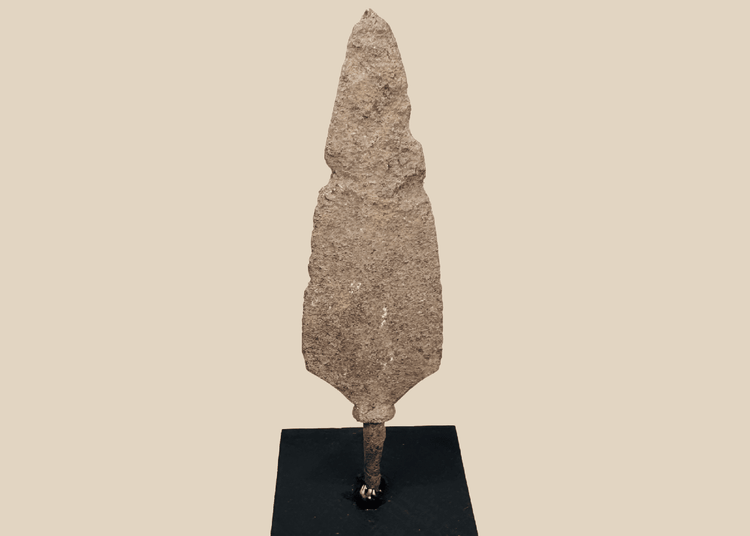
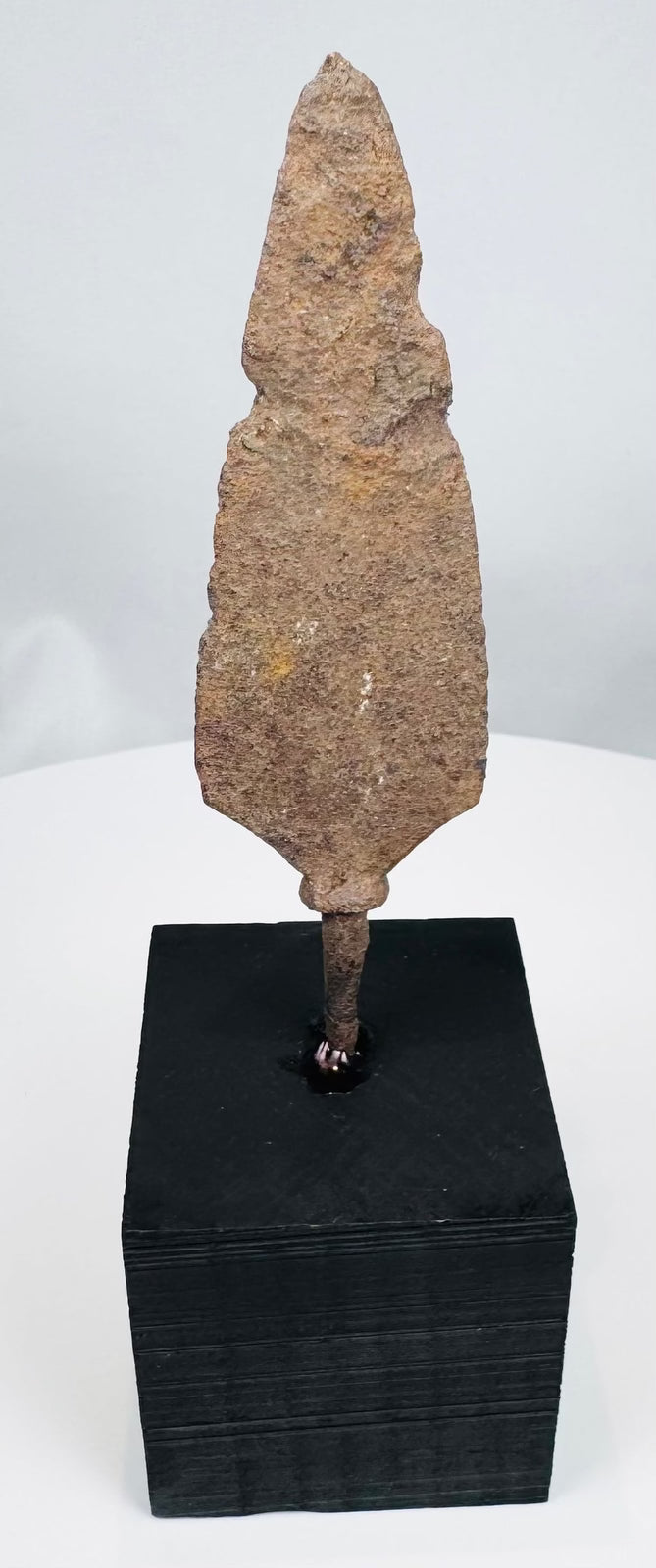
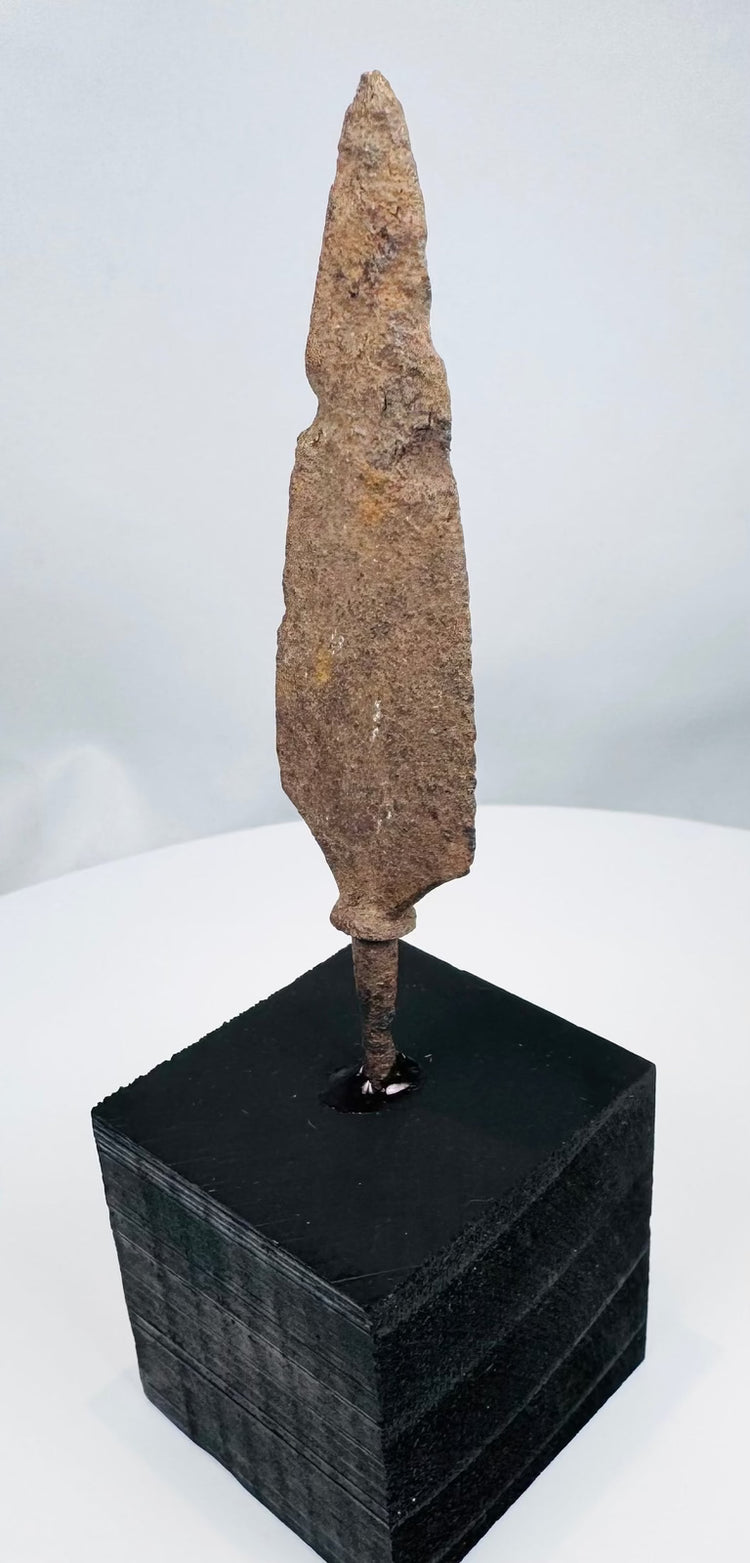
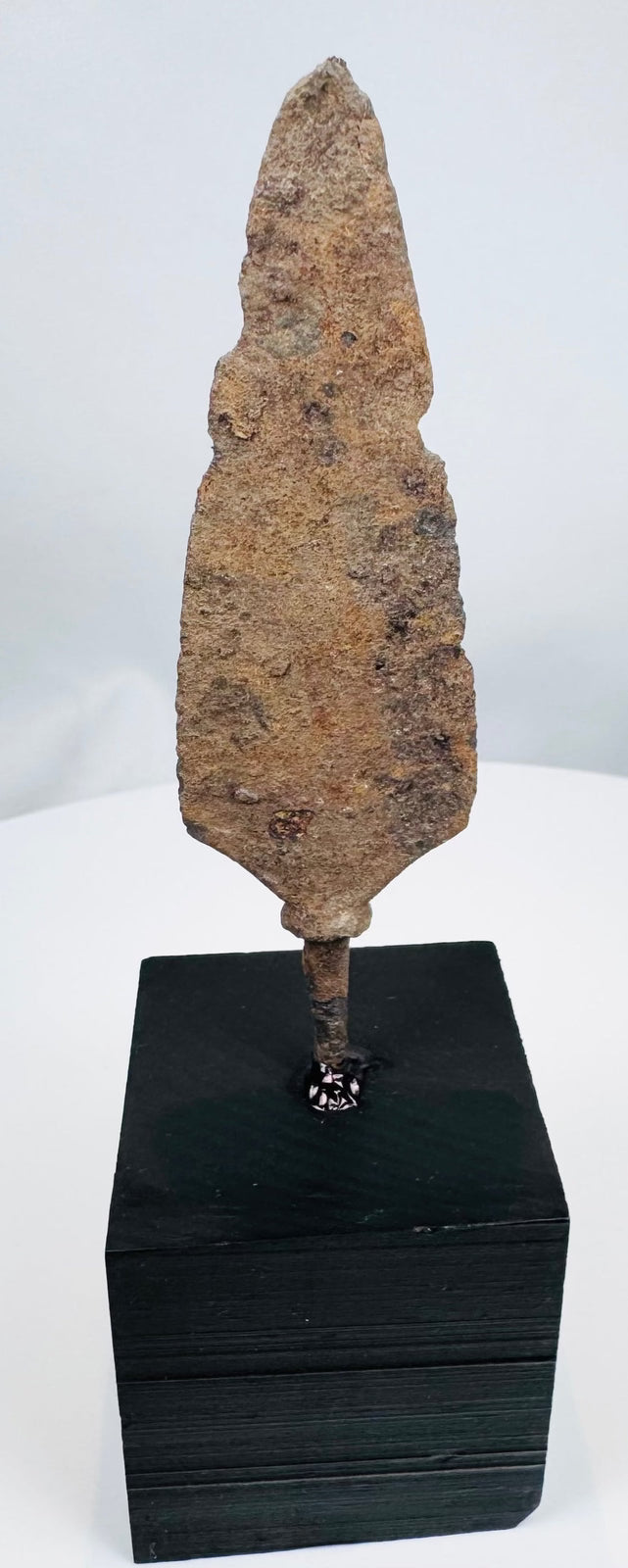
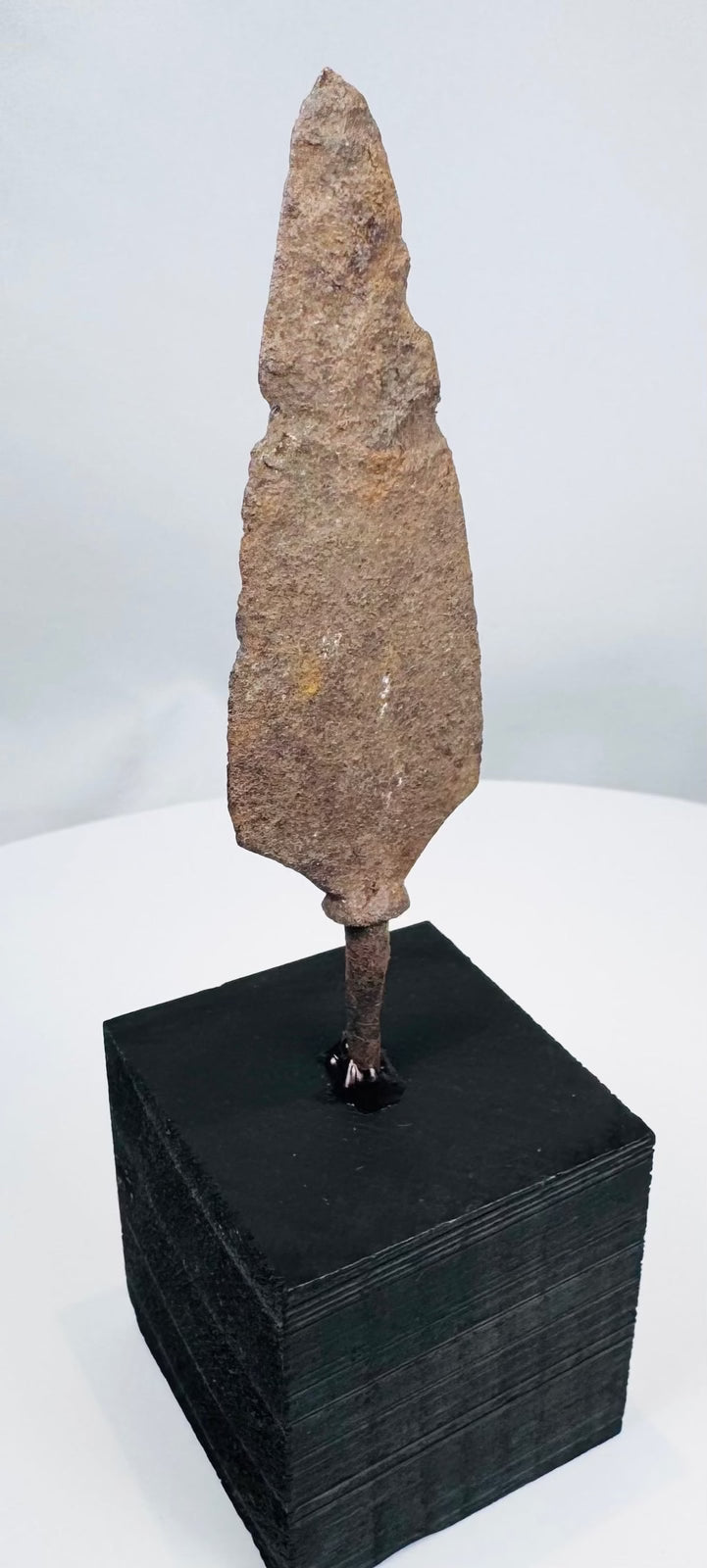
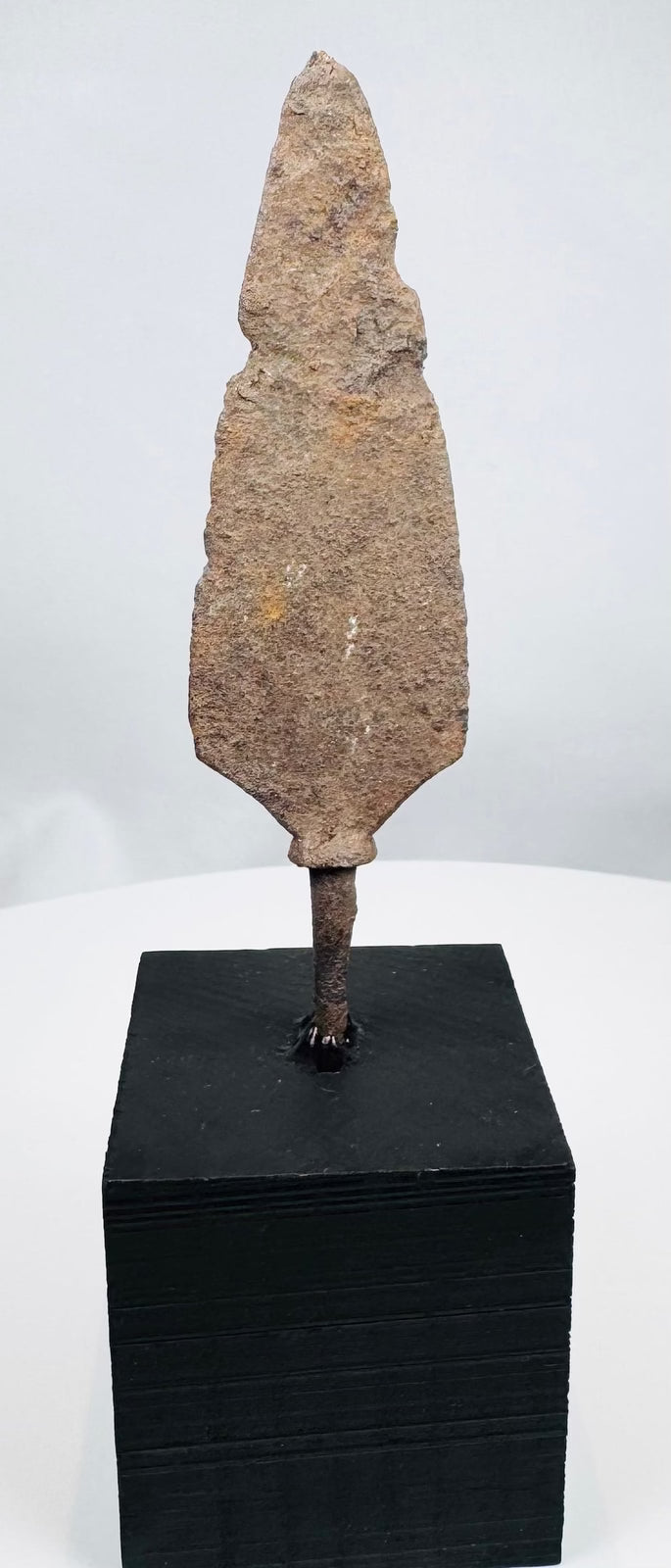
This substantial archaeological iron weapon point is a broad, tanged example dating generally from the Late Roman through the medieval period. Its wide, elongated blade, tapering upper profile, and surviving attachment tang suggest that it was originally mounted onto a wooden shaft and used as a light spearhead, javelin point, large projectile head, or hunting weapon.
The blade is formed with a broad lower body that narrows toward the shoulders before extending upward into a more slender, pointed terminal. Although heavy oxidation and mineral encrustation have altered the original outline, the remaining form retains a distinct leaf-shaped profile with a comparatively flat central surface and irregularly preserved edges.
At the base of the blade is a small raised transition or collar leading into a long rectangular tang. This tang would originally have been inserted into a prepared wooden shaft and secured using binding, adhesive, or pressure fitting. Tanged construction was widely employed across Europe for arrows, bolts, javelins, and light spears throughout the Roman and medieval periods.
Its relatively broad blade may have been intended to create a larger wound channel than a narrow armour-piercing point, making it suitable for hunting or use against lightly protected targets. The extended upper portion may also indicate that the original blade was designed to combine penetration with a wider cutting surface.
Features
- Individually hand forged from iron
- Broad leaf-shaped blade with elongated pointed terminal
- Retains original rectangular attachment tang
- Possible spearhead, javelin point, or large projectile head
- Designed for attachment to a wooden shaft
- Extensive archaeological oxidation and mineral encrustation
- Distinctive asymmetrical surface and irregular ancient edges
- Mounted on a modern black wooden display base
- Formerly held within established European collections
Cultural Significance
Iron spearheads, javelin points, and heavy projectile heads were essential components of warfare and hunting throughout the Roman and medieval worlds. Their forms varied according to intended use, regional tradition, available materials, and the type of target they were designed to engage.
Broad-bladed points were particularly effective against lightly protected targets and game animals, as their wider cutting surfaces could create substantial wounds. Narrower examples were better suited to penetration, while larger leaf-shaped forms could serve on throwing spears, light lances, or multipurpose hunting weapons.
The tanged construction seen here reflects a long-established European method of attaching forged iron points to wooden shafts. Although the shaft itself has not survived, the remaining tang provides evidence of the object’s original assembly and practical function.
Condition
The weapon point remains stable in heavily oxidized archaeological condition. It displays extensive rusting, mineral encrustation, pitting, surface flaking, discoloration, edge loss, and irregularities consistent with prolonged burial and considerable age.
The original blade profile has been partially altered by corrosion, with losses and thinning visible along the edges and upper section. The tang remains present but also exhibits oxidation, surface roughness, and localized metal loss.
The object has been permanently secured to a modern black wooden display base with visible mounting material. The base displays minor scratches, surface marks, and natural irregularities.
Dimensions (Approximate)
Overall Height: 6.75 in
Age (Approximate)
625–1,725 years old
Provenance
Formerly offered through the German art market during the 2000s, where the group entered the modern European antiquities trade.
Subsequently acquired from a European Union collector residing in London, England, who maintained a private collection of ancient and medieval artifacts.
Later held in the private collection of a gentleman in Surrey, United Kingdom.
Learn More
Gain further historical context through the Archaeological Museum of Kraków, which presents related iron javelin and spearheads.
Browse our curated Collection of Arms, Armour & Historical Weaponry
Description
Historical Context & Origin
Region: Europe
Material: Hand-forged iron
Period: Late Roman to Medieval Period, circa 3rd–14th Century CE
Description
This substantial archaeological iron weapon point is a broad, tanged example dating generally from the Late Roman through the medieval period. Its wide, elongated blade, tapering upper profile, and surviving attachment tang suggest that it was originally mounted onto a wooden shaft and used as a light spearhead, javelin point, large projectile head, or hunting weapon.
The blade is formed with a broad lower body that narrows toward the shoulders before extending upward into a more slender, pointed terminal. Although heavy oxidation and mineral encrustation have altered the original outline, the remaining form retains a distinct leaf-shaped profile with a comparatively flat central surface and irregularly preserved edges.
At the base of the blade is a small raised transition or collar leading into a long rectangular tang. This tang would originally have been inserted into a prepared wooden shaft and secured using binding, adhesive, or pressure fitting. Tanged construction was widely employed across Europe for arrows, bolts, javelins, and light spears throughout the Roman and medieval periods.
Its relatively broad blade may have been intended to create a larger wound channel than a narrow armour-piercing point, making it suitable for hunting or use against lightly protected targets. The extended upper portion may also indicate that the original blade was designed to combine penetration with a wider cutting surface.
Features
- Individually hand forged from iron
- Broad leaf-shaped blade with elongated pointed terminal
- Retains original rectangular attachment tang
- Possible spearhead, javelin point, or large projectile head
- Designed for attachment to a wooden shaft
- Extensive archaeological oxidation and mineral encrustation
- Distinctive asymmetrical surface and irregular ancient edges
- Mounted on a modern black wooden display base
- Formerly held within established European collections
Cultural Significance
Iron spearheads, javelin points, and heavy projectile heads were essential components of warfare and hunting throughout the Roman and medieval worlds. Their forms varied according to intended use, regional tradition, available materials, and the type of target they were designed to engage.
Broad-bladed points were particularly effective against lightly protected targets and game animals, as their wider cutting surfaces could create substantial wounds. Narrower examples were better suited to penetration, while larger leaf-shaped forms could serve on throwing spears, light lances, or multipurpose hunting weapons.
The tanged construction seen here reflects a long-established European method of attaching forged iron points to wooden shafts. Although the shaft itself has not survived, the remaining tang provides evidence of the object’s original assembly and practical function.
Condition
The weapon point remains stable in heavily oxidized archaeological condition. It displays extensive rusting, mineral encrustation, pitting, surface flaking, discoloration, edge loss, and irregularities consistent with prolonged burial and considerable age.
The original blade profile has been partially altered by corrosion, with losses and thinning visible along the edges and upper section. The tang remains present but also exhibits oxidation, surface roughness, and localized metal loss.
The object has been permanently secured to a modern black wooden display base with visible mounting material. The base displays minor scratches, surface marks, and natural irregularities.
Dimensions (Approximate)
Overall Height: 6.75 in
Age (Approximate)
625–1,725 years old
Provenance
Formerly offered through the German art market during the 2000s, where the group entered the modern European antiquities trade.
Subsequently acquired from a European Union collector residing in London, England, who maintained a private collection of ancient and medieval artifacts.
Later held in the private collection of a gentleman in Surrey, United Kingdom.
Learn More
Gain further historical context through the Archaeological Museum of Kraków, which presents related iron javelin and spearheads.
Browse our curated Collection of Arms, Armour & Historical Weaponry
You May Also Like
