



Attic White-Ground Lekythos | Classical Greece | Circa 460–440 BCE
Couldn't load pickup availability


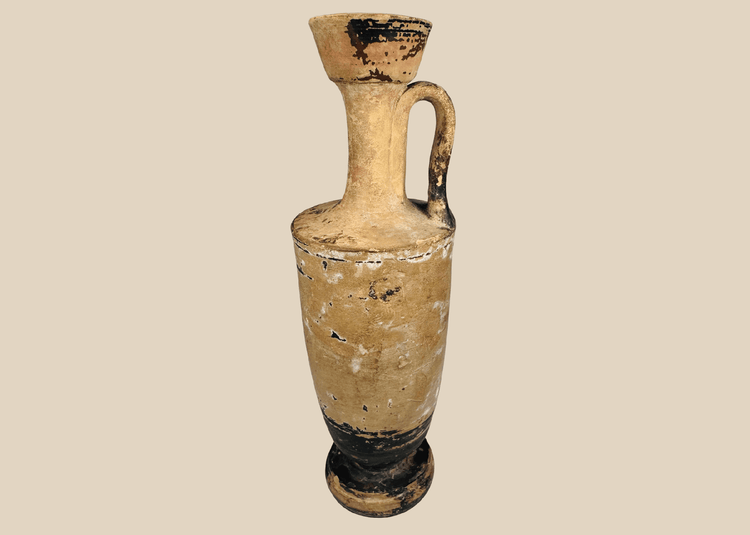


Attic White-Ground Lekythos | Classical Greece | Circa 460–440 BCE
Description
More
Less
Historical Context & Origin
Region: Attica, Ancient Greece
Material: Wheel-made terracotta with white slip and black glaze
Period: Classical Period, circa 460–440 BCE
Description
This ancient Greek Attic white-ground lekythos dates to approximately 460–440 BCE, during the Classical period.
Wheel-made in terracotta, the vessel has the characteristic slender form of a lekythos, with a cylindrical body, sloping shoulder, tall neck widening into a cup-shaped mouth, vertical strap handle, and stepped foot.
The body was originally covered with a white slip, much of which survives in a worn and yellowed state. Black glaze remains on the lower body, foot, handle, and mouth, while thin black painted lines are preserved around the shoulder. No figural decoration is presently visible.
Lekythoi were narrow-necked vessels commonly associated with oils and are particularly well known from funerary contexts in Classical Athens. The restrained proportions and white-ground surface treatment place this example firmly within the Attic ceramic tradition of the mid-5th century BCE.
Features
- Wheel-made terracotta construction
- Slender cylindrical body
- Sloping shoulder
- Tall neck with cup-shaped mouth
- Vertical strap handle
- Stepped foot
- Surviving white slip
- Black glaze on mouth, handle, lower body, and foot
- Thin black lines at the shoulder
- No surviving figural decoration
Cultural Significance
White-ground lekythoi are among the most recognizable ceramic forms of Classical Athens. These vessels were closely associated with the storage and presentation of oils and became particularly important in Athenian funerary practice.
The white-ground technique provided a pale surface upon which painted decoration could be applied, although in this example no figural imagery survives. Its vessel form, surface treatment, and proportions support the specialist attribution to Attica, circa 460–440 BCE.
Condition
Substantially intact ancient condition with significant age-related surface wear. The white slip is worn, yellowed, and lost in patches, while areas of the surviving black glaze exhibit flaking and surface loss. Additional abrasions, deposits, discoloration, and minor edge wear are consistent with considerable age.
Dimensions (Approximate)
Height: 7.75 in
Width: 2.5 in
Age (Approximate)
2,465–2,485 years old
Provenance
Purchased from E. Gazarossian & E. Vitali in the early 1970s. E. Vitali is independently documented by the Corpus Vasorum Antiquorum of the Academy of Athens as an antiquarian and collector. At least two Attic black-figure lekythoi from her collection entered the National Archaeological Museum in Athens as gifts, where they are recorded under inventory nos. 19664 and 19665. This provides important institutional documentation of Vitali's involvement with ancient Greek pottery and the antiquities market.
The vessel was subsequently held in a private collection in Virginia, USA. It was later offered by Quinn’s Auction Galleries in Falls Church, Virginia in 2026.
The piece was later examined by Luca Salvaggio, an Italian archaeologist and specialist in ancient Mediterranean material. He holds a Postgraduate Diploma from the Italian Archaeological School at Athens (IASA) and is accredited for preventive archaeology by the Italian Ministry of Culture (MiC). Salvaggio identified the vessel as an Attic white-ground lekythos dating to circa 460–440 BCE, based on its slender cylindrical body, sloping shoulder, tall neck, cup-shaped mouth, vertical strap handle, stepped foot, surviving white slip, and black-glazed details.
Learn More
Study a closely related 5th-century BCE Attic pattern lekythos preserved by the Spurlock Museum of World Cultures.
Browse our Collection of Roman and Greek Artifacts and Ancient Relics.
Description
Historical Context & Origin
Region: Attica, Ancient Greece
Material: Wheel-made terracotta with white slip and black glaze
Period: Classical Period, circa 460–440 BCE
Description
This ancient Greek Attic white-ground lekythos dates to approximately 460–440 BCE, during the Classical period.
Wheel-made in terracotta, the vessel has the characteristic slender form of a lekythos, with a cylindrical body, sloping shoulder, tall neck widening into a cup-shaped mouth, vertical strap handle, and stepped foot.
The body was originally covered with a white slip, much of which survives in a worn and yellowed state. Black glaze remains on the lower body, foot, handle, and mouth, while thin black painted lines are preserved around the shoulder. No figural decoration is presently visible.
Lekythoi were narrow-necked vessels commonly associated with oils and are particularly well known from funerary contexts in Classical Athens. The restrained proportions and white-ground surface treatment place this example firmly within the Attic ceramic tradition of the mid-5th century BCE.
Features
- Wheel-made terracotta construction
- Slender cylindrical body
- Sloping shoulder
- Tall neck with cup-shaped mouth
- Vertical strap handle
- Stepped foot
- Surviving white slip
- Black glaze on mouth, handle, lower body, and foot
- Thin black lines at the shoulder
- No surviving figural decoration
Cultural Significance
White-ground lekythoi are among the most recognizable ceramic forms of Classical Athens. These vessels were closely associated with the storage and presentation of oils and became particularly important in Athenian funerary practice.
The white-ground technique provided a pale surface upon which painted decoration could be applied, although in this example no figural imagery survives. Its vessel form, surface treatment, and proportions support the specialist attribution to Attica, circa 460–440 BCE.
Condition
Substantially intact ancient condition with significant age-related surface wear. The white slip is worn, yellowed, and lost in patches, while areas of the surviving black glaze exhibit flaking and surface loss. Additional abrasions, deposits, discoloration, and minor edge wear are consistent with considerable age.
Dimensions (Approximate)
Height: 7.75 in
Width: 2.5 in
Age (Approximate)
2,465–2,485 years old
Provenance
Purchased from E. Gazarossian & E. Vitali in the early 1970s. E. Vitali is independently documented by the Corpus Vasorum Antiquorum of the Academy of Athens as an antiquarian and collector. At least two Attic black-figure lekythoi from her collection entered the National Archaeological Museum in Athens as gifts, where they are recorded under inventory nos. 19664 and 19665. This provides important institutional documentation of Vitali's involvement with ancient Greek pottery and the antiquities market.
The vessel was subsequently held in a private collection in Virginia, USA. It was later offered by Quinn’s Auction Galleries in Falls Church, Virginia in 2026.
The piece was later examined by Luca Salvaggio, an Italian archaeologist and specialist in ancient Mediterranean material. He holds a Postgraduate Diploma from the Italian Archaeological School at Athens (IASA) and is accredited for preventive archaeology by the Italian Ministry of Culture (MiC). Salvaggio identified the vessel as an Attic white-ground lekythos dating to circa 460–440 BCE, based on its slender cylindrical body, sloping shoulder, tall neck, cup-shaped mouth, vertical strap handle, stepped foot, surviving white slip, and black-glazed details.
Learn More
Study a closely related 5th-century BCE Attic pattern lekythos preserved by the Spurlock Museum of World Cultures.
Browse our Collection of Roman and Greek Artifacts and Ancient Relics.
You May Also Like
