



Bornean Headhunter Sword with Carved Ironwood Hilt and Feathered Scabbard | Circa 1900 – 1930
Couldn't load pickup availability


Bornean Headhunter Sword with Carved Ironwood Hilt and Feathered Scabbard | Circa 1900 – 1930
Description
More
Less
Historical Context & Origin
Region: Borneo, Indonesia / Malaysia
Culture: Dayak, likely Kayan or Kenyah
Material: Hand-forged iron, carved hardwood, woven plant fibre, carved antler, wood, hair, feathers, and natural pigments
Period: Early 20th Century CE, circa 1900–1930
Description
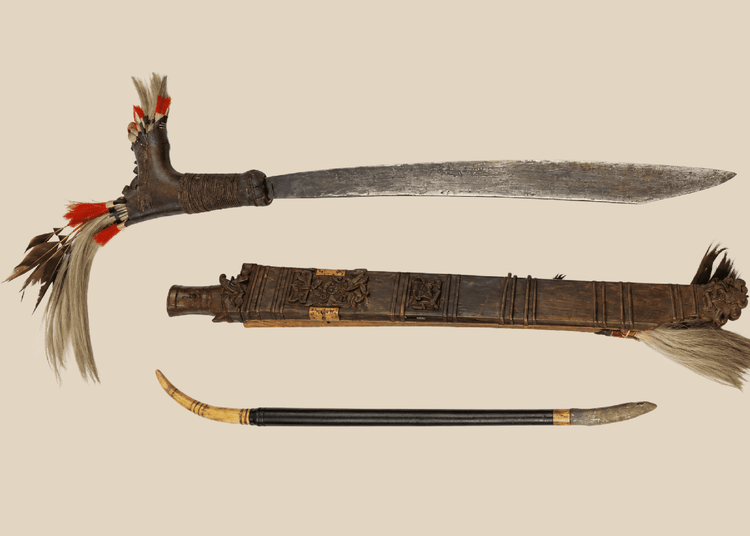
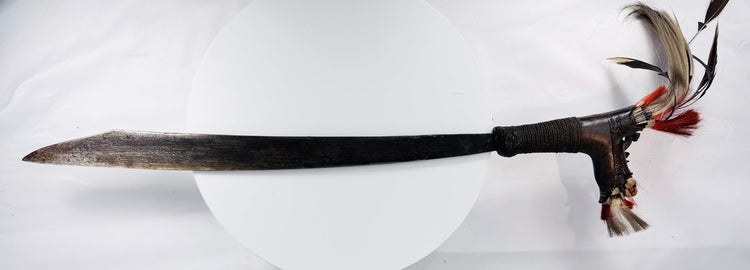
This exceptional Dayak sword is a finely decorated example of the traditional Mandau, also known regionally as the Parang Ilang, one of the most distinctive edged weapons produced by the Indigenous peoples of Borneo. Historically carried by Dayak warriors, hunters, travellers, and community leaders, the Mandau functioned as a practical cutting weapon while also serving as an important expression of identity, status, craftsmanship, and spiritual belief.
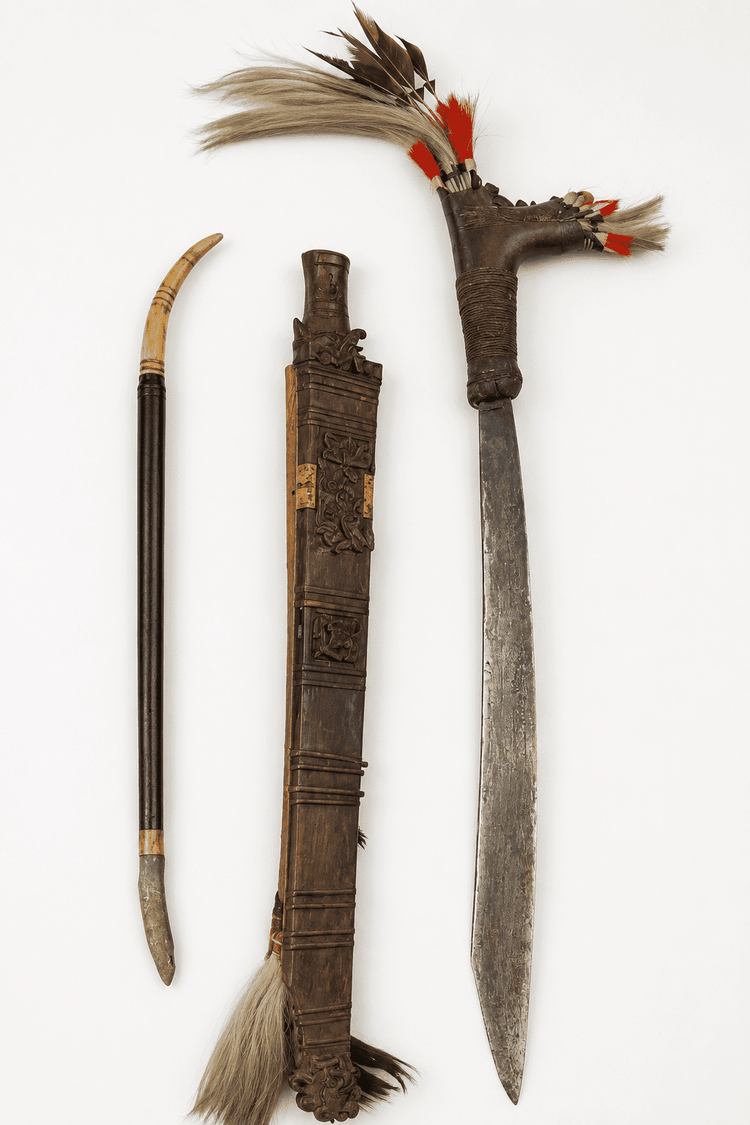
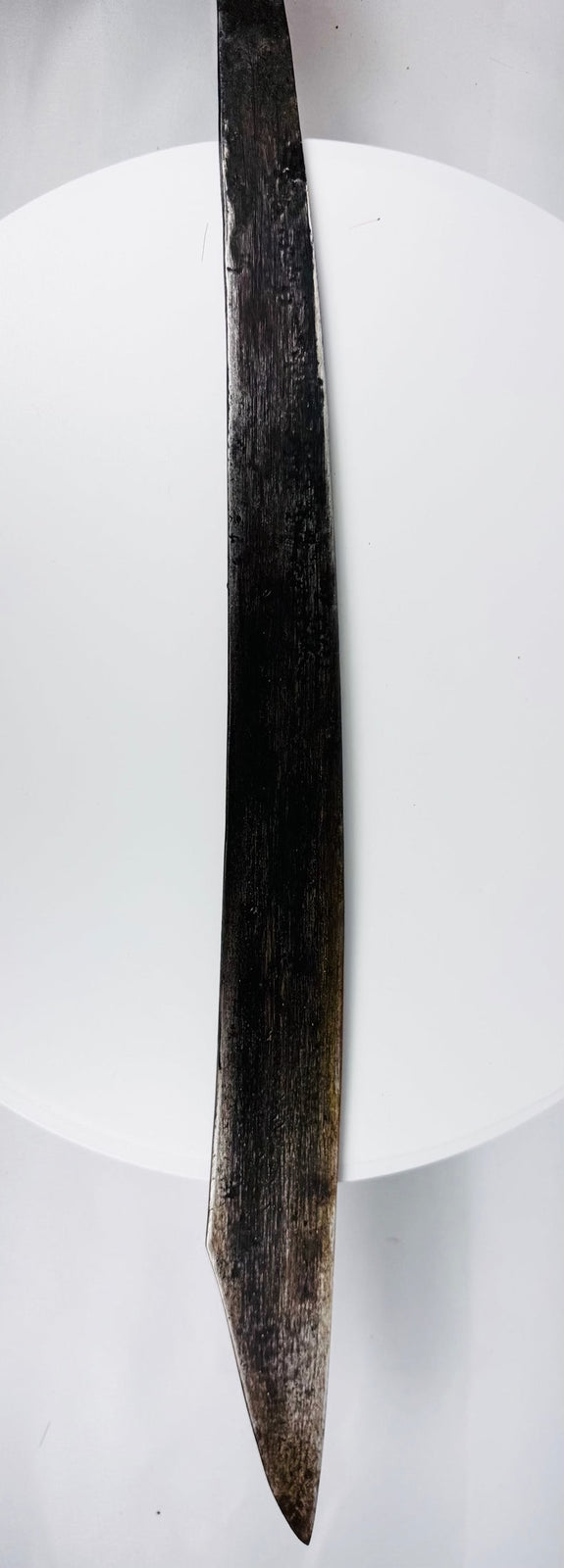
The sword retains its substantial hand-forged blade, formed with a long, slightly curved profile that expands gradually toward the tip. The blade is sharpened along a single edge and terminates in the characteristic obliquely formed, chisel-like point associated with the Mandau. Its opposing faces are asymmetrically worked, with one side comparatively flat and the reverse subtly convex, reflecting the specialized forging traditions used to produce these swords.
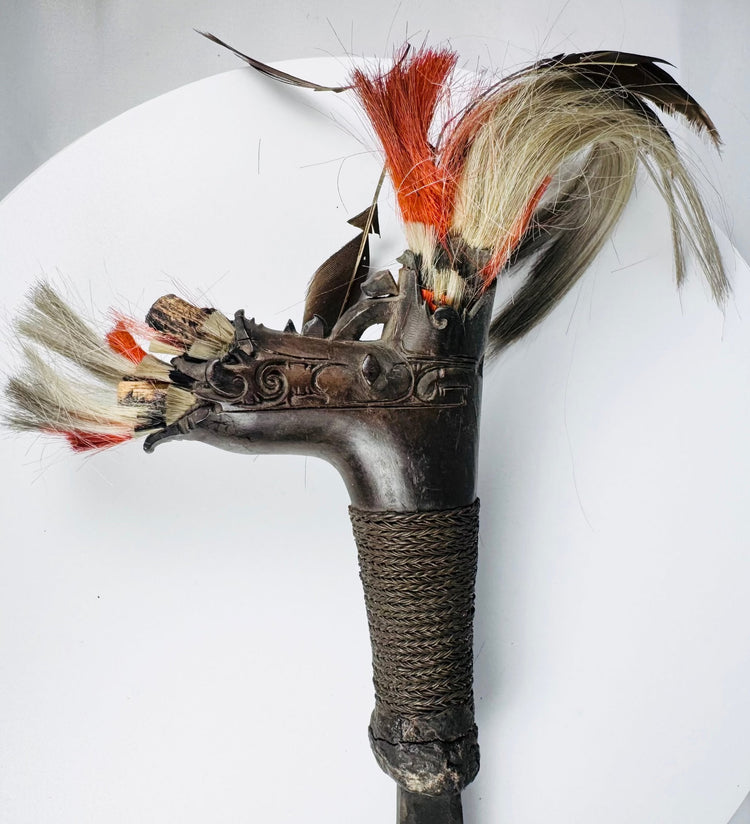
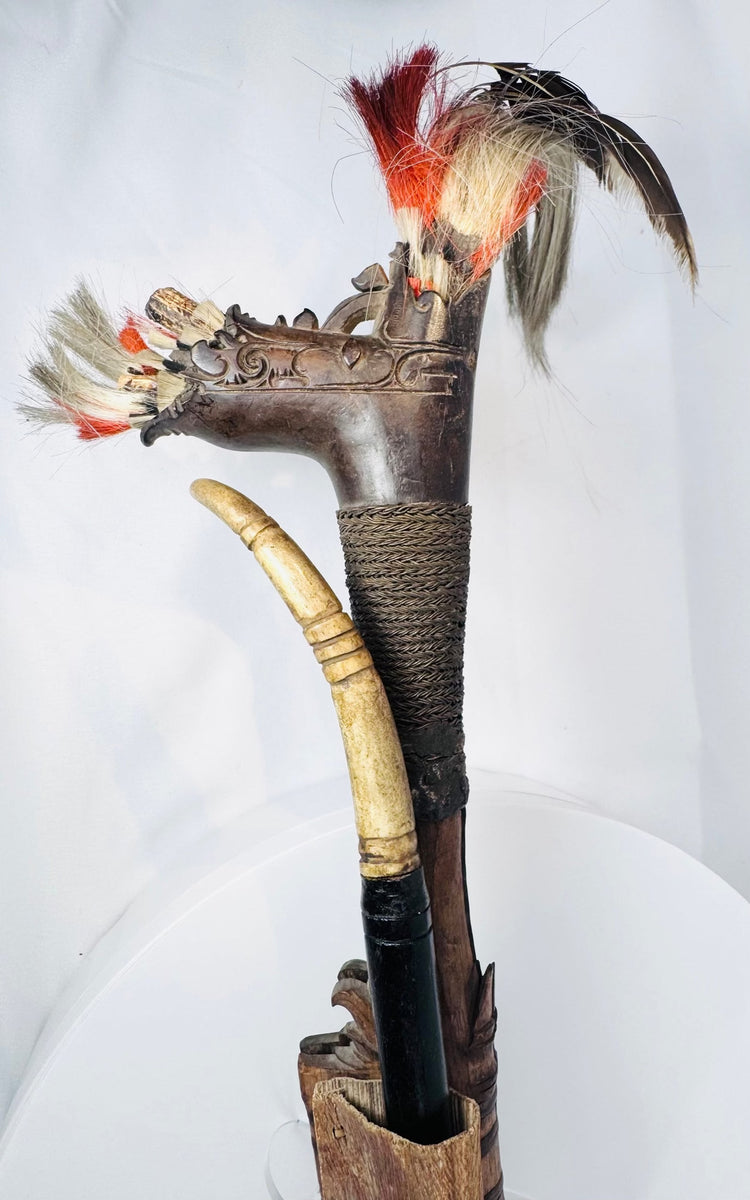
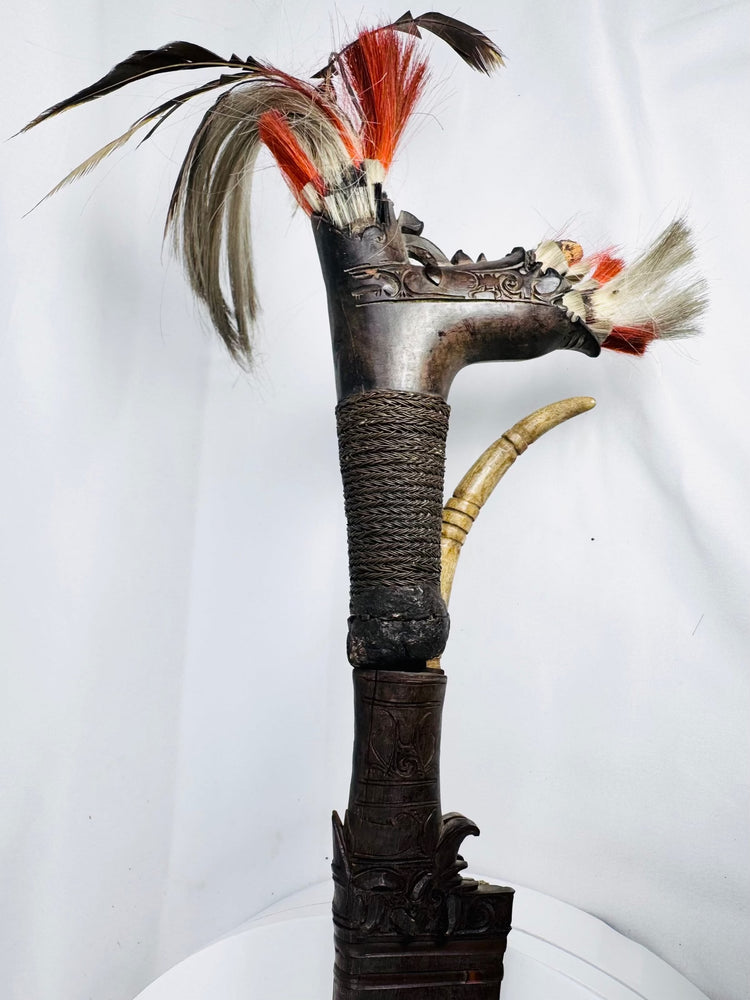
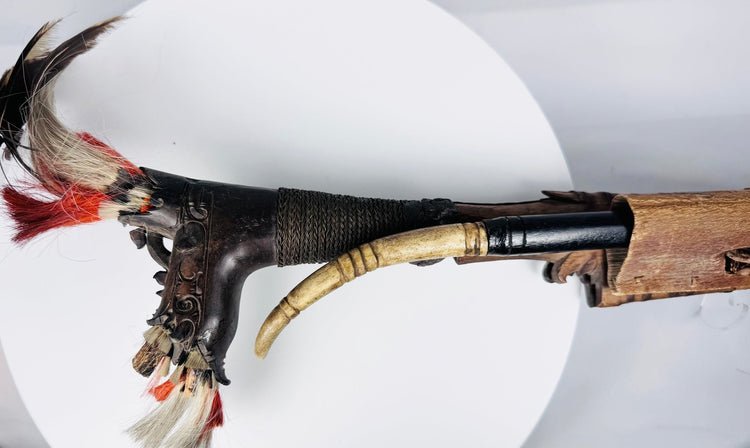
The elaborate hilt is carved from dense dark hardwood, traditionally identified as ironwood, and displays scrolling Aso motifs associated with the stylized dragon-dog or protective spirit imagery found throughout Dayak art. The grip retains its intricate woven plant-fibre wrapping, providing both a secure surface and an additional decorative element. Numerous tufts of red, black, cream, and grey hair and feathers remain attached around the carved upper section, giving the sword a particularly commanding ceremonial appearance.
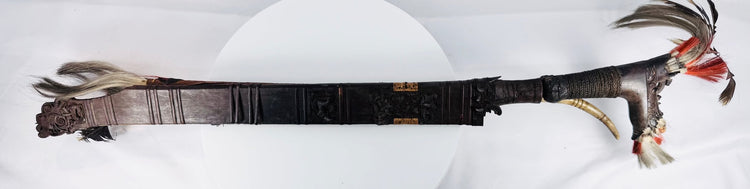
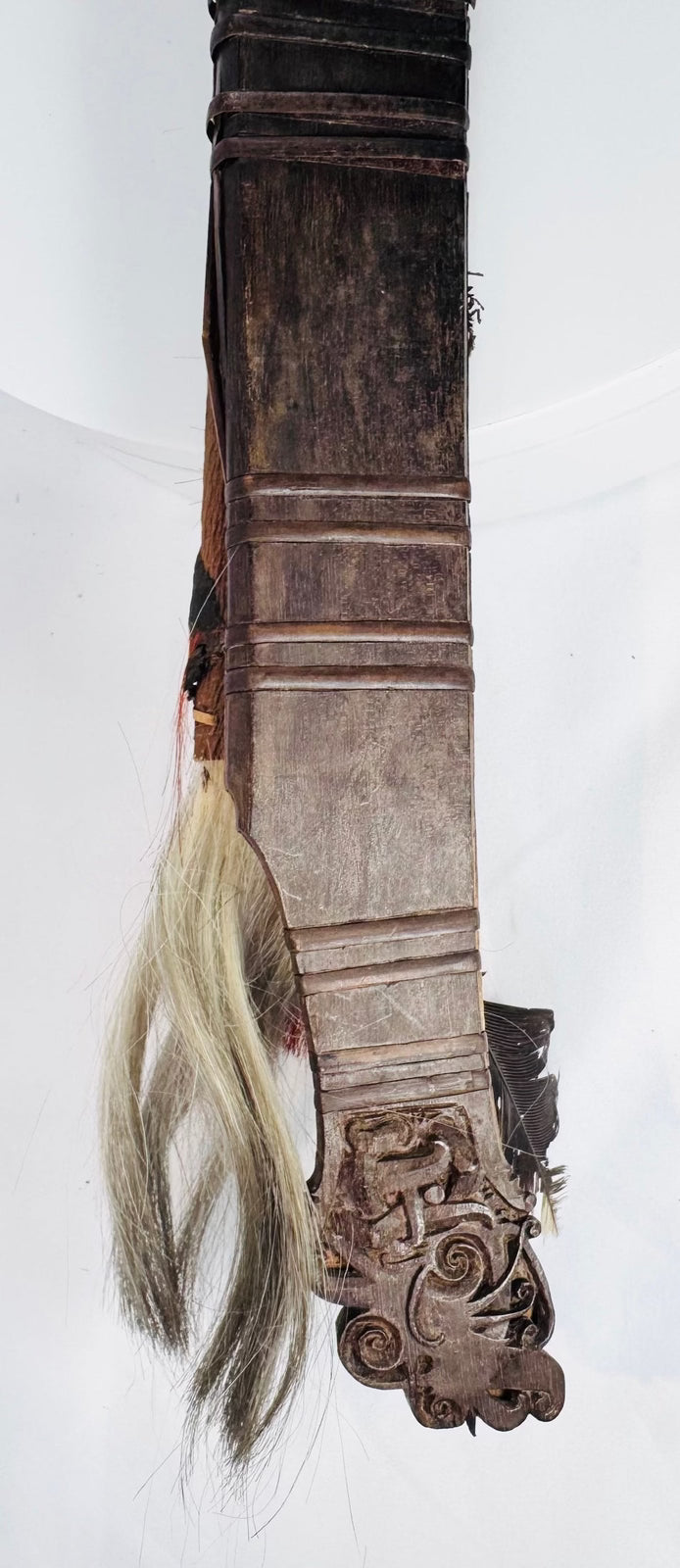
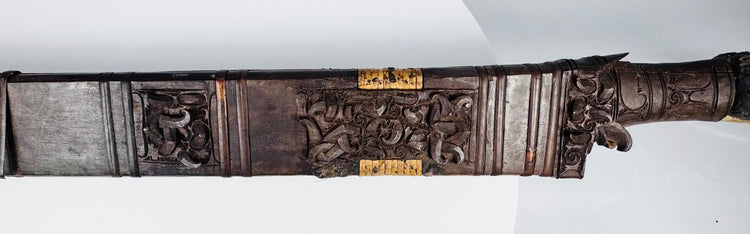
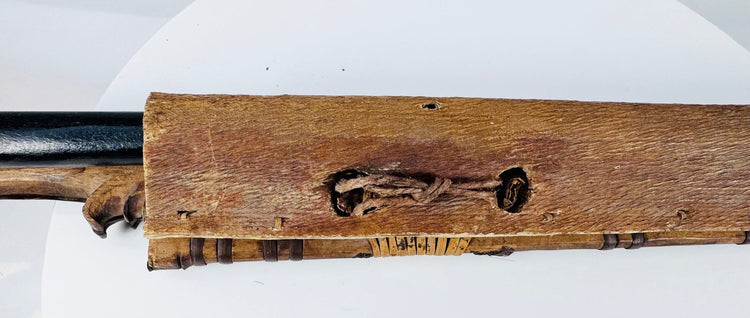
The sword is accompanied by its original carved wooden scabbard, constructed from fitted wooden sections secured with narrow binding strips. The exterior is embellished with deeply carved scrolling and openwork ornament, including additional Aso-inspired designs, projecting finials, and raised decorative panels. Small pale inlaid or applied elements provide contrasting accents against the darkened wood.
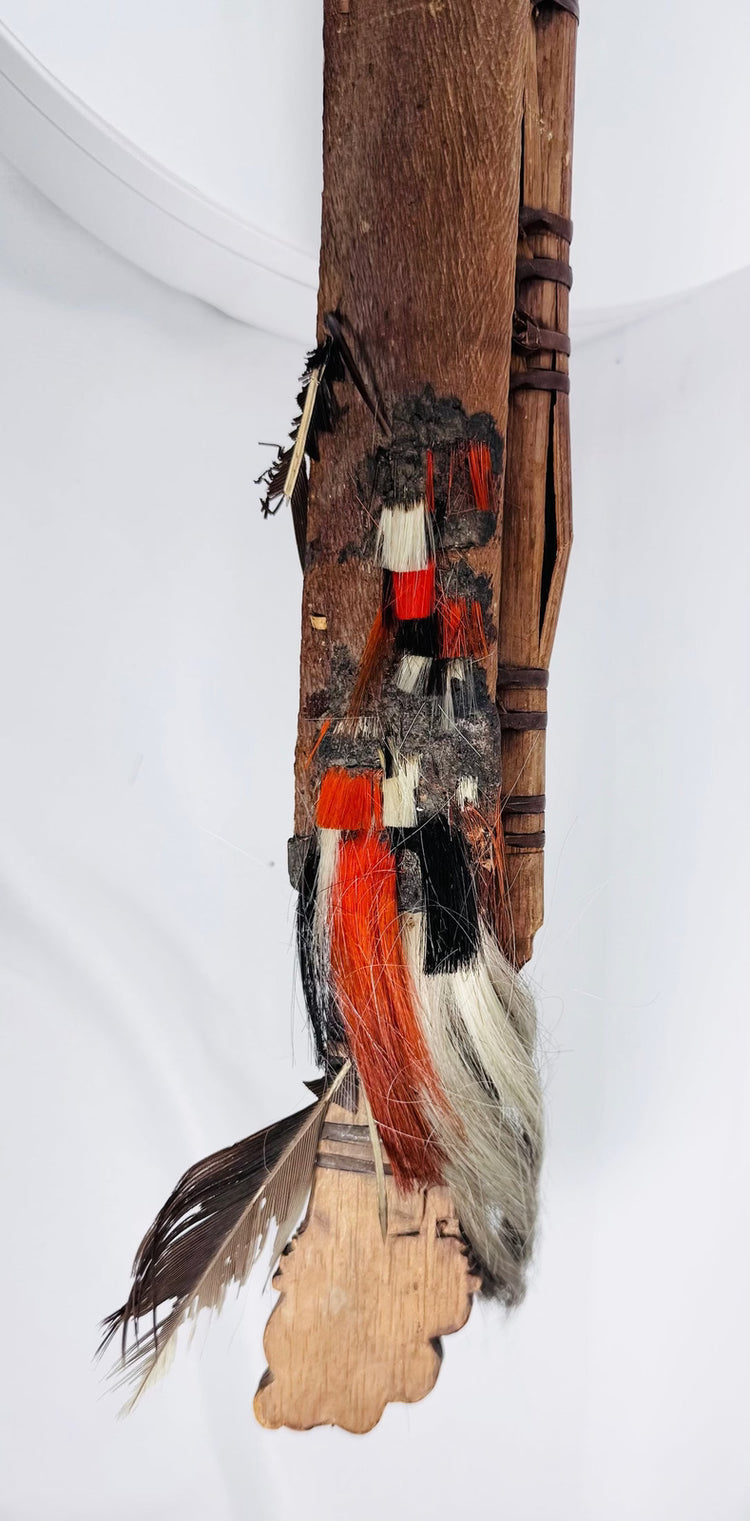
Further hair and feather ornaments remain attached near the lower end of the scabbard, including alternating red, black, cream, and grey fibres together with carved wooden pendants. These attachments formed an important part of the sword’s visual presentation and may have reflected the owner’s community, achievements, personal standing, or ceremonial role.
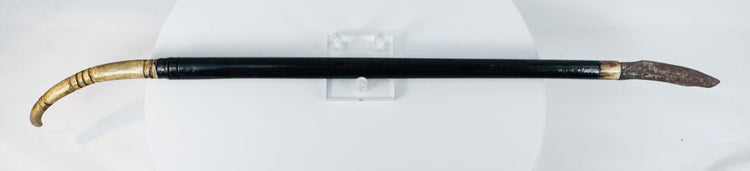
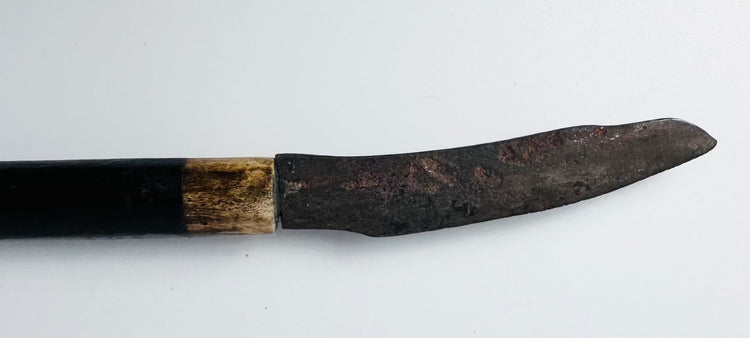
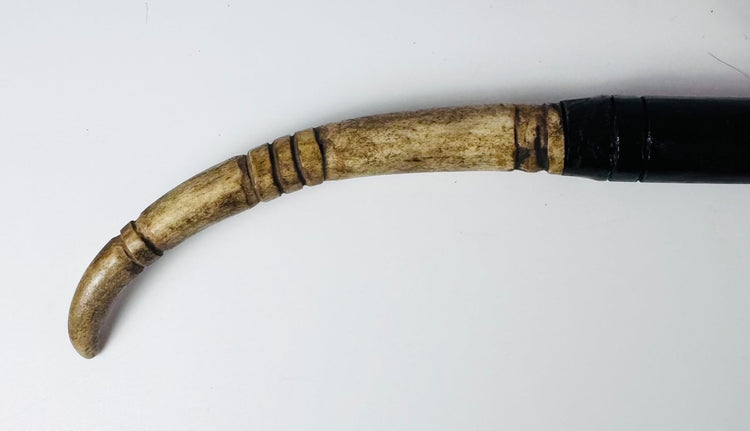
The scabbard also retains its rare secondary utility knife, commonly known as a pisau raut. This slender knife is housed in an attached side compartment and features a long dark shaft with a curved carved antler grip.
Features
- Likely associated with the Kayan or Kenyah peoples of Borneo
- Long hand-forged single-edged iron blade
- Dense dark hardwood or ironwood hilt
- Finely carved scrolling Aso-inspired motifs
- Original intricately woven plant-fibre grip wrapping
- Retains extensive red, black, cream, and grey hair and feather ornaments
- Original carved wooden scabbard with fitted construction
- Deeply carved openwork and relief decoration
- Decorative bindings and contrasting applied elements
- Retains its rare secondary pisau raut utility knife
- Pisau raut fitted with a curved carved antler grip
- Well above average and substantially complete ceremonial example
Cultural Significance
The Mandau is among the most recognizable objects associated with the Dayak peoples of Borneo. Different communities used regional names for the form, including Parang Ilang, while variations occurred in the blade profile, carving, ornamentation, and materials employed. The Metropolitan Museum of Art identifies comparable Dayak sword handles from northern Borneo as carved from antler and covered with plaited fibre grips, demonstrating the importance of intricate carving and woven materials within Mandau construction.
Although frequently described in the collecting field as a headhunter’s sword because of the weapon’s historical association with warfare and former headhunting traditions, the Mandau held a much broader place in Dayak society. It served as a weapon, agricultural implement, travelling tool, ceremonial object, status symbol, and heirloom. The carvings and attachments were not merely ornamental but could communicate cultural identity, spiritual protection, social position, and the accomplishments of the wearer.
The recurring Aso motif is one of the defining visual elements of Dayak decorative art. Often interpreted as a stylized supernatural creature combining serpentine, canine, and dragon-like characteristics, the Aso appeared on weapons, architectural elements, textiles, beadwork, and ritual objects. Its use on a sword hilt and scabbard enhanced the object’s symbolic and protective significance.
Condition
The ensemble remains in good antique condition and displays age-related wear consistent with traditional use and preservation. The hand-forged blade exhibits dark patination, oxidation, pitting, scratches, edge wear, surface deposits, and evidence of historic cleaning. The blade remains substantial and retains its characteristic expanded, obliquely pointed profile.
The carved hardwood hilt displays rubbing, surface abrasions, minor cracking, small losses, and darkened patination. The woven fibre grip remains substantially intact with localized looseness and wear. The hair and feather ornaments exhibit fading, breakage, fraying, shedding, deformation, and losses consistent with their fragile organic materials.
The wooden scabbard displays scratches, abrasions, age cracks, minor separations, old repairs, losses to projecting carved details, and wear to the binding strips. Some carved and applied elements are incomplete or partially detached. The associated pisau raut remains present and exhibits surface wear, discoloration, cracking, and patination to its antler and wooden components. Minor wear throughout, as expected for an object of this age and type.
Dimensions (Approximate)
Length: 27.95 in
Age (Approximate)
96–126 years old
Provenance
Formerly part of a private Cheyenne, Wyoming, USA collection specializing in antique arms, armour, and militaria. The collection was assembled over many years with a particular emphasis on historic weapons, powder accessories, armour, and martial objects.
Learn More
Learn more about the history, construction, and cultural significance of the Mandau sword through the Lam Museum of Anthropology
Explore our curated Collection of Arms, Armour & Historical Weaponry
Description
Historical Context & Origin
Region: Borneo, Indonesia / Malaysia
Culture: Dayak, likely Kayan or Kenyah
Material: Hand-forged iron, carved hardwood, woven plant fibre, carved antler, wood, hair, feathers, and natural pigments
Period: Early 20th Century CE, circa 1900–1930
Description
This exceptional Dayak sword is a finely decorated example of the traditional Mandau, also known regionally as the Parang Ilang, one of the most distinctive edged weapons produced by the Indigenous peoples of Borneo. Historically carried by Dayak warriors, hunters, travellers, and community leaders, the Mandau functioned as a practical cutting weapon while also serving as an important expression of identity, status, craftsmanship, and spiritual belief.
The sword retains its substantial hand-forged blade, formed with a long, slightly curved profile that expands gradually toward the tip. The blade is sharpened along a single edge and terminates in the characteristic obliquely formed, chisel-like point associated with the Mandau. Its opposing faces are asymmetrically worked, with one side comparatively flat and the reverse subtly convex, reflecting the specialized forging traditions used to produce these swords.
The elaborate hilt is carved from dense dark hardwood, traditionally identified as ironwood, and displays scrolling Aso motifs associated with the stylized dragon-dog or protective spirit imagery found throughout Dayak art. The grip retains its intricate woven plant-fibre wrapping, providing both a secure surface and an additional decorative element. Numerous tufts of red, black, cream, and grey hair and feathers remain attached around the carved upper section, giving the sword a particularly commanding ceremonial appearance.
The sword is accompanied by its original carved wooden scabbard, constructed from fitted wooden sections secured with narrow binding strips. The exterior is embellished with deeply carved scrolling and openwork ornament, including additional Aso-inspired designs, projecting finials, and raised decorative panels. Small pale inlaid or applied elements provide contrasting accents against the darkened wood.
Further hair and feather ornaments remain attached near the lower end of the scabbard, including alternating red, black, cream, and grey fibres together with carved wooden pendants. These attachments formed an important part of the sword’s visual presentation and may have reflected the owner’s community, achievements, personal standing, or ceremonial role.
The scabbard also retains its rare secondary utility knife, commonly known as a pisau raut. This slender knife is housed in an attached side compartment and features a long dark shaft with a curved carved antler grip.
Features
- Likely associated with the Kayan or Kenyah peoples of Borneo
- Long hand-forged single-edged iron blade
- Dense dark hardwood or ironwood hilt
- Finely carved scrolling Aso-inspired motifs
- Original intricately woven plant-fibre grip wrapping
- Retains extensive red, black, cream, and grey hair and feather ornaments
- Original carved wooden scabbard with fitted construction
- Deeply carved openwork and relief decoration
- Decorative bindings and contrasting applied elements
- Retains its rare secondary pisau raut utility knife
- Pisau raut fitted with a curved carved antler grip
- Well above average and substantially complete ceremonial example
Cultural Significance
The Mandau is among the most recognizable objects associated with the Dayak peoples of Borneo. Different communities used regional names for the form, including Parang Ilang, while variations occurred in the blade profile, carving, ornamentation, and materials employed. The Metropolitan Museum of Art identifies comparable Dayak sword handles from northern Borneo as carved from antler and covered with plaited fibre grips, demonstrating the importance of intricate carving and woven materials within Mandau construction.
Although frequently described in the collecting field as a headhunter’s sword because of the weapon’s historical association with warfare and former headhunting traditions, the Mandau held a much broader place in Dayak society. It served as a weapon, agricultural implement, travelling tool, ceremonial object, status symbol, and heirloom. The carvings and attachments were not merely ornamental but could communicate cultural identity, spiritual protection, social position, and the accomplishments of the wearer.
The recurring Aso motif is one of the defining visual elements of Dayak decorative art. Often interpreted as a stylized supernatural creature combining serpentine, canine, and dragon-like characteristics, the Aso appeared on weapons, architectural elements, textiles, beadwork, and ritual objects. Its use on a sword hilt and scabbard enhanced the object’s symbolic and protective significance.
Condition
The ensemble remains in good antique condition and displays age-related wear consistent with traditional use and preservation. The hand-forged blade exhibits dark patination, oxidation, pitting, scratches, edge wear, surface deposits, and evidence of historic cleaning. The blade remains substantial and retains its characteristic expanded, obliquely pointed profile.
The carved hardwood hilt displays rubbing, surface abrasions, minor cracking, small losses, and darkened patination. The woven fibre grip remains substantially intact with localized looseness and wear. The hair and feather ornaments exhibit fading, breakage, fraying, shedding, deformation, and losses consistent with their fragile organic materials.
The wooden scabbard displays scratches, abrasions, age cracks, minor separations, old repairs, losses to projecting carved details, and wear to the binding strips. Some carved and applied elements are incomplete or partially detached. The associated pisau raut remains present and exhibits surface wear, discoloration, cracking, and patination to its antler and wooden components. Minor wear throughout, as expected for an object of this age and type.
Dimensions (Approximate)
Length: 27.95 in
Age (Approximate)
96–126 years old
Provenance
Formerly part of a private Cheyenne, Wyoming, USA collection specializing in antique arms, armour, and militaria. The collection was assembled over many years with a particular emphasis on historic weapons, powder accessories, armour, and martial objects.
Learn More
Learn more about the history, construction, and cultural significance of the Mandau sword through the Lam Museum of Anthropology
Explore our curated Collection of Arms, Armour & Historical Weaponry
You May Also Like
