


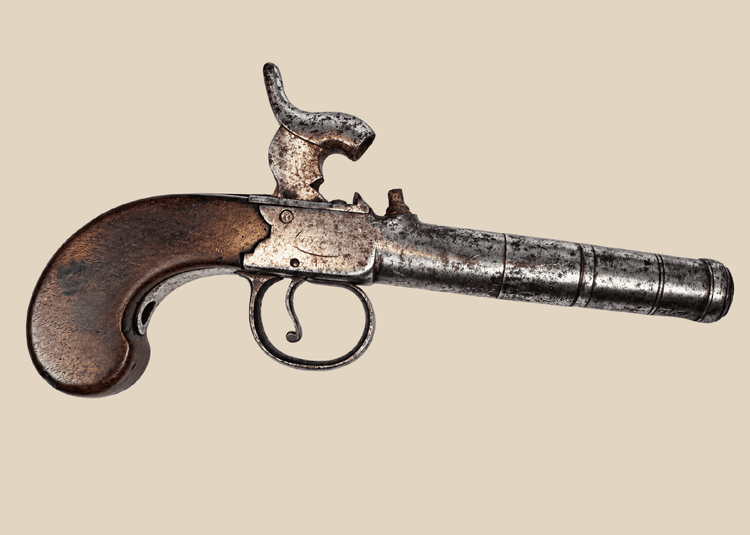
British Cannon-Barrel Percussion Pocket Pistol | Circa 1830 – 1850
Couldn't load pickup availability


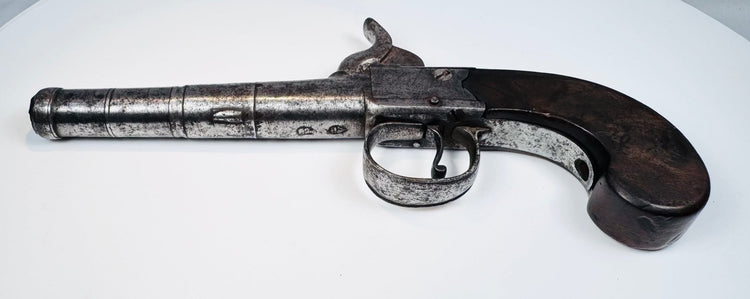
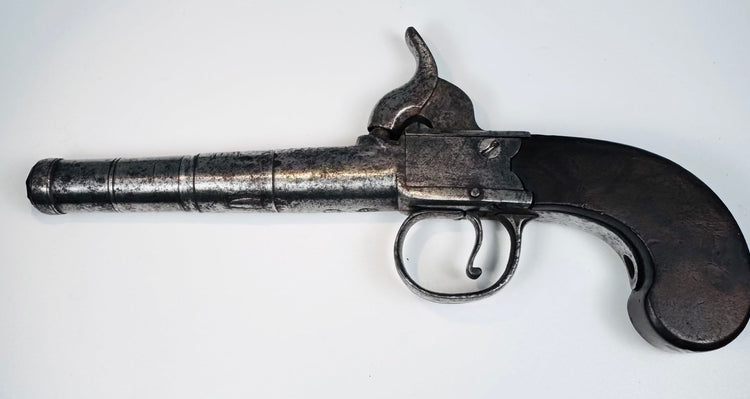
British Cannon-Barrel Percussion Pocket Pistol | Circa 1830 – 1850
Description
More
Less
Historical Context & Origin
Region: England, United Kingdom, marked London
Material: Steel and iron with wooden grip
Period: Early–Mid 19th Century, circa 1830–1850
Description
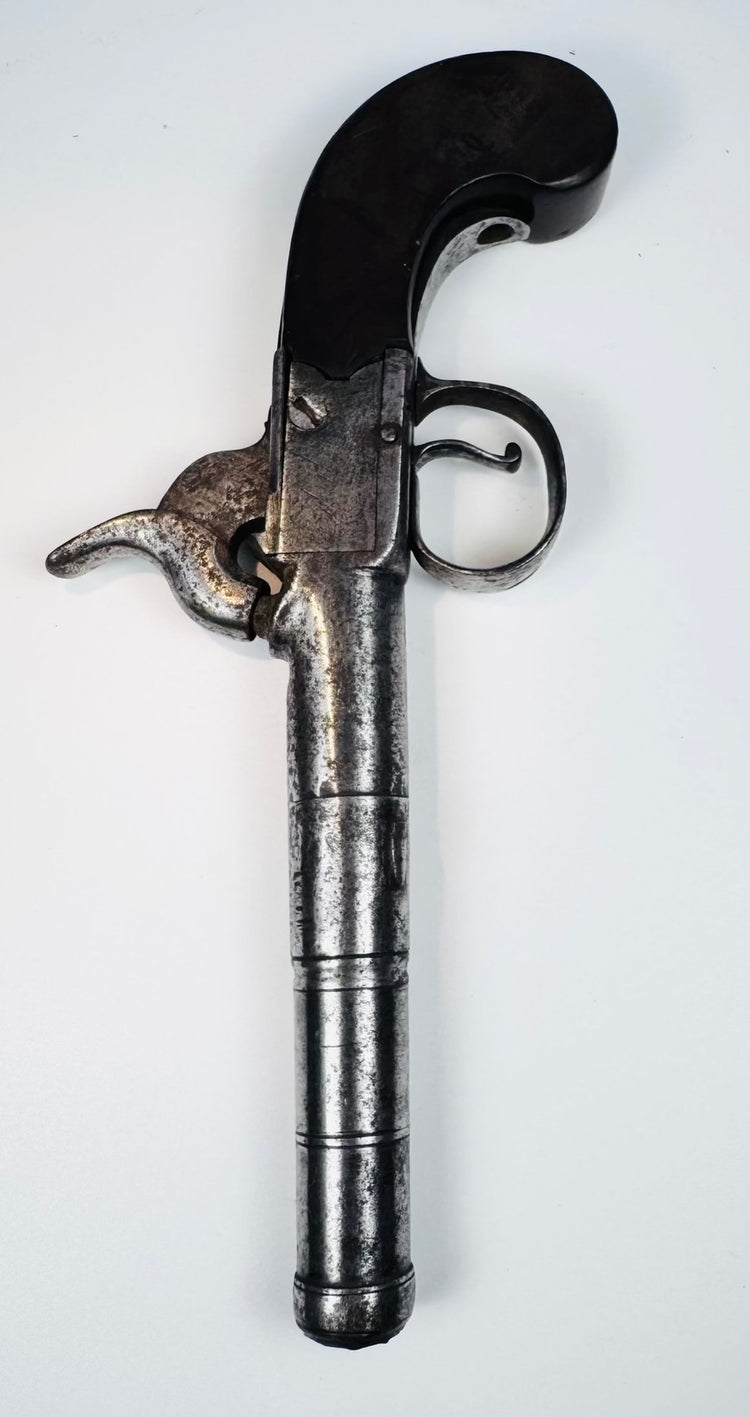
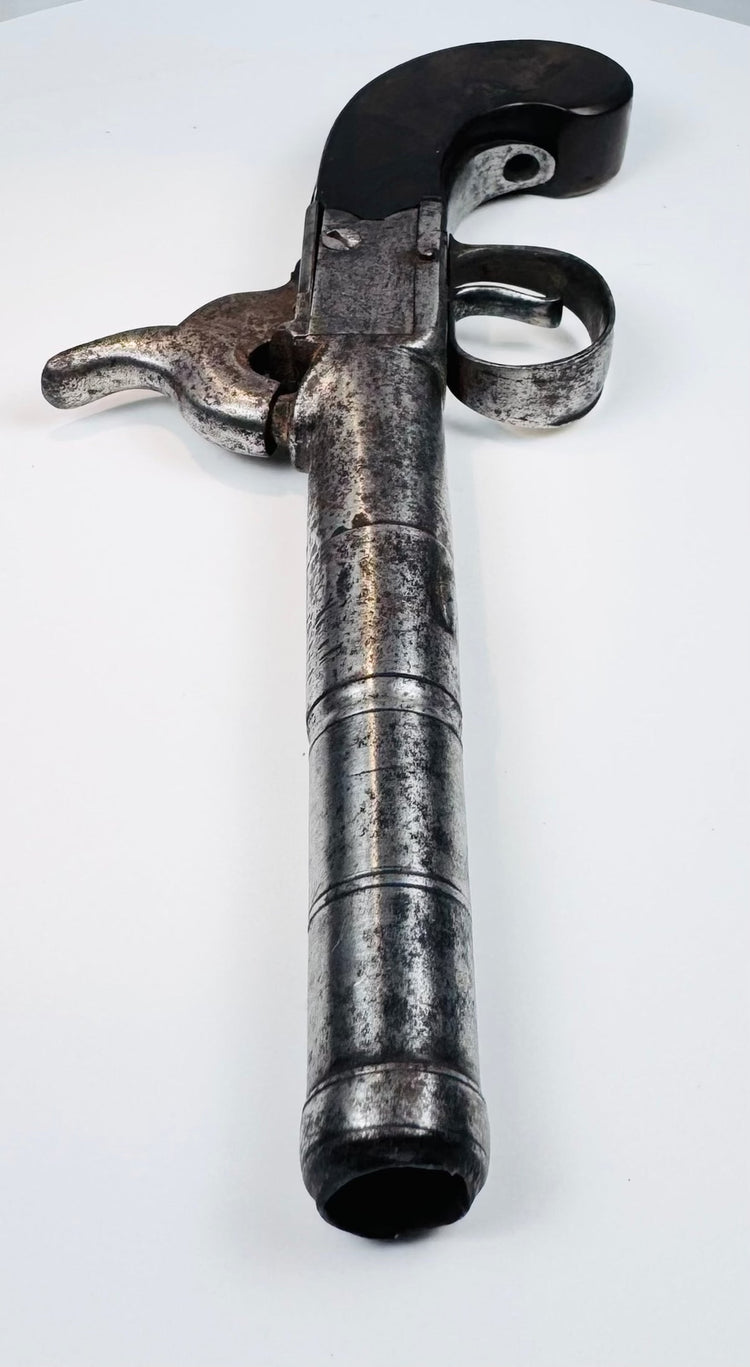
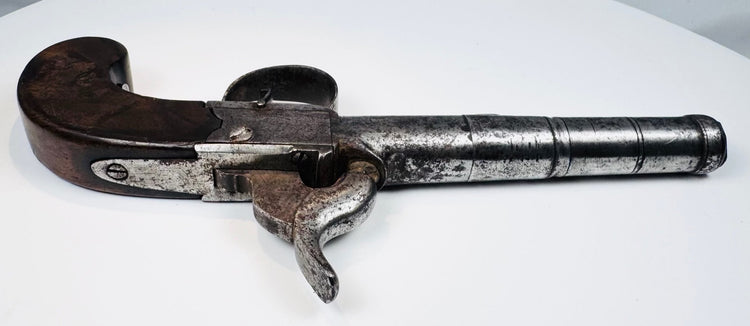
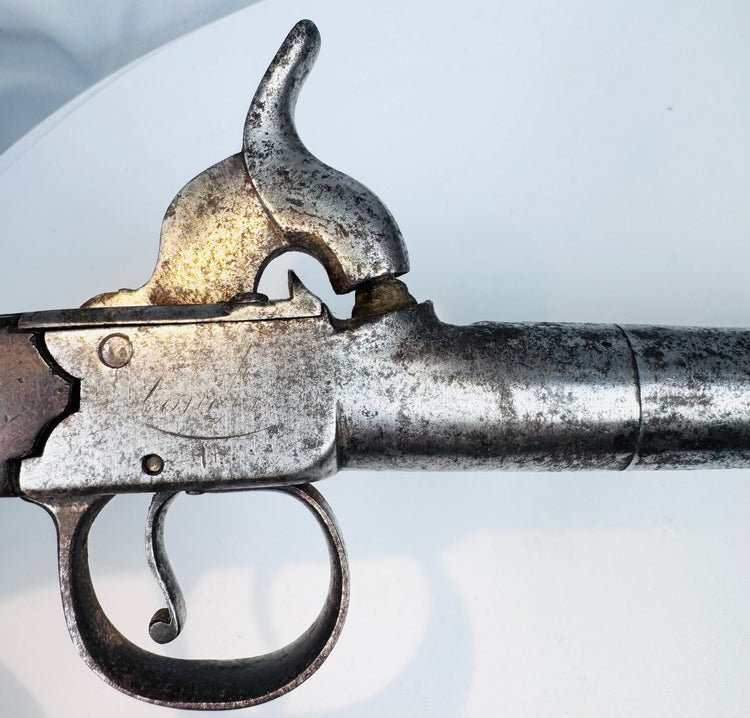
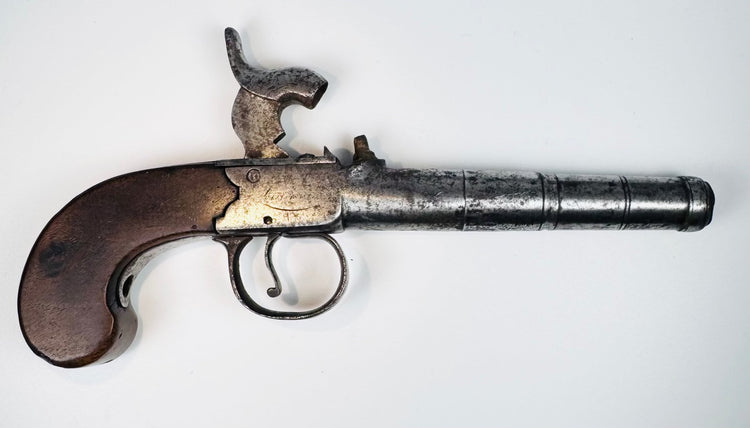
This early 19th-century British percussion pocket pistol features an elongated cannon-form barrel, compact boxlock-style action, external percussion hammer, and curved wooden grip.
The pistol belongs to the transitional period when percussion-cap ignition rapidly replaced the older flintlock system across Britain and Europe. Its percussion mechanism strongly suggests manufacture during the second quarter of the 19th century, with a working date of approximately 1830–1850.
The long cylindrical barrel is divided by a series of neatly turned circumferential bands, creating the distinctive cannon-barrel profile associated with a variety of British pocket and travelling pistols.
The compact action incorporates an external percussion hammer positioned above the breech. When originally in service, the hammer would have struck a percussion cap seated over the nipple, igniting the main powder charge within the barrel.
A large oval trigger guard surrounds the slender curved trigger, while the dark wooden grip sweeps downward into a rounded bag-shaped butt designed to sit comfortably in the hand.
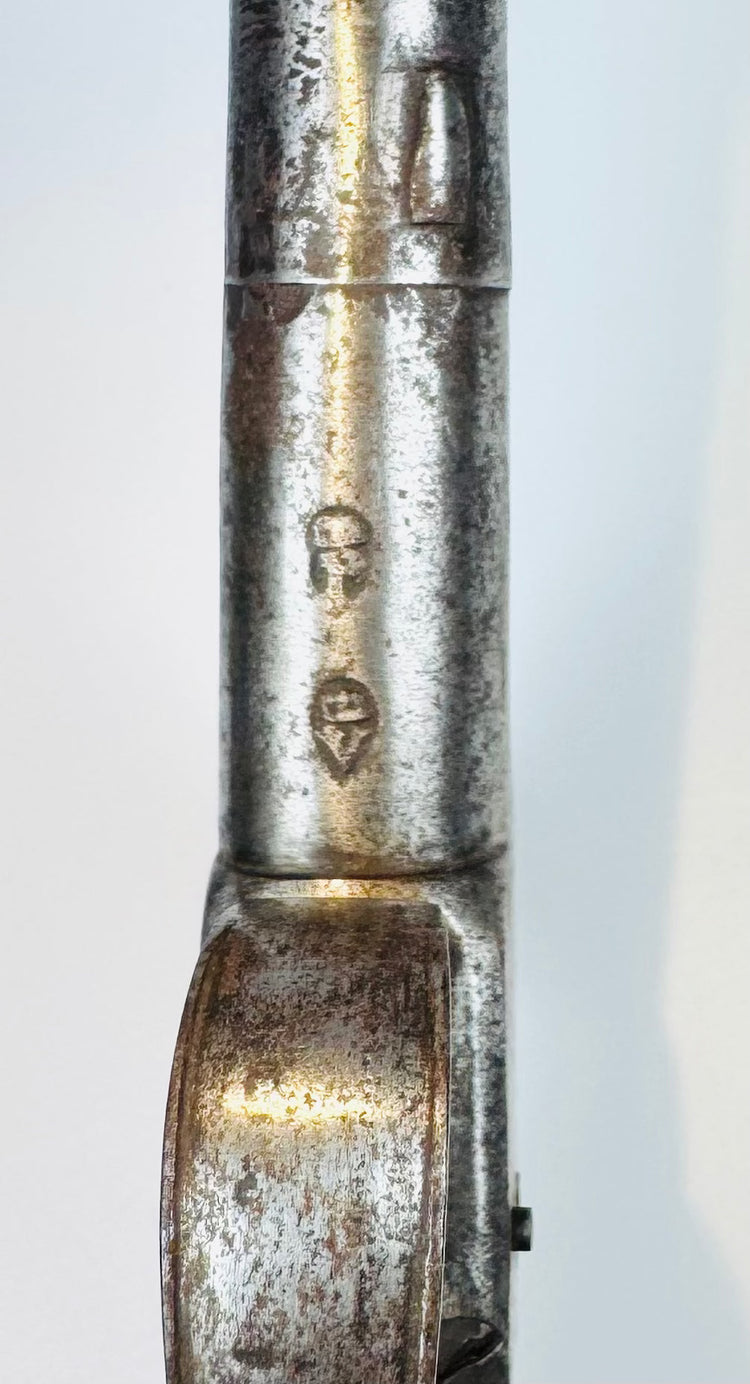
Several stamped marks are visible on the barrel near the breech. These appear more consistent with British proof or inspection marks than a clearly identifiable maker's trademark, although additional close examination may permit a more precise attribution.
The pistol is also marked London on one side. Such inscriptions commonly indicated a London maker, retailer, or intended place of sale, though firearms carrying London markings were sometimes produced partly or entirely through the extensive Birmingham gun trade before being retailed in the capital.
The metal surfaces retain an attractive combination of dark oxidation, grey steel, old patination, and areas of brighter wear, giving the pistol considerable historical character.
Features
- British percussion-cap pocket pistol
- Elongated cannon-form steel barrel
- Turned decorative bands around the barrel
- External percussion hammer
- Compact boxlock-style action
- Large oval trigger guard
- Curved bag-shaped wooden grip
- London inscription
- Multiple stamped proof or inspection marks near the breech
- Naturally aged steel surface with oxidation and patination
Cultural Significance
Compact pocket pistols were widely produced in Britain during the late 18th and early 19th centuries for personal protection, travel, and civilian use.
During the early decades of the 19th century, the development of reliable percussion-cap ignition transformed firearm manufacture. The system replaced the flint, frizzen, and priming pan of the traditional flintlock with a small percussion cap containing an impact-sensitive compound. When struck by the hammer, the cap produced a flash that passed through the nipple into the main powder charge. The system was simpler, more compact, and generally more reliable in poor weather than the flintlock mechanism it replaced.
By the 1830s and 1840s, percussion pistols had become common throughout Britain, including compact forms intended to be carried discreetly in a coat pocket, travelling case, or personal luggage. The cannon-shaped barrel was both decorative and functional in appearance, drawing upon an established British gunmaking tradition in which turned barrel profiles gave small pistols a distinctive visual character.
The London marking reflects the importance of the capital as a major centre for firearm retail and gunmaking, while the stamped barrel marks provide evidence of the proofing and inspection systems used to regulate British firearm production.
Condition
The pistol survives in good antique condition consistent with considerable age and use. The steel and iron surfaces exhibit extensive oxidation, dark patination, scattered pitting, scratches, abrasions, discoloration, and areas of polished or brighter wear. The barrel retains its turned decorative bands and several visible stamped marks. The London inscription is present, though some markings exhibit age-related wear. The wooden grip displays surface wear, scratches, darkening, minor abrasions, and natural variations consistent with prolonged handling and age. The percussion hammer, trigger, trigger guard, barrel, and principal components remain present. Mechanical functionality has not been tested, and no representation is made regarding the pistol's ability to operate or its safety for use. The pistol is missing one screw from the wooden handle.
Dimensions (Approximate)
Overall Length: 7.3 in / 18.5 cm
Age (Approximate)
175–195 years old
Provenance
Formerly part of a private collection in Newcastle upon Tyne, United Kingdom. The collection included historical objects and arms.
Learn More
Explore a similar pocket percussion pistol at the London Museum
Browse our Collection of Arms, Armour and Historical Weaponry
Antique Firearm Notice
All firearms offered by Relic & Rarity are sold strictly as antique collectibles and display pieces. They are supplied in disabled/non-firing condition and are not represented, tested, or warranted as safe or suitable for firing. Buyers are responsible for confirming all applicable laws regarding purchase, possession, transport, import, and ownership in their jurisdiction.
Description
Historical Context & Origin
Region: England, United Kingdom, marked London
Material: Steel and iron with wooden grip
Period: Early–Mid 19th Century, circa 1830–1850
Description
This early 19th-century British percussion pocket pistol features an elongated cannon-form barrel, compact boxlock-style action, external percussion hammer, and curved wooden grip.
The pistol belongs to the transitional period when percussion-cap ignition rapidly replaced the older flintlock system across Britain and Europe. Its percussion mechanism strongly suggests manufacture during the second quarter of the 19th century, with a working date of approximately 1830–1850.
The long cylindrical barrel is divided by a series of neatly turned circumferential bands, creating the distinctive cannon-barrel profile associated with a variety of British pocket and travelling pistols.
The compact action incorporates an external percussion hammer positioned above the breech. When originally in service, the hammer would have struck a percussion cap seated over the nipple, igniting the main powder charge within the barrel.
A large oval trigger guard surrounds the slender curved trigger, while the dark wooden grip sweeps downward into a rounded bag-shaped butt designed to sit comfortably in the hand.
Several stamped marks are visible on the barrel near the breech. These appear more consistent with British proof or inspection marks than a clearly identifiable maker's trademark, although additional close examination may permit a more precise attribution.
The pistol is also marked London on one side. Such inscriptions commonly indicated a London maker, retailer, or intended place of sale, though firearms carrying London markings were sometimes produced partly or entirely through the extensive Birmingham gun trade before being retailed in the capital.
The metal surfaces retain an attractive combination of dark oxidation, grey steel, old patination, and areas of brighter wear, giving the pistol considerable historical character.
Features
- British percussion-cap pocket pistol
- Elongated cannon-form steel barrel
- Turned decorative bands around the barrel
- External percussion hammer
- Compact boxlock-style action
- Large oval trigger guard
- Curved bag-shaped wooden grip
- London inscription
- Multiple stamped proof or inspection marks near the breech
- Naturally aged steel surface with oxidation and patination
Cultural Significance
Compact pocket pistols were widely produced in Britain during the late 18th and early 19th centuries for personal protection, travel, and civilian use.
During the early decades of the 19th century, the development of reliable percussion-cap ignition transformed firearm manufacture. The system replaced the flint, frizzen, and priming pan of the traditional flintlock with a small percussion cap containing an impact-sensitive compound. When struck by the hammer, the cap produced a flash that passed through the nipple into the main powder charge. The system was simpler, more compact, and generally more reliable in poor weather than the flintlock mechanism it replaced.
By the 1830s and 1840s, percussion pistols had become common throughout Britain, including compact forms intended to be carried discreetly in a coat pocket, travelling case, or personal luggage. The cannon-shaped barrel was both decorative and functional in appearance, drawing upon an established British gunmaking tradition in which turned barrel profiles gave small pistols a distinctive visual character.
The London marking reflects the importance of the capital as a major centre for firearm retail and gunmaking, while the stamped barrel marks provide evidence of the proofing and inspection systems used to regulate British firearm production.
Condition
The pistol survives in good antique condition consistent with considerable age and use. The steel and iron surfaces exhibit extensive oxidation, dark patination, scattered pitting, scratches, abrasions, discoloration, and areas of polished or brighter wear. The barrel retains its turned decorative bands and several visible stamped marks. The London inscription is present, though some markings exhibit age-related wear. The wooden grip displays surface wear, scratches, darkening, minor abrasions, and natural variations consistent with prolonged handling and age. The percussion hammer, trigger, trigger guard, barrel, and principal components remain present. Mechanical functionality has not been tested, and no representation is made regarding the pistol's ability to operate or its safety for use. The pistol is missing one screw from the wooden handle.
Dimensions (Approximate)
Overall Length: 7.3 in / 18.5 cm
Age (Approximate)
175–195 years old
Provenance
Formerly part of a private collection in Newcastle upon Tyne, United Kingdom. The collection included historical objects and arms.
Learn More
Explore a similar pocket percussion pistol at the London Museum
Browse our Collection of Arms, Armour and Historical Weaponry
Antique Firearm Notice
All firearms offered by Relic & Rarity are sold strictly as antique collectibles and display pieces. They are supplied in disabled/non-firing condition and are not represented, tested, or warranted as safe or suitable for firing. Buyers are responsible for confirming all applicable laws regarding purchase, possession, transport, import, and ownership in their jurisdiction.
You May Also Like
