


Bronze Penannular Bracelet with Incised Geometric Decoration | Ancient Near East | Circa 1000 – 1 BCE
Couldn't load pickup availability


Bronze Penannular Bracelet with Incised Geometric Decoration | Ancient Near East | Circa 1000 – 1 BCE
Description
More
Less
Historical Context & Origin
Region: Western Asia, likely Iranian Plateau or neighbouring regions
Material: Cast bronze / copper alloy
Period: 1st Millennium BCE, circa 1000–1 BCE
Description
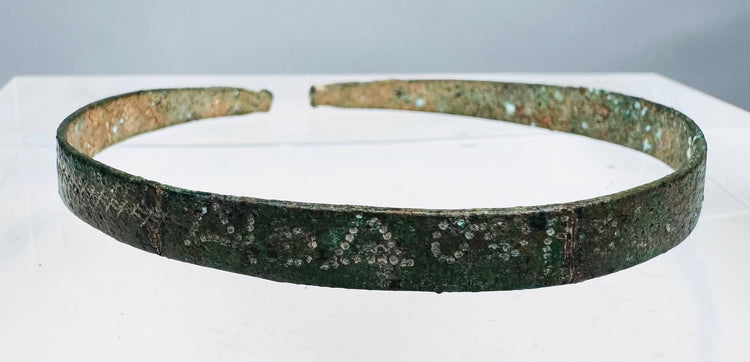
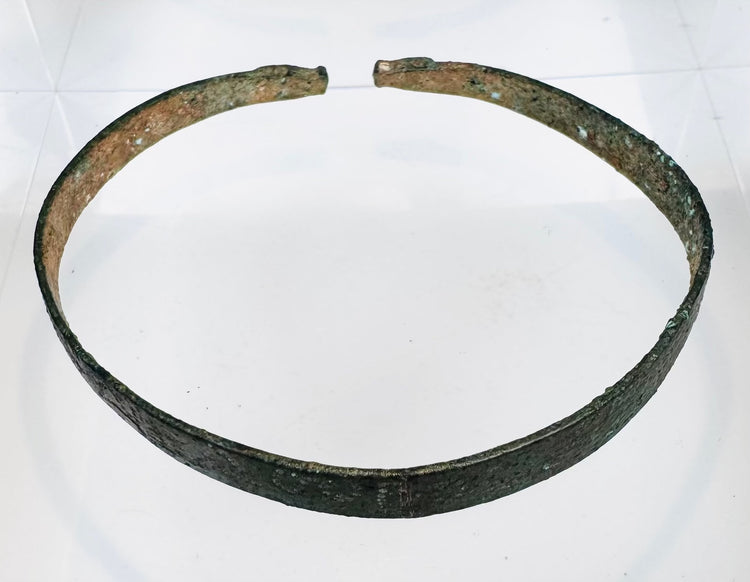
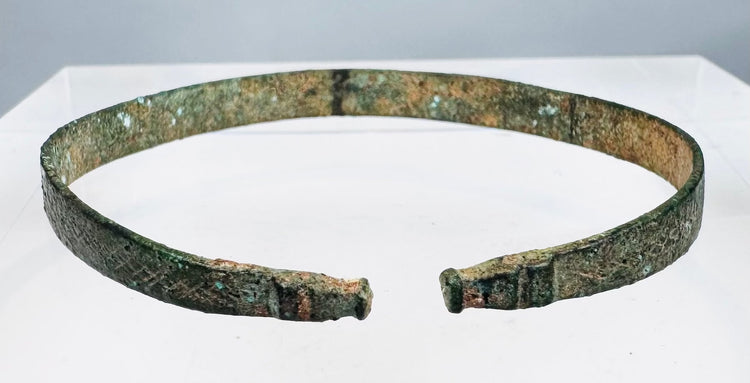
This ancient Western Asiatic bronze bracelet is a finely decorated penannular example dating broadly to the 1st millennium BCE. Formed from a single flat-section band of cast bronze, the bracelet curves into an open circular shape and terminates at either end in stylized animal-head finials.
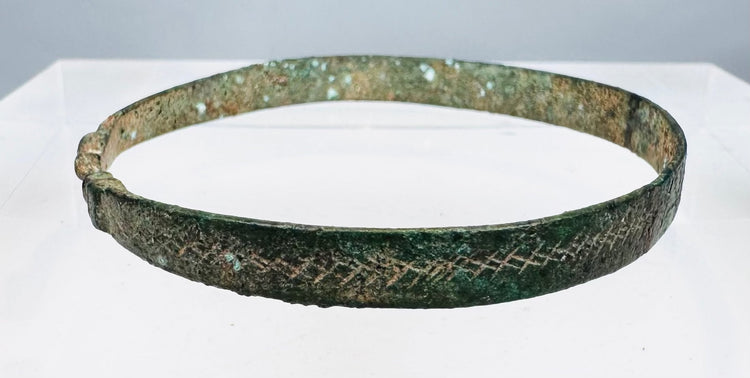
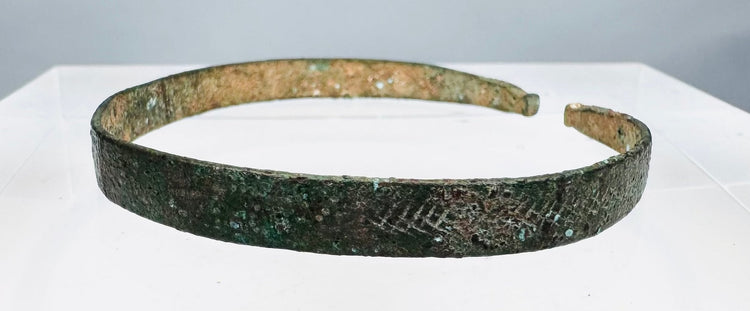
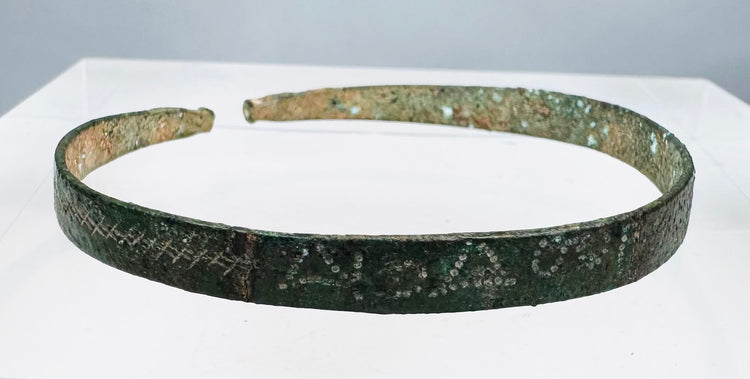
The body is broadest across the front and gradually narrows toward the open terminals. Its upper surface is decorated with a combination of incised and punched ornament, including hatched bands, repeated diagonal motifs, pointillé triangles, and small annulets. These geometric elements are arranged in organized panels around the circumference, creating a restrained but visually complex decorative scheme.
The terminal ends are slightly thickened and modelled to suggest simplified animal heads. Although age and surface wear have softened the finer details, the ends retain a distinct zoomorphic character through their squared profiles, raised transitions, and projecting tips. Animal-headed terminals were a recurring feature in ancient Western Asiatic jewellery and may have carried protective, symbolic, or status-related significance.
The bracelet’s flat internal surface and gently convex exterior would have allowed it to sit securely around the wrist or forearm. Its open penannular form also permitted minor adjustment when worn. The substantial green and brown patination visible throughout the surface reflects the natural oxidation of ancient bronze over many centuries.
Features
- Cast from bronze or copper alloy
- Flat-section open circular form
- Stylized animal-head terminals
- Incised hatched decoration
- Central pointillé triangle and annulet motifs
- Repeated geometric ornament around the outer surface
- Tapered ends with thickened zoomorphic finials
- Green, blue-green, brown, and earthen patination
- Retains an intact and wearable overall form
- Formerly part of a long-established European private collection
Cultural Significance
Bronze bracelets were widely worn throughout ancient Western Asia as personal ornaments, status symbols, protective objects, and expressions of regional identity. Penannular bracelets were particularly practical because their open construction allowed them to be fitted over the wrist while still retaining a visually substantial form.
Animal-headed terminals appear across a wide range of ancient jewellery and metalwork traditions. Depending on the region and period, these zoomorphic ends could represent serpents, felines, birds, caprids, or other protective creatures. In many cases, the animal imagery was deliberately stylized rather than naturalistic, blending symbolic meaning with geometric design.
The combination of hatched bands, pointillé triangles, annulets, and animal-head terminals suggests that this bracelet was intended to serve as more than a purely functional adornment. Its decoration may have communicated cultural affiliation, social standing, personal identity, or protective symbolism.
Condition
The bracelet remains substantially intact and displays age-related wear consistent with ancient burial and long-term preservation. The bronze surface exhibits extensive green and blue-green patination, brown oxidation, mineral encrustation, pitting, surface deposits, abrasions, and localized losses.
The incised and punched decoration remains visible across much of the outer surface, although some areas have been softened or obscured by corrosion and mineral buildup. The animal-head terminals retain their general form but show wear, rounding, and minor irregularities.
Dimensions (Approximate)
Diameter: 2.40 in
Age (Approximate)
2,025–3,025 years old
Provenance
Formerly part of the private collection of a European gentleman, born in 1942 and deceased in 2024.
The collection was formed beginning in the 1970s and developed over several decades, with a focus on ancient and historical objects.
Learn More
View a related ancient bronze bracelet in the collection of National Museums Liverpool
Explore our curated Collection of Ancient Rings, Jewellery & Historic Relics
Description
Historical Context & Origin
Region: Western Asia, likely Iranian Plateau or neighbouring regions
Material: Cast bronze / copper alloy
Period: 1st Millennium BCE, circa 1000–1 BCE
Description
This ancient Western Asiatic bronze bracelet is a finely decorated penannular example dating broadly to the 1st millennium BCE. Formed from a single flat-section band of cast bronze, the bracelet curves into an open circular shape and terminates at either end in stylized animal-head finials.
The body is broadest across the front and gradually narrows toward the open terminals. Its upper surface is decorated with a combination of incised and punched ornament, including hatched bands, repeated diagonal motifs, pointillé triangles, and small annulets. These geometric elements are arranged in organized panels around the circumference, creating a restrained but visually complex decorative scheme.
The terminal ends are slightly thickened and modelled to suggest simplified animal heads. Although age and surface wear have softened the finer details, the ends retain a distinct zoomorphic character through their squared profiles, raised transitions, and projecting tips. Animal-headed terminals were a recurring feature in ancient Western Asiatic jewellery and may have carried protective, symbolic, or status-related significance.
The bracelet’s flat internal surface and gently convex exterior would have allowed it to sit securely around the wrist or forearm. Its open penannular form also permitted minor adjustment when worn. The substantial green and brown patination visible throughout the surface reflects the natural oxidation of ancient bronze over many centuries.
Features
- Cast from bronze or copper alloy
- Flat-section open circular form
- Stylized animal-head terminals
- Incised hatched decoration
- Central pointillé triangle and annulet motifs
- Repeated geometric ornament around the outer surface
- Tapered ends with thickened zoomorphic finials
- Green, blue-green, brown, and earthen patination
- Retains an intact and wearable overall form
- Formerly part of a long-established European private collection
Cultural Significance
Bronze bracelets were widely worn throughout ancient Western Asia as personal ornaments, status symbols, protective objects, and expressions of regional identity. Penannular bracelets were particularly practical because their open construction allowed them to be fitted over the wrist while still retaining a visually substantial form.
Animal-headed terminals appear across a wide range of ancient jewellery and metalwork traditions. Depending on the region and period, these zoomorphic ends could represent serpents, felines, birds, caprids, or other protective creatures. In many cases, the animal imagery was deliberately stylized rather than naturalistic, blending symbolic meaning with geometric design.
The combination of hatched bands, pointillé triangles, annulets, and animal-head terminals suggests that this bracelet was intended to serve as more than a purely functional adornment. Its decoration may have communicated cultural affiliation, social standing, personal identity, or protective symbolism.
Condition
The bracelet remains substantially intact and displays age-related wear consistent with ancient burial and long-term preservation. The bronze surface exhibits extensive green and blue-green patination, brown oxidation, mineral encrustation, pitting, surface deposits, abrasions, and localized losses.
The incised and punched decoration remains visible across much of the outer surface, although some areas have been softened or obscured by corrosion and mineral buildup. The animal-head terminals retain their general form but show wear, rounding, and minor irregularities.
Dimensions (Approximate)
Diameter: 2.40 in
Age (Approximate)
2,025–3,025 years old
Provenance
Formerly part of the private collection of a European gentleman, born in 1942 and deceased in 2024.
The collection was formed beginning in the 1970s and developed over several decades, with a focus on ancient and historical objects.
Learn More
View a related ancient bronze bracelet in the collection of National Museums Liverpool
Explore our curated Collection of Ancient Rings, Jewellery & Historic Relics
You May Also Like
