



Large Chinese Bronze | Mythical Beast Sculpture | Late Qing Dynasty | Circa 1850 – 1920
Couldn't load pickup availability


Large Chinese Bronze | Mythical Beast Sculpture | Late Qing Dynasty | Circa 1850 – 1920
Description
More
Less
Historical Context & Origin
Region: China
Material: Cast bronze or copper alloy with naturally aged green and dark brown patina
Period: Late Qing Dynasty to Early Republic Period, circa 1850–1920
Description
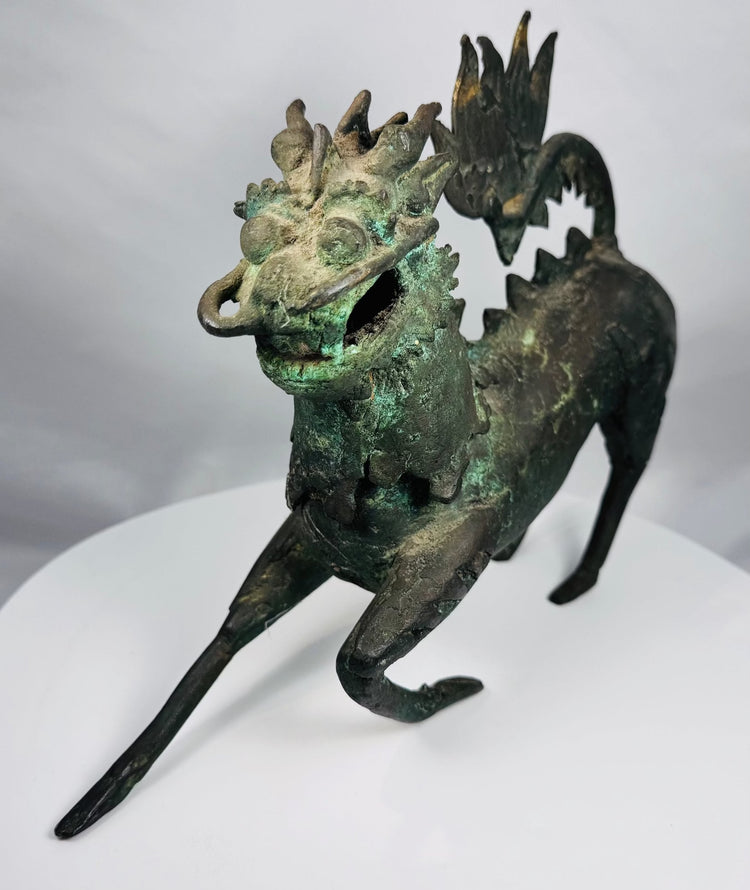
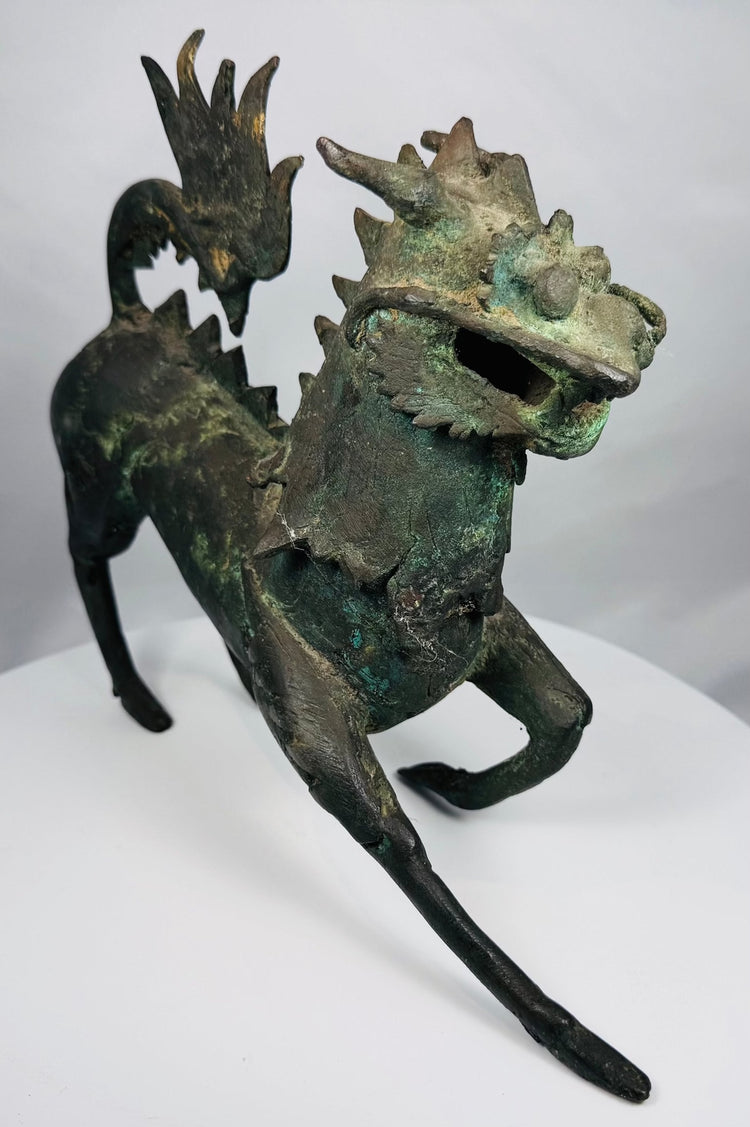
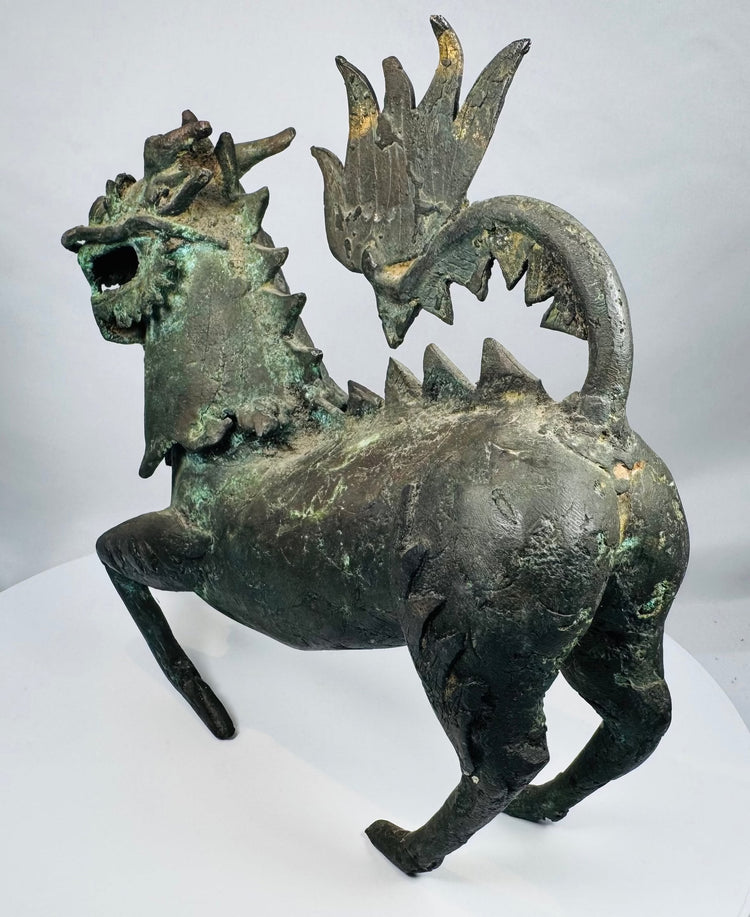
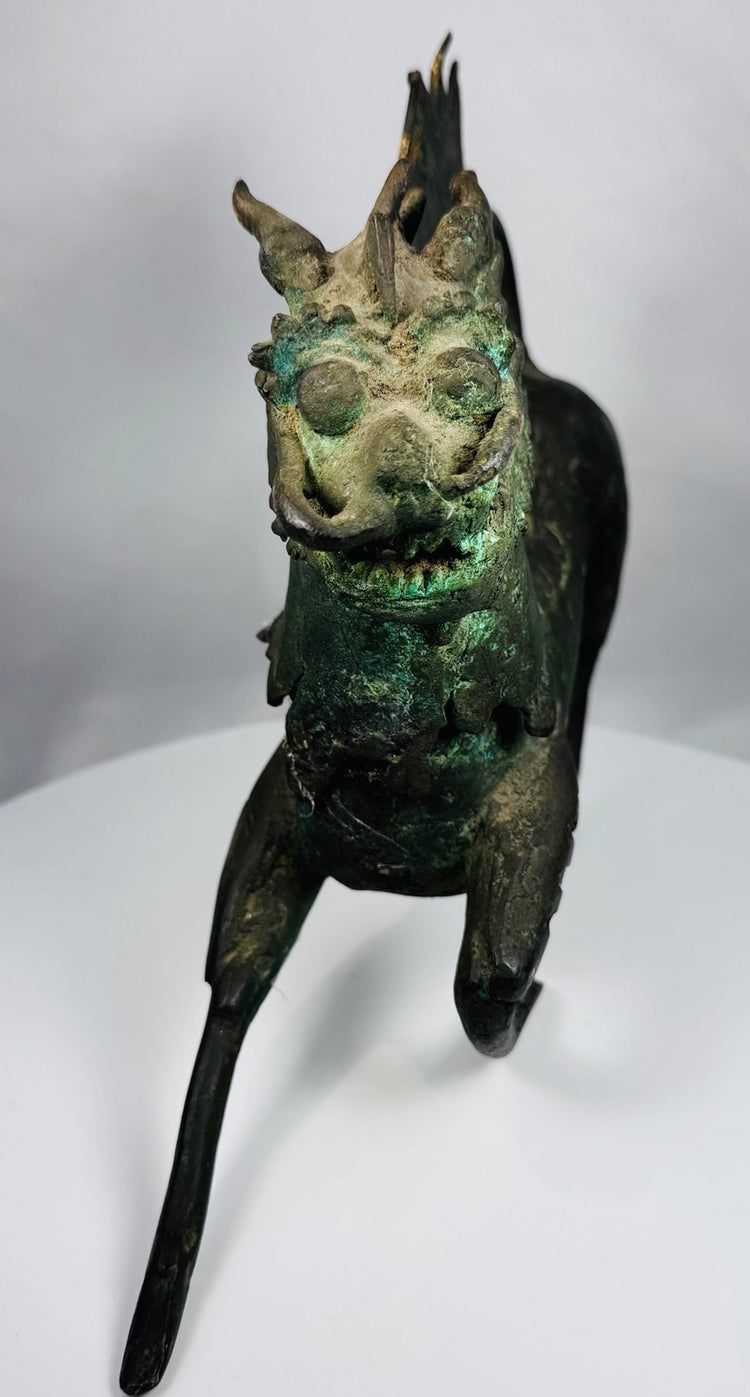
This substantial Chinese bronze sculpture depicts a qilin, one of the most important auspicious creatures in traditional Chinese mythology.
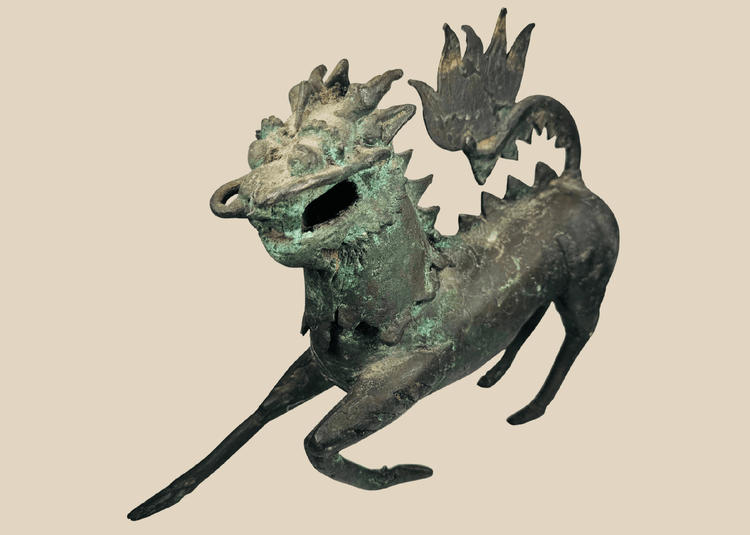
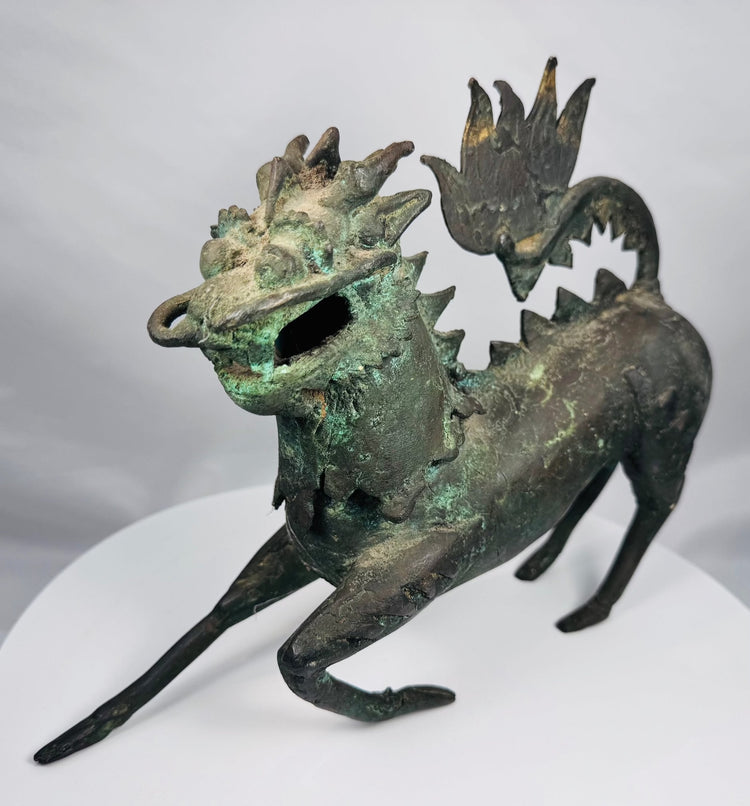
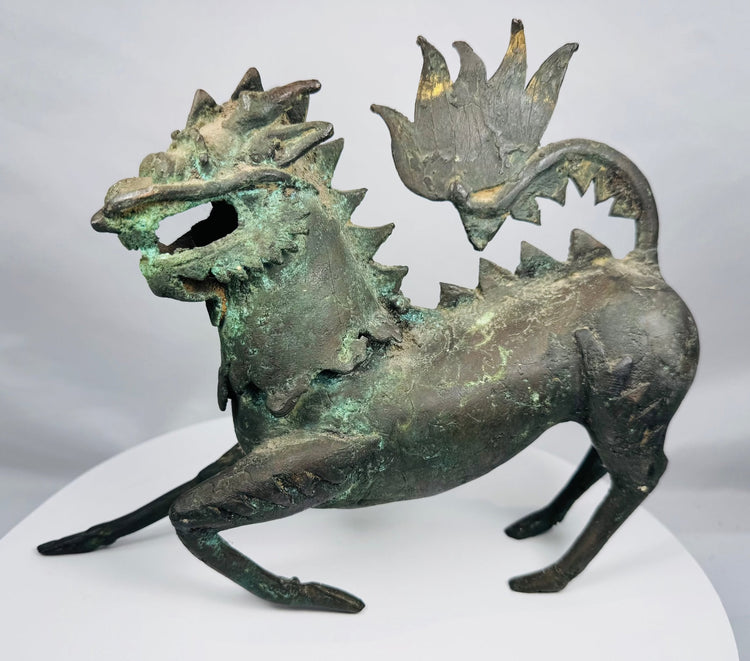
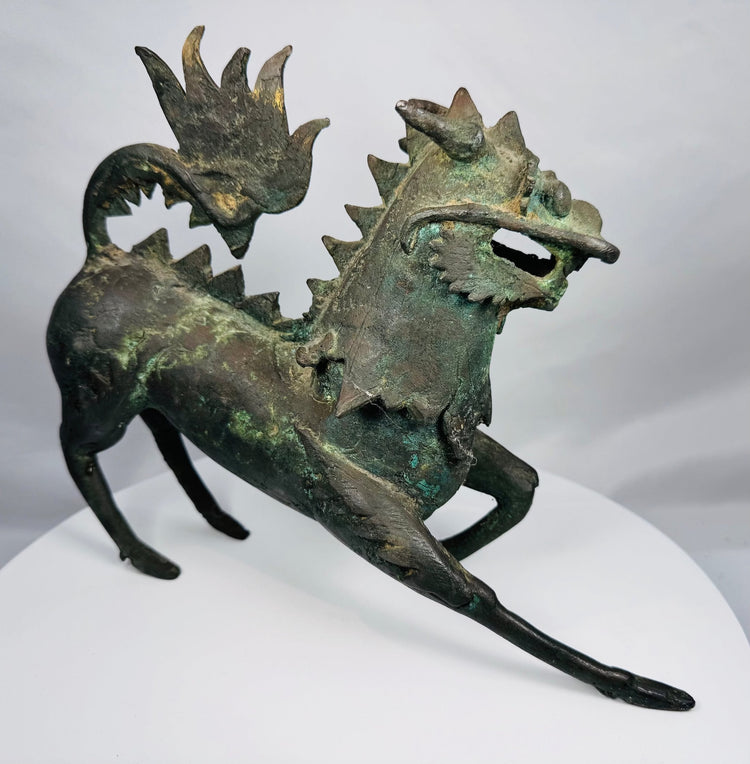
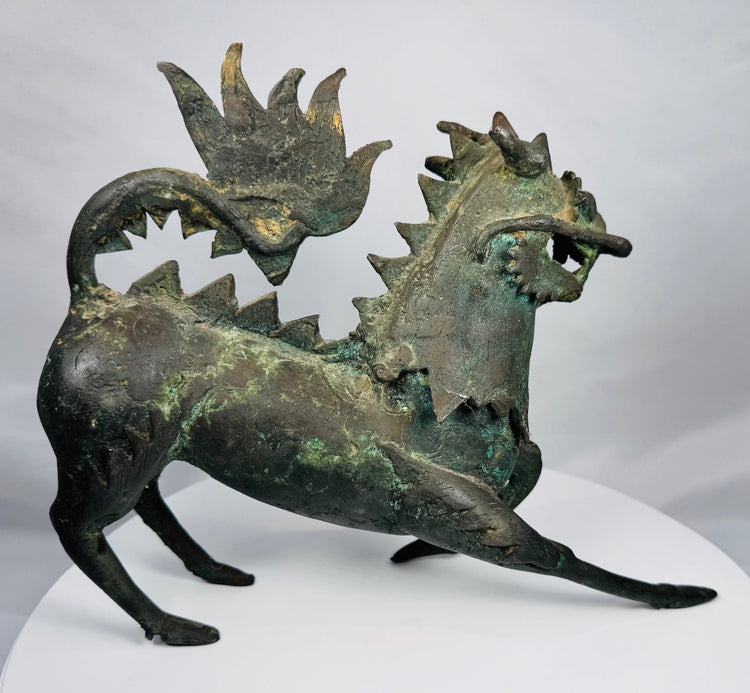
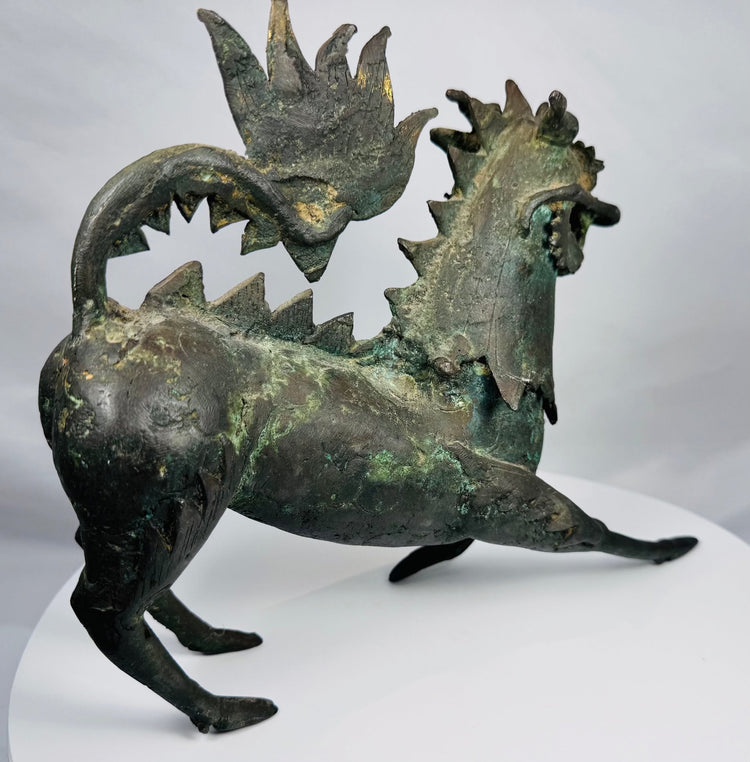
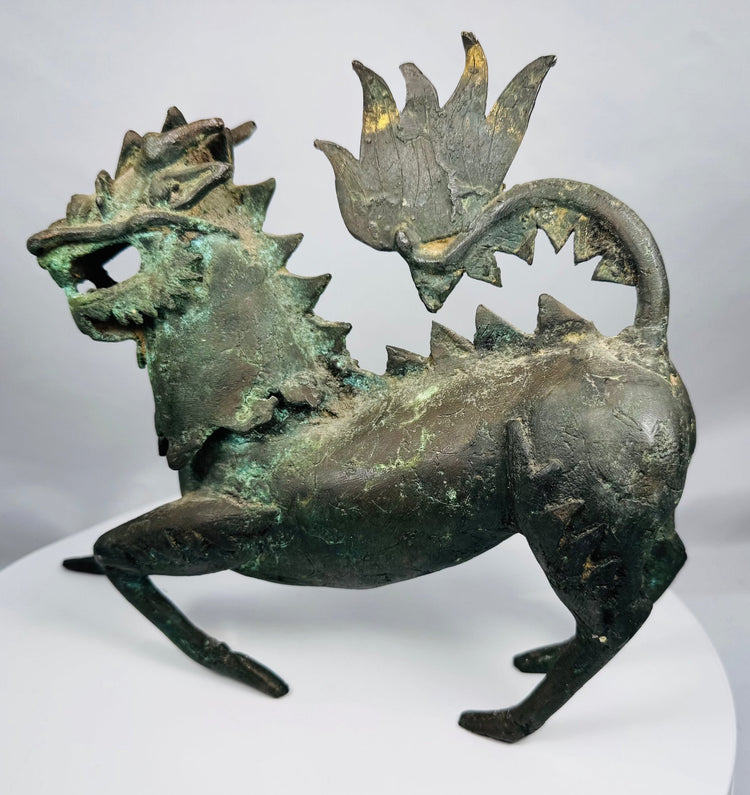
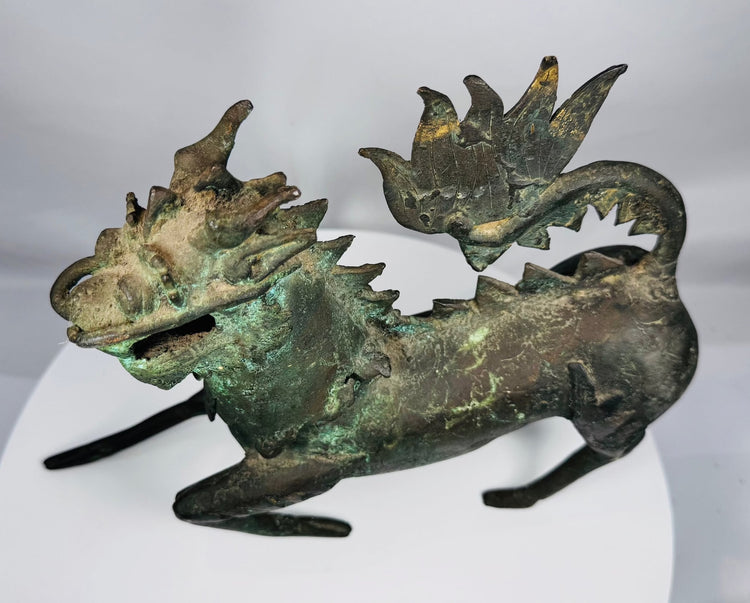
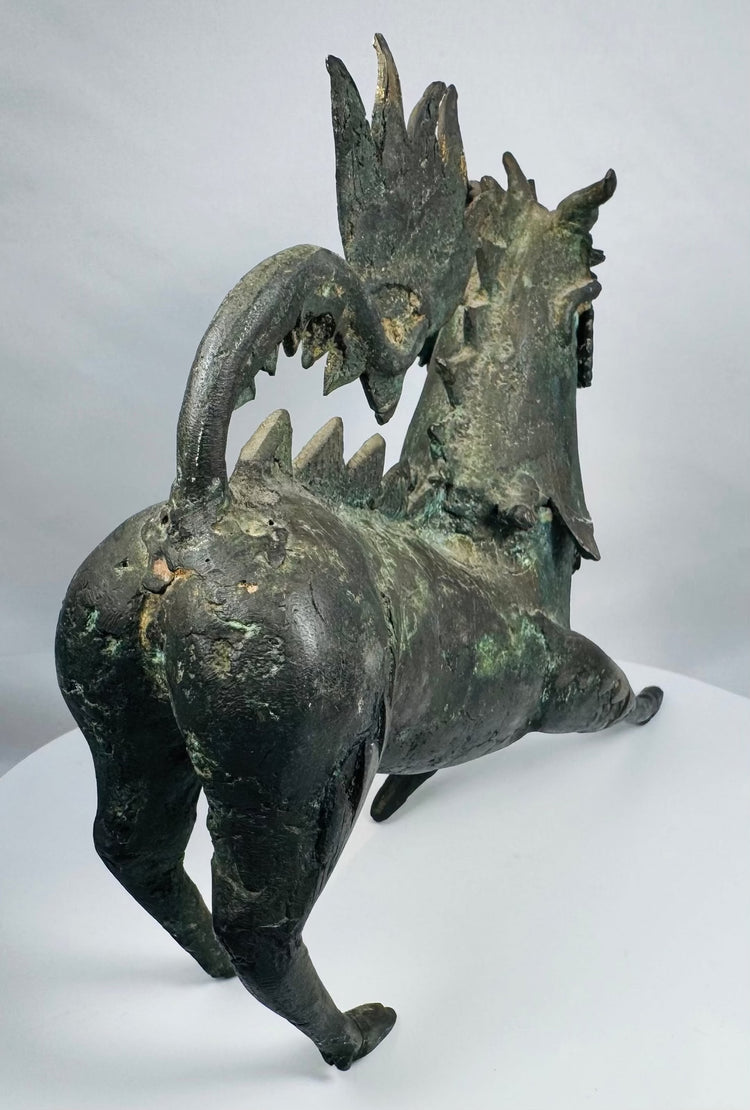
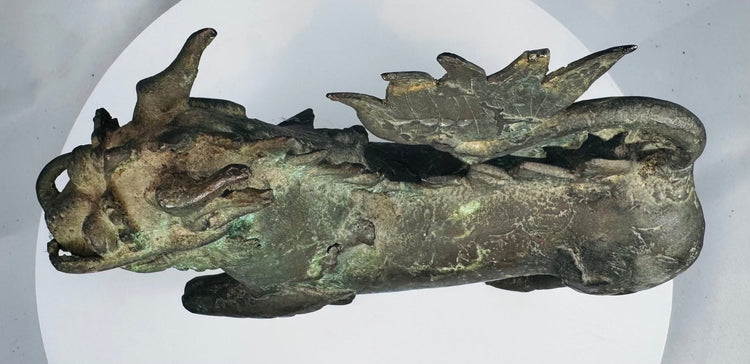
The mythical beast is represented in a dynamic forward-moving stance with an elongated body, powerful legs, raised head, open mouth, prominent teeth, horns, and a dramatic series of pointed projections extending along the head, neck, and spine. The facial treatment combines characteristics traditionally associated with the dragon, lion, and deer. Large rounded eyes, curling brows, projecting horns, an open jaw, and sharply modelled teeth give the creature an animated and protective expression. A pronounced mane or ruff frames the neck, while triangular spines continue along the back toward the hindquarters. The tail rises dramatically from the rear of the body before curling forward in a broad arch. It terminates in an elaborate flame- or leaf-shaped flourish with multiple pointed lobes, adding considerable height and movement to the composition. The body is relatively smooth compared with the highly ornamented head and tail, creating a strong visual contrast between the massive torso and the elaborate supernatural features.
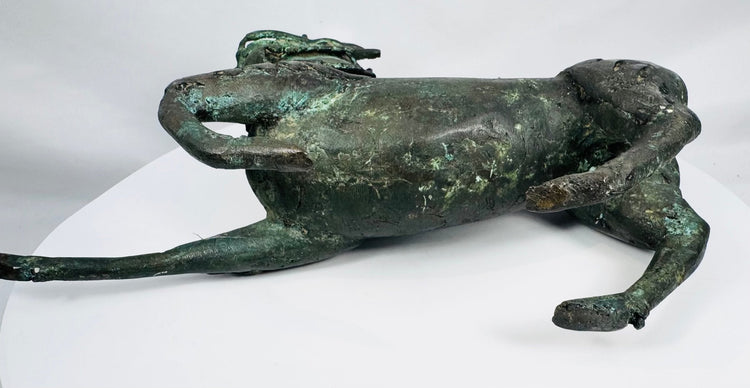
The bronze displays extensive naturally varied surface coloration ranging from deep brown and black to green and turquoise oxidation. Areas of lighter exposed metal and mineral deposits further emphasize the sculptural details. The underside remains substantially open and reveals the hollow cast construction typical of larger decorative bronze sculpture.
Features
- Mythical dragon-lion-deer composite form
- Dramatically modelled horned head
- Open mouth with visible teeth
- Pronounced mane and dorsal spines
- Long arched tail
- Flame- or leaf-shaped tail terminal
- Hollow cast bronze construction
- Extensive green, turquoise, brown, and dark patination
- Substantial sculptural presence
Cultural Significance
The qilin occupies an important position within Chinese mythology and is traditionally regarded as one of the great auspicious creatures alongside the dragon, phoenix, and tortoise.
Descriptions of the qilin vary considerably across Chinese history, but it is frequently portrayed as a hybrid animal combining elements of the deer, dragon, horse, ox, and lion. Despite its sometimes fierce appearance, the qilin was regarded as a fundamentally benevolent creature associated with peace, justice, fertility, prosperity, and moral virtue.
According to traditional belief, the appearance of a qilin could herald the birth or arrival of an exceptional ruler, sage, or person of great virtue. One famous tradition associates a qilin with the birth of Confucius. Images of qilin were incorporated into sculpture, architecture, ceramics, textiles, metalwork, and decorative arts, where they functioned as protective and auspicious symbols. The dramatic horns, dorsal projections, and flame-like tail seen on the present sculpture reflect the increasingly fantastical treatment of mythical animals in later Chinese decorative art.
Condition
The sculpture remains in good antique condition overall with extensive surface wear consistent with age. The bronze exhibits substantial dark brown, black, green, and turquoise patination, together with oxidation, mineral deposits, discoloration, abrasions, scratches, casting irregularities, and areas of exposed underlying metal. Several projecting elements, particularly around the horns, mane, dorsal spines, and tail ornament, exhibit wear, bending, small losses, and irregular edges.
Surface cracking, rough casting areas, small pits, and localized losses are visible throughout. The open mouth, facial details, legs, tail, and primary decorative elements remain clearly defined. The underside is open as part of the hollow casting process and displays additional oxidation and age-related surface changes.
Dimensions (Approximate)
Height: 8.25 in
Length: 10 in
Depth: 3.25 in
Age (Approximate)
100–175 years old
Provenance
Formerly part of a private collection in Falls Church, Virginia, USA, assembled with a particular focus on Chinese art, antiques, and decorative objects.
Learn More
View a comparable 19th-century Qing Dynasty bronze mythical beast offered by Sotheby’s.
Browse our Collection of Ancient Chinese Artifacts and Imperial Relics.
Description
Historical Context & Origin
Region: China
Material: Cast bronze or copper alloy with naturally aged green and dark brown patina
Period: Late Qing Dynasty to Early Republic Period, circa 1850–1920
Description
This substantial Chinese bronze sculpture depicts a qilin, one of the most important auspicious creatures in traditional Chinese mythology.
The mythical beast is represented in a dynamic forward-moving stance with an elongated body, powerful legs, raised head, open mouth, prominent teeth, horns, and a dramatic series of pointed projections extending along the head, neck, and spine. The facial treatment combines characteristics traditionally associated with the dragon, lion, and deer. Large rounded eyes, curling brows, projecting horns, an open jaw, and sharply modelled teeth give the creature an animated and protective expression. A pronounced mane or ruff frames the neck, while triangular spines continue along the back toward the hindquarters. The tail rises dramatically from the rear of the body before curling forward in a broad arch. It terminates in an elaborate flame- or leaf-shaped flourish with multiple pointed lobes, adding considerable height and movement to the composition. The body is relatively smooth compared with the highly ornamented head and tail, creating a strong visual contrast between the massive torso and the elaborate supernatural features.
The bronze displays extensive naturally varied surface coloration ranging from deep brown and black to green and turquoise oxidation. Areas of lighter exposed metal and mineral deposits further emphasize the sculptural details. The underside remains substantially open and reveals the hollow cast construction typical of larger decorative bronze sculpture.
Features
- Mythical dragon-lion-deer composite form
- Dramatically modelled horned head
- Open mouth with visible teeth
- Pronounced mane and dorsal spines
- Long arched tail
- Flame- or leaf-shaped tail terminal
- Hollow cast bronze construction
- Extensive green, turquoise, brown, and dark patination
- Substantial sculptural presence
Cultural Significance
The qilin occupies an important position within Chinese mythology and is traditionally regarded as one of the great auspicious creatures alongside the dragon, phoenix, and tortoise.
Descriptions of the qilin vary considerably across Chinese history, but it is frequently portrayed as a hybrid animal combining elements of the deer, dragon, horse, ox, and lion. Despite its sometimes fierce appearance, the qilin was regarded as a fundamentally benevolent creature associated with peace, justice, fertility, prosperity, and moral virtue.
According to traditional belief, the appearance of a qilin could herald the birth or arrival of an exceptional ruler, sage, or person of great virtue. One famous tradition associates a qilin with the birth of Confucius. Images of qilin were incorporated into sculpture, architecture, ceramics, textiles, metalwork, and decorative arts, where they functioned as protective and auspicious symbols. The dramatic horns, dorsal projections, and flame-like tail seen on the present sculpture reflect the increasingly fantastical treatment of mythical animals in later Chinese decorative art.
Condition
The sculpture remains in good antique condition overall with extensive surface wear consistent with age. The bronze exhibits substantial dark brown, black, green, and turquoise patination, together with oxidation, mineral deposits, discoloration, abrasions, scratches, casting irregularities, and areas of exposed underlying metal. Several projecting elements, particularly around the horns, mane, dorsal spines, and tail ornament, exhibit wear, bending, small losses, and irregular edges.
Surface cracking, rough casting areas, small pits, and localized losses are visible throughout. The open mouth, facial details, legs, tail, and primary decorative elements remain clearly defined. The underside is open as part of the hollow casting process and displays additional oxidation and age-related surface changes.
Dimensions (Approximate)
Height: 8.25 in
Length: 10 in
Depth: 3.25 in
Age (Approximate)
100–175 years old
Provenance
Formerly part of a private collection in Falls Church, Virginia, USA, assembled with a particular focus on Chinese art, antiques, and decorative objects.
Learn More
View a comparable 19th-century Qing Dynasty bronze mythical beast offered by Sotheby’s.
Browse our Collection of Ancient Chinese Artifacts and Imperial Relics.
You May Also Like
