

Chinese Polychrome Wood Shrine Group with Official and Attendants | Late Qing Dynasty | Circa 1850 – 1911
Couldn't load pickup availability



Chinese Polychrome Wood Shrine Group with Official and Attendants | Late Qing Dynasty | Circa 1850 – 1911
Description
More
Less
Historical Context & Origin
Region: China, probably southern China
Material: Hand-carved wood with gesso ground and surviving polychrome pigments
Period: Late Qing Dynasty–Early Republic Period, circa 1850–1920
Description
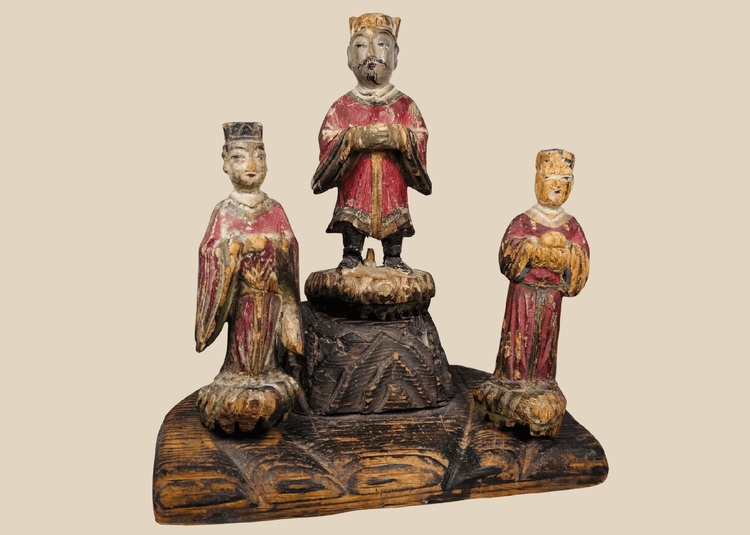
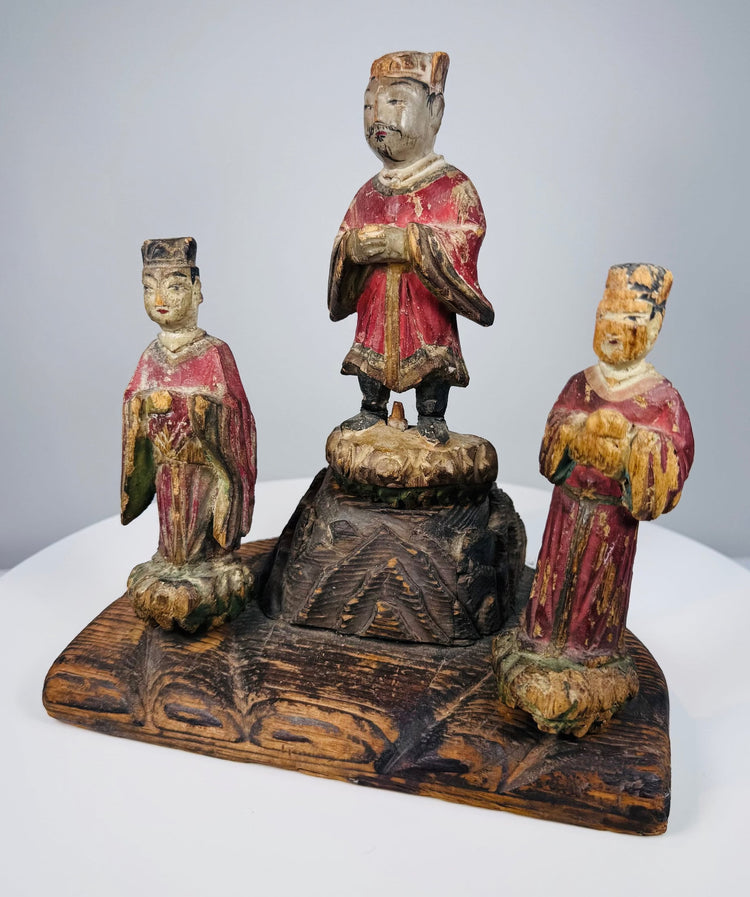
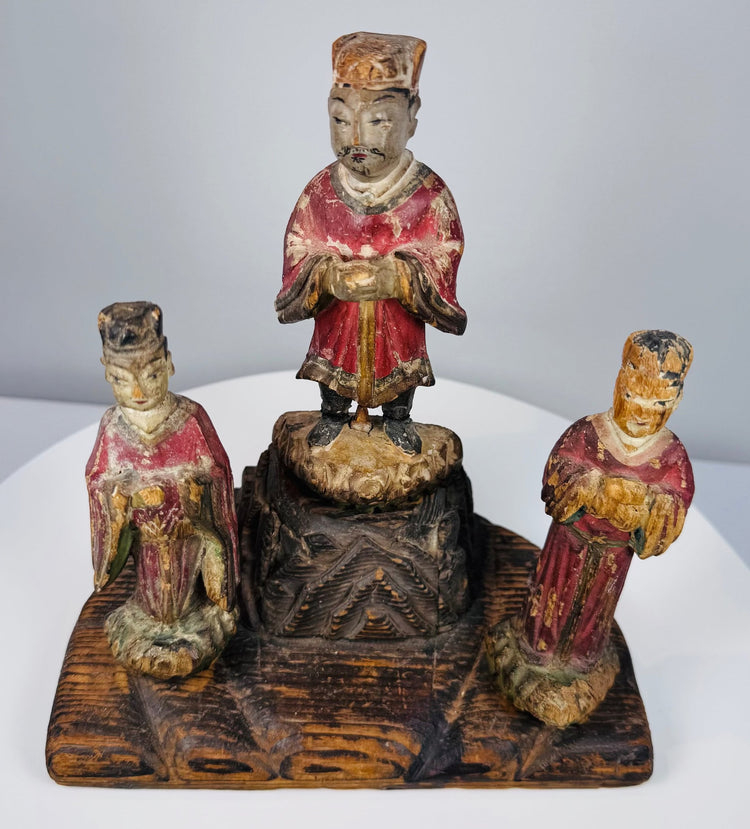
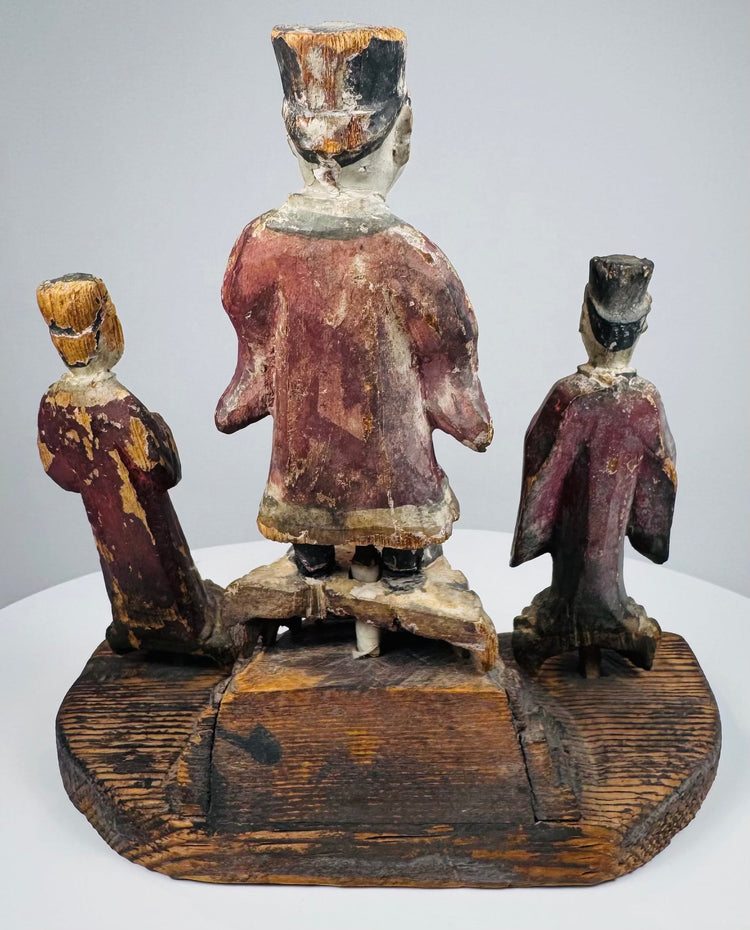
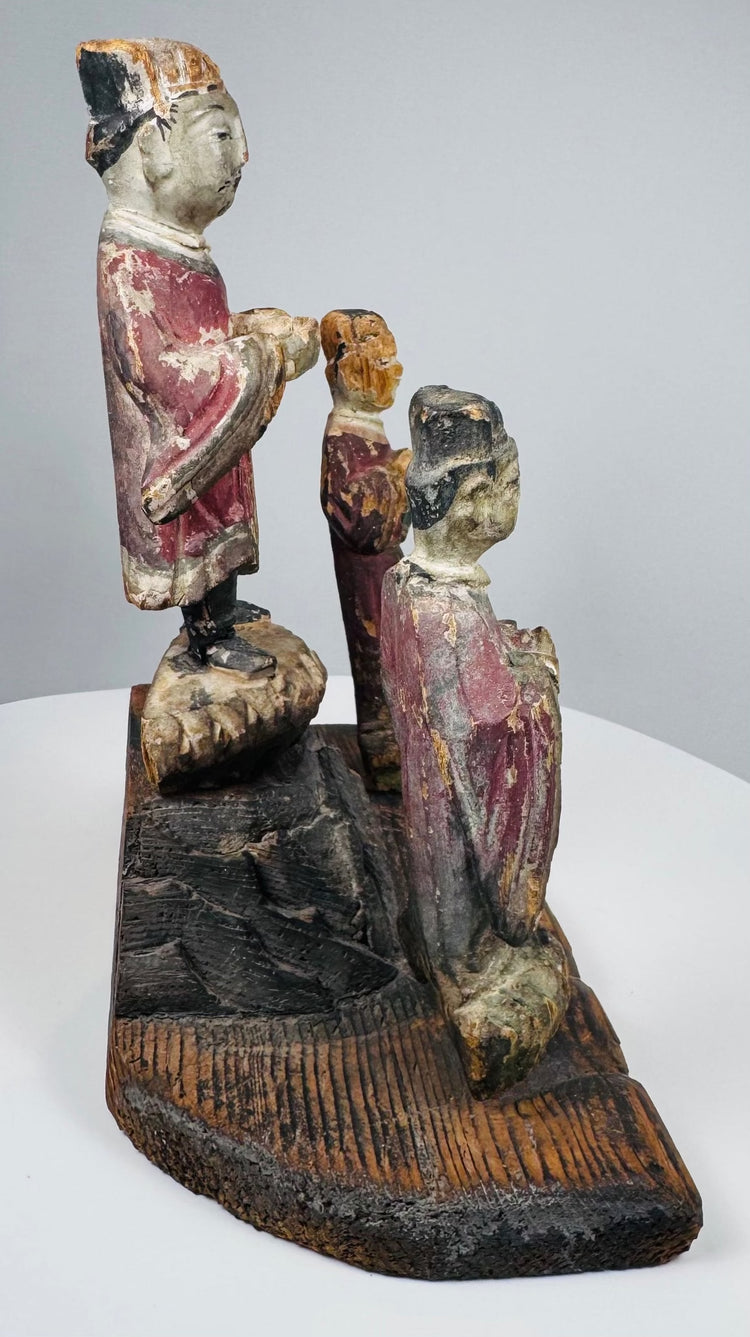
This antique Chinese polychrome wooden shrine group depicts a central male official or folk-religious figure elevated above two smaller attendants, all arranged upon an intricately carved architectural base.
The principal figure stands with his hands respectfully clasped before his chest. He wears a tall ceremonial headdress, a long red court robe with contrasting borders, black trousers, and dark footwear. His face retains delicately painted eyes, eyebrows, moustache, beard, and red lips. He stands upon a separately carved lotus-form pedestal positioned above a raised central structure decorated with stylized mountain, leaf, or flame-like motifs.
Two smaller figures flank the central official. Both wear long red robes with wide sleeves and stand upon individual lotus-form bases. One appears to carry a long ceremonial object or offering, while the other holds an object against the chest. Their formal postures and placement suggest attendants participating in a ritual or courtly presentation.
The figures are mounted upon a broad rectangular wooden platform decorated with deeply incised geometric, vegetal, cloud, or wave-like patterns. Surviving red, green, ochre, black, cream, and brown pigments provide a vivid impression of the ensemble's original appearance despite extensive age-related wear.
Features
- Elevated central official or folk-religious figure
- Two smaller flanking attendants
- Formal clasped-hand ritual postures
- Traditional court robes and ceremonial headdresses
- Individual lotus-form pedestals
- Carved architectural or mountainous central platform
- Incised cloud, wave, geometric, and vegetal decoration
- Surviving red, green, ochre, black, cream, and brown pigments
- Strongly aged surface with exposed wood and historic patination
Cultural Significance
Painted wooden figures occupied an important place within Chinese household shrines, community temples, ancestral halls, and regional religious traditions. Such images could portray ancestors, civil officials, Daoist divinities, protective figures, or local deities accompanied by attendants.
The hierarchical arrangement employed here—with a larger central figure elevated above two smaller attendants—communicates rank and ceremonial importance. Clasped hands, formal robes, lotus-form supports, and the architectural base reinforce the group's devotional or ritual character.
Regional workshops frequently produced such carvings for local temples and domestic altars. Their original identities were often communicated through removable attributes, inscriptions, garments, or surrounding shrine furnishings. When these elements are lost, the precise identities of the represented figures can become difficult to establish, as is the case with this evocative surviving ensemble.
Condition
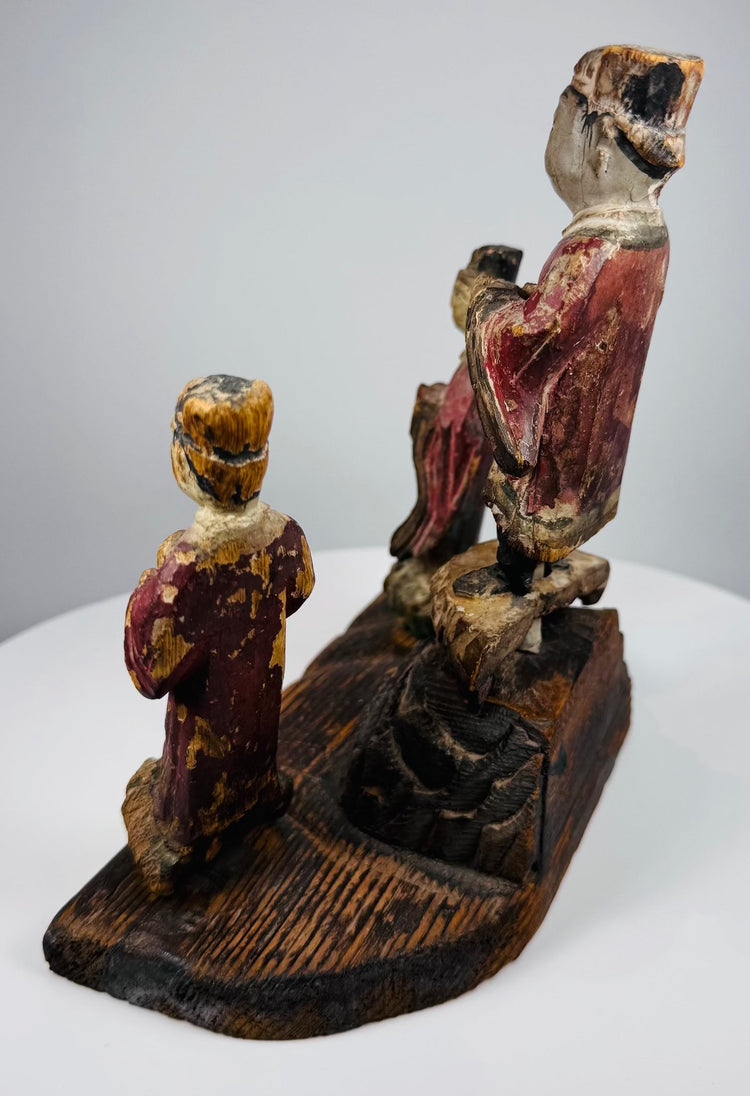
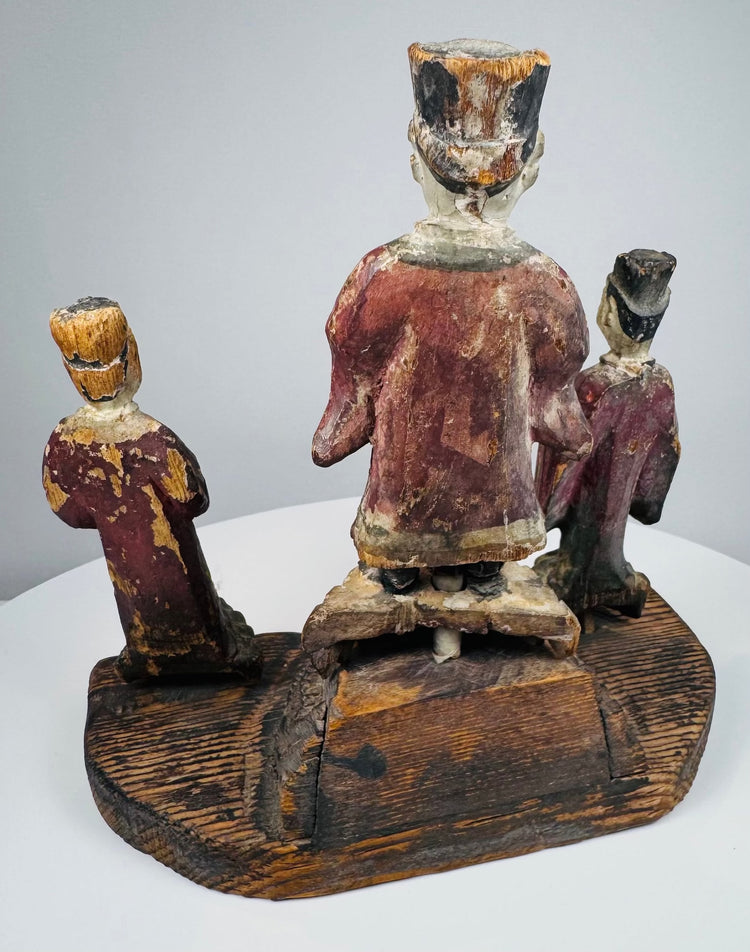
Antique condition with extensive age-related wear, including substantial loss, flaking, and abrasion to the original polychrome-painted and gessoed surfaces. Areas of exposed wood, accumulated grime, darkening, discoloration, scratches, small chips, cracks, splits, and minor losses are visible throughout.
The headdresses, facial features, hands, sleeves, ritual objects, and lotus-form bases exhibit varying degrees of wear and material loss. The face and headdress of the right attendant are particularly weathered. A small projecting element between the feet of the central figure appears incomplete, suggesting the loss of an original attribute or decorative component.
The carved base displays surface erosion, darkened patination, edge wear, cracking, abrasions, and losses to portions of the carved decoration. Evidence of old attachment, stabilization, or repair may be present around the figures and their bases. The ensemble remains structurally displayable and retains considerable historic character.
Dimensions (Approximate)
Width: 7 in
Depth: 3.75 in
Height: 7.5 in
Age (Approximate)
105–175 years old
Provenance
Formerly held in a private collection in Chevy Chase, Maryland, USA, specializing in Asian art, antiquities, and traditional cultural objects.
Learn More
Learn about the history and construction of painted Chinese devotional imagery through the Metropolitan Museum of Art’s Chinese Religious Sculpture Collection
Browse our Ancient Chinese Artifacts & Imperial Relics Collection
Description
Historical Context & Origin
Region: China, probably southern China
Material: Hand-carved wood with gesso ground and surviving polychrome pigments
Period: Late Qing Dynasty–Early Republic Period, circa 1850–1920
Description
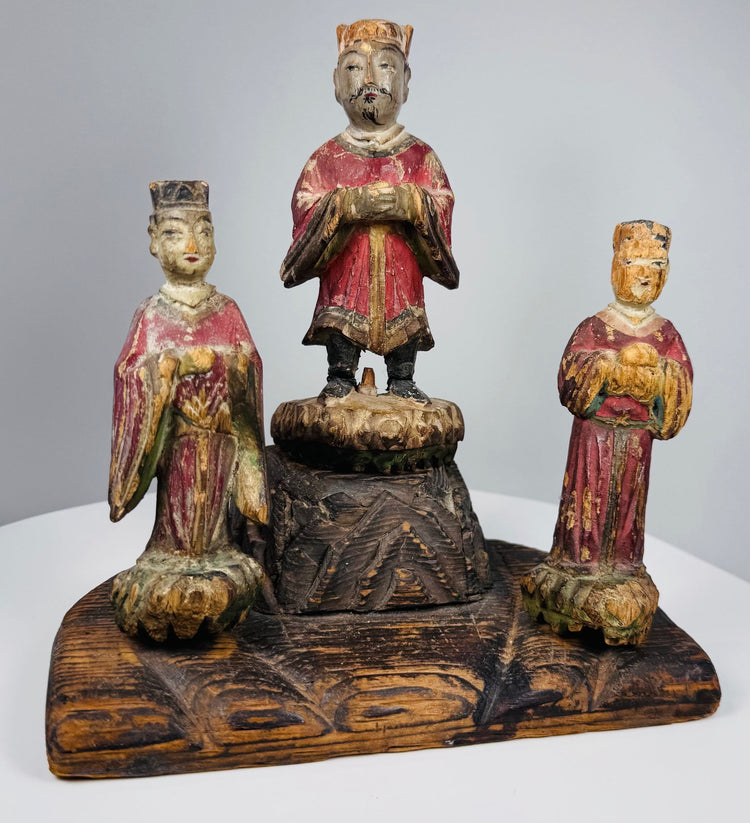
This antique Chinese polychrome wooden shrine group depicts a central male official or folk-religious figure elevated above two smaller attendants, all arranged upon an intricately carved architectural base.
The principal figure stands with his hands respectfully clasped before his chest. He wears a tall ceremonial headdress, a long red court robe with contrasting borders, black trousers, and dark footwear. His face retains delicately painted eyes, eyebrows, moustache, beard, and red lips. He stands upon a separately carved lotus-form pedestal positioned above a raised central structure decorated with stylized mountain, leaf, or flame-like motifs.
Two smaller figures flank the central official. Both wear long red robes with wide sleeves and stand upon individual lotus-form bases. One appears to carry a long ceremonial object or offering, while the other holds an object against the chest. Their formal postures and placement suggest attendants participating in a ritual or courtly presentation.
The figures are mounted upon a broad rectangular wooden platform decorated with deeply incised geometric, vegetal, cloud, or wave-like patterns. Surviving red, green, ochre, black, cream, and brown pigments provide a vivid impression of the ensemble's original appearance despite extensive age-related wear.
Features
- Elevated central official or folk-religious figure
- Two smaller flanking attendants
- Formal clasped-hand ritual postures
- Traditional court robes and ceremonial headdresses
- Individual lotus-form pedestals
- Carved architectural or mountainous central platform
- Incised cloud, wave, geometric, and vegetal decoration
- Surviving red, green, ochre, black, cream, and brown pigments
- Strongly aged surface with exposed wood and historic patination
Cultural Significance
Painted wooden figures occupied an important place within Chinese household shrines, community temples, ancestral halls, and regional religious traditions. Such images could portray ancestors, civil officials, Daoist divinities, protective figures, or local deities accompanied by attendants.
The hierarchical arrangement employed here—with a larger central figure elevated above two smaller attendants—communicates rank and ceremonial importance. Clasped hands, formal robes, lotus-form supports, and the architectural base reinforce the group's devotional or ritual character.
Regional workshops frequently produced such carvings for local temples and domestic altars. Their original identities were often communicated through removable attributes, inscriptions, garments, or surrounding shrine furnishings. When these elements are lost, the precise identities of the represented figures can become difficult to establish, as is the case with this evocative surviving ensemble.
Condition
Antique condition with extensive age-related wear, including substantial loss, flaking, and abrasion to the original polychrome-painted and gessoed surfaces. Areas of exposed wood, accumulated grime, darkening, discoloration, scratches, small chips, cracks, splits, and minor losses are visible throughout.
The headdresses, facial features, hands, sleeves, ritual objects, and lotus-form bases exhibit varying degrees of wear and material loss. The face and headdress of the right attendant are particularly weathered. A small projecting element between the feet of the central figure appears incomplete, suggesting the loss of an original attribute or decorative component.
The carved base displays surface erosion, darkened patination, edge wear, cracking, abrasions, and losses to portions of the carved decoration. Evidence of old attachment, stabilization, or repair may be present around the figures and their bases. The ensemble remains structurally displayable and retains considerable historic character.
Dimensions (Approximate)
Width: 7 in
Depth: 3.75 in
Height: 7.5 in
Age (Approximate)
105–175 years old
Provenance
Formerly held in a private collection in Chevy Chase, Maryland, USA, specializing in Asian art, antiquities, and traditional cultural objects.
Learn More
Learn about the history and construction of painted Chinese devotional imagery through the Metropolitan Museum of Art’s Chinese Religious Sculpture Collection
Browse our Ancient Chinese Artifacts & Imperial Relics Collection
You May Also Like
