



Early Islamic Miniature Glass Vessel | Iranian Area | Circa 9th–10th Century CE
Couldn't load pickup availability


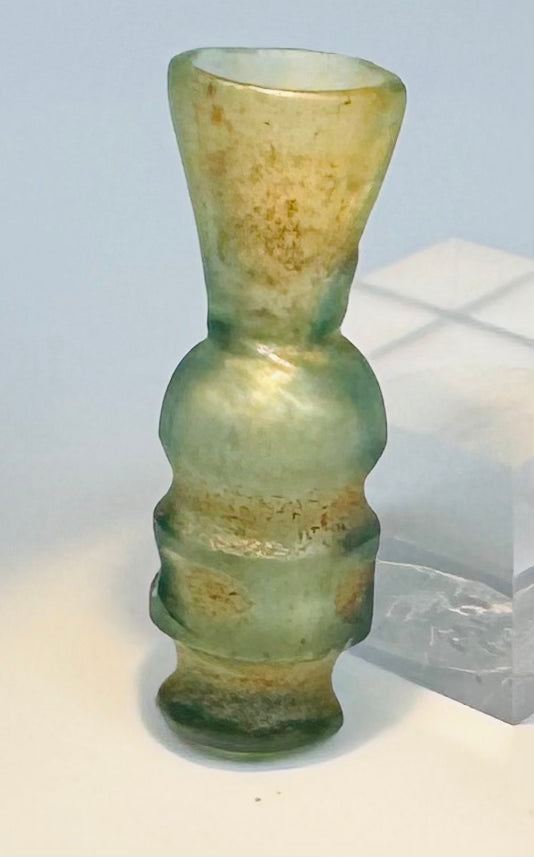
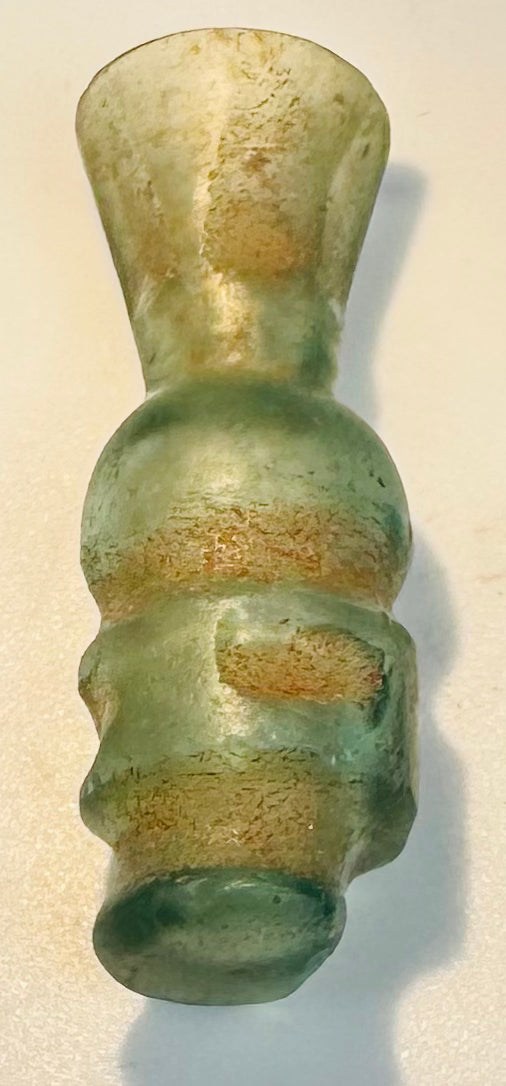


Early Islamic Miniature Glass Vessel | Iranian Area | Circa 9th–10th Century CE
Description
More
Less
Historical Context & Origin
Region: Iranian Area, Western Asia
Material: Pale blue-green blown glass
Period: Early Islamic Period, circa 9th–10th Century CE
Description
This miniature pale blue-green glass vessel is a distinctive example of Early Islamic glassmaking, attributed to the Iranian area and dating to the 9th–10th century CE. Produced during a period of significant artistic and technological development across the Islamic world, the vessel reflects the sophisticated glassworking traditions that flourished in medieval Iran.
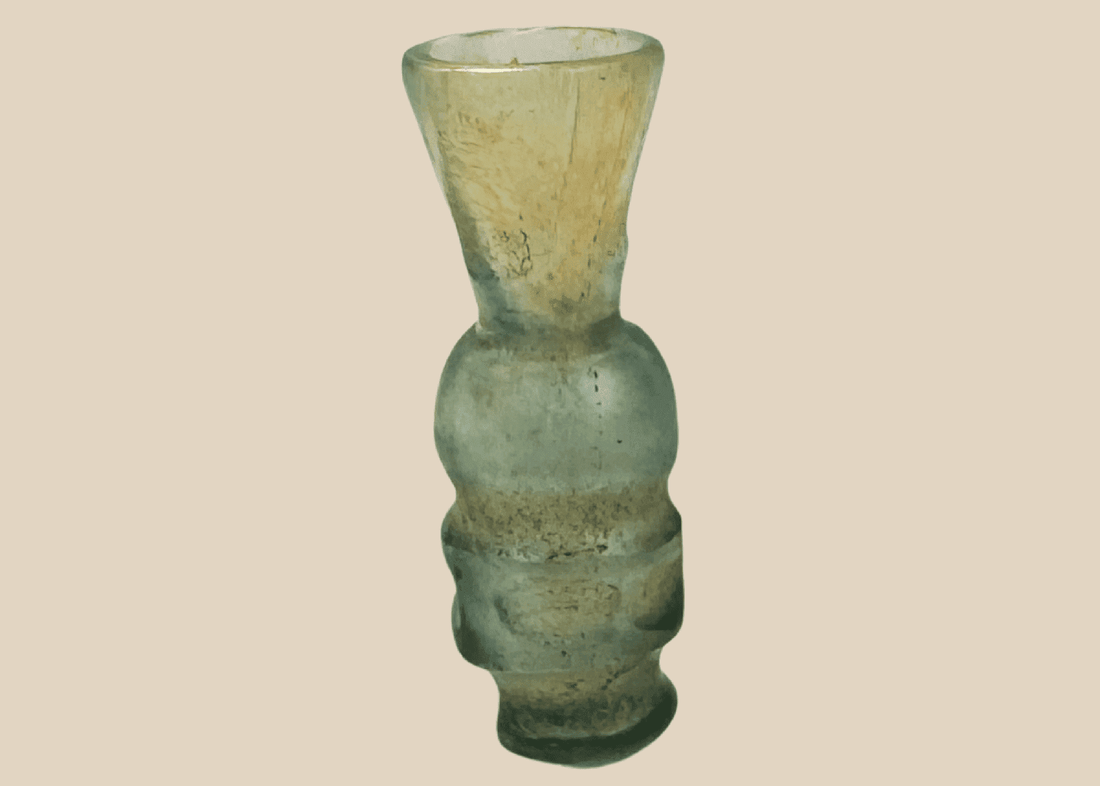
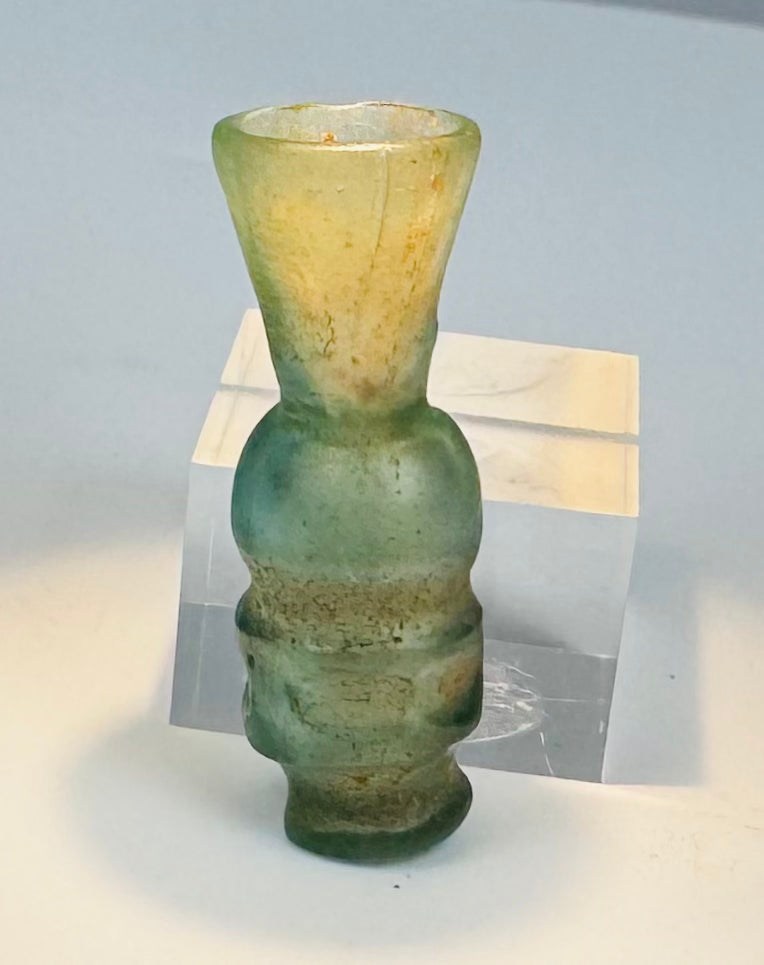
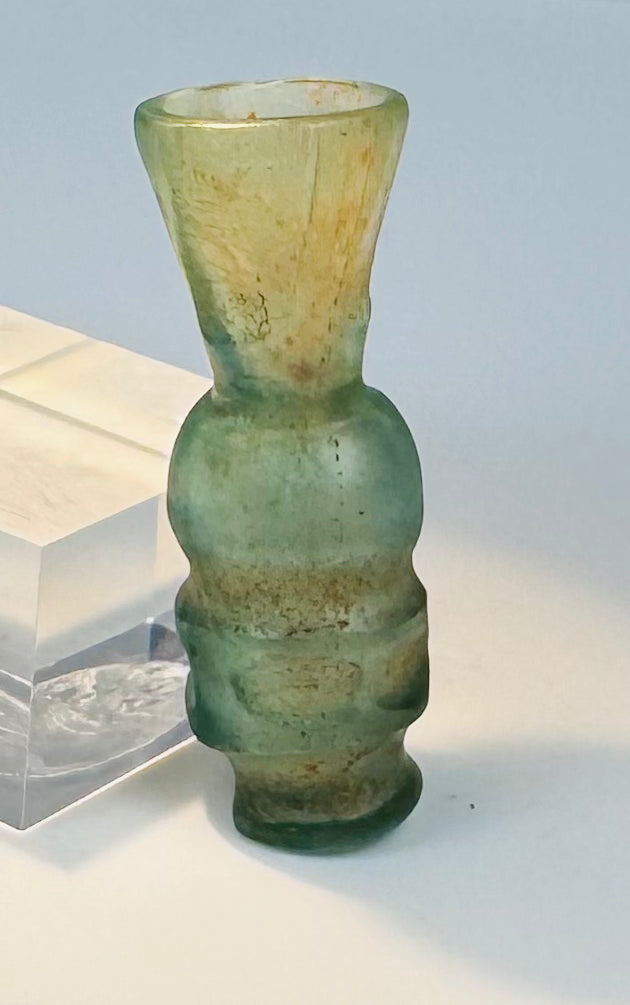
The vessel features a carefully shaped, vertically arranged profile distinguished by its narrow neck, trumpet-shaped mouth, pronounced globular swelling, and intricately moulded lower body. Despite its diminutive proportions, the piece demonstrates considerable attention to form and craftsmanship.
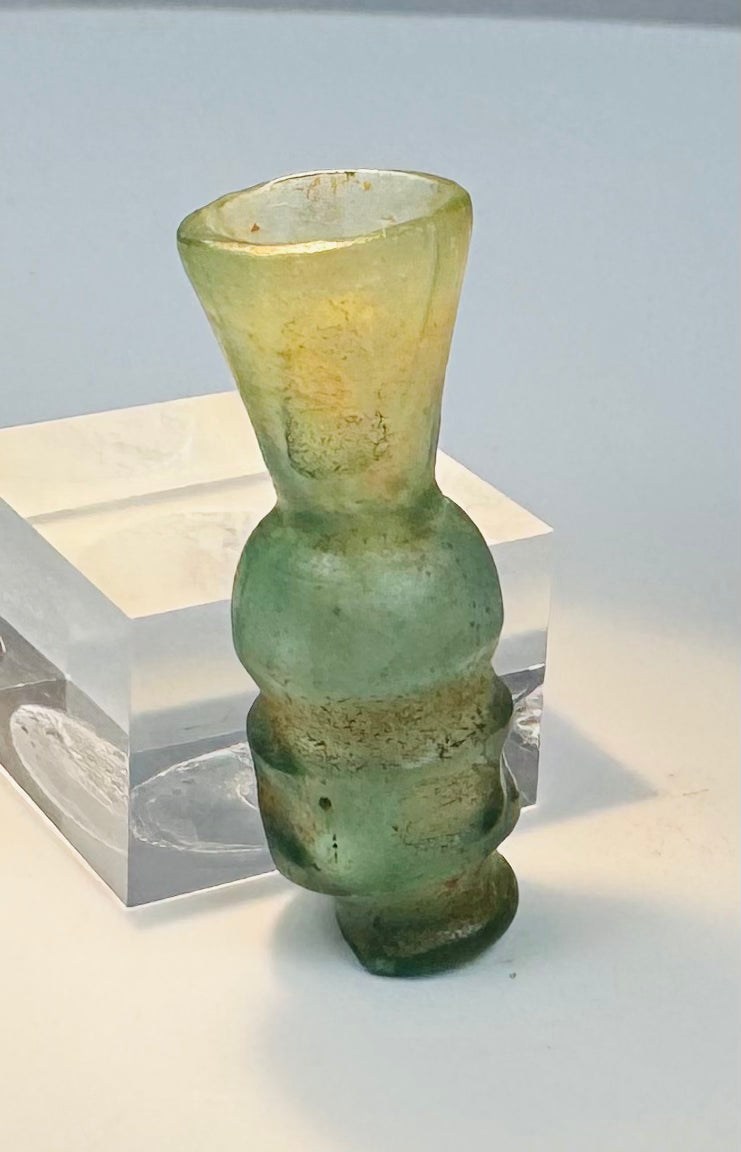
The narrow neck expands outward into a flared, trumpet-shaped opening with a thin, slightly uneven rim. Immediately beneath the neck is a rounded globular swelling, which transitions into a series of raised horizontal mouldings that divide the lower body into rounded and cylindrical sections. The vessel terminates in a small discoid foot, allowing it to stand upright.
Fashioned from pale blue-green blown glass, the surface exhibits cloudy translucency, pale yellow and brown mineral staining, localized iridescence, and areas of weathering. These characteristics contribute to the vessel's archaeological appearance, while the surviving raised mouldings preserve its distinctive decorative profile.
Miniature glass vessels were produced throughout the medieval Islamic world, where small containers could serve various domestic, personal, or specialized purposes. Examples of comparable size may have been associated with perfumes, scented oils, cosmetics, medicinal preparations, or other substances used in limited quantities. Although the precise function of this particular vessel remains uncertain, its compact form suggests it was designed to accommodate a small volume of material.
Features
- Pale blue-green blown glass construction with cloudy translucency
- Narrow neck expanding into a distinctive trumpet-shaped mouth
- Thin, slightly uneven rim with minor chipping and surface wear
- Pronounced globular swelling beneath the neck
- Raised horizontal mouldings dividing the lower body into rounded and cylindrical sections
- Small projecting discoid foot allowing the vessel to stand upright
- Delicate miniature proportions measuring approximately 3.2 cm in height
- Pale yellow and brown mineral staining with localized surface iridescence
- Natural surface weathering, minor pitting, and abrasions throughout
Cultural Significance
During the 9th–10th centuries CE, the Iranian region was an important centre of artistic production within the expanding Islamic world. Glassmaking continued to develop through the adaptation of earlier Sasanian and other regional traditions, alongside innovations in vessel design, decoration, and manufacturing techniques.
Early Islamic glassmakers produced a wide variety of objects, ranging from everyday household containers to elaborately decorated luxury vessels. Workshops throughout Iran and neighbouring regions demonstrated considerable skill in shaping molten glass into vessels of varying sizes, profiles, and functions.
Miniature glass containers formed part of this broader tradition of specialized vessel production. Their small capacity made them potentially suitable for holding limited quantities of valuable or concentrated substances, although the original contents and function of individual archaeological examples cannot always be determined.
The distinctive globular swelling, raised horizontal mouldings, and carefully shaped foot of this example demonstrate an emphasis on proportion and decorative form. Its compact construction illustrates the technical control required to produce a miniature glass vessel with multiple shaped sections.
Condition
The vessel remains substantially complete, preserving its distinctive miniature profile, globular swelling, raised horizontal mouldings, and projecting discoid foot.
The pale blue-green glass exhibits extensive surface weathering, cloudy translucency, pale yellow and brown mineral staining, localized iridescence, small pits, and abrasions.
The thin, trumpet-shaped rim displays minor chips, unevenness, and surface wear. Additional chipping is present around the discoid foot, although the vessel remains capable of standing upright.
Despite these age-related surface characteristics, the vessel retains its recognizable overall form and decorative features.
Dimensions (Approximate)
Height: 1.25 in
Age (Approximate)
1,000–1,200 years old
Provenance
Formerly part of the private collection of a European gentleman, born in 1942 and deceased in 2024. The collection was formed beginning in the 1970s and developed over several decades, with a focus on ancient and historical objects.
Expert Assessment: Examined by Luca Salvaggio, an Italian archaeologist specializing in Greek, Roman, Near Eastern, and Cypriot material, with a Postgraduate Diploma from the Italian Archaeological School at Athens (IASA) and accreditation from the Italian Ministry of Culture (MiC). He attributed the miniature glass vessel to the Early Islamic period of the Iranian area, dating to the 9th–10th century CE, based on its pale blue-green blown-glass construction, narrow neck, trumpet-shaped mouth, globular swelling, raised horizontal mouldings, and distinctive discoid foot. He further documented its cloudy glass surface, localized iridescence, mineral staining, pitting, and weathering.
Learn More
Discover a comparable miniature blown-glass bottle dating to the 9th–10th century CE from Nishapur, Iran, at The Metropolitan Museum of Art
Browse Our Collection of Middle Eastern Antiquities & Ancient Art
Description
Historical Context & Origin
Region: Iranian Area, Western Asia
Material: Pale blue-green blown glass
Period: Early Islamic Period, circa 9th–10th Century CE
Description
This miniature pale blue-green glass vessel is a distinctive example of Early Islamic glassmaking, attributed to the Iranian area and dating to the 9th–10th century CE. Produced during a period of significant artistic and technological development across the Islamic world, the vessel reflects the sophisticated glassworking traditions that flourished in medieval Iran.
The vessel features a carefully shaped, vertically arranged profile distinguished by its narrow neck, trumpet-shaped mouth, pronounced globular swelling, and intricately moulded lower body. Despite its diminutive proportions, the piece demonstrates considerable attention to form and craftsmanship.
The narrow neck expands outward into a flared, trumpet-shaped opening with a thin, slightly uneven rim. Immediately beneath the neck is a rounded globular swelling, which transitions into a series of raised horizontal mouldings that divide the lower body into rounded and cylindrical sections. The vessel terminates in a small discoid foot, allowing it to stand upright.
Fashioned from pale blue-green blown glass, the surface exhibits cloudy translucency, pale yellow and brown mineral staining, localized iridescence, and areas of weathering. These characteristics contribute to the vessel's archaeological appearance, while the surviving raised mouldings preserve its distinctive decorative profile.
Miniature glass vessels were produced throughout the medieval Islamic world, where small containers could serve various domestic, personal, or specialized purposes. Examples of comparable size may have been associated with perfumes, scented oils, cosmetics, medicinal preparations, or other substances used in limited quantities. Although the precise function of this particular vessel remains uncertain, its compact form suggests it was designed to accommodate a small volume of material.
Features
- Pale blue-green blown glass construction with cloudy translucency
- Narrow neck expanding into a distinctive trumpet-shaped mouth
- Thin, slightly uneven rim with minor chipping and surface wear
- Pronounced globular swelling beneath the neck
- Raised horizontal mouldings dividing the lower body into rounded and cylindrical sections
- Small projecting discoid foot allowing the vessel to stand upright
- Delicate miniature proportions measuring approximately 3.2 cm in height
- Pale yellow and brown mineral staining with localized surface iridescence
- Natural surface weathering, minor pitting, and abrasions throughout
Cultural Significance
During the 9th–10th centuries CE, the Iranian region was an important centre of artistic production within the expanding Islamic world. Glassmaking continued to develop through the adaptation of earlier Sasanian and other regional traditions, alongside innovations in vessel design, decoration, and manufacturing techniques.
Early Islamic glassmakers produced a wide variety of objects, ranging from everyday household containers to elaborately decorated luxury vessels. Workshops throughout Iran and neighbouring regions demonstrated considerable skill in shaping molten glass into vessels of varying sizes, profiles, and functions.
Miniature glass containers formed part of this broader tradition of specialized vessel production. Their small capacity made them potentially suitable for holding limited quantities of valuable or concentrated substances, although the original contents and function of individual archaeological examples cannot always be determined.
The distinctive globular swelling, raised horizontal mouldings, and carefully shaped foot of this example demonstrate an emphasis on proportion and decorative form. Its compact construction illustrates the technical control required to produce a miniature glass vessel with multiple shaped sections.
Condition
The vessel remains substantially complete, preserving its distinctive miniature profile, globular swelling, raised horizontal mouldings, and projecting discoid foot.
The pale blue-green glass exhibits extensive surface weathering, cloudy translucency, pale yellow and brown mineral staining, localized iridescence, small pits, and abrasions.
The thin, trumpet-shaped rim displays minor chips, unevenness, and surface wear. Additional chipping is present around the discoid foot, although the vessel remains capable of standing upright.
Despite these age-related surface characteristics, the vessel retains its recognizable overall form and decorative features.
Dimensions (Approximate)
Height: 1.25 in
Age (Approximate)
1,000–1,200 years old
Provenance
Formerly part of the private collection of a European gentleman, born in 1942 and deceased in 2024. The collection was formed beginning in the 1970s and developed over several decades, with a focus on ancient and historical objects.
Expert Assessment: Examined by Luca Salvaggio, an Italian archaeologist specializing in Greek, Roman, Near Eastern, and Cypriot material, with a Postgraduate Diploma from the Italian Archaeological School at Athens (IASA) and accreditation from the Italian Ministry of Culture (MiC). He attributed the miniature glass vessel to the Early Islamic period of the Iranian area, dating to the 9th–10th century CE, based on its pale blue-green blown-glass construction, narrow neck, trumpet-shaped mouth, globular swelling, raised horizontal mouldings, and distinctive discoid foot. He further documented its cloudy glass surface, localized iridescence, mineral staining, pitting, and weathering.
Learn More
Discover a comparable miniature blown-glass bottle dating to the 9th–10th century CE from Nishapur, Iran, at The Metropolitan Museum of Art
Browse Our Collection of Middle Eastern Antiquities & Ancient Art
You May Also Like
