


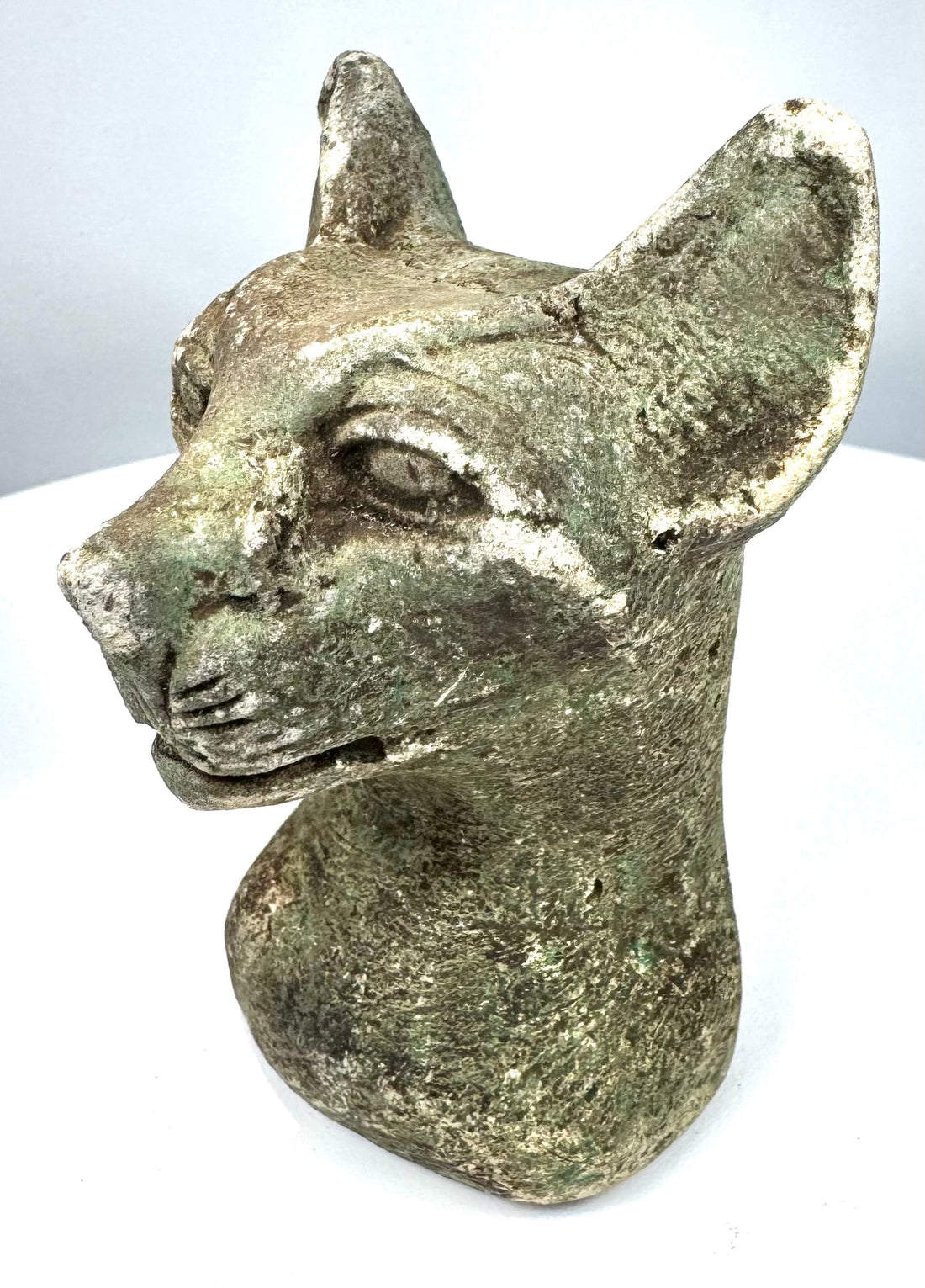
Ancient Egyptian Bastet Cat Head Sculpture | Late Period–Ptolemaic Period | Circa 664–30 BCE (Attributed)
- Regular price
- $495.00
- Sale price
- $495.00
- Regular price
Sold
This artifact has been acquired and is no longer available. Discover similar museum-quality antiquities from our carefully curated collection.
Explore Ancient EgyptCouldn't load pickup availability




Ancient Egyptian Bastet Cat Head Sculpture | Late Period–Ptolemaic Period | Circa 664–30 BCE (Attributed)
Description
More
Less
Historical Context & Origin
Region: Ancient Egypt
Material: Unidentified stone-like material with mottled grey-green coloration and textured surface deposits
Period: Attributed to the Late Period–Ptolemaic Period, circa 664–30 BCE, based on stylistic comparisons with documented ancient Egyptian feline sculptures
Description
This distinctive Egyptian feline head sculpture, attributed to the Late Period–Ptolemaic Period, circa 664–30 BCE, portrays the sacred cat associated with Bastet, one of ancient Egypt's most revered protective goddesses. The sculpture is distinguished by its prominent upright ears, expressive almond-shaped eyes, projecting muzzle, and carefully delineated whisker markings, reflecting the artistic characteristics of Egyptian feline representations.
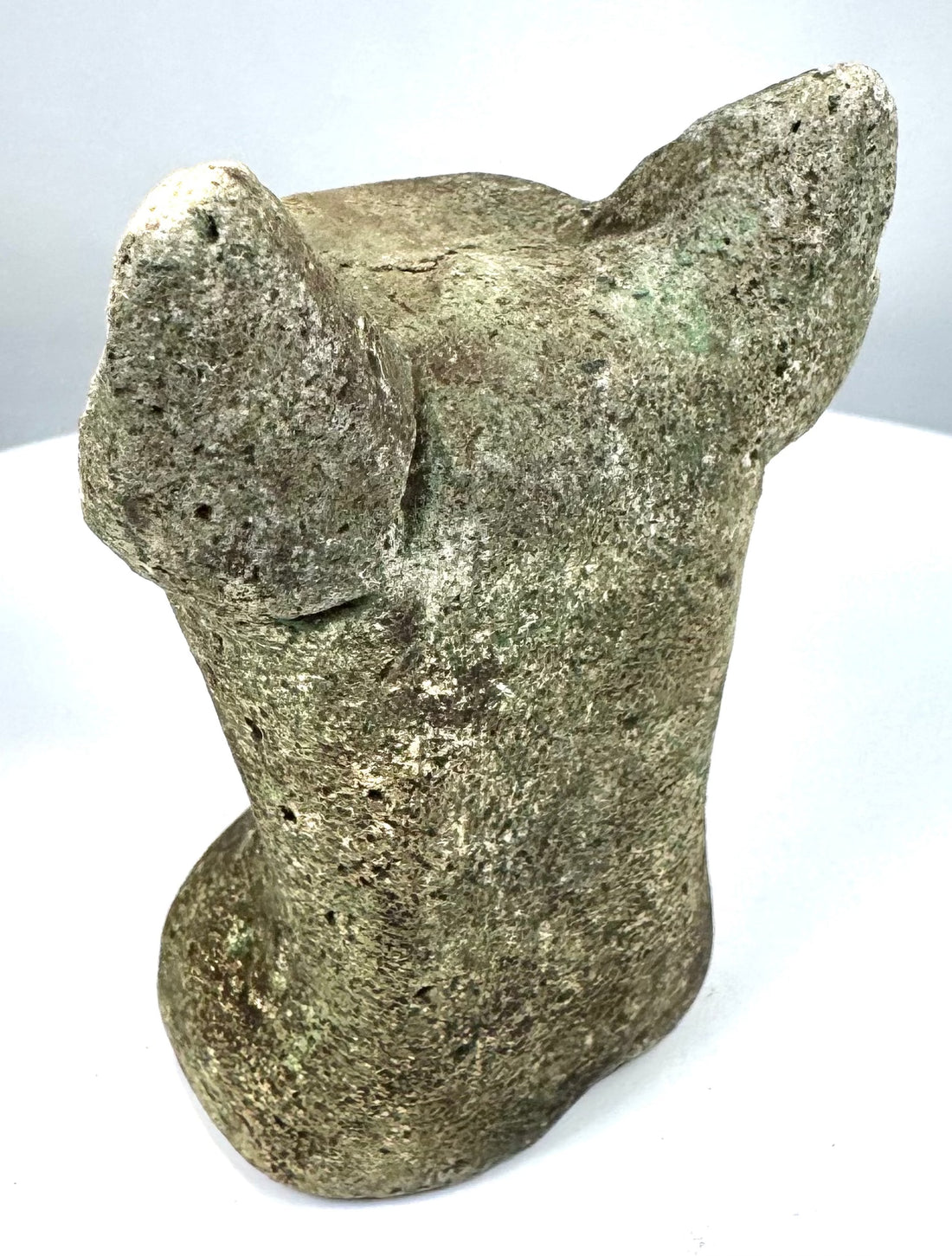
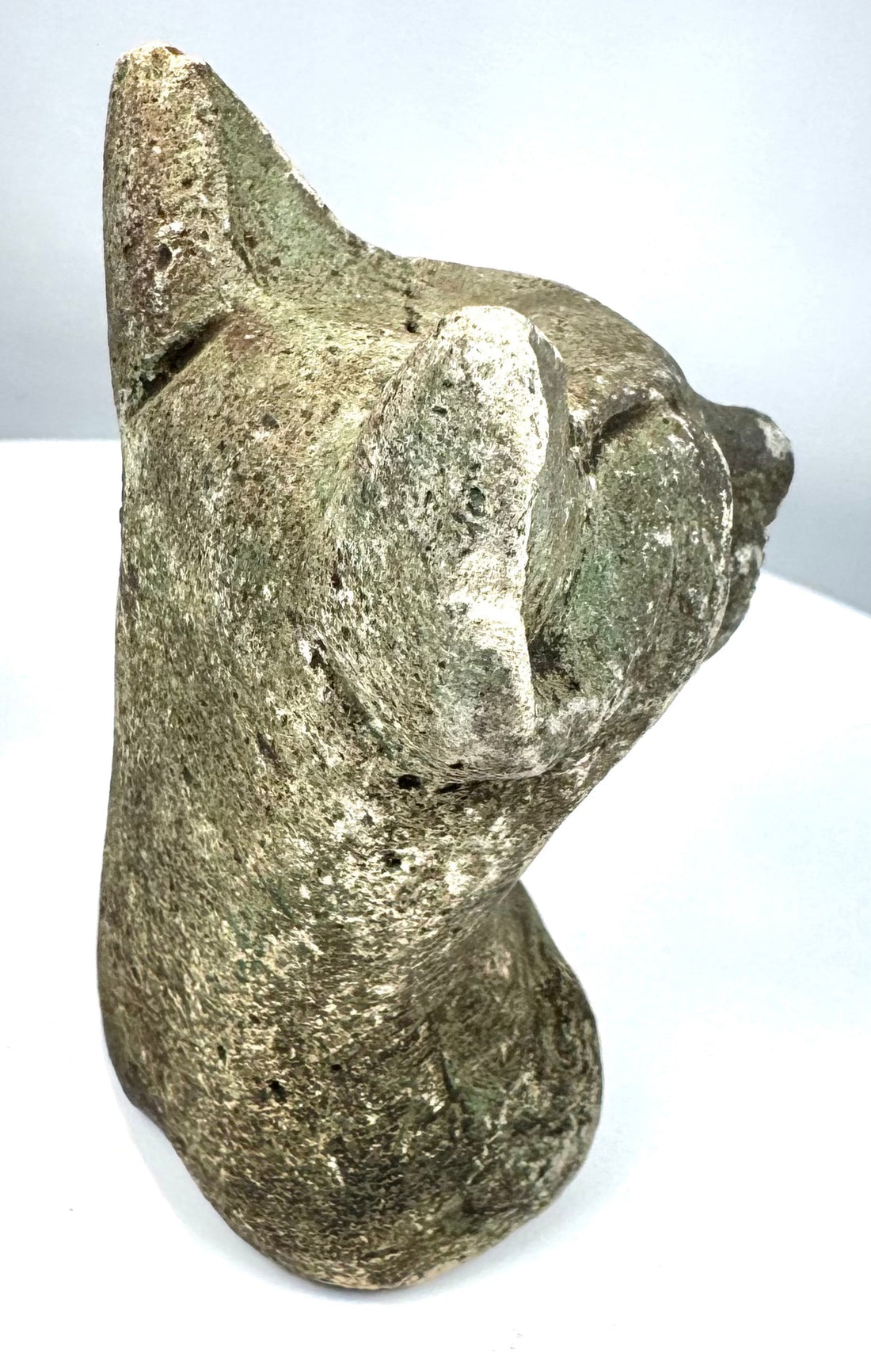
The head features two tall, triangular ears with recessed interior surfaces and gently rounded upper edges. Subtle differences in their proportions, contours, and positioning lend the sculpture an individual character. Their broad, upright arrangement creates an alert and attentive expression, characteristic of Egyptian depictions of sacred cats.
The eyes are particularly expressive, displaying elongated almond-shaped forms framed by pronounced upper eyelids. Their subtly asymmetrical modelling creates variations in depth, contour, and definition, with one eye appearing more deeply recessed while the other retains a fuller, more prominently raised form. These individual characteristics contribute to the sculpture's distinctive facial expression.
The projecting muzzle is carefully articulated, featuring a rounded nose with defined nostrils and a central ridge extending toward the mouth. Short, incised lines radiate from either side of the muzzle, representing the cat's whiskers and emphasizing the attention given to its feline anatomy. The softly defined mouth and rounded cheeks complete the composition.
The head transitions into an elongated neck that gradually broadens toward a substantial, rounded base. This integrated construction creates a compact, freestanding bust-like form. The reverse is comparatively restrained, with smoothly transitioning contours and subtle variations in surface texture.
The sculpture displays a distinctive mottled surface combining olive-green, grey, brown, and pale mineral-like tones. Its stone-like material exhibits an interesting contrast between smoother areas and finely textured surfaces, with scattered deposits, localized pitting, and irregular markings throughout. These variations are particularly noticeable around the eyes, ears, muzzle, and elongated neck.
The underside retains a handwritten identification marking reading "1500 BC," documenting an earlier chronological attribution associated with the sculpture's collection history. The marking provides an interesting record of its previous identification, while the present attribution draws upon stylistic comparisons with Egyptian feline representations of the Late and Ptolemaic Periods.
The sculpture's prominent triangular ears, pronounced eyelids, projecting muzzle, and incised whisker markings share notable stylistic characteristics with documented ancient Egyptian cat-head sculptures preserved in major museum collections. Its compact proportions, expressive facial modelling, and distinctive surface character make it an intriguing representation of the feline imagery associated with ancient Egyptian religious traditions.
Features
- Egyptian feline head associated with the goddess Bastet
- Prominent upright triangular ears with recessed interior detailing
- Subtle asymmetry in the proportions and positioning of the ears
- Expressive almond-shaped eyes with pronounced upper eyelids and individually varied contours
- Rounded projecting muzzle with carefully defined nostrils and central ridge
- Incised whisker markings radiating from either side of the nose
- Softly articulated mouth and rounded facial contours
- Elongated neck transitioning into a substantial, rounded base
- Compact, freestanding bust-like sculptural form
- Stone-like material with contrasting smooth and finely textured surfaces
- Mottled olive-green, grey, brown, and pale surface coloration
- Localized pitting, fine linear markings, and irregular surface deposits
- Underside retaining an earlier identification marking reading "1500 BC"
- Stylistic characteristics comparable to documented ancient Egyptian feline sculptures
Cultural Significance
Cats occupied a prominent position in ancient Egyptian society, admired for their protective qualities, hunting abilities, and close association with the goddess Bastet. Their importance extended beyond domestic life into religious traditions, where feline imagery became a powerful symbol of divine protection and guardianship.
Bastet was one of ancient Egypt's most significant protective deities, associated with the safeguarding of the household, fertility, motherhood, prosperity, and protection against harmful forces. Originally represented in leonine form, Bastet increasingly became associated with the domestic cat, whose watchful nature and graceful appearance reflected the goddess's protective and benevolent characteristics.
Her principal cult centre was located at Bubastis in the eastern Nile Delta, where she received widespread worship. Numerous representations of sacred cats, votive figures, and mummified animals were dedicated in her honour, particularly during the later periods of ancient Egyptian history.
During the Late Period, especially from the 26th Dynasty onward, feline representations became increasingly prominent within Egyptian religious art. Sculptures depicting cats were produced in various materials and forms, ranging from complete seated figures to individual heads and other sculptural elements.
The distinctive features of Egyptian cat-head sculptures, including prominent upright ears, elongated eyes, carefully defined muzzles, and stylized whisker markings, reflect the artistic conventions associated with these sacred animals. The present sculpture incorporates these recognizable characteristics, connecting its visual composition with the enduring iconography of Bastet and the religious significance of felines in ancient Egyptian culture.
Condition
The sculpture exhibits visible surface wear, discoloration, localized pitting, fine abrasions, and irregular deposits throughout.
The exterior displays a mottled combination of olive-green, grey, brown, and pale coloration, with contrasting smoother and more finely textured surfaces. Scattered lighter deposits and darker recessed areas contribute to the varied appearance of the material.
Both ears retain their principal forms, with localized edge wear, subtle irregularities, and minor rounding along the upper portions. The facial features remain clearly recognizable, including the almond-shaped eyes, projecting nose, nostrils, mouth, and incised whisker markings.
The eyes exhibit variations in surface definition and contour, with darker deposits visible around the upper eyelids and surrounding recessed areas. Additional textural irregularities and fine surface markings are present across the forehead, cheeks, and muzzle.
The elongated neck and rounded base retain their overall form, displaying further surface discoloration, fine abrasions, localized pitting, and scattered pale deposits.
The underside retains a handwritten identification marking reading "1500 BC," preserved as part of the sculpture's earlier collection identification.
Dimensions (Approximate)
Height: 4 in
Width: 2.85 in
Depth: 2.5 in
Age (Approximate)
2,050–2,690 years old (based on stylistic attribution)
Provenance
Formerly private collection, London, United Kingdom.
The underside retains an earlier handwritten identification marking reading "1500 BC," reflecting a previous chronological attribution to Egypt's New Kingdom. This historical notation has been preserved as part of the sculpture's collection history.
Subsequently, private collection, Chichester, West Sussex, England.
Learn More
Discover a comparable Egyptian feline head with prominent upright ears, expressive eyes, and incised whisker detailing at The Metropolitan Museum of Art
Explore related artifacts and sacred imagery in our Collection of Ancient Egyptian Mummies & Artifacts
Description
Historical Context & Origin
Region: Ancient Egypt
Material: Unidentified stone-like material with mottled grey-green coloration and textured surface deposits
Period: Attributed to the Late Period–Ptolemaic Period, circa 664–30 BCE, based on stylistic comparisons with documented ancient Egyptian feline sculptures
Description
This distinctive Egyptian feline head sculpture, attributed to the Late Period–Ptolemaic Period, circa 664–30 BCE, portrays the sacred cat associated with Bastet, one of ancient Egypt's most revered protective goddesses. The sculpture is distinguished by its prominent upright ears, expressive almond-shaped eyes, projecting muzzle, and carefully delineated whisker markings, reflecting the artistic characteristics of Egyptian feline representations.
The head features two tall, triangular ears with recessed interior surfaces and gently rounded upper edges. Subtle differences in their proportions, contours, and positioning lend the sculpture an individual character. Their broad, upright arrangement creates an alert and attentive expression, characteristic of Egyptian depictions of sacred cats.
The eyes are particularly expressive, displaying elongated almond-shaped forms framed by pronounced upper eyelids. Their subtly asymmetrical modelling creates variations in depth, contour, and definition, with one eye appearing more deeply recessed while the other retains a fuller, more prominently raised form. These individual characteristics contribute to the sculpture's distinctive facial expression.
The projecting muzzle is carefully articulated, featuring a rounded nose with defined nostrils and a central ridge extending toward the mouth. Short, incised lines radiate from either side of the muzzle, representing the cat's whiskers and emphasizing the attention given to its feline anatomy. The softly defined mouth and rounded cheeks complete the composition.
The head transitions into an elongated neck that gradually broadens toward a substantial, rounded base. This integrated construction creates a compact, freestanding bust-like form. The reverse is comparatively restrained, with smoothly transitioning contours and subtle variations in surface texture.
The sculpture displays a distinctive mottled surface combining olive-green, grey, brown, and pale mineral-like tones. Its stone-like material exhibits an interesting contrast between smoother areas and finely textured surfaces, with scattered deposits, localized pitting, and irregular markings throughout. These variations are particularly noticeable around the eyes, ears, muzzle, and elongated neck.
The underside retains a handwritten identification marking reading "1500 BC," documenting an earlier chronological attribution associated with the sculpture's collection history. The marking provides an interesting record of its previous identification, while the present attribution draws upon stylistic comparisons with Egyptian feline representations of the Late and Ptolemaic Periods.
The sculpture's prominent triangular ears, pronounced eyelids, projecting muzzle, and incised whisker markings share notable stylistic characteristics with documented ancient Egyptian cat-head sculptures preserved in major museum collections. Its compact proportions, expressive facial modelling, and distinctive surface character make it an intriguing representation of the feline imagery associated with ancient Egyptian religious traditions.
Features
- Egyptian feline head associated with the goddess Bastet
- Prominent upright triangular ears with recessed interior detailing
- Subtle asymmetry in the proportions and positioning of the ears
- Expressive almond-shaped eyes with pronounced upper eyelids and individually varied contours
- Rounded projecting muzzle with carefully defined nostrils and central ridge
- Incised whisker markings radiating from either side of the nose
- Softly articulated mouth and rounded facial contours
- Elongated neck transitioning into a substantial, rounded base
- Compact, freestanding bust-like sculptural form
- Stone-like material with contrasting smooth and finely textured surfaces
- Mottled olive-green, grey, brown, and pale surface coloration
- Localized pitting, fine linear markings, and irregular surface deposits
- Underside retaining an earlier identification marking reading "1500 BC"
- Stylistic characteristics comparable to documented ancient Egyptian feline sculptures
Cultural Significance
Cats occupied a prominent position in ancient Egyptian society, admired for their protective qualities, hunting abilities, and close association with the goddess Bastet. Their importance extended beyond domestic life into religious traditions, where feline imagery became a powerful symbol of divine protection and guardianship.
Bastet was one of ancient Egypt's most significant protective deities, associated with the safeguarding of the household, fertility, motherhood, prosperity, and protection against harmful forces. Originally represented in leonine form, Bastet increasingly became associated with the domestic cat, whose watchful nature and graceful appearance reflected the goddess's protective and benevolent characteristics.
Her principal cult centre was located at Bubastis in the eastern Nile Delta, where she received widespread worship. Numerous representations of sacred cats, votive figures, and mummified animals were dedicated in her honour, particularly during the later periods of ancient Egyptian history.
During the Late Period, especially from the 26th Dynasty onward, feline representations became increasingly prominent within Egyptian religious art. Sculptures depicting cats were produced in various materials and forms, ranging from complete seated figures to individual heads and other sculptural elements.
The distinctive features of Egyptian cat-head sculptures, including prominent upright ears, elongated eyes, carefully defined muzzles, and stylized whisker markings, reflect the artistic conventions associated with these sacred animals. The present sculpture incorporates these recognizable characteristics, connecting its visual composition with the enduring iconography of Bastet and the religious significance of felines in ancient Egyptian culture.
Condition
The sculpture exhibits visible surface wear, discoloration, localized pitting, fine abrasions, and irregular deposits throughout.
The exterior displays a mottled combination of olive-green, grey, brown, and pale coloration, with contrasting smoother and more finely textured surfaces. Scattered lighter deposits and darker recessed areas contribute to the varied appearance of the material.
Both ears retain their principal forms, with localized edge wear, subtle irregularities, and minor rounding along the upper portions. The facial features remain clearly recognizable, including the almond-shaped eyes, projecting nose, nostrils, mouth, and incised whisker markings.
The eyes exhibit variations in surface definition and contour, with darker deposits visible around the upper eyelids and surrounding recessed areas. Additional textural irregularities and fine surface markings are present across the forehead, cheeks, and muzzle.
The elongated neck and rounded base retain their overall form, displaying further surface discoloration, fine abrasions, localized pitting, and scattered pale deposits.
The underside retains a handwritten identification marking reading "1500 BC," preserved as part of the sculpture's earlier collection identification.
Dimensions (Approximate)
Height: 4 in
Width: 2.85 in
Depth: 2.5 in
Age (Approximate)
2,050–2,690 years old (based on stylistic attribution)
Provenance
Formerly private collection, London, United Kingdom.
The underside retains an earlier handwritten identification marking reading "1500 BC," reflecting a previous chronological attribution to Egypt's New Kingdom. This historical notation has been preserved as part of the sculpture's collection history.
Subsequently, private collection, Chichester, West Sussex, England.
Learn More
Discover a comparable Egyptian feline head with prominent upright ears, expressive eyes, and incised whisker detailing at The Metropolitan Museum of Art
Explore related artifacts and sacred imagery in our Collection of Ancient Egyptian Mummies & Artifacts
You May Also Like
