
Ancient Egyptian | Recumbent Lion Faience Amulet with Suspension Loop | Late Period | Circa 664–332 BCE
Couldn't load pickup availability


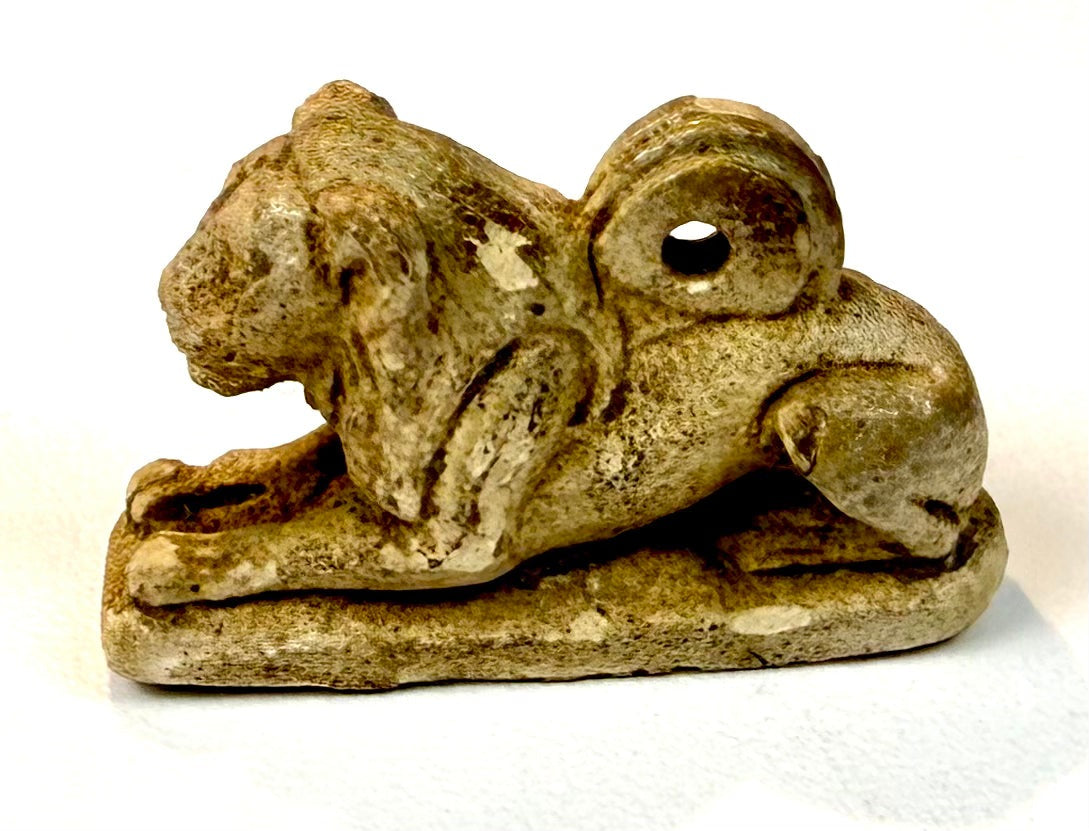






Ancient Egyptian | Recumbent Lion Faience Amulet with Suspension Loop | Late Period | Circa 664–332 BCE
Description
More
Less
Historical Context & Origin
Region: Ancient Egypt
Material: Glazed composition (faience)
Period: Late Period, circa 664–332 BCE (attributed)
Description
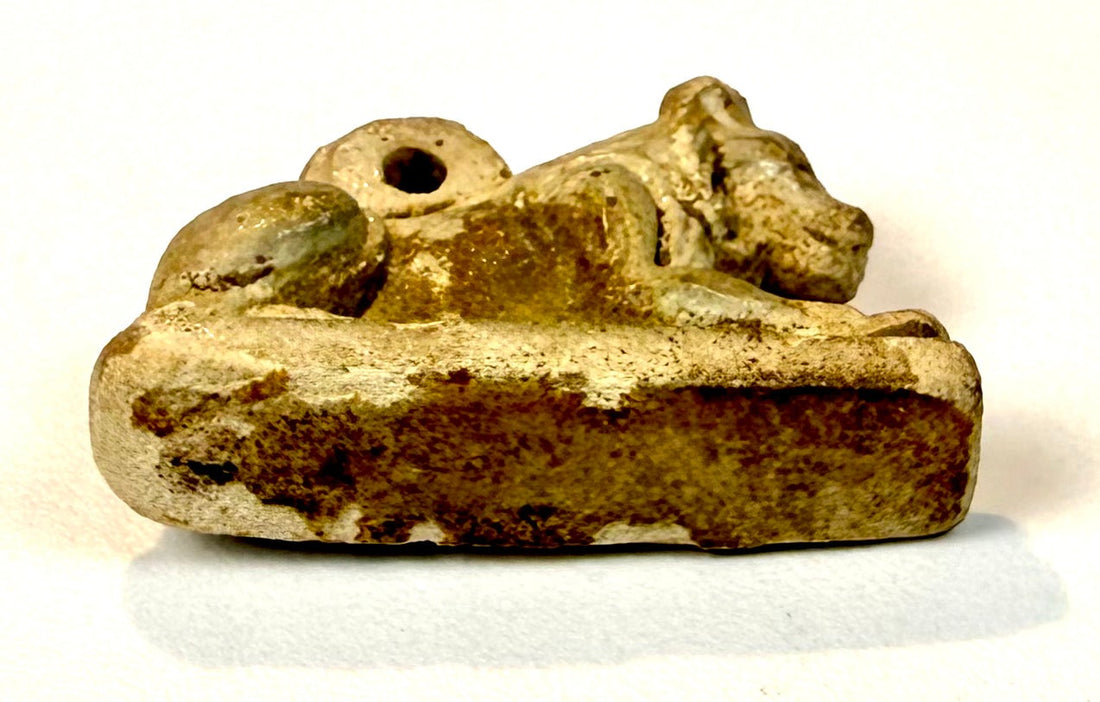
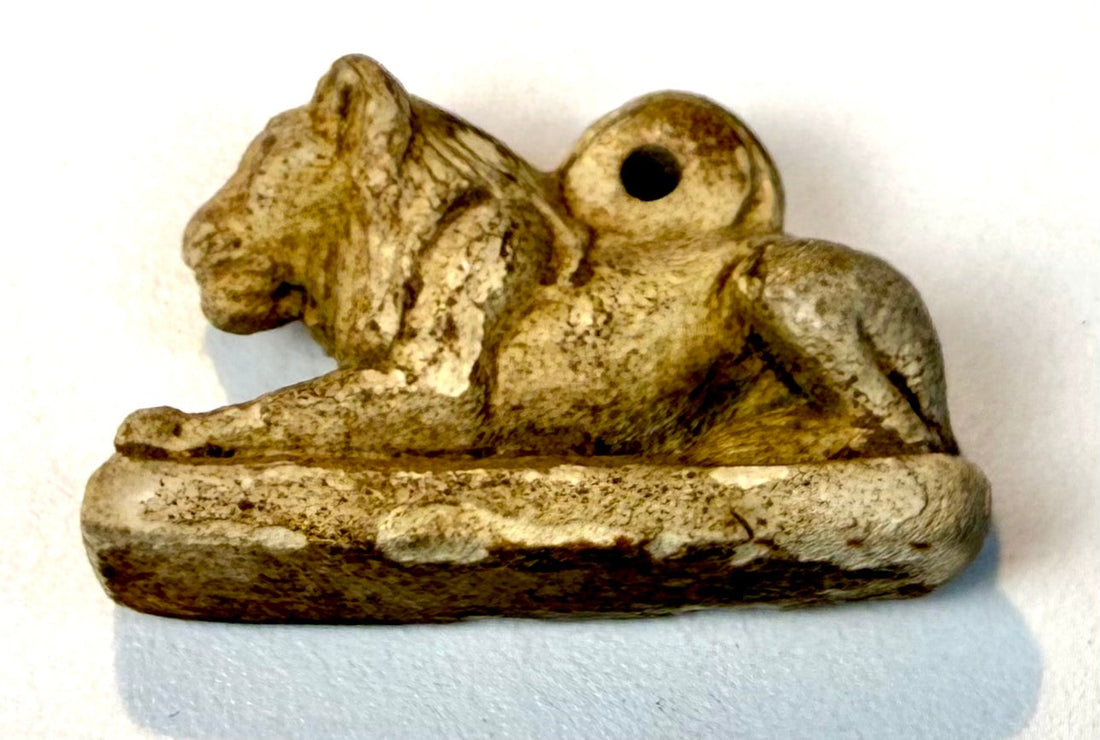
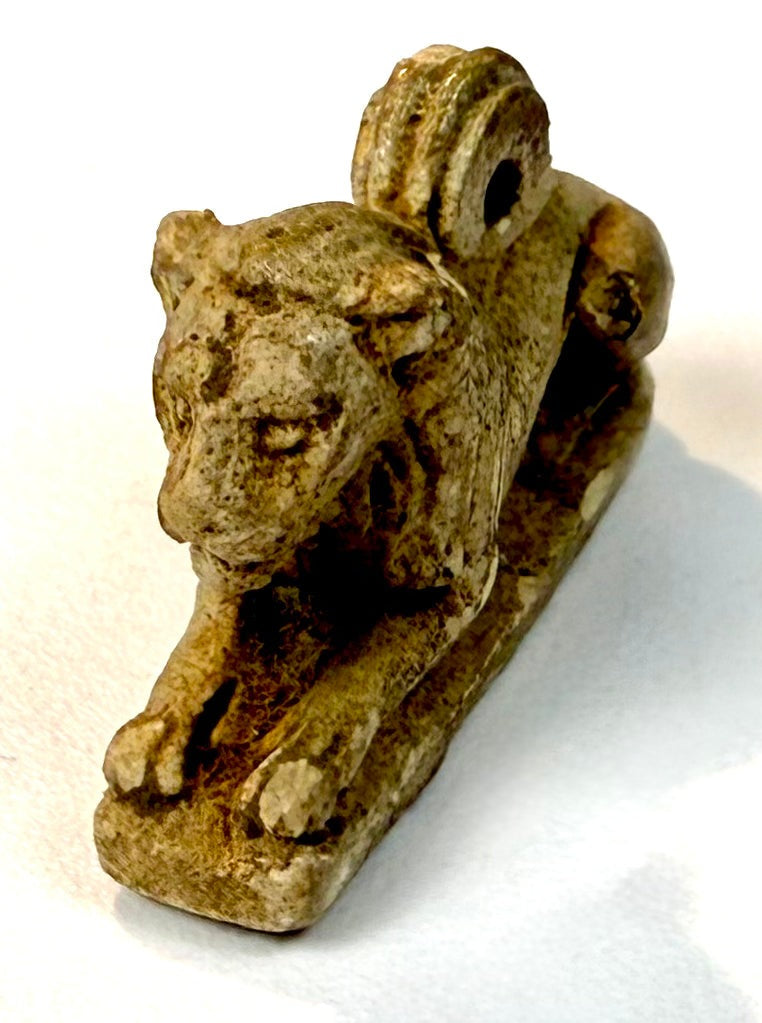
This finely detailed miniature Egyptian recumbent lion amulet features a carefully modelled feline form, traditionally associated with divine protection, strength, and royal authority in ancient Egyptian religious beliefs. Attributed to the Late Period, circa 664–332 BCE, the amulet reflects the artistic craftsmanship and protective symbolism of sacred animal representations in ancient Egypt.
The lion is depicted in a recumbent position upon an integral rectangular base, with its elongated forelegs extended forward and its head raised in an alert, watchful posture. The sculpted head features a prominent muzzle, defined facial features, rounded ears, and incised detailing suggesting the animal's mane. Its gently curved back, muscular shoulders, rounded hindquarters, and curled tail contribute to the recognizable feline form. A distinctive circular suspension loop rises from the upper back, immediately behind the neck, with a central perforation designed to accommodate a cord or attachment.
The surface retains a pale cream to light beige coloration with scattered traces of a glossy glaze, warm brown discolouration, and mineral-like deposits. Extensive surface wear and areas of apparent original glaze loss reveal variations in texture and colour throughout the figure. Despite these changes, the lion's characteristic reclining posture, sculpted anatomy, rectangular base, and pierced suspension loop remain clearly recognizable. Comparable Egyptian lion amulets featuring similar construction and decorative characteristics are preserved in major museum collections.
Features
- Sculpted feline figure with raised head and alert posture
- Integral rectangular base supporting the reclining lion
- Distinctive circular suspension loop with central perforation
- Extended forelegs with individually defined paws
- Modelled facial features, rounded ears, and incised mane detailing
- Gently curved back, muscular shoulders, and rounded hindquarters with curled tail
- Pale cream-coloured surface retaining scattered traces of glossy glaze
- Warm brown discolouration, mineral-like deposits, and areas of apparent original glaze loss
Cultural Significance
The lion held considerable religious and symbolic importance throughout ancient Egyptian civilization, representing strength, kingship, divine power, and protection against malevolent forces. Lions were closely associated with several Egyptian deities, particularly Sekhmet, the powerful lioness-headed goddess of warfare, healing, and protection. As a fierce manifestation of divine power, the lion embodied both protective and destructive qualities within ancient Egyptian religious traditions.
Small lion-shaped amulets were created to invoke the protective qualities associated with these powerful animals and their divine counterparts. Their miniature proportions allowed them to be worn as personal talismans, incorporated into jewellery, or included among funerary possessions. The pierced suspension loop of this example reflects the practical construction of such protective ornaments, which could be carried or worn close to the body.
During the Late Period (664–332 BCE), Egyptian artisans continued producing a wide variety of amulets depicting deities, sacred animals, and protective symbols. Faience was particularly valued for its versatility, decorative finish, and symbolic associations with renewal and regeneration. Recumbent lion amulets exemplify the relationship between skilled craftsmanship, animal symbolism, and personal religious devotion in ancient Egyptian material culture.
Condition
The amulet retains its complete overall form, including the reclining lion, raised head, extended forelegs, rectangular base, curled tail, and pierced suspension loop. Extensive surface wear is visible throughout, including abrasions, scattered chips, localized pitting, mineral-like deposits, and areas of discolouration. The pale cream-coloured surface retains scattered traces of a glossy glaze, with extensive areas of apparent original glaze loss, surface abrasion, and age-related deterioration. Warm brown discolouration and accumulated deposits are particularly visible within the sculpted recesses and around the suspension loop. The facial features, incised mane, and anatomical details remain recognizable despite localized surface wear. Minor irregularities and small losses are present along the edges of the rectangular base, particularly toward the lower corners. The suspension loop remains intact, retaining its distinctive circular form and central perforation.
Dimensions (Approximate)
Height: 0.75 in
Length: 1.25 in
Depth: 0.5 in
Age (Approximate)
2,350–2,690 years old
Provenance
Previously held in a private collection in Hollywood, Florida, United States.
Learn More
Explore a comparable ancient Egyptian recumbent lion amulet dating to the Late Period, featuring a pierced suspension loop and rectangular base, through Museo Egizio, Turin
Discover additional ancient Egyptian amulets, sacred animal figures, and historical artifacts in our Ancient Egyptian Mummies & Artifacts Collection
Description
Historical Context & Origin
Region: Ancient Egypt
Material: Glazed composition (faience)
Period: Late Period, circa 664–332 BCE (attributed)
Description
This finely detailed miniature Egyptian recumbent lion amulet features a carefully modelled feline form, traditionally associated with divine protection, strength, and royal authority in ancient Egyptian religious beliefs. Attributed to the Late Period, circa 664–332 BCE, the amulet reflects the artistic craftsmanship and protective symbolism of sacred animal representations in ancient Egypt.
The lion is depicted in a recumbent position upon an integral rectangular base, with its elongated forelegs extended forward and its head raised in an alert, watchful posture. The sculpted head features a prominent muzzle, defined facial features, rounded ears, and incised detailing suggesting the animal's mane. Its gently curved back, muscular shoulders, rounded hindquarters, and curled tail contribute to the recognizable feline form. A distinctive circular suspension loop rises from the upper back, immediately behind the neck, with a central perforation designed to accommodate a cord or attachment.
The surface retains a pale cream to light beige coloration with scattered traces of a glossy glaze, warm brown discolouration, and mineral-like deposits. Extensive surface wear and areas of apparent original glaze loss reveal variations in texture and colour throughout the figure. Despite these changes, the lion's characteristic reclining posture, sculpted anatomy, rectangular base, and pierced suspension loop remain clearly recognizable. Comparable Egyptian lion amulets featuring similar construction and decorative characteristics are preserved in major museum collections.
Features
- Sculpted feline figure with raised head and alert posture
- Integral rectangular base supporting the reclining lion
- Distinctive circular suspension loop with central perforation
- Extended forelegs with individually defined paws
- Modelled facial features, rounded ears, and incised mane detailing
- Gently curved back, muscular shoulders, and rounded hindquarters with curled tail
- Pale cream-coloured surface retaining scattered traces of glossy glaze
- Warm brown discolouration, mineral-like deposits, and areas of apparent original glaze loss
Cultural Significance
The lion held considerable religious and symbolic importance throughout ancient Egyptian civilization, representing strength, kingship, divine power, and protection against malevolent forces. Lions were closely associated with several Egyptian deities, particularly Sekhmet, the powerful lioness-headed goddess of warfare, healing, and protection. As a fierce manifestation of divine power, the lion embodied both protective and destructive qualities within ancient Egyptian religious traditions.
Small lion-shaped amulets were created to invoke the protective qualities associated with these powerful animals and their divine counterparts. Their miniature proportions allowed them to be worn as personal talismans, incorporated into jewellery, or included among funerary possessions. The pierced suspension loop of this example reflects the practical construction of such protective ornaments, which could be carried or worn close to the body.
During the Late Period (664–332 BCE), Egyptian artisans continued producing a wide variety of amulets depicting deities, sacred animals, and protective symbols. Faience was particularly valued for its versatility, decorative finish, and symbolic associations with renewal and regeneration. Recumbent lion amulets exemplify the relationship between skilled craftsmanship, animal symbolism, and personal religious devotion in ancient Egyptian material culture.
Condition
The amulet retains its complete overall form, including the reclining lion, raised head, extended forelegs, rectangular base, curled tail, and pierced suspension loop. Extensive surface wear is visible throughout, including abrasions, scattered chips, localized pitting, mineral-like deposits, and areas of discolouration. The pale cream-coloured surface retains scattered traces of a glossy glaze, with extensive areas of apparent original glaze loss, surface abrasion, and age-related deterioration. Warm brown discolouration and accumulated deposits are particularly visible within the sculpted recesses and around the suspension loop. The facial features, incised mane, and anatomical details remain recognizable despite localized surface wear. Minor irregularities and small losses are present along the edges of the rectangular base, particularly toward the lower corners. The suspension loop remains intact, retaining its distinctive circular form and central perforation.
Dimensions (Approximate)
Height: 0.75 in
Length: 1.25 in
Depth: 0.5 in
Age (Approximate)
2,350–2,690 years old
Provenance
Previously held in a private collection in Hollywood, Florida, United States.
Learn More
Explore a comparable ancient Egyptian recumbent lion amulet dating to the Late Period, featuring a pierced suspension loop and rectangular base, through Museo Egizio, Turin
Discover additional ancient Egyptian amulets, sacred animal figures, and historical artifacts in our Ancient Egyptian Mummies & Artifacts Collection
You May Also Like
