



Greater Nicoya Painted Ceramic Vessel | Pre-Columbian Costa Rica–Nicaragua | Circa 800 – 1350 CE
Couldn't load pickup availability


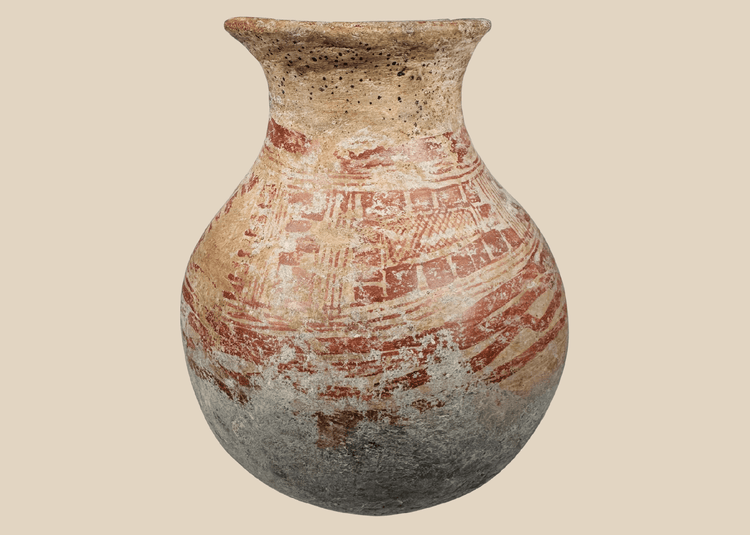


Greater Nicoya Painted Ceramic Vessel | Pre-Columbian Costa Rica–Nicaragua | Circa 800 – 1350 CE
Description
More
Less
Historical Context & Origin
Region: Greater Nicoya cultural area, likely present-day Costa Rica or Nicaragua
Material: Terracotta with pale cream slip and red mineral pigment
Period: Late Pre-Columbian Period, tentatively circa 800–1350 CE
Description
This substantial Pre-Columbian ceramic vessel is attributed to the Greater Nicoya cultural region of Central America, an area encompassing portions of present-day northwestern Costa Rica and southwestern Nicaragua.
The vessel presents a strongly rounded, almost spherical body rising to a constricted neck and broad flaring mouth. Its substantial proportions and symmetrical profile give the piece a particularly commanding presence. Across the upper body and shoulder is an extensive program of painted geometric decoration executed predominantly in red over a pale cream or buff-colored ground.
The decoration is organized into horizontal registers composed of parallel lines, rectangular blocks, diagonal bands, crosshatched fields, stepped forms, and repeating geometric motifs. Although considerable surface wear has softened portions of the design, enough pigment survives to clearly demonstrate the vessel's original decorative complexity.
The arrangement of geometric bands around the shoulder recalls ceramic traditions associated with the Greater Nicoya region, including Mora Polychrome and related wares produced during the later Pre-Columbian period. Museum examples of Mora Polychrome ceramics likewise employ globular vessel forms and structured geometric decoration in red and darker pigments.
The broad flaring rim creates a pronounced transition between the comparatively narrow neck and large rounded body. The interior remains unglazed and displays natural earthen coloration, while the exterior has developed substantial archaeological surface deposits and weathering.
The vessel is accompanied by a modern display stand, allowing it to be presented securely while preserving the rounded original base.
Features
- Broad flaring mouth and pronounced rim
- Pale cream or buff surface slip
- Extensive surviving red painted decoration
- Geometric horizontal registers
- Parallel line and stepped motifs
- Crosshatched decorative panels
- Repeating rectangular and diagonal elements
- Substantial archaeological surface patina
- Accompanied by a modern display stand
Cultural Significance
The Greater Nicoya region developed one of the most distinctive ceramic traditions of ancient Central America. Potters produced a wide variety of vessels decorated with carefully organized painted motifs incorporating geometric forms, animals, supernatural imagery, and symbolic designs.
Mora Polychrome ceramics, dating broadly to approximately 800–1350 CE, are particularly associated with globular vessels decorated in horizontal bands containing red, black, and geometric ornament. Comparable vessels preserved by the Museo del Jade y de la Cultura Precolombina demonstrate the importance of structured geometric decoration within Greater Nicoya ceramic traditions.
Large vessels such as this may have served domestic, ceremonial, storage, or funerary purposes depending upon their original context. Their surviving painted surfaces provide important evidence for the sophisticated ceramic technologies and visual traditions that flourished in Central America before European contact.
The repetition of painted geometric elements across the shoulder would have created a strong visual effect when the vessel was viewed from multiple directions, demonstrating that the decoration was conceived as a continuous composition rather than a single frontal image.
Condition
The vessel remains substantially intact and displays extensive surface wear consistent with considerable age. The exterior exhibits widespread abrasion, pigment loss, mineral deposits, discoloration, surface encrustation, scratches, pitting, staining, and weathering. The original red painted decoration remains clearly visible across much of the shoulder and upper body, although numerous areas are faded, fragmented, or obscured by surface deposits. The rim displays irregularity, edge wear, small chips, and localized losses. Minor surface fissures and areas of erosion are visible throughout. The lower body and rounded base display particularly heavy surface wear and pale mineral accretion. The interior exhibits deposits, discoloration, and general age-related wear.
Dimensions (Approximate)
Height: 8 in
Diameter: 6.5 in
Measurements exclude the display stand.
Age (Approximate)
700–1,200 years old
Provenance
Formerly part of a private Scarborough, Ontario, Canada collection assembled by a lifelong collector of Pre-Columbian artifacts, antiquities, and archaeological material.
The collection was formed over many years and included objects representing a variety of ancient cultures from Mexico, Central America, and South America.
Learn More
Study a related Greater Nicoya polychrome ceramic vessel preserved by the Peabody Museum of Archaeology and Ethnology.
Browse our Collection of Ancient Pre-Columbian Artifacts and Relics.
Description
Historical Context & Origin
Region: Greater Nicoya cultural area, likely present-day Costa Rica or Nicaragua
Material: Terracotta with pale cream slip and red mineral pigment
Period: Late Pre-Columbian Period, tentatively circa 800–1350 CE
Description
This substantial Pre-Columbian ceramic vessel is attributed to the Greater Nicoya cultural region of Central America, an area encompassing portions of present-day northwestern Costa Rica and southwestern Nicaragua.
The vessel presents a strongly rounded, almost spherical body rising to a constricted neck and broad flaring mouth. Its substantial proportions and symmetrical profile give the piece a particularly commanding presence. Across the upper body and shoulder is an extensive program of painted geometric decoration executed predominantly in red over a pale cream or buff-colored ground.
The decoration is organized into horizontal registers composed of parallel lines, rectangular blocks, diagonal bands, crosshatched fields, stepped forms, and repeating geometric motifs. Although considerable surface wear has softened portions of the design, enough pigment survives to clearly demonstrate the vessel's original decorative complexity.
The arrangement of geometric bands around the shoulder recalls ceramic traditions associated with the Greater Nicoya region, including Mora Polychrome and related wares produced during the later Pre-Columbian period. Museum examples of Mora Polychrome ceramics likewise employ globular vessel forms and structured geometric decoration in red and darker pigments.
The broad flaring rim creates a pronounced transition between the comparatively narrow neck and large rounded body. The interior remains unglazed and displays natural earthen coloration, while the exterior has developed substantial archaeological surface deposits and weathering.
The vessel is accompanied by a modern display stand, allowing it to be presented securely while preserving the rounded original base.
Features
- Broad flaring mouth and pronounced rim
- Pale cream or buff surface slip
- Extensive surviving red painted decoration
- Geometric horizontal registers
- Parallel line and stepped motifs
- Crosshatched decorative panels
- Repeating rectangular and diagonal elements
- Substantial archaeological surface patina
- Accompanied by a modern display stand
Cultural Significance
The Greater Nicoya region developed one of the most distinctive ceramic traditions of ancient Central America. Potters produced a wide variety of vessels decorated with carefully organized painted motifs incorporating geometric forms, animals, supernatural imagery, and symbolic designs.
Mora Polychrome ceramics, dating broadly to approximately 800–1350 CE, are particularly associated with globular vessels decorated in horizontal bands containing red, black, and geometric ornament. Comparable vessels preserved by the Museo del Jade y de la Cultura Precolombina demonstrate the importance of structured geometric decoration within Greater Nicoya ceramic traditions.
Large vessels such as this may have served domestic, ceremonial, storage, or funerary purposes depending upon their original context. Their surviving painted surfaces provide important evidence for the sophisticated ceramic technologies and visual traditions that flourished in Central America before European contact.
The repetition of painted geometric elements across the shoulder would have created a strong visual effect when the vessel was viewed from multiple directions, demonstrating that the decoration was conceived as a continuous composition rather than a single frontal image.
Condition
The vessel remains substantially intact and displays extensive surface wear consistent with considerable age. The exterior exhibits widespread abrasion, pigment loss, mineral deposits, discoloration, surface encrustation, scratches, pitting, staining, and weathering. The original red painted decoration remains clearly visible across much of the shoulder and upper body, although numerous areas are faded, fragmented, or obscured by surface deposits. The rim displays irregularity, edge wear, small chips, and localized losses. Minor surface fissures and areas of erosion are visible throughout. The lower body and rounded base display particularly heavy surface wear and pale mineral accretion. The interior exhibits deposits, discoloration, and general age-related wear.
Dimensions (Approximate)
Height: 8 in
Diameter: 6.5 in
Measurements exclude the display stand.
Age (Approximate)
700–1,200 years old
Provenance
Formerly part of a private Scarborough, Ontario, Canada collection assembled by a lifelong collector of Pre-Columbian artifacts, antiquities, and archaeological material.
The collection was formed over many years and included objects representing a variety of ancient cultures from Mexico, Central America, and South America.
Learn More
Study a related Greater Nicoya polychrome ceramic vessel preserved by the Peabody Museum of Archaeology and Ethnology.
Browse our Collection of Ancient Pre-Columbian Artifacts and Relics.
You May Also Like
