

Pair of Ancient Chinese Terracotta Funerary Attendants | Han Dynasty | Circa 206 BCE – 9 CE
Couldn't load pickup availability




Pair of Ancient Chinese Terracotta Funerary Attendants | Han Dynasty | Circa 206 BCE – 9 CE
Description
More
Less
Historical Context & Origin
Region: China
Material: Terracotta with surviving polychrome pigment
Period: Attributed to Han Dynasty, likely Western Han, circa 206 BCE–9 CE
Description
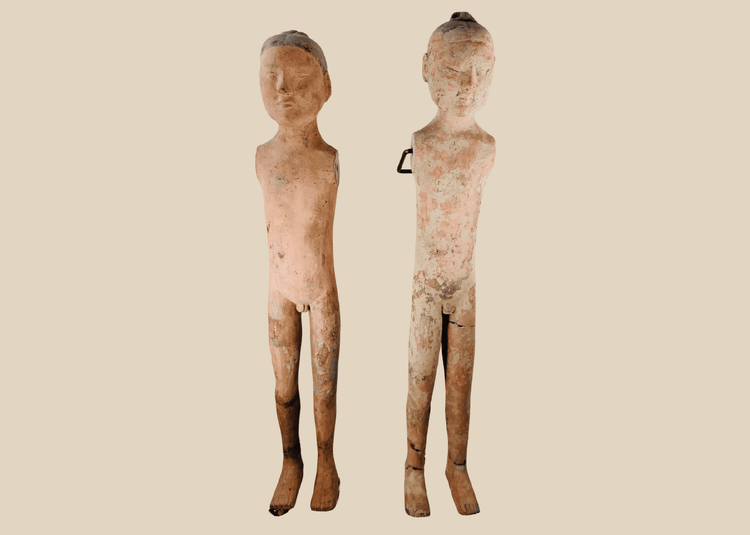
This remarkable pair of Chinese terracotta standing male funerary figures represents the distinctive elongated “stick figure” tradition associated with the Han Dynasty. Each figure is modeled with an exceptionally slender body, long straight legs, individualized facial features, molded ears, and hair gathered into a compact topknot.
The surfaces retain extensive traces of ancient-style polychrome decoration, including salmon-pink, cream, gray, and darker pigment across the bodies, faces, and hair. Painted terracotta and earthenware figures were widely employed within Han funerary contexts, and surviving museum examples demonstrate the extensive use of pigments over ceramic bodies during the period.
Circular apertures are present at the shoulders of both figures. Comparable Han funerary figures were originally fitted with separately fashioned wooden arms secured through these openings; archaeological evidence also indicates that some examples were dressed in perishable textile garments. Those organic components rarely survive, leaving the elongated ceramic bodies in the distinctive form now commonly described by collectors as “stick figures.”
The figures display subtly differing facial modeling and surface treatment. One preserves a comparatively even salmon-colored surface with strongly defined gray hair, while the other exhibits considerably more weathering and mineralized deposits, with pale cream and pink pigment surviving irregularly across the body.
Both figures retain modeled male anatomical details, reinforcing their identification as male attendants or servants rather than female court figures. The calm frontal expressions and rigid standing poses are consistent with funerary attendants intended to accompany and serve the deceased in the afterlife. Han funerary sculpture formed part of the broader tradition of mingqi — objects specifically created for burial and representation of the material and social world surrounding the deceased.
Features
- Elongated “stick figure” body proportions
- Surviving salmon-pink, cream, gray, and dark pigment
- Individually modeled facial features
- Hair arranged in raised topknots
- Original shoulder apertures for now-lost wooden arms
- Modeled anatomical details
- Extensive burial-style surface deposits and weathering
- Mounted on custom clear acrylic display stands
- Offered together as a matched pair
Cultural Significance
During the Han Dynasty, ceramic tomb figures became an important component of elite burial practice. Known collectively as mingqi, these objects represented attendants, servants, soldiers, animals, architecture, and other aspects of daily life intended to accompany the deceased into the afterlife. The Metropolitan Museum notes the increasingly elaborate role such objects played within Han tombs.
The unusual construction of figures such as these demonstrates the sophisticated combination of multiple materials employed by Han craftsmen. The terracotta body provided the permanent core, while wooden arms and textile garments could create a more lifelike appearance when originally installed within the tomb. Surviving examples today often appear strikingly minimalist because these organic components have disappeared over time.
Their large scale, surviving pigment, and presentation as a pair make these particularly striking examples of Chinese funerary sculpture and compelling representations of Han-period beliefs concerning service, status, and continuity after death.
Condition
Ancient condition with extensive age-related wear throughout. Both figures exhibit pigment loss, surface abrasion, mineral deposits, discoloration, earthen encrustation, scratches, chips, small losses, and areas of surface instability.
The taller figure exhibits substantial cracking through the upper legs and lower body, including visible horizontal fractures around the thigh, knee, and ankle areas. Additional surface losses and old stabilization may be present.
The second figure displays wear and losses around the feet, including damage to the toes and lower extremities, together with surface discoloration and localized cracking.
The original arms and any textile garments are no longer present, as is typical of comparable figures constructed with perishable components. Both figures are presently supported by later custom acrylic stands with modern metal mounting elements.
Dimensions (Approximate)
Figure I:
Height: 24 in
Width: 3.75 in
Depth: 4 in
Figure II:
Height: 23.5 in
Width: 3.5 in
Depth: 4 in
Age (Approximate)
2,000–2,200 years old
Provenance
From a private collection in Beverly Hills, California, United States.
Subsequently handled by Toomey & Co. Auctioneers, Chicago, Illinois, a respected auction house specializing in fine art, design, decorative arts, and important private collections. The firm is particularly known for presenting carefully catalogued material across a broad range of historical categories.
Learn More
Study a closely related Western Han funerary figure preserved by the Montreal Museum of Fine Arts.
Compare this pair with a related set of painted pottery stick figures presented by Sotheby’s.
Browse our Collection of Ancient Chinese Artifacts and Imperial Relics.
Description
Historical Context & Origin
Region: China
Material: Terracotta with surviving polychrome pigment
Period: Attributed to Han Dynasty, likely Western Han, circa 206 BCE–9 CE
Description
This remarkable pair of Chinese terracotta standing male funerary figures represents the distinctive elongated “stick figure” tradition associated with the Han Dynasty. Each figure is modeled with an exceptionally slender body, long straight legs, individualized facial features, molded ears, and hair gathered into a compact topknot.
The surfaces retain extensive traces of ancient-style polychrome decoration, including salmon-pink, cream, gray, and darker pigment across the bodies, faces, and hair. Painted terracotta and earthenware figures were widely employed within Han funerary contexts, and surviving museum examples demonstrate the extensive use of pigments over ceramic bodies during the period.
Circular apertures are present at the shoulders of both figures. Comparable Han funerary figures were originally fitted with separately fashioned wooden arms secured through these openings; archaeological evidence also indicates that some examples were dressed in perishable textile garments. Those organic components rarely survive, leaving the elongated ceramic bodies in the distinctive form now commonly described by collectors as “stick figures.”
The figures display subtly differing facial modeling and surface treatment. One preserves a comparatively even salmon-colored surface with strongly defined gray hair, while the other exhibits considerably more weathering and mineralized deposits, with pale cream and pink pigment surviving irregularly across the body.
Both figures retain modeled male anatomical details, reinforcing their identification as male attendants or servants rather than female court figures. The calm frontal expressions and rigid standing poses are consistent with funerary attendants intended to accompany and serve the deceased in the afterlife. Han funerary sculpture formed part of the broader tradition of mingqi — objects specifically created for burial and representation of the material and social world surrounding the deceased.
Features
- Elongated “stick figure” body proportions
- Surviving salmon-pink, cream, gray, and dark pigment
- Individually modeled facial features
- Hair arranged in raised topknots
- Original shoulder apertures for now-lost wooden arms
- Modeled anatomical details
- Extensive burial-style surface deposits and weathering
- Mounted on custom clear acrylic display stands
- Offered together as a matched pair
Cultural Significance
During the Han Dynasty, ceramic tomb figures became an important component of elite burial practice. Known collectively as mingqi, these objects represented attendants, servants, soldiers, animals, architecture, and other aspects of daily life intended to accompany the deceased into the afterlife. The Metropolitan Museum notes the increasingly elaborate role such objects played within Han tombs.
The unusual construction of figures such as these demonstrates the sophisticated combination of multiple materials employed by Han craftsmen. The terracotta body provided the permanent core, while wooden arms and textile garments could create a more lifelike appearance when originally installed within the tomb. Surviving examples today often appear strikingly minimalist because these organic components have disappeared over time.
Their large scale, surviving pigment, and presentation as a pair make these particularly striking examples of Chinese funerary sculpture and compelling representations of Han-period beliefs concerning service, status, and continuity after death.
Condition
Ancient condition with extensive age-related wear throughout. Both figures exhibit pigment loss, surface abrasion, mineral deposits, discoloration, earthen encrustation, scratches, chips, small losses, and areas of surface instability.
The taller figure exhibits substantial cracking through the upper legs and lower body, including visible horizontal fractures around the thigh, knee, and ankle areas. Additional surface losses and old stabilization may be present.
The second figure displays wear and losses around the feet, including damage to the toes and lower extremities, together with surface discoloration and localized cracking.
The original arms and any textile garments are no longer present, as is typical of comparable figures constructed with perishable components. Both figures are presently supported by later custom acrylic stands with modern metal mounting elements.
Dimensions (Approximate)
Figure I:
Height: 24 in
Width: 3.75 in
Depth: 4 in
Figure II:
Height: 23.5 in
Width: 3.5 in
Depth: 4 in
Age (Approximate)
2,000–2,200 years old
Provenance
From a private collection in Beverly Hills, California, United States.
Subsequently handled by Toomey & Co. Auctioneers, Chicago, Illinois, a respected auction house specializing in fine art, design, decorative arts, and important private collections. The firm is particularly known for presenting carefully catalogued material across a broad range of historical categories.
Learn More
Study a closely related Western Han funerary figure preserved by the Montreal Museum of Fine Arts.
Compare this pair with a related set of painted pottery stick figures presented by Sotheby’s.
Browse our Collection of Ancient Chinese Artifacts and Imperial Relics.
You May Also Like
