

Indian Brass Naga Cobra Shrine Canopy | Circa 19th Century
Couldn't load pickup availability



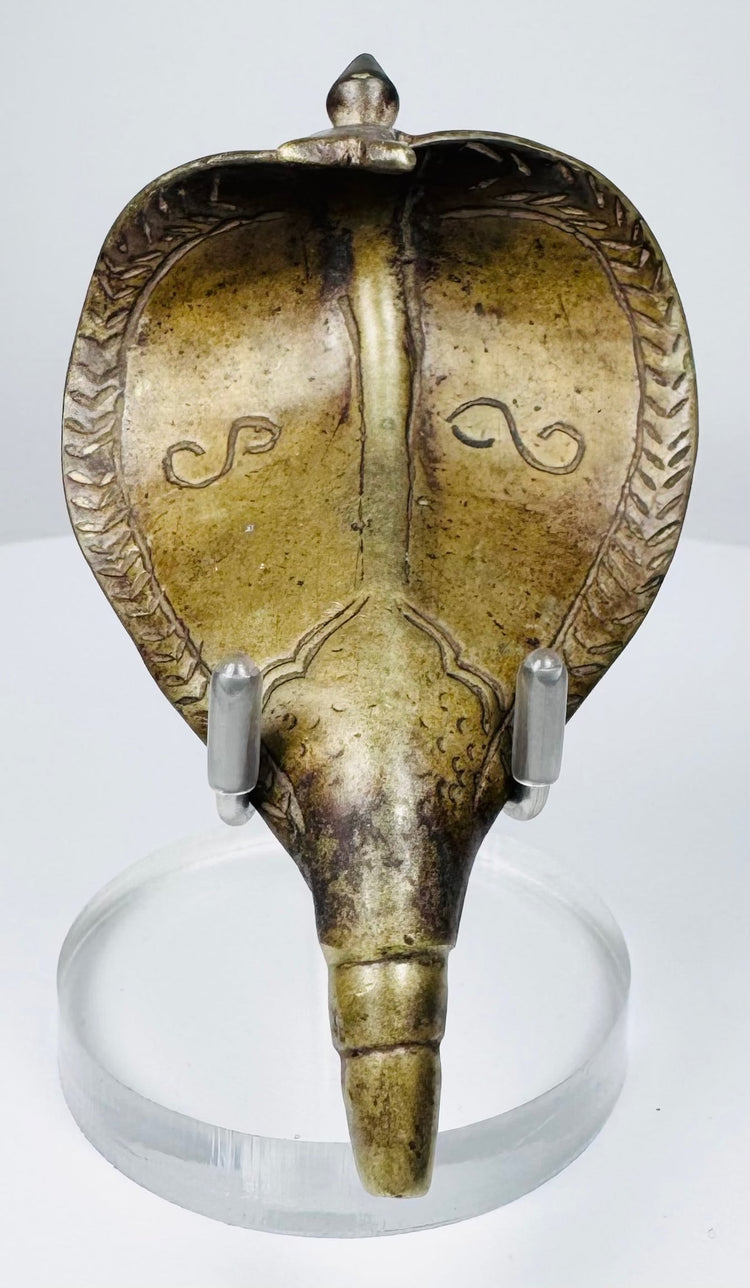


Indian Brass Naga Cobra Shrine Canopy | Circa 19th Century
Description
More
Less
Historical Context & Origin
Region: India, possibly Deccan / Maharashtra
Material: Cast copper alloy, likely brass
Period: 19th Century
Description
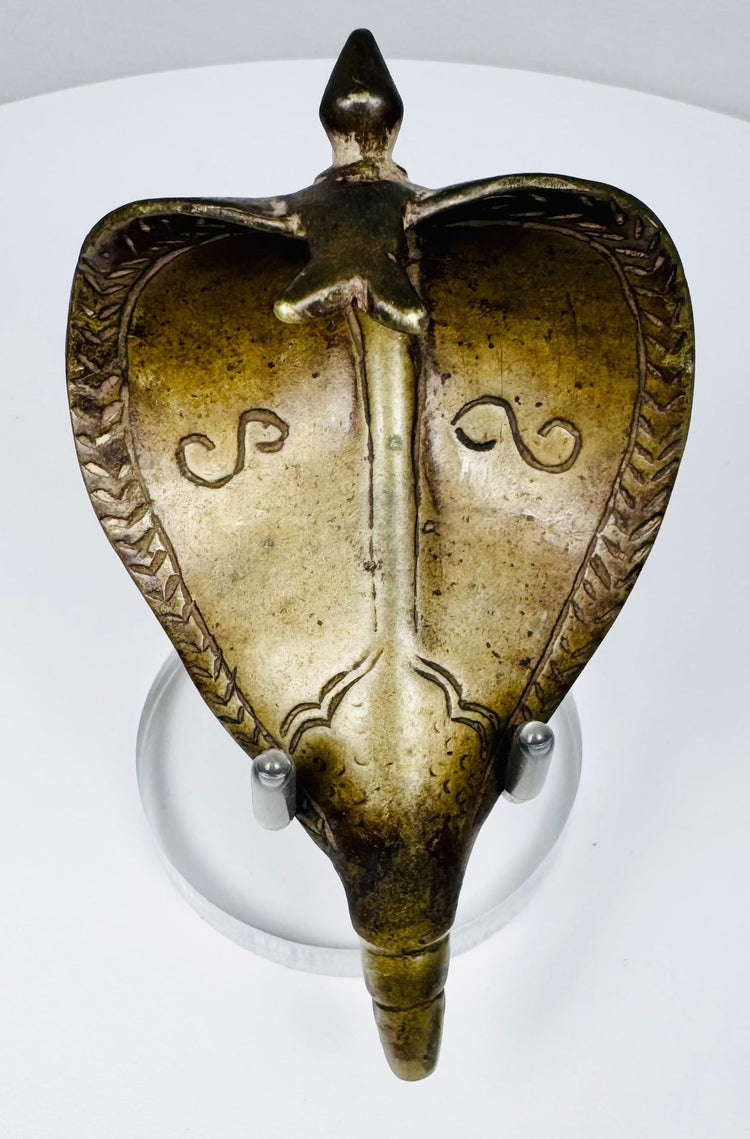
A finely cast antique Indian Naga, or cobra, canopy dating to approximately the 19th century. Conceived as a detachable component of a larger religious assemblage, the piece was likely intended to rise protectively above a sacred image or shrine element and is particularly consistent with historic Shaivite devotional metalwork.
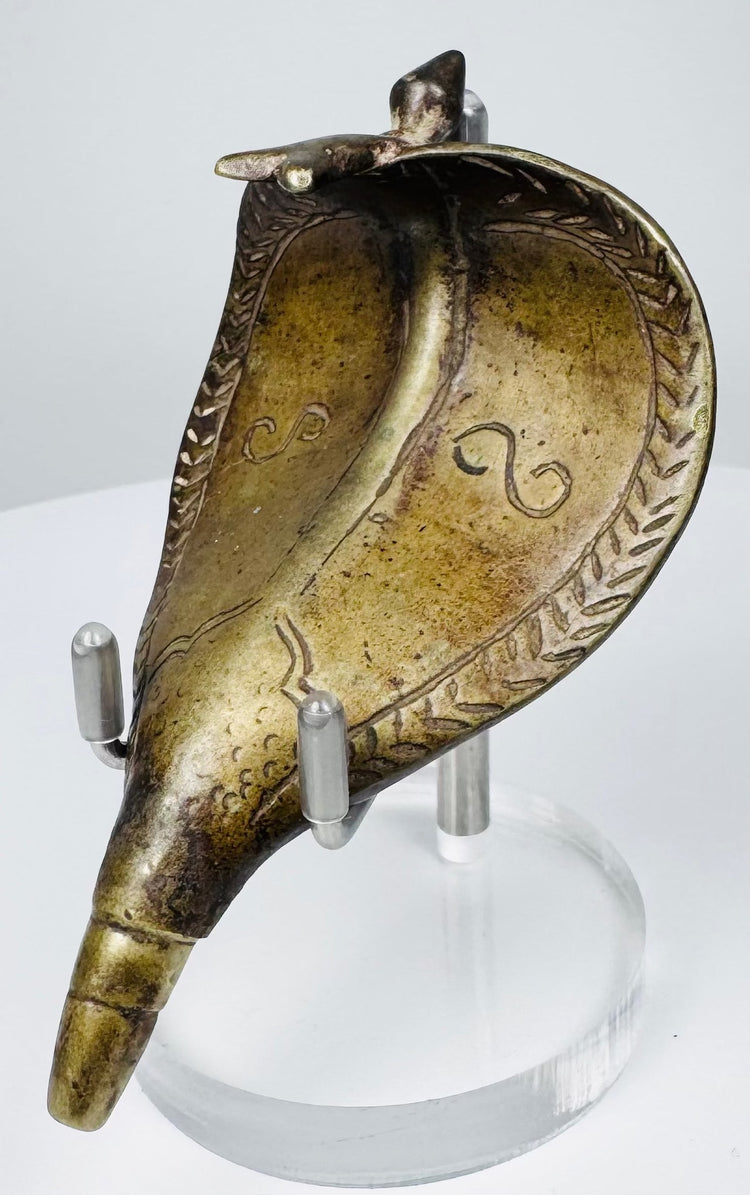
The piece takes the form of a dramatically expanded cobra hood with a broad, heart-shaped silhouette. A pronounced raised ridge extends through the center of the hood, suggesting the serpent's body or spine, while the outer perimeter is embellished with repeated incised chevron and scale-like decoration.
The interior of the hood is ornamented with a pair of engraved scrolling motifs evocative of the distinctive markings associated with a cobra's expanded hood. These stylized details add both visual symmetry and symbolic emphasis to the protective serpent form.
At the upper center, the serpent's head rises prominently above the hood and incorporates a distinctive forked or bifurcated projection associated with the head. The precise interpretation of this small detail is uncertain, and it is therefore best understood as part of the stylized treatment of the cobra rather than definitively identified as a tongue.
The lower portion narrows into a substantial tapered mounting tang intended for insertion into a corresponding socket or fitting. This construction strongly suggests that the canopy originally formed part of a larger composite religious object rather than functioning as an independent decorative finial.
Comparable historic Indian devotional bronzes employ expanded cobra hoods as protective canopies above Shiva lingams, and related examples are preserved in major museum collections. The present object's form and mounting system are therefore consistent with a detachable Naga canopy from a Shaivite shrine, although its exact original assemblage cannot presently be established.
Features
- Sculpted as an expanded hooded Naga cobra
- Broad heart-shaped protective canopy form
- Pronounced raised central ridge suggesting the serpent's body or spine
- Stylized cobra head rising above the upper edge of the hood
- Distinctive forked or bifurcated projection associated with the serpent's head
- Incised chevron and scale-like decoration around the perimeter
- Paired scrolling motifs decorating the interior of the hood
- Substantial tapered lower mounting tang
- Designed for insertion into a corresponding shrine socket or fitting
- Cast copper-alloy construction, likely brass
- Golden-brown and darkened aged surface patina
- Form consistent with protective cobra canopies used in Indian devotional metalwork
- Likely associated with a larger Hindu shrine assemblage, possibly Shaivite
Cultural Significance
The Naga, or sacred serpent, occupies an important place within Hindu religious imagery, where serpents can serve as symbols of protection, divine power, fertility, water, and supernatural guardianship.
Within Shaivite devotional art, the cobra is particularly closely associated with Shiva. Expanded serpent hoods may appear above or behind a Shiva lingam, forming a protective canopy over the sacred emblem. In this context, the cobra functions not merely as ornament but as a visual guardian of the divine image beneath it.
Museum collections preserve historic Indian Shiva lingams and related devotional objects incorporating cobra canopies, including separately cast or modular components. Such constructions demonstrate how metal shrines could be assembled from multiple elements, potentially including the lingam, yoni base, Nandi, serpent canopy, and architectural supports.
The tapered mounting tang of the present example is consistent with this type of composite construction. While a Shaivite association is strongly suggested by comparable objects, the precise shrine, deity, or assemblage for which this individual canopy was originally made cannot be determined with certainty.
Condition
Good antique condition consistent with age and prolonged handling. The metal exhibits darkened and golden-brown patination, areas of oxidation and discoloration, rubbing, surface scratches, abrasions, minor pitting, and scattered surface deposits.
The incised decoration remains clearly visible, including the patterned border and paired ornamental motifs within the hood. The raised serpent head and central ridge remain well defined, and the tapered mounting tang is intact.
Minor surface and casting irregularities are present throughout and are consistent with traditional manufacture and age.
Dimensions (Approximate)
Height: 3.75 inches
Width: 2.25 inches
Depth: 1.25 inches
Age (Approximate)
125–225 years old
Provenance
From a Long Island, New York collection of Asian art and historical objects.
Formerly in the collection of Nancy and John Hyde Devoe, New York City and New Jersey.
Subsequently handled by Artemis Fine Arts Gallery, a specialist dealer in ancient, classical, ethnographic, and culturally significant works of art.
Learn More
Explore a closely comparable detached Naga cobra hood in the collection of the British Museum
Explore our Collection of Religious & Spiritual Relics
Description
Historical Context & Origin
Region: India, possibly Deccan / Maharashtra
Material: Cast copper alloy, likely brass
Period: 19th Century
Description
A finely cast antique Indian Naga, or cobra, canopy dating to approximately the 19th century. Conceived as a detachable component of a larger religious assemblage, the piece was likely intended to rise protectively above a sacred image or shrine element and is particularly consistent with historic Shaivite devotional metalwork.
The piece takes the form of a dramatically expanded cobra hood with a broad, heart-shaped silhouette. A pronounced raised ridge extends through the center of the hood, suggesting the serpent's body or spine, while the outer perimeter is embellished with repeated incised chevron and scale-like decoration.
The interior of the hood is ornamented with a pair of engraved scrolling motifs evocative of the distinctive markings associated with a cobra's expanded hood. These stylized details add both visual symmetry and symbolic emphasis to the protective serpent form.
At the upper center, the serpent's head rises prominently above the hood and incorporates a distinctive forked or bifurcated projection associated with the head. The precise interpretation of this small detail is uncertain, and it is therefore best understood as part of the stylized treatment of the cobra rather than definitively identified as a tongue.
The lower portion narrows into a substantial tapered mounting tang intended for insertion into a corresponding socket or fitting. This construction strongly suggests that the canopy originally formed part of a larger composite religious object rather than functioning as an independent decorative finial.
Comparable historic Indian devotional bronzes employ expanded cobra hoods as protective canopies above Shiva lingams, and related examples are preserved in major museum collections. The present object's form and mounting system are therefore consistent with a detachable Naga canopy from a Shaivite shrine, although its exact original assemblage cannot presently be established.
Features
- Sculpted as an expanded hooded Naga cobra
- Broad heart-shaped protective canopy form
- Pronounced raised central ridge suggesting the serpent's body or spine
- Stylized cobra head rising above the upper edge of the hood
- Distinctive forked or bifurcated projection associated with the serpent's head
- Incised chevron and scale-like decoration around the perimeter
- Paired scrolling motifs decorating the interior of the hood
- Substantial tapered lower mounting tang
- Designed for insertion into a corresponding shrine socket or fitting
- Cast copper-alloy construction, likely brass
- Golden-brown and darkened aged surface patina
- Form consistent with protective cobra canopies used in Indian devotional metalwork
- Likely associated with a larger Hindu shrine assemblage, possibly Shaivite
Cultural Significance
The Naga, or sacred serpent, occupies an important place within Hindu religious imagery, where serpents can serve as symbols of protection, divine power, fertility, water, and supernatural guardianship.
Within Shaivite devotional art, the cobra is particularly closely associated with Shiva. Expanded serpent hoods may appear above or behind a Shiva lingam, forming a protective canopy over the sacred emblem. In this context, the cobra functions not merely as ornament but as a visual guardian of the divine image beneath it.
Museum collections preserve historic Indian Shiva lingams and related devotional objects incorporating cobra canopies, including separately cast or modular components. Such constructions demonstrate how metal shrines could be assembled from multiple elements, potentially including the lingam, yoni base, Nandi, serpent canopy, and architectural supports.
The tapered mounting tang of the present example is consistent with this type of composite construction. While a Shaivite association is strongly suggested by comparable objects, the precise shrine, deity, or assemblage for which this individual canopy was originally made cannot be determined with certainty.
Condition
Good antique condition consistent with age and prolonged handling. The metal exhibits darkened and golden-brown patination, areas of oxidation and discoloration, rubbing, surface scratches, abrasions, minor pitting, and scattered surface deposits.
The incised decoration remains clearly visible, including the patterned border and paired ornamental motifs within the hood. The raised serpent head and central ridge remain well defined, and the tapered mounting tang is intact.
Minor surface and casting irregularities are present throughout and are consistent with traditional manufacture and age.
Dimensions (Approximate)
Height: 3.75 inches
Width: 2.25 inches
Depth: 1.25 inches
Age (Approximate)
125–225 years old
Provenance
From a Long Island, New York collection of Asian art and historical objects.
Formerly in the collection of Nancy and John Hyde Devoe, New York City and New Jersey.
Subsequently handled by Artemis Fine Arts Gallery, a specialist dealer in ancient, classical, ethnographic, and culturally significant works of art.
Learn More
Explore a closely comparable detached Naga cobra hood in the collection of the British Museum
Explore our Collection of Religious & Spiritual Relics
You May Also Like
