

Indo-Afghan Percussion Holster Pistol | Modeled After British Military Arms | Mid-19th Century
Couldn't load pickup availability


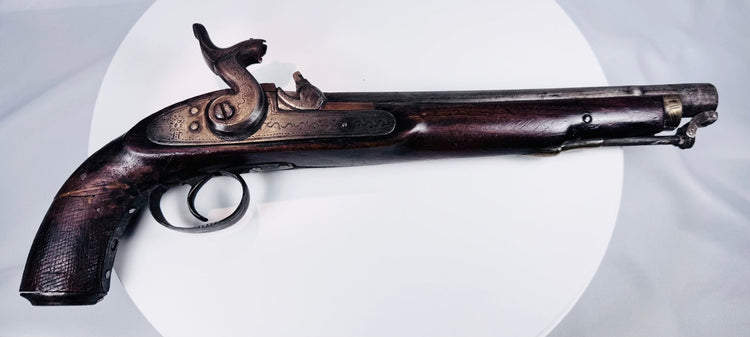
Indo-Afghan Percussion Holster Pistol | Modeled After British Military Arms | Mid-19th Century
Description
More
Less
Historical Context & Origin
Region: Afghanistan / Northwest Frontier Region
Material: Hardwood stock, iron lock and barrel, brass mounts
Period: Mid-19th Century CE, circa 1840–1870
Description
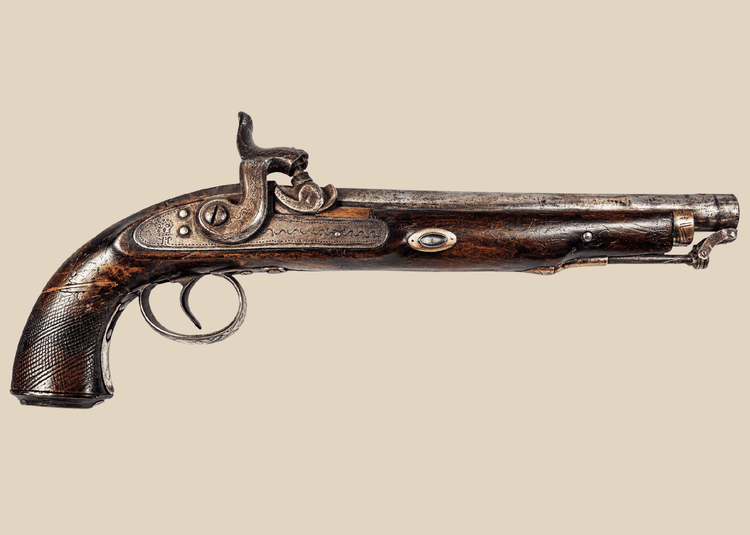
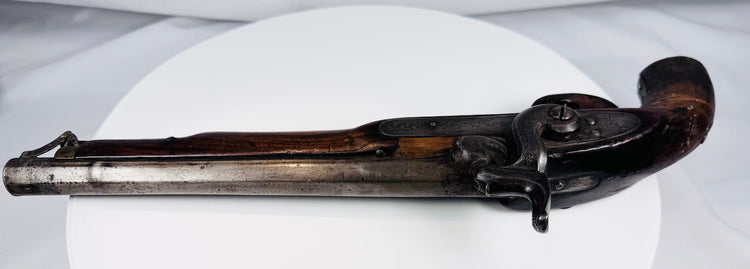
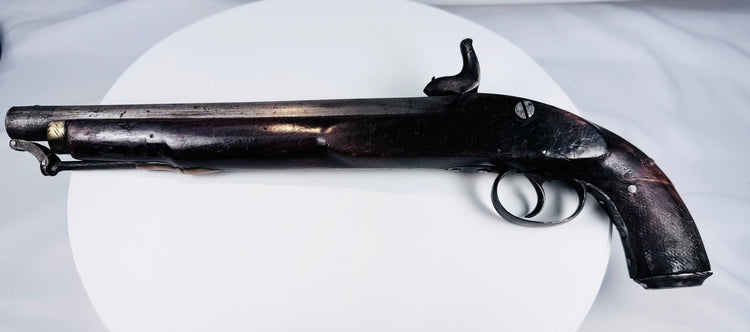
This distinctive percussion holster pistol is a classic example of the firearms produced throughout Afghanistan and the broader Northwest Frontier region during the nineteenth century. Closely modeled after contemporary British military pistols introduced into Central Asia during the expansion of British influence, the weapon reflects the adaptation of European firearm technology by local craftsmen and gunsmiths.
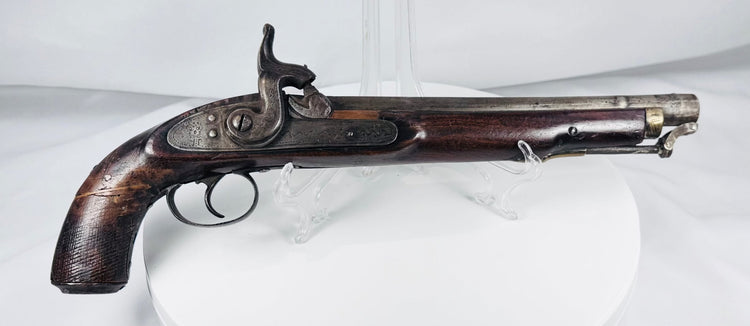
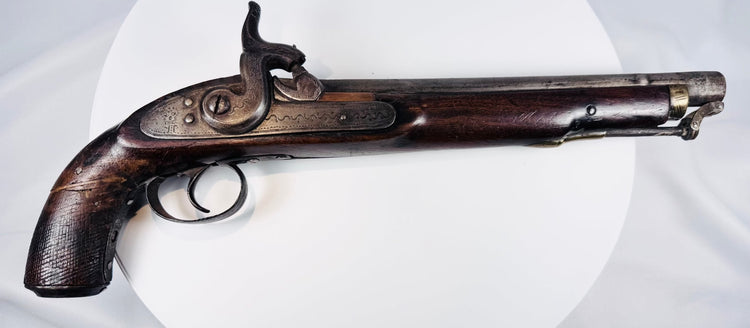
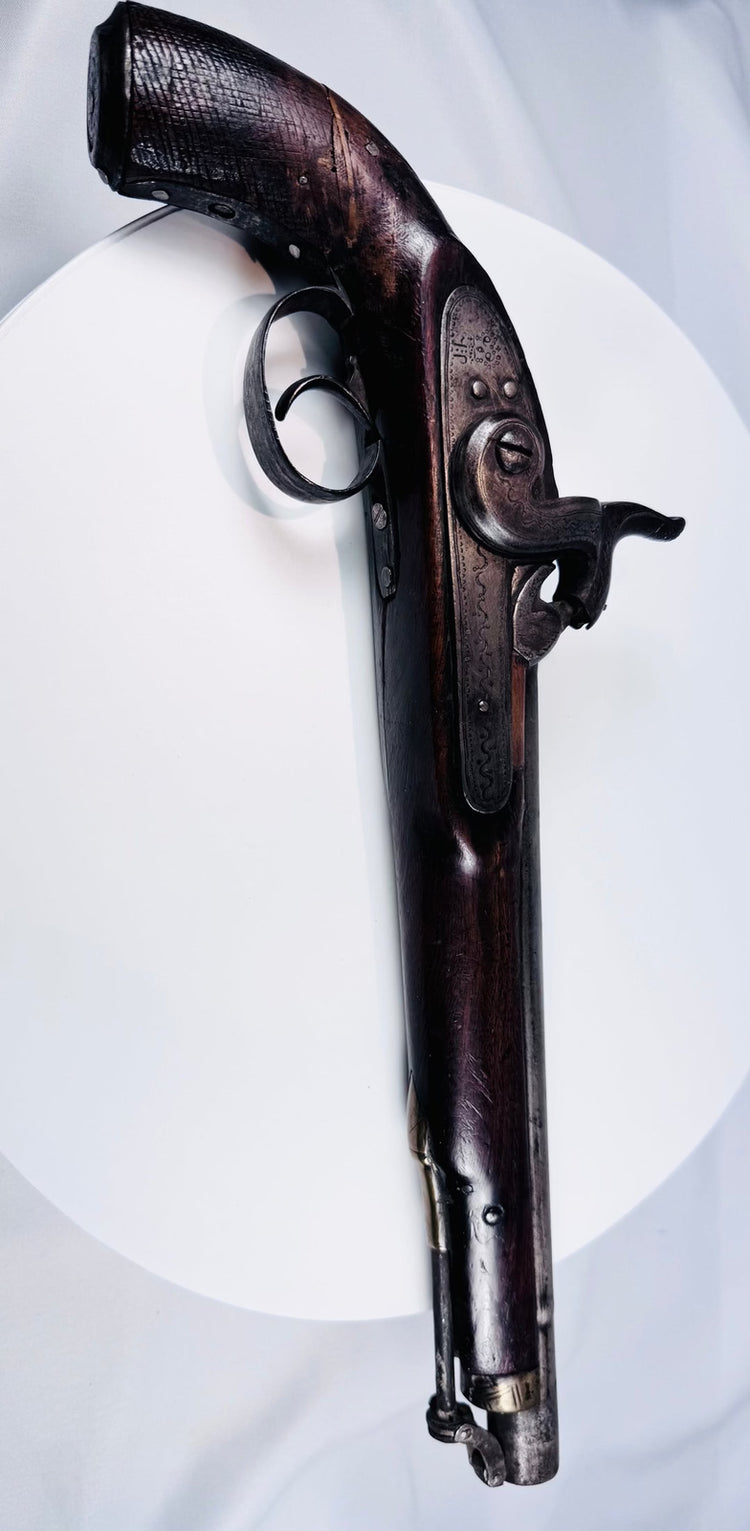
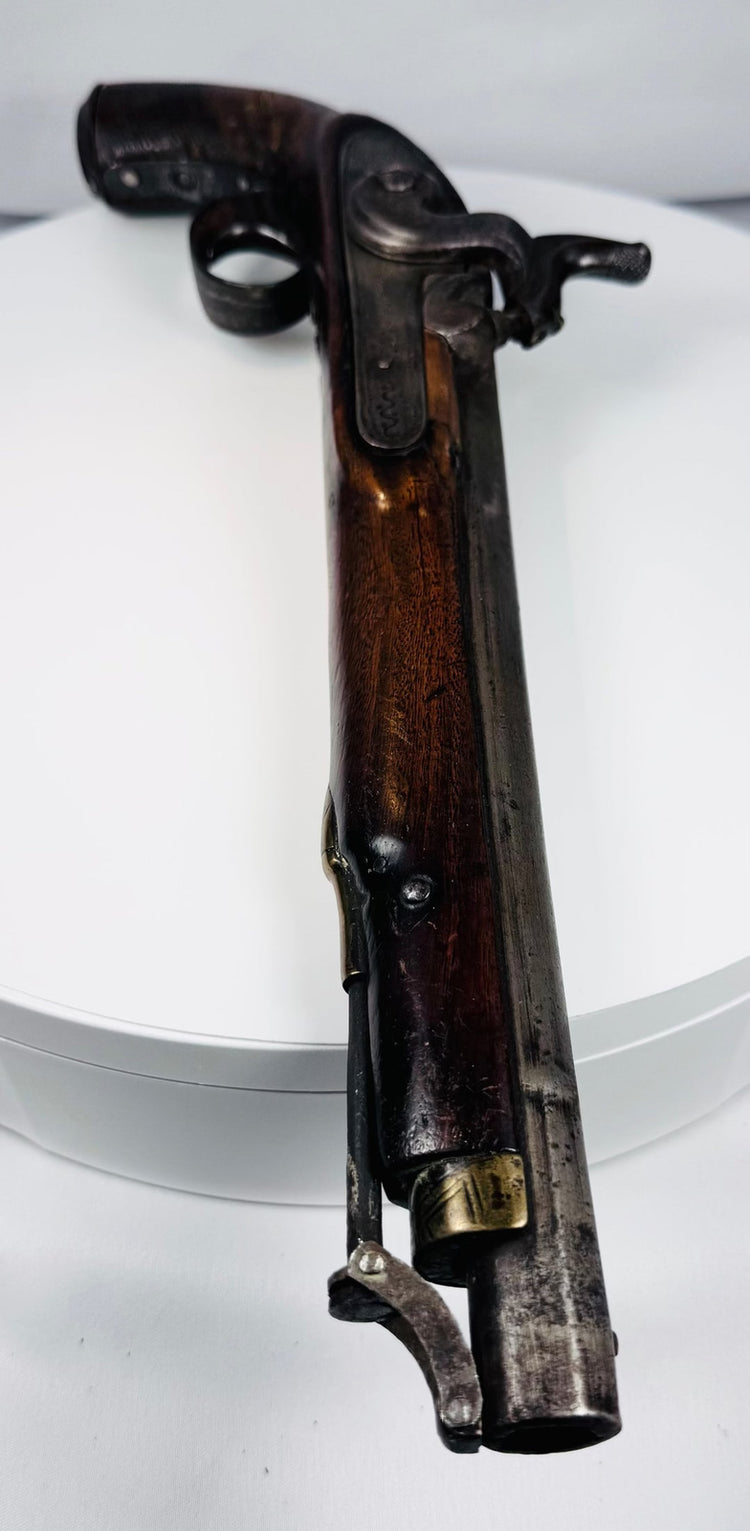
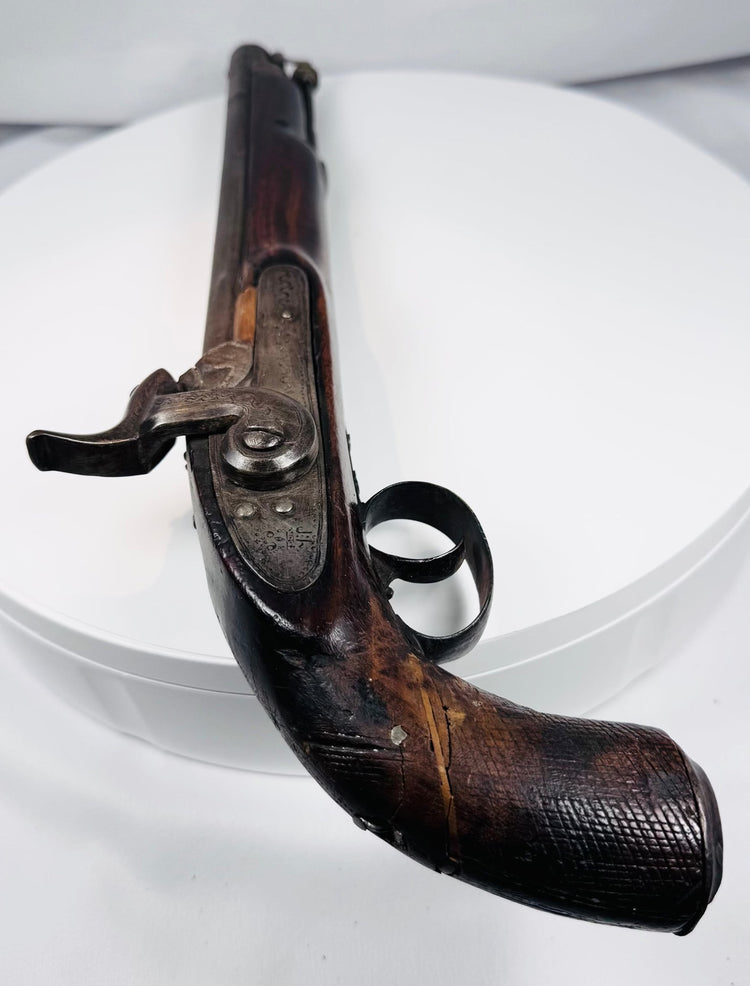
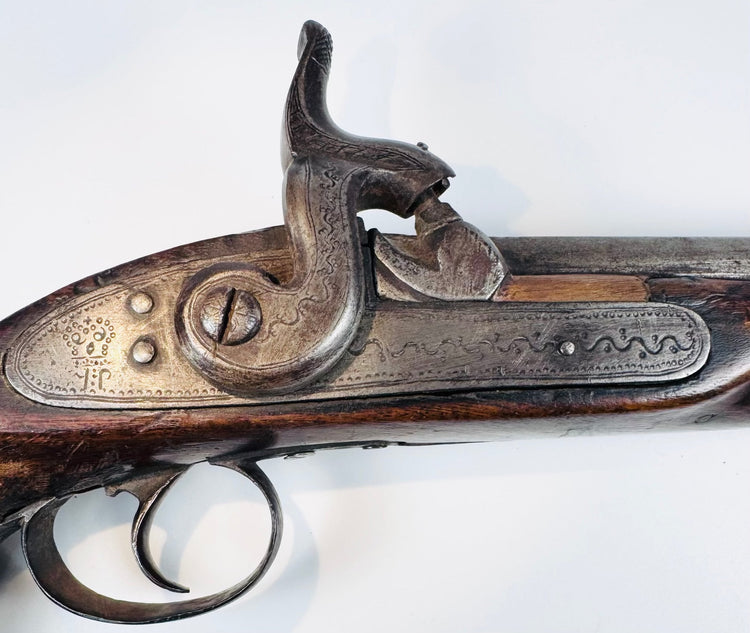
Constructed with a substantial hardwood stock and fitted with an iron barrel and lock mechanism, the pistol exhibits the characteristic form of Indo-Afghan martial firearms of the period. The lock plate and hammer are embellished with engraved decoration, while brass fittings at the muzzle provide both reinforcement and visual contrast. The pistol retains its original captive ramrod mounted beneath the barrel, an increasingly uncommon survival among comparable examples.
The overall silhouette draws heavily from British military percussion pistols of the early Victorian era, though several regional characteristics—including the engraved lockwork, stock profile, and hand-finished components—suggest manufacture within Afghanistan or the tribal regions bordering British India. Firearms of this type were widely carried by tribal horsemen, local militias, merchants, and irregular troops during a period of intense political and military activity that included the Anglo-Afghan conflicts of the nineteenth century.
Examples such as this embody the cultural exchange between British military arms and the long-established gunmaking traditions of Central and South Asia, where local workshops often reinterpreted imported designs according to indigenous tastes and manufacturing techniques.
Features
- Likely Afghan or Northwest Frontier manufacture
- Mid-19th century, circa 1840–1870
- Hardwood stock with iron lock and barrel
- Engraved lock plate and hammer
- Brass reinforcement at the muzzle
- Retains its original captive ramrod
- Traditional percussion ignition system
- Displays hand-crafted regional construction techniques
Cultural Significance
During the nineteenth century, Afghanistan and the Northwest Frontier served as crossroads between Central Asia, Persia, and British India. The introduction of British military firearms during the Anglo-Afghan Wars profoundly influenced local gunmaking traditions, leading regional craftsmen to produce pistols and muskets inspired by European designs while incorporating indigenous decorative motifs and construction methods.
Such pistols were valued not only as practical weapons but also as symbols of status, authority, and martial identity. The fusion of British military technology with Afghan craftsmanship resulted in a distinctive class of arms that remains of interest to collectors of Islamic weaponry, colonial militaria, and frontier artifacts.
Condition
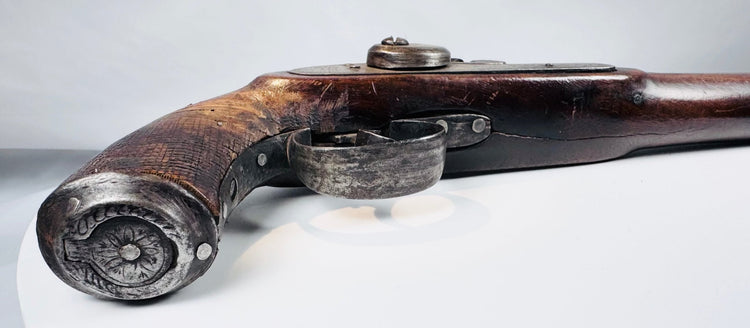
The pistol remains structurally sound and displays expected age-related wear throughout. The hardwood stock exhibits scattered scuffs, abrasions, and losses, particularly around the grip and fore-end. Surface oxidation, handling wear, and areas of age-darkened patina are present across the metal components. The engraved lock decoration remains visible, and the original captive ramrod is retained beneath the barrel.
Dimensions (Approximate)
Overall Length: 14.75 in
Age (Approximate)
155–185 years old
Provenance
Formerly part of a private Cheyenne, Wyoming, USA collection comprising an extensive assemblage of historical firearms. The collection was assembled over many years with a particular emphasis on antique pistols, muskets, and arms originating from Europe, the Middle East, and Central Asia.
Learn More
Explore the history of warfare and firearms along the Afghan frontier through the National Army Museum
Browse our curated Collection of Collectible Firearms & Historical Weaponry
Antique Firearm Notice
All firearms offered by Relic & Rarity are sold strictly as antique collectibles and display pieces. They are supplied in disabled/non-firing condition and are not represented, tested, or warranted as safe or suitable for firing. Buyers are responsible for confirming all applicable laws regarding purchase, possession, transport, import, and ownership in their jurisdiction.
Description
Historical Context & Origin
Region: Afghanistan / Northwest Frontier Region
Material: Hardwood stock, iron lock and barrel, brass mounts
Period: Mid-19th Century CE, circa 1840–1870
Description
This distinctive percussion holster pistol is a classic example of the firearms produced throughout Afghanistan and the broader Northwest Frontier region during the nineteenth century. Closely modeled after contemporary British military pistols introduced into Central Asia during the expansion of British influence, the weapon reflects the adaptation of European firearm technology by local craftsmen and gunsmiths.
Constructed with a substantial hardwood stock and fitted with an iron barrel and lock mechanism, the pistol exhibits the characteristic form of Indo-Afghan martial firearms of the period. The lock plate and hammer are embellished with engraved decoration, while brass fittings at the muzzle provide both reinforcement and visual contrast. The pistol retains its original captive ramrod mounted beneath the barrel, an increasingly uncommon survival among comparable examples.
The overall silhouette draws heavily from British military percussion pistols of the early Victorian era, though several regional characteristics—including the engraved lockwork, stock profile, and hand-finished components—suggest manufacture within Afghanistan or the tribal regions bordering British India. Firearms of this type were widely carried by tribal horsemen, local militias, merchants, and irregular troops during a period of intense political and military activity that included the Anglo-Afghan conflicts of the nineteenth century.
Examples such as this embody the cultural exchange between British military arms and the long-established gunmaking traditions of Central and South Asia, where local workshops often reinterpreted imported designs according to indigenous tastes and manufacturing techniques.
Features
- Likely Afghan or Northwest Frontier manufacture
- Mid-19th century, circa 1840–1870
- Hardwood stock with iron lock and barrel
- Engraved lock plate and hammer
- Brass reinforcement at the muzzle
- Retains its original captive ramrod
- Traditional percussion ignition system
- Displays hand-crafted regional construction techniques
Cultural Significance
During the nineteenth century, Afghanistan and the Northwest Frontier served as crossroads between Central Asia, Persia, and British India. The introduction of British military firearms during the Anglo-Afghan Wars profoundly influenced local gunmaking traditions, leading regional craftsmen to produce pistols and muskets inspired by European designs while incorporating indigenous decorative motifs and construction methods.
Such pistols were valued not only as practical weapons but also as symbols of status, authority, and martial identity. The fusion of British military technology with Afghan craftsmanship resulted in a distinctive class of arms that remains of interest to collectors of Islamic weaponry, colonial militaria, and frontier artifacts.
Condition
The pistol remains structurally sound and displays expected age-related wear throughout. The hardwood stock exhibits scattered scuffs, abrasions, and losses, particularly around the grip and fore-end. Surface oxidation, handling wear, and areas of age-darkened patina are present across the metal components. The engraved lock decoration remains visible, and the original captive ramrod is retained beneath the barrel.
Dimensions (Approximate)
Overall Length: 14.75 in
Age (Approximate)
155–185 years old
Provenance
Formerly part of a private Cheyenne, Wyoming, USA collection comprising an extensive assemblage of historical firearms. The collection was assembled over many years with a particular emphasis on antique pistols, muskets, and arms originating from Europe, the Middle East, and Central Asia.
Learn More
Explore the history of warfare and firearms along the Afghan frontier through the National Army Museum
Browse our curated Collection of Collectible Firearms & Historical Weaponry
Antique Firearm Notice
All firearms offered by Relic & Rarity are sold strictly as antique collectibles and display pieces. They are supplied in disabled/non-firing condition and are not represented, tested, or warranted as safe or suitable for firing. Buyers are responsible for confirming all applicable laws regarding purchase, possession, transport, import, and ownership in their jurisdiction.
You May Also Like
