



Islamic Bronze Dagger Sheath | Double-Blade Scabbard | Medieval to Post-Medieval
Couldn't load pickup availability


Islamic Bronze Dagger Sheath | Double-Blade Scabbard | Medieval to Post-Medieval
Description
More
Less
Historical Context & Origin
Region: Islamic World
Material: Bronze over a wooden liner, with three cabochon stones
Period: Islamic Period, Medieval to Post-Medieval
Description
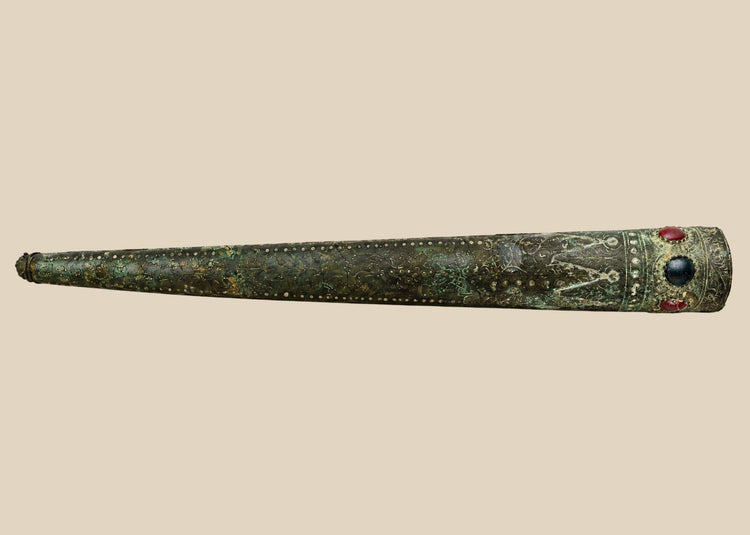
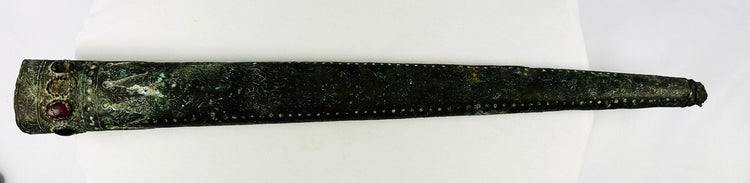
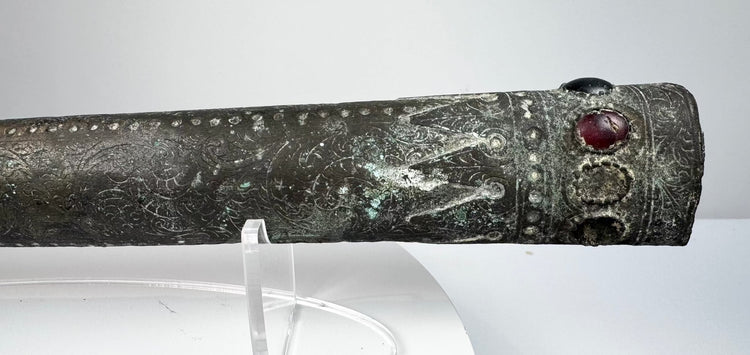
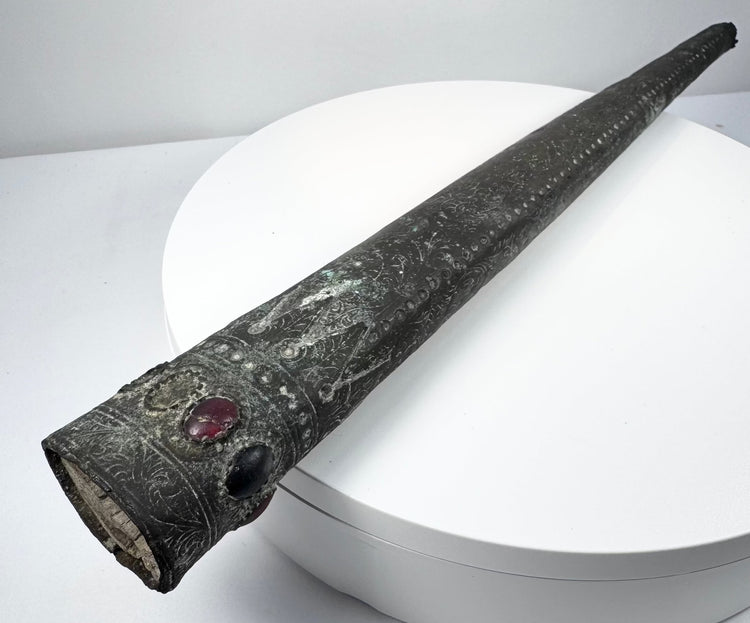
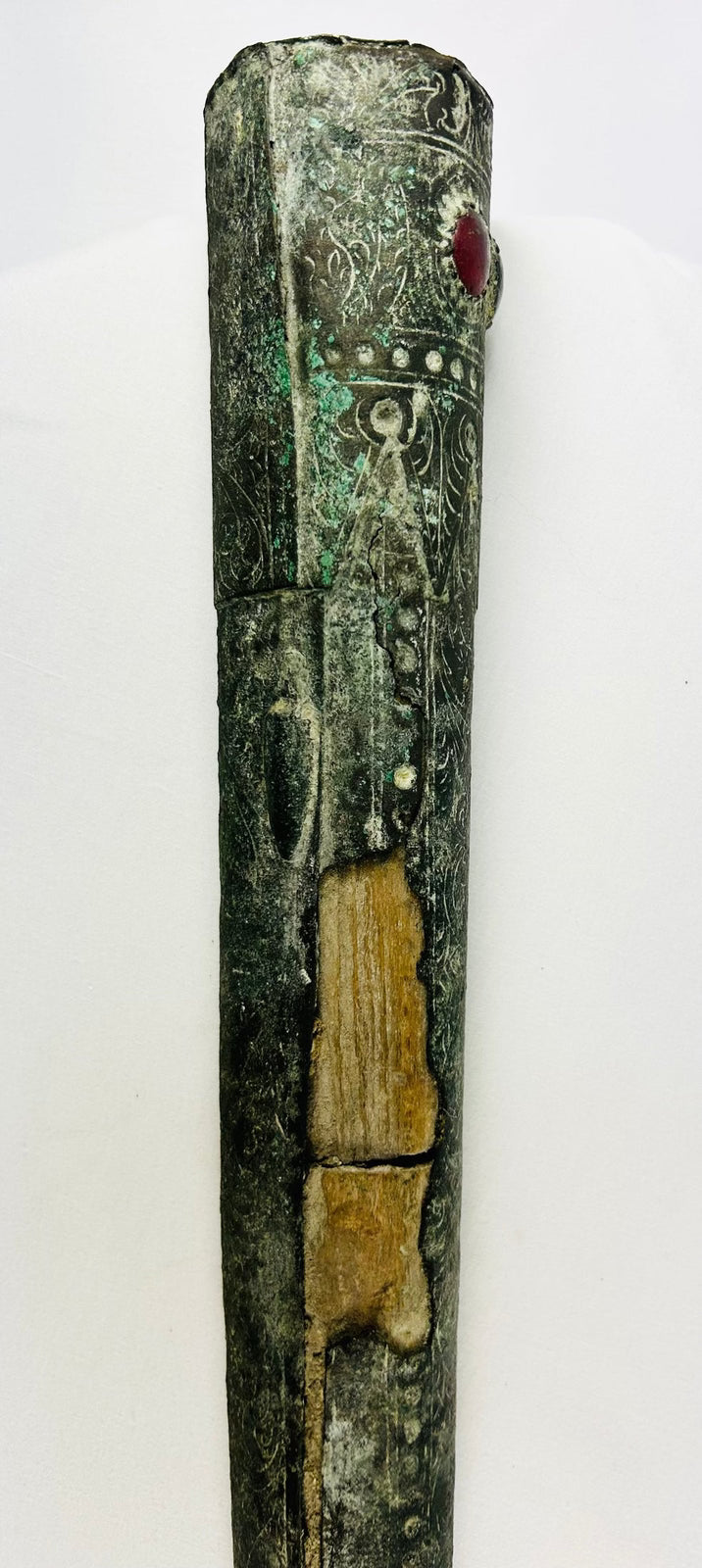
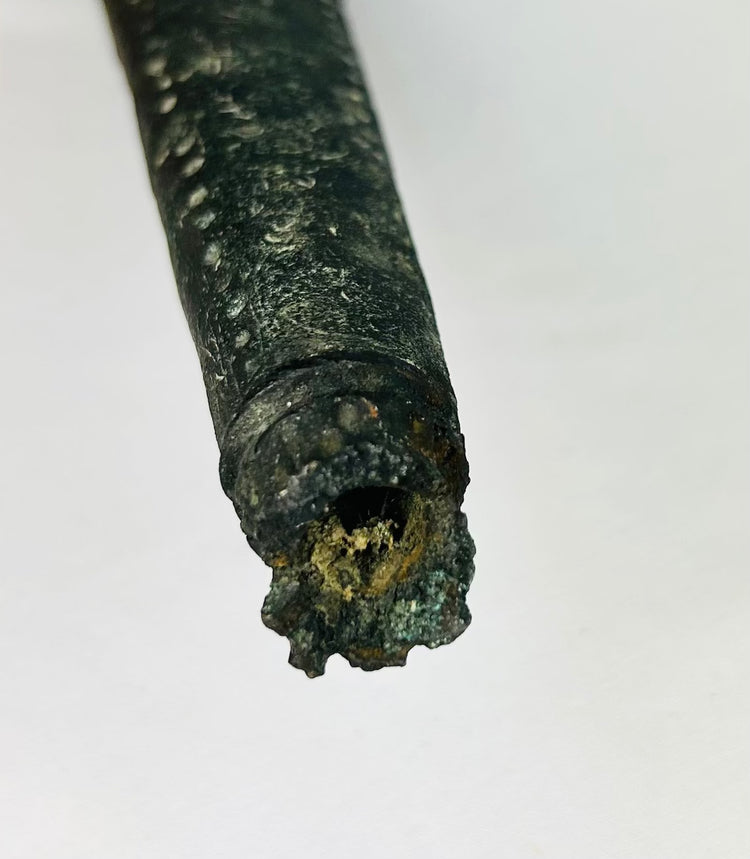
This finely decorated Islamic bronze sheath was made to accommodate a dagger or long knife together with a second, smaller blade. Narrow and conical in profile, the sheath terminates in a small knob and is constructed from a thin sheet of bronze wrapped around an internal wooden liner.
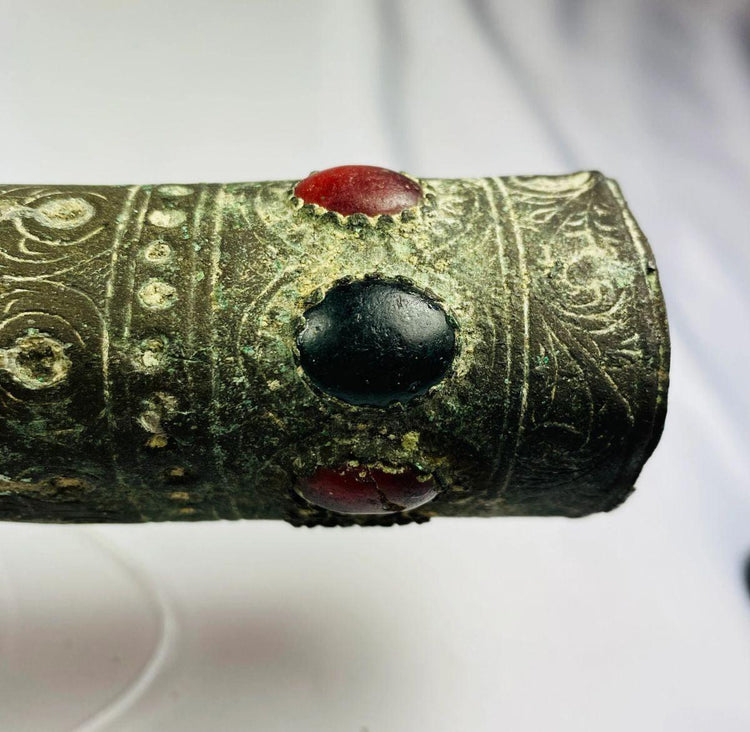
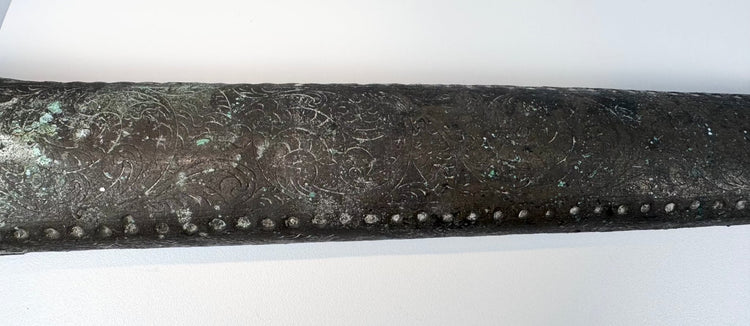
The bronze exterior is richly decorated with engraved arabesque scrollwork, while the mouth is emphasized by a band of foliate ornament and a lobed decorative panel. Three cabochon stones remain set within raised collars—two red and one dark blue—providing a striking contrast to the aged bronze surface. Rows of punched dots follow the edges of the sheath.
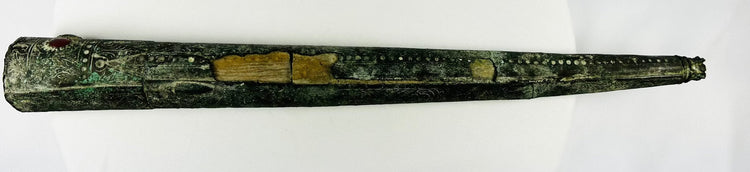
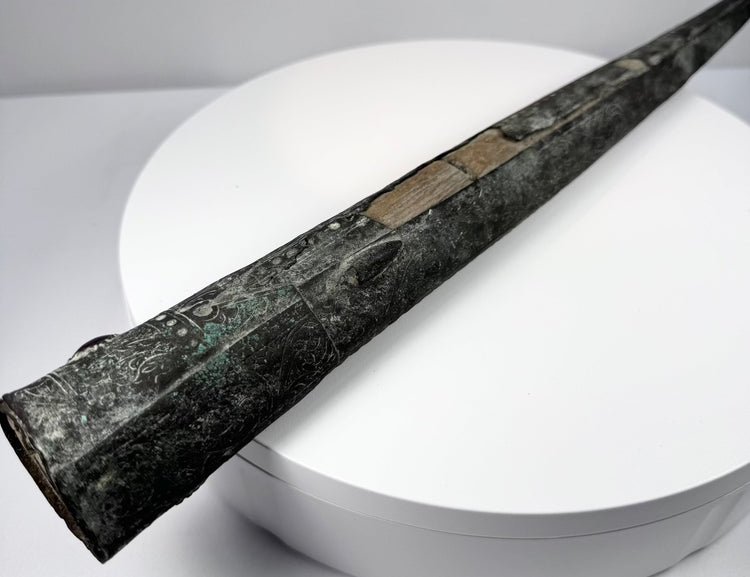
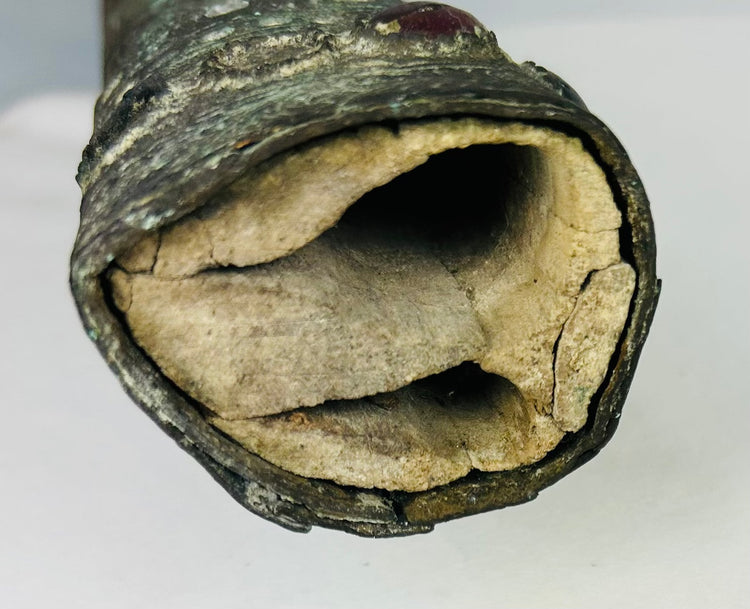
Of particular interest is the surviving wooden interior. The liner is hollowed into two separate cavities divided by a thin wooden wall, indicating that the sheath was designed to carry two blades: a primary dagger and a second, smaller knife.
Features
- Medieval to post-medieval Islamic workmanship
- Narrow conical form terminating in a small knob
- Engraved arabesque scroll decoration
- Foliate ornament and lobed panel at the mouth
- Three surviving cabochon stones: two red and one dark blue
- Decorative punched-dot borders
- Thin bronze body wrapped around an original wooden liner
- Double internal cavity designed for a dagger and secondary knife
- Green archaeological patina with mineral and soil deposits
Cultural Significance
The decoration belongs to the established repertoire of Islamic arms and armour, particularly dagger sheaths embellished with arabesque scrolls, foliate bands, lobed panels, and inset cabochon stones.
The specialist attributes the sheath to Islamic workmanship on the basis of these decorative and constructional features. Because these motifs remained in use over an extended period, the ornament alone does not allow for a precise date, and the piece is therefore conservatively classified as medieval to post-medieval Islamic.
Condition
Ancient to antique condition with a developed green patina, mineral and soil deposits, and age-related surface wear. The three cabochon stones remain in place. The exposed wooden liner is dry and cracked, with the two original internal blade cavities still visible. The yellowish material visible within some of the punched decoration is identified as surface encrustation rather than applied pigment or inlay.
Dimensions (Approximate)
Length: 18 in
Age (Approximate)
400–1,000 years old
Provenance
Formerly part of a private collection in Toronto, Ontario, Canada, assembled by a dedicated collector of historical arms and armour. The piece remained in the collection for approximately 40 years and was subsequently offered by Kelso & Company Auctioneers, Guelph, Ontario, in its Antiques and Rarities auction of December 13, 2023, as Lot 514.
The piece was later examined by Luca Salvaggio, an Italian archaeologist and specialist in Ancient Mediterranean material. He holds a Postgraduate Diploma from the Italian Archaeological School at Athens (IASA) and is accredited for preventive archaeology by the Italian Ministry of Culture (MiC). Salvaggio attributed the sheath to Islamic workmanship, dating broadly from the medieval to post-medieval period, based on its engraved arabesque decoration, foliate and lobed motifs, cabochon stones, and distinctive double-cavity wooden liner designed to accommodate two blades. His signed specialist report accompanies the piece and is included with the purchase.
Learn More
Study early Mediterranean weaponry at the British Museum Collection
Browse our Collection of Ancient Swords and Historic Weaponry
Description
Historical Context & Origin
Region: Islamic World
Material: Bronze over a wooden liner, with three cabochon stones
Period: Islamic Period, Medieval to Post-Medieval
Description
This finely decorated Islamic bronze sheath was made to accommodate a dagger or long knife together with a second, smaller blade. Narrow and conical in profile, the sheath terminates in a small knob and is constructed from a thin sheet of bronze wrapped around an internal wooden liner.
The bronze exterior is richly decorated with engraved arabesque scrollwork, while the mouth is emphasized by a band of foliate ornament and a lobed decorative panel. Three cabochon stones remain set within raised collars—two red and one dark blue—providing a striking contrast to the aged bronze surface. Rows of punched dots follow the edges of the sheath.
Of particular interest is the surviving wooden interior. The liner is hollowed into two separate cavities divided by a thin wooden wall, indicating that the sheath was designed to carry two blades: a primary dagger and a second, smaller knife.
Features
- Medieval to post-medieval Islamic workmanship
- Narrow conical form terminating in a small knob
- Engraved arabesque scroll decoration
- Foliate ornament and lobed panel at the mouth
- Three surviving cabochon stones: two red and one dark blue
- Decorative punched-dot borders
- Thin bronze body wrapped around an original wooden liner
- Double internal cavity designed for a dagger and secondary knife
- Green archaeological patina with mineral and soil deposits
Cultural Significance
The decoration belongs to the established repertoire of Islamic arms and armour, particularly dagger sheaths embellished with arabesque scrolls, foliate bands, lobed panels, and inset cabochon stones.
The specialist attributes the sheath to Islamic workmanship on the basis of these decorative and constructional features. Because these motifs remained in use over an extended period, the ornament alone does not allow for a precise date, and the piece is therefore conservatively classified as medieval to post-medieval Islamic.
Condition
Ancient to antique condition with a developed green patina, mineral and soil deposits, and age-related surface wear. The three cabochon stones remain in place. The exposed wooden liner is dry and cracked, with the two original internal blade cavities still visible. The yellowish material visible within some of the punched decoration is identified as surface encrustation rather than applied pigment or inlay.
Dimensions (Approximate)
Length: 18 in
Age (Approximate)
400–1,000 years old
Provenance
Formerly part of a private collection in Toronto, Ontario, Canada, assembled by a dedicated collector of historical arms and armour. The piece remained in the collection for approximately 40 years and was subsequently offered by Kelso & Company Auctioneers, Guelph, Ontario, in its Antiques and Rarities auction of December 13, 2023, as Lot 514.
The piece was later examined by Luca Salvaggio, an Italian archaeologist and specialist in Ancient Mediterranean material. He holds a Postgraduate Diploma from the Italian Archaeological School at Athens (IASA) and is accredited for preventive archaeology by the Italian Ministry of Culture (MiC). Salvaggio attributed the sheath to Islamic workmanship, dating broadly from the medieval to post-medieval period, based on its engraved arabesque decoration, foliate and lobed motifs, cabochon stones, and distinctive double-cavity wooden liner designed to accommodate two blades. His signed specialist report accompanies the piece and is included with the purchase.
Learn More
Study early Mediterranean weaponry at the British Museum Collection
Browse our Collection of Ancient Swords and Historic Weaponry
You May Also Like
