



Japanese Carved Wood Standing Amida Nyorai Buddha with Inscription | Circa 1800 - 1880
Couldn't load pickup availability


Japanese Carved Wood Standing Amida Nyorai Buddha with Inscription | Circa 1800 - 1880
Description
More
Less
Historical Context & Origin
Region: Japan, likely a provincial temple or household-shrine workshop
Material: Hand-carved wood with lacquer, gilding or gold pigment, and polychrome decoration
Period: Late Edo to Early Meiji Period, Circa 1800–1880
Description
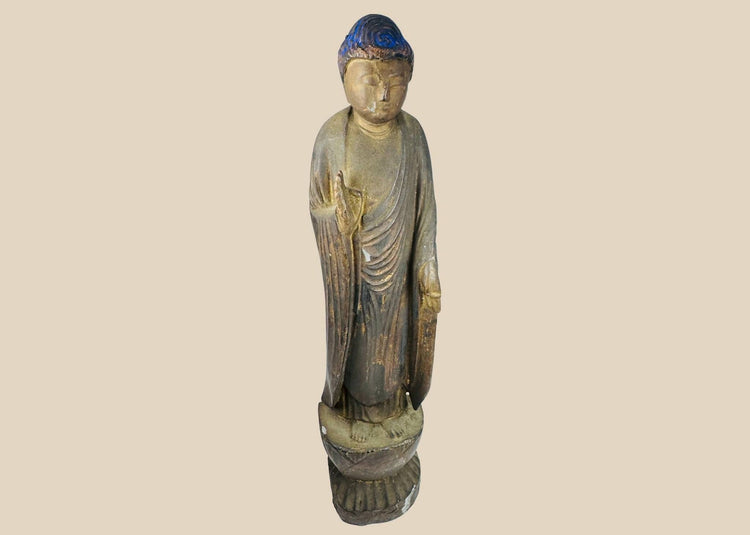
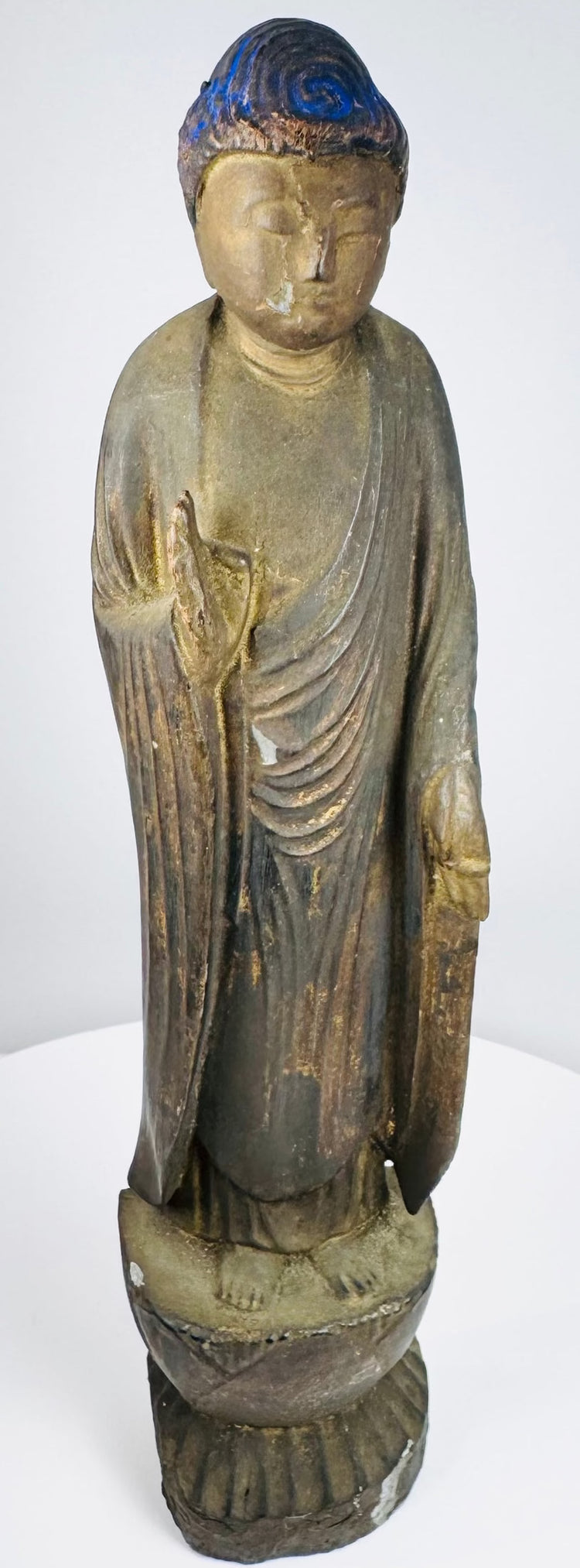
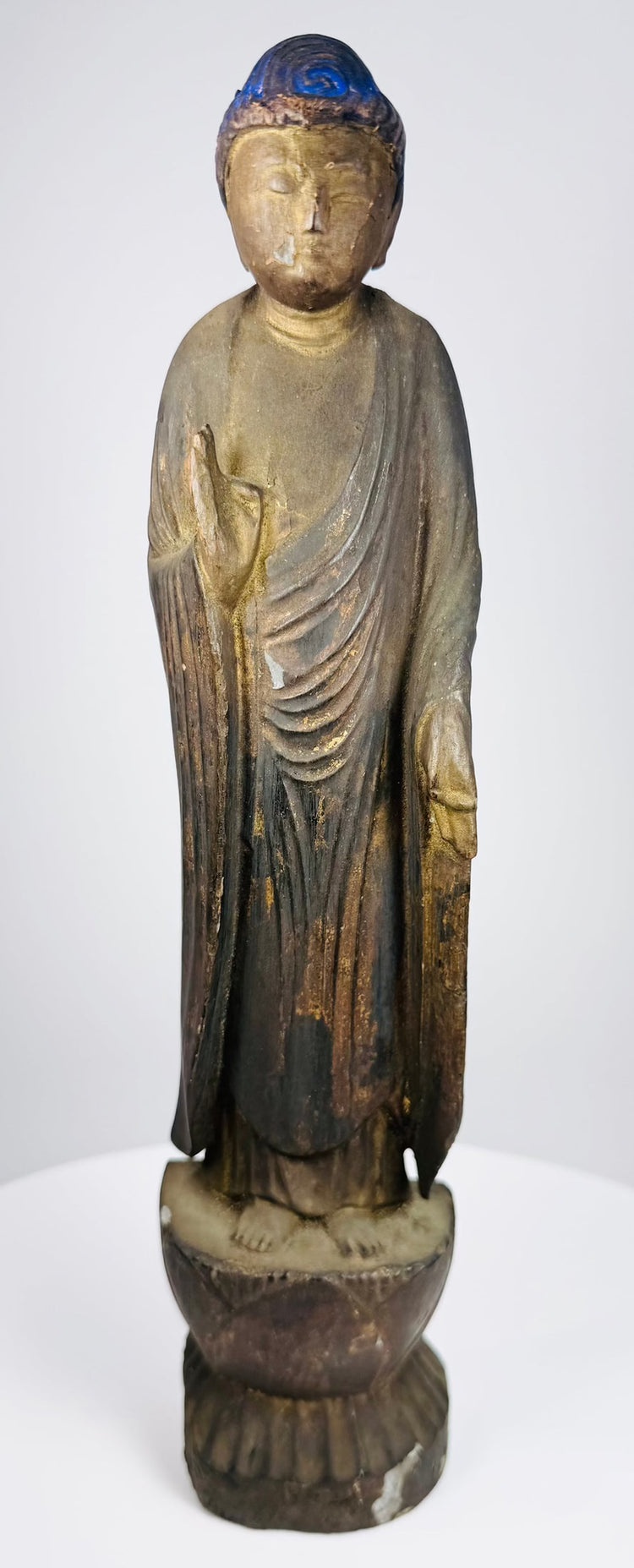
This antique Japanese devotional sculpture depicts Amida Nyorai, known in Sanskrit as Amitabha, the Buddha of Infinite Light and the central Buddha of Pure Land Buddhism. Most likely dating from the late Edo to early Meiji period, the figure would originally have been displayed within a Buddhist temple, domestic altar, or portable shrine.
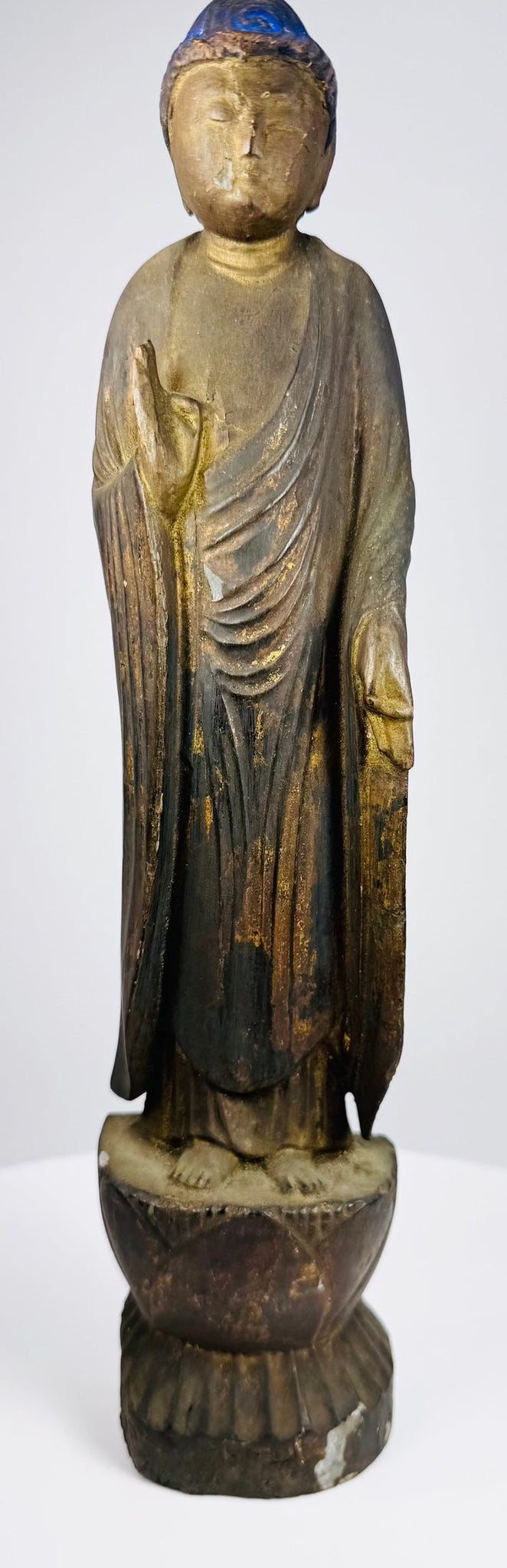
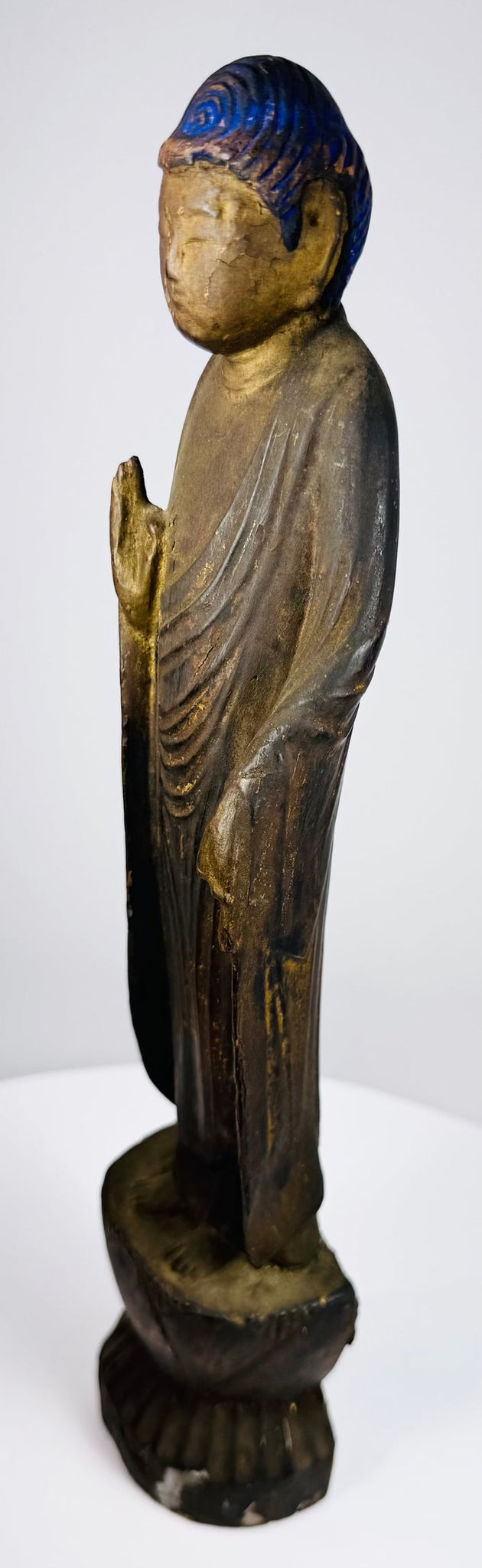
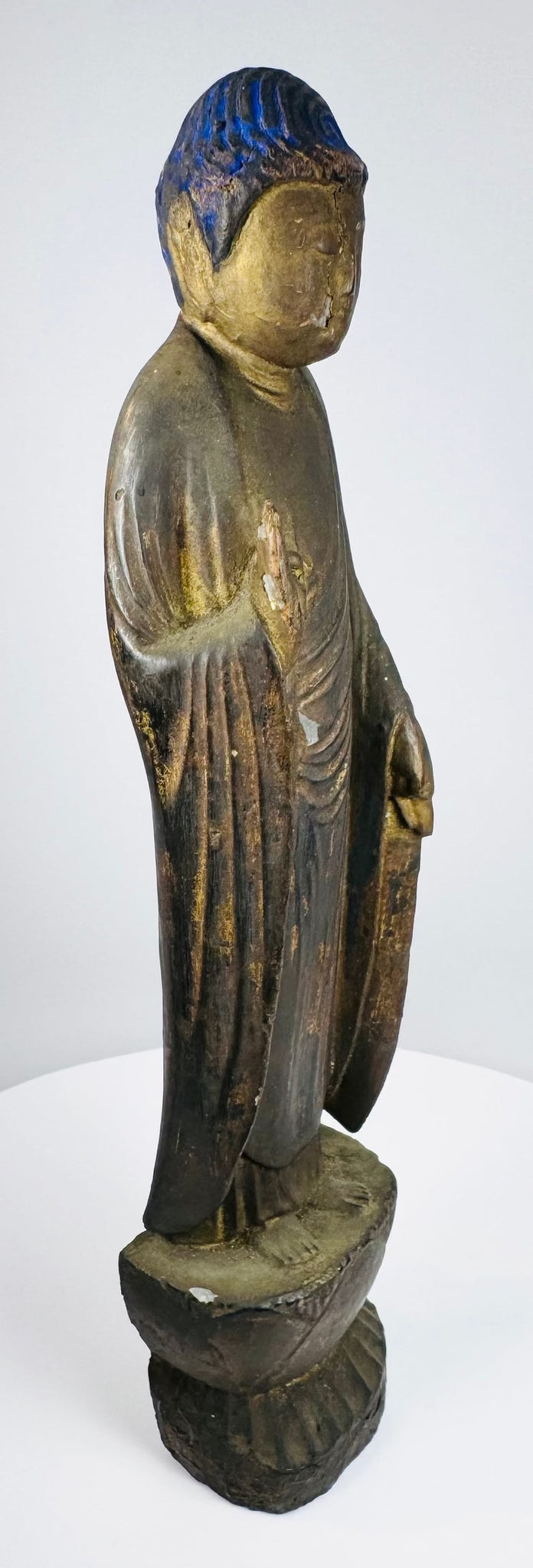
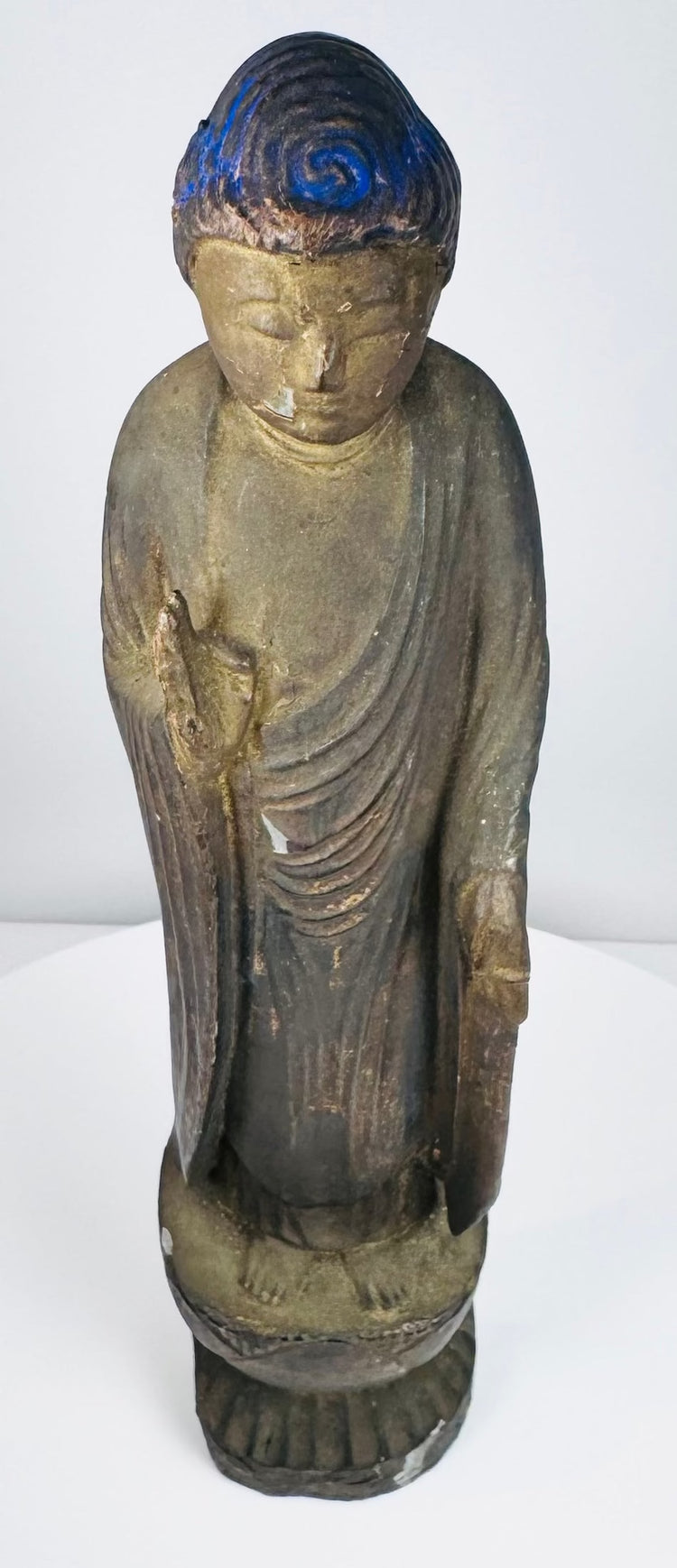
Amida stands upright upon a tiered double-lotus pedestal, dressed in flowing monastic robes that descend in long vertical folds. Gracefully layered folds cross the chest and continue down the front of the body, creating a sense of movement within the otherwise restrained composition.
The right hand is raised while the left is lowered, forming the traditional raigō-in, or welcoming gesture. Although several fingers of the raised hand are now incomplete, the surviving configuration remains characteristic of Japanese standing representations of Amida. In this form, the Buddha is understood to descend from the Western Paradise to receive the souls of faithful devotees and guide them toward rebirth in the Pure Land.
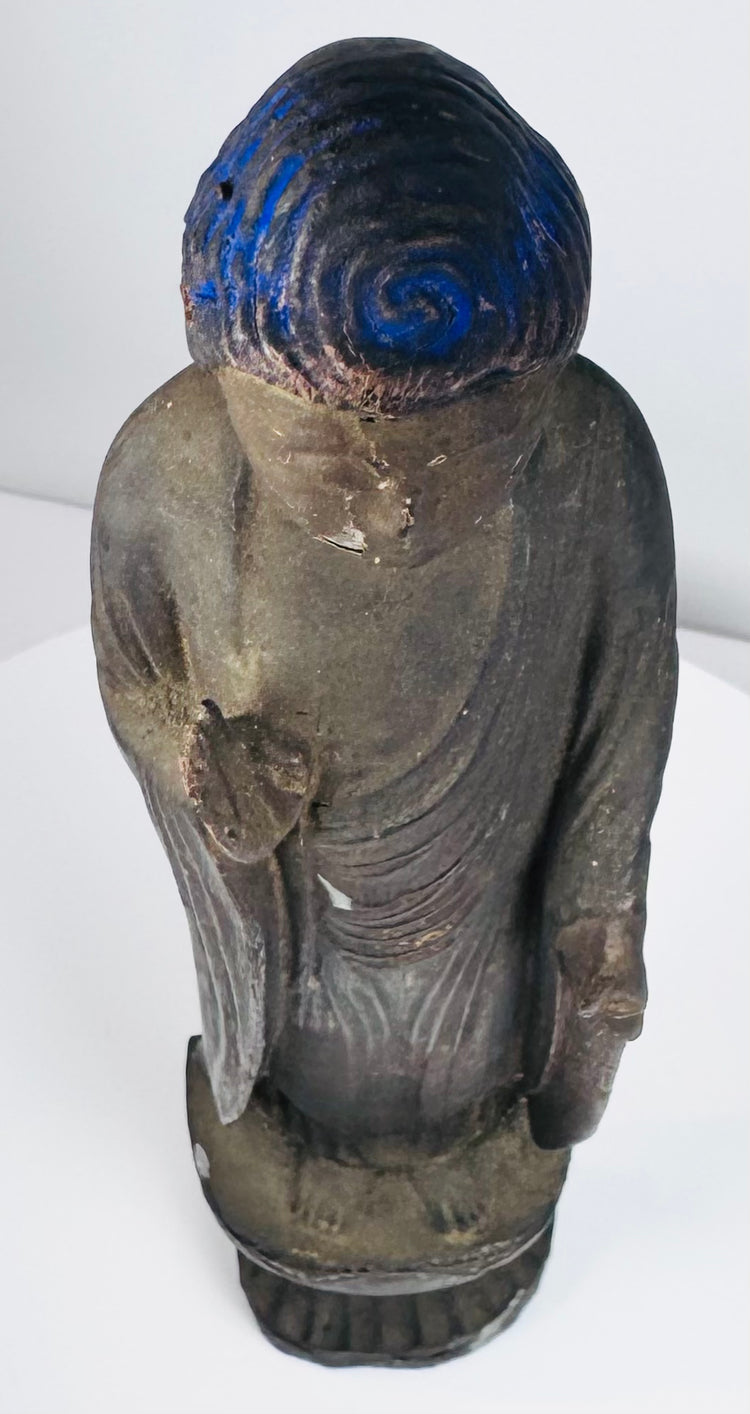
The figure has a rounded, contemplative face with downcast eyes, a long straight nose, gently closed lips, and elongated earlobes. Remnants of gold-colored decoration survive across the face, neck, hands, and garments. The hair is distinguished by surviving deep-blue pigment applied over the stylized curls and rounded ushnisha.
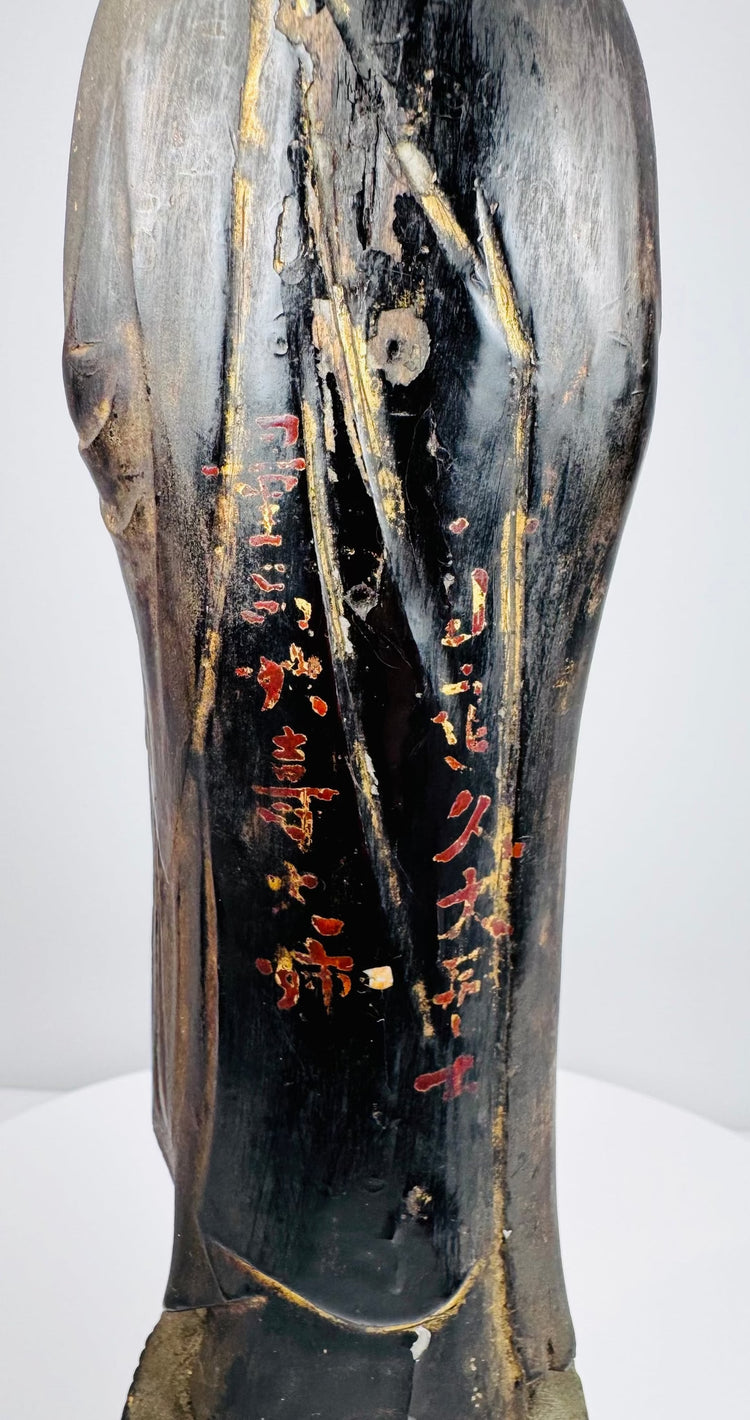
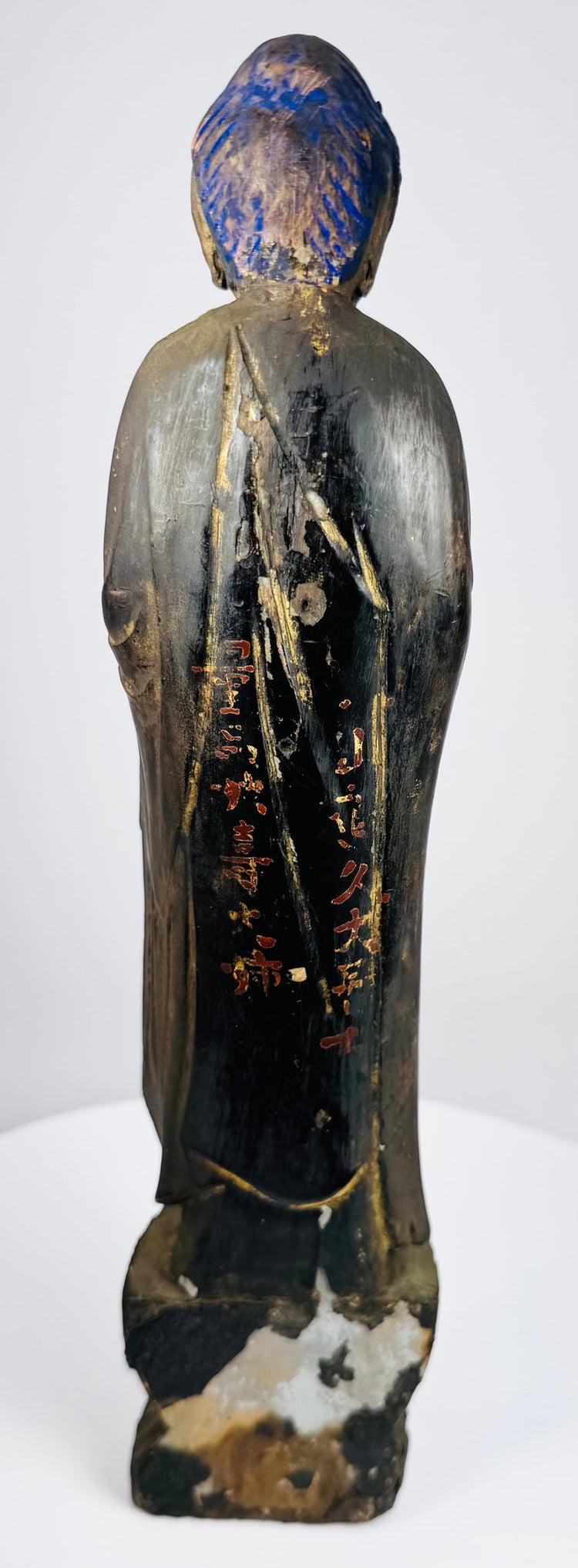
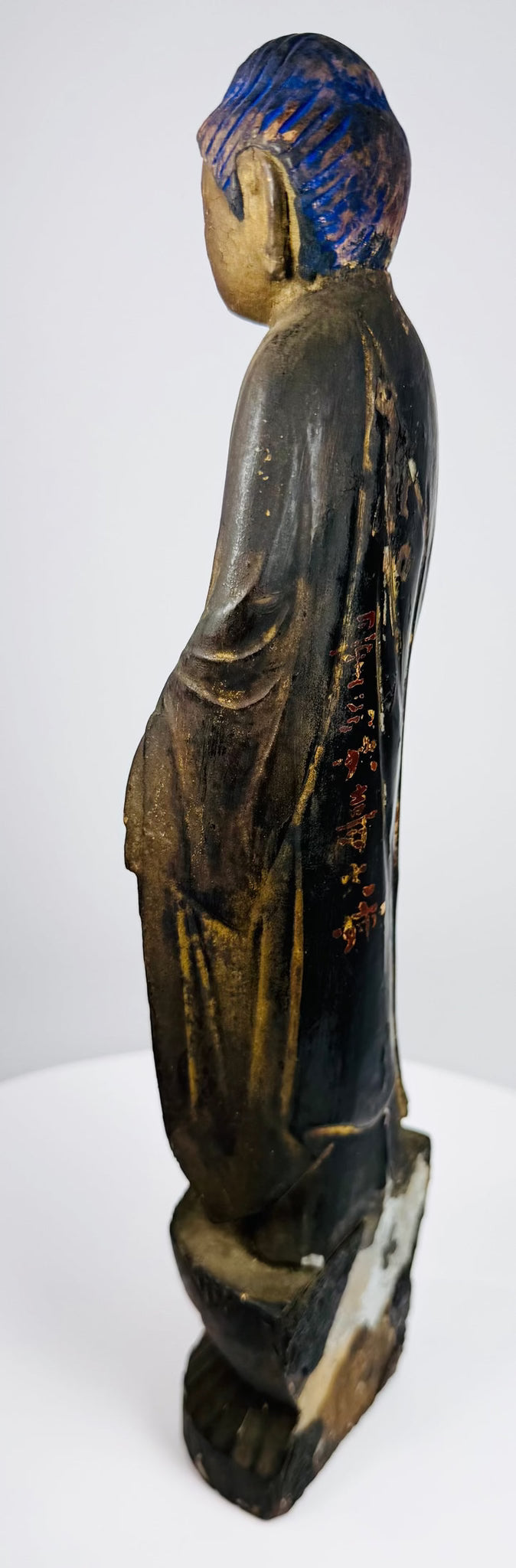
The reverse retains areas of dark lacquer together with two vertical lines of worn red-and-gold Japanese characters. The inscription may represent a Buddhist invocation, dedication, ownership inscription, or record of devotional use. Because of substantial surface loss, it cannot presently be translated with confidence.
Several holes and attachment points on the reverse suggest that the sculpture may originally have been accompanied by a separately constructed mandorla or halo, or secured within a larger shrine arrangement. Its compact proportions would have made it suitable for personal devotion as well as temple display.
Features
- Standing posture associated with the welcoming descent of Amida
- Raised and lowered hands forming the traditional raigō-in gesture
- Tiered double-lotus pedestal carved integrally with the figure
- Long monastic robes with deeply carved cascading folds
- Serene face with downcast eyes and elongated earlobes
- Surviving blue pigment across the stylized hair
- Remnants of gilding or gold-colored decoration
- Dark-lacquered reverse with red-and-gold devotional inscription
- Rear attachment points indicating a possible former halo or shrine fitting
- Naturally aged surface with extensive devotional wear and patina
Cultural Significance
Amida Nyorai is one of the most widely revered figures in Japanese Buddhism. According to Pure Land teachings, Amida presides over the Western Paradise, a realm in which beings may be reborn and progress toward enlightenment without the suffering and distractions of the earthly world.
Standing images of Amida became especially important in Japan because they visualized the concept of raigō, or Amida’s welcoming descent. At the moment of a faithful devotee’s death, Amida was believed to descend from the Pure Land, often accompanied by attendant bodhisattvas, to guide the soul toward paradise.
The recitation of the nembutsu—Namu Amida Butsu, meaning devotion or homage to Amida Buddha—became central to Japanese Pure Land practice. Small wooden figures such as this allowed Amida’s compassionate presence to be represented within domestic altars, portable shrines, and intimate devotional settings.
Condition
Fair to good antique condition with substantial wear consistent with age and devotional use. Extensive rubbing, fading, lacquer loss, pigment loss, abrasions, scratches, and surface deposits are present throughout.
Several fingers of the raised right hand are incomplete. Additional small chips, losses, age-related cracks, old holes, and areas of exposed wood are visible. The reverse exhibits splitting, surface losses, and areas of exposed pale ground or old fill, particularly around the lower body and base. The original mandorla or halo, if once present, is no longer retained.
Dimensions (Approximate)
Height: 12 in
Width: 2.5 in
Depth: 1.7 in
Age (Approximate)
145–225 years old
Provenance
From a private collection in Toronto, Ontario, Canada, assembled with a particular focus on Chinese and broader Asian sculpture and traditional decorative arts.
Subsequently sold through Waddington’s Auctioneers & Appraisers, Toronto, Ontario, Canada. Established in 1850, Waddington’s describes itself as Canada’s original auction house and has long maintained specialist departments devoted to Asian and international art.
Learn More
Discover the history of the Japanese Amida Buddha and the welcoming descent through the National Gallery of Victoria
Explore our Collection of Buddhist & Hindu Relics and Sacred Statues
Description
Historical Context & Origin
Region: Japan, likely a provincial temple or household-shrine workshop
Material: Hand-carved wood with lacquer, gilding or gold pigment, and polychrome decoration
Period: Late Edo to Early Meiji Period, Circa 1800–1880
Description
This antique Japanese devotional sculpture depicts Amida Nyorai, known in Sanskrit as Amitabha, the Buddha of Infinite Light and the central Buddha of Pure Land Buddhism. Most likely dating from the late Edo to early Meiji period, the figure would originally have been displayed within a Buddhist temple, domestic altar, or portable shrine.
Amida stands upright upon a tiered double-lotus pedestal, dressed in flowing monastic robes that descend in long vertical folds. Gracefully layered folds cross the chest and continue down the front of the body, creating a sense of movement within the otherwise restrained composition.
The right hand is raised while the left is lowered, forming the traditional raigō-in, or welcoming gesture. Although several fingers of the raised hand are now incomplete, the surviving configuration remains characteristic of Japanese standing representations of Amida. In this form, the Buddha is understood to descend from the Western Paradise to receive the souls of faithful devotees and guide them toward rebirth in the Pure Land.
The figure has a rounded, contemplative face with downcast eyes, a long straight nose, gently closed lips, and elongated earlobes. Remnants of gold-colored decoration survive across the face, neck, hands, and garments. The hair is distinguished by surviving deep-blue pigment applied over the stylized curls and rounded ushnisha.
The reverse retains areas of dark lacquer together with two vertical lines of worn red-and-gold Japanese characters. The inscription may represent a Buddhist invocation, dedication, ownership inscription, or record of devotional use. Because of substantial surface loss, it cannot presently be translated with confidence.
Several holes and attachment points on the reverse suggest that the sculpture may originally have been accompanied by a separately constructed mandorla or halo, or secured within a larger shrine arrangement. Its compact proportions would have made it suitable for personal devotion as well as temple display.
Features
- Standing posture associated with the welcoming descent of Amida
- Raised and lowered hands forming the traditional raigō-in gesture
- Tiered double-lotus pedestal carved integrally with the figure
- Long monastic robes with deeply carved cascading folds
- Serene face with downcast eyes and elongated earlobes
- Surviving blue pigment across the stylized hair
- Remnants of gilding or gold-colored decoration
- Dark-lacquered reverse with red-and-gold devotional inscription
- Rear attachment points indicating a possible former halo or shrine fitting
- Naturally aged surface with extensive devotional wear and patina
Cultural Significance
Amida Nyorai is one of the most widely revered figures in Japanese Buddhism. According to Pure Land teachings, Amida presides over the Western Paradise, a realm in which beings may be reborn and progress toward enlightenment without the suffering and distractions of the earthly world.
Standing images of Amida became especially important in Japan because they visualized the concept of raigō, or Amida’s welcoming descent. At the moment of a faithful devotee’s death, Amida was believed to descend from the Pure Land, often accompanied by attendant bodhisattvas, to guide the soul toward paradise.
The recitation of the nembutsu—Namu Amida Butsu, meaning devotion or homage to Amida Buddha—became central to Japanese Pure Land practice. Small wooden figures such as this allowed Amida’s compassionate presence to be represented within domestic altars, portable shrines, and intimate devotional settings.
Condition
Fair to good antique condition with substantial wear consistent with age and devotional use. Extensive rubbing, fading, lacquer loss, pigment loss, abrasions, scratches, and surface deposits are present throughout.
Several fingers of the raised right hand are incomplete. Additional small chips, losses, age-related cracks, old holes, and areas of exposed wood are visible. The reverse exhibits splitting, surface losses, and areas of exposed pale ground or old fill, particularly around the lower body and base. The original mandorla or halo, if once present, is no longer retained.
Dimensions (Approximate)
Height: 12 in
Width: 2.5 in
Depth: 1.7 in
Age (Approximate)
145–225 years old
Provenance
From a private collection in Toronto, Ontario, Canada, assembled with a particular focus on Chinese and broader Asian sculpture and traditional decorative arts.
Subsequently sold through Waddington’s Auctioneers & Appraisers, Toronto, Ontario, Canada. Established in 1850, Waddington’s describes itself as Canada’s original auction house and has long maintained specialist departments devoted to Asian and international art.
Learn More
Discover the history of the Japanese Amida Buddha and the welcoming descent through the National Gallery of Victoria
Explore our Collection of Buddhist & Hindu Relics and Sacred Statues
You May Also Like
