


Antique Japanese Kogatana Blade with Four Sleepers Kozuka Handle | Circa 1800 – 1900
Couldn't load pickup availability


Antique Japanese Kogatana Blade with Four Sleepers Kozuka Handle | Circa 1800 – 1900
Description
More
Less
Historical Context & Origin
Region: Japan
Material: Steel blade with patinated copper-alloy kozuka handle
Period: Late Edo–Early Meiji Period, Circa 1800–1900
Description
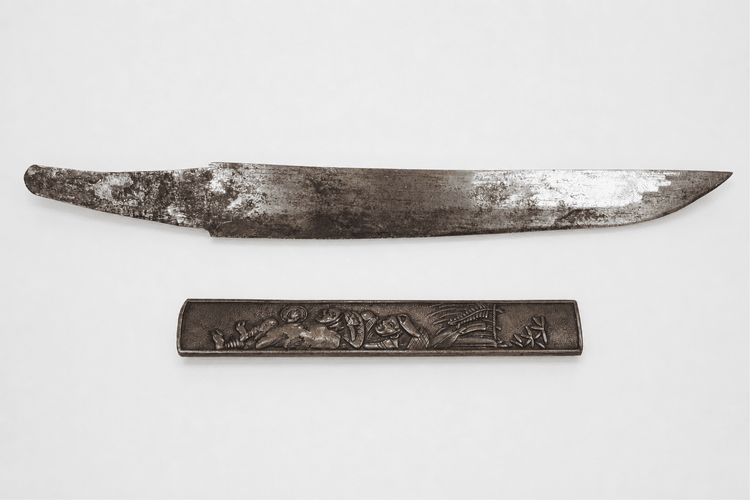
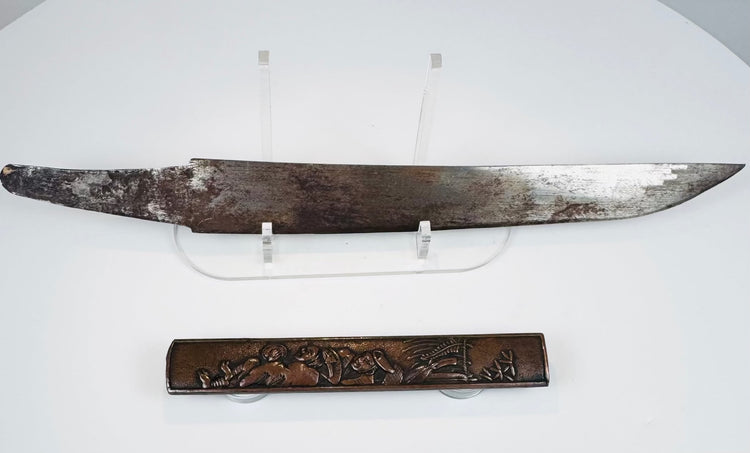
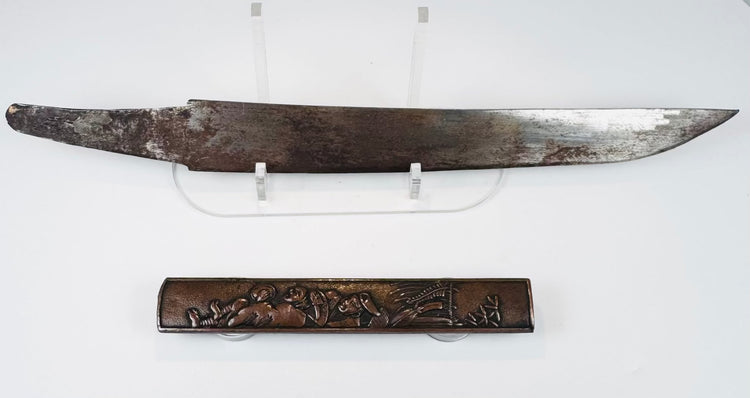
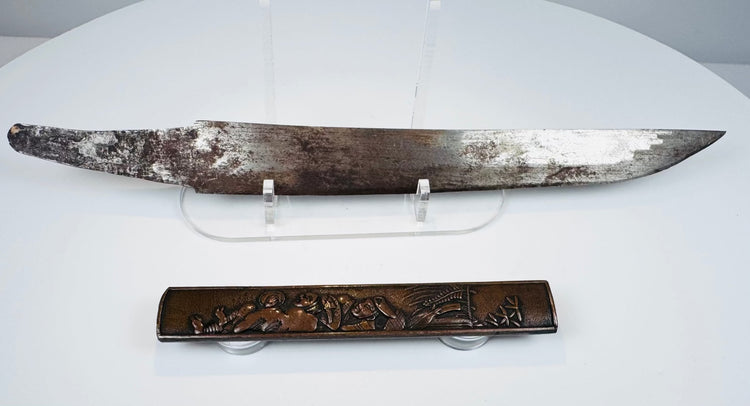
An antique Japanese kogatana utility knife blade accompanied by its decorated kozuka handle, a compact accessory traditionally incorporated into the mounting of a katana, wakizashi, or tanto. Although sometimes mistaken for a miniature tanto, this object is more accurately identified as a kogatana; the term kozuka refers specifically to its removable metal handle.
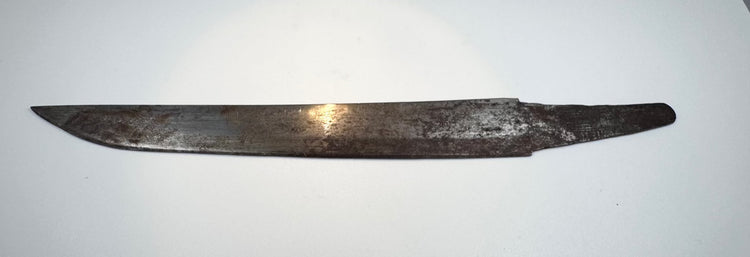
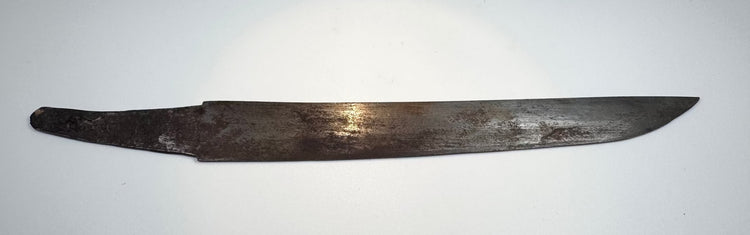
The single-edged steel blade has a gently curved cutting edge, pointed tip, plain surface, and elongated tang designed to slide inside the hollow kozuka. Its absence of the habaki, hand guard, and conventional wrapped handle associated with a tanto further supports its identification as a sword-mounted utility knife.
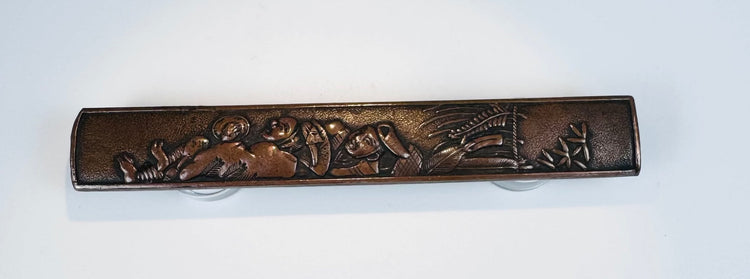
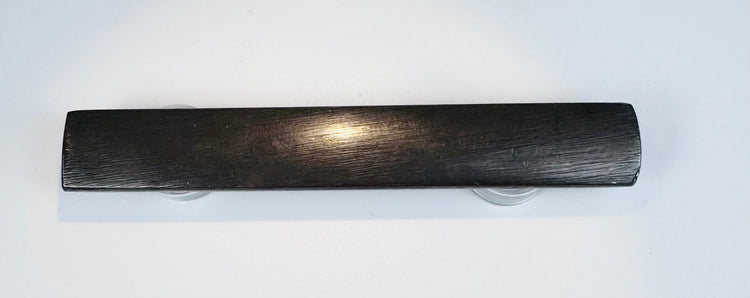
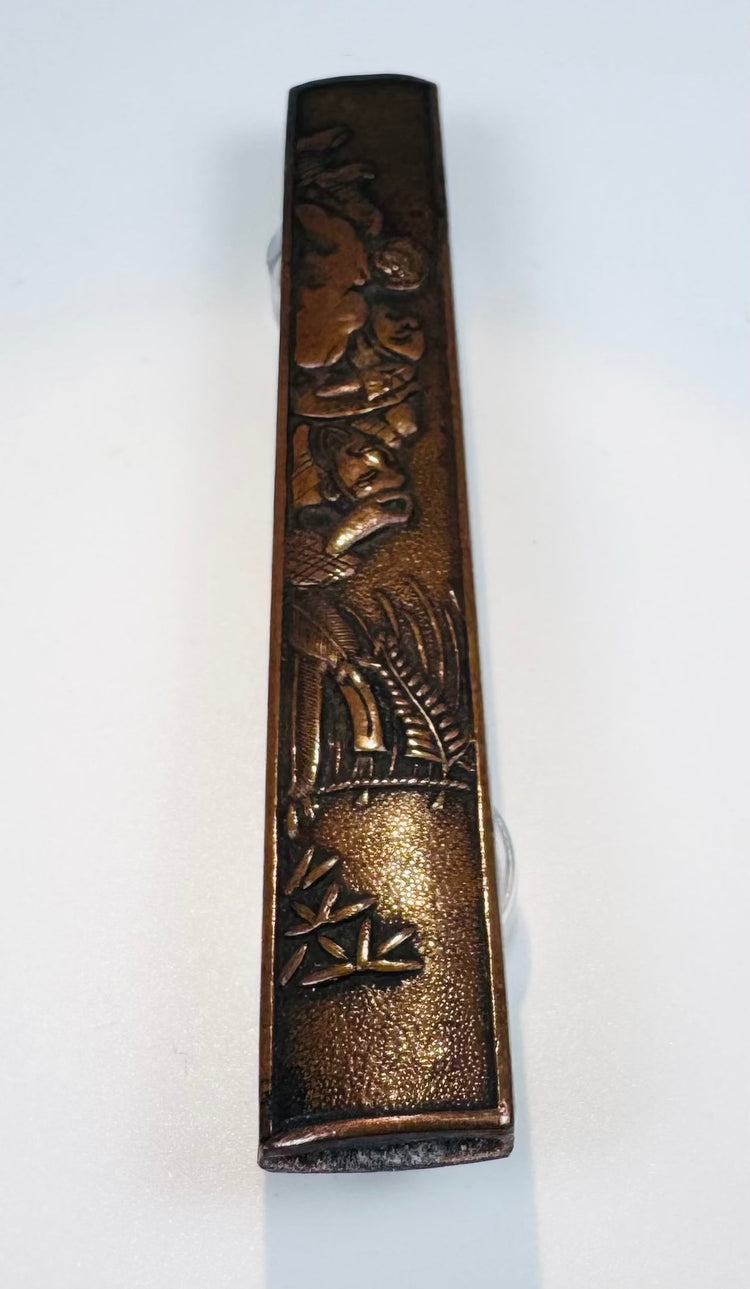
The slim rectangular kozuka is fashioned from a warm copper alloy with a dark patinated surface and raised figural decoration. The scene appears to depict the Four Sleepers, or Shisui: the Zen monk Bukan reclining with his tiger alongside the legendary eccentrics Kanzan and Jittoku. The figures are surrounded by delicately worked bamboo and landscape details.
Features
- Traditional Japanese kogatana utility blade
- Separate patinated copper-alloy kozuka handle
- Single-edged steel blade with elongated mounting tang
- Raised figural and landscape decoration
- Likely Four Sleepers Zen Buddhist subject
- Traditional proportions associated with Japanese sword furniture
Cultural Significance
The kogatana was a small utility knife traditionally carried in a purpose-made pocket along the scabbard of a Japanese sword. It could be used for ordinary cutting tasks and was frequently accompanied by a kōgai, or slender grooming implement.
While the blade was primarily functional, the kozuka offered Japanese metalworkers a narrow surface for highly detailed miniature artwork. Subjects drawn from mythology, literature, nature, and Zen Buddhism transformed these practical sword accessories into individual works of decorative art.
Condition
Fair antique condition with extensive oxidation, surface rust, pitting, staining, scratches, and wear throughout the steel blade. The kozuka retains an attractive dark patina with surface rubbing, small marks, and wear to the raised details. No maker’s signature is visible on the photographed surfaces. The blade and handle are presented separately.
Dimensions (Approximate)
Blade
Length: 8 in
Width: 0.8 in
Kozuka Handle
Length: 3.75 in
Width: 0.5 in
Age (Approximate)
126–226 years old
Provenance
From a private collection in Toronto, Ontario, Canada, assembled with a particular focus on Chinese and broader Asian sculpture and traditional decorative arts.
Subsequently sold through Waddington’s Auctioneers & Appraisers, Toronto, Ontario, Canada. Established in 1850, Waddington’s describes itself as Canada’s original auction house and has long maintained specialist departments devoted to Asian and international art.
Learn More
Learn more about Japanese kozuka handles and kogatana blades through The Metropolitan Museum of Art
Explore our Collection of Arms, Armour & Historical Weaponry
Description
Historical Context & Origin
Region: Japan
Material: Steel blade with patinated copper-alloy kozuka handle
Period: Late Edo–Early Meiji Period, Circa 1800–1900
Description
An antique Japanese kogatana utility knife blade accompanied by its decorated kozuka handle, a compact accessory traditionally incorporated into the mounting of a katana, wakizashi, or tanto. Although sometimes mistaken for a miniature tanto, this object is more accurately identified as a kogatana; the term kozuka refers specifically to its removable metal handle.
The single-edged steel blade has a gently curved cutting edge, pointed tip, plain surface, and elongated tang designed to slide inside the hollow kozuka. Its absence of the habaki, hand guard, and conventional wrapped handle associated with a tanto further supports its identification as a sword-mounted utility knife.
The slim rectangular kozuka is fashioned from a warm copper alloy with a dark patinated surface and raised figural decoration. The scene appears to depict the Four Sleepers, or Shisui: the Zen monk Bukan reclining with his tiger alongside the legendary eccentrics Kanzan and Jittoku. The figures are surrounded by delicately worked bamboo and landscape details.
Features
- Traditional Japanese kogatana utility blade
- Separate patinated copper-alloy kozuka handle
- Single-edged steel blade with elongated mounting tang
- Raised figural and landscape decoration
- Likely Four Sleepers Zen Buddhist subject
- Traditional proportions associated with Japanese sword furniture
Cultural Significance
The kogatana was a small utility knife traditionally carried in a purpose-made pocket along the scabbard of a Japanese sword. It could be used for ordinary cutting tasks and was frequently accompanied by a kōgai, or slender grooming implement.
While the blade was primarily functional, the kozuka offered Japanese metalworkers a narrow surface for highly detailed miniature artwork. Subjects drawn from mythology, literature, nature, and Zen Buddhism transformed these practical sword accessories into individual works of decorative art.
Condition
Fair antique condition with extensive oxidation, surface rust, pitting, staining, scratches, and wear throughout the steel blade. The kozuka retains an attractive dark patina with surface rubbing, small marks, and wear to the raised details. No maker’s signature is visible on the photographed surfaces. The blade and handle are presented separately.
Dimensions (Approximate)
Blade
Length: 8 in
Width: 0.8 in
Kozuka Handle
Length: 3.75 in
Width: 0.5 in
Age (Approximate)
126–226 years old
Provenance
From a private collection in Toronto, Ontario, Canada, assembled with a particular focus on Chinese and broader Asian sculpture and traditional decorative arts.
Subsequently sold through Waddington’s Auctioneers & Appraisers, Toronto, Ontario, Canada. Established in 1850, Waddington’s describes itself as Canada’s original auction house and has long maintained specialist departments devoted to Asian and international art.
Learn More
Learn more about Japanese kozuka handles and kogatana blades through The Metropolitan Museum of Art
Explore our Collection of Arms, Armour & Historical Weaponry
You May Also Like
