

Japanese Meiji Carved Bone Samurai Handle or Sword Fitting | Circa 1870–1910
Couldn't load pickup availability


Japanese Meiji Carved Bone Samurai Handle or Sword Fitting | Circa 1870–1910
Description
More
Less
Historical Context & Origin
Region: Japan
Material: Carved and engraved bone with darkened incised decoration
Period: Meiji Period, circa 1870–1910
Description
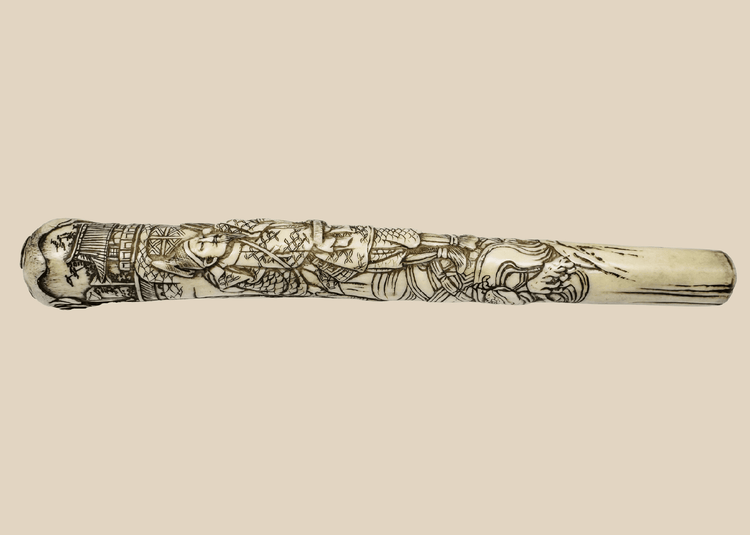
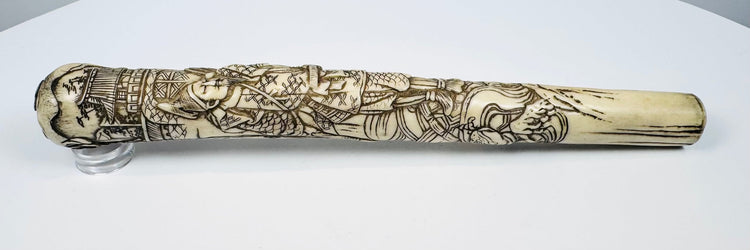
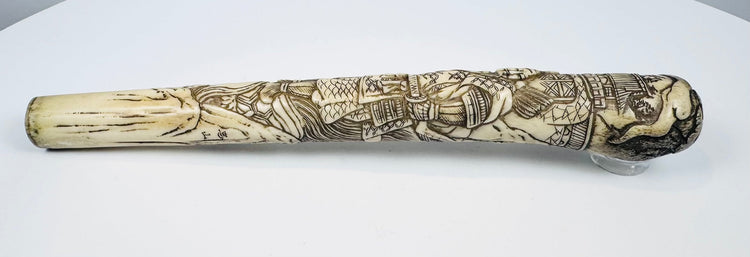
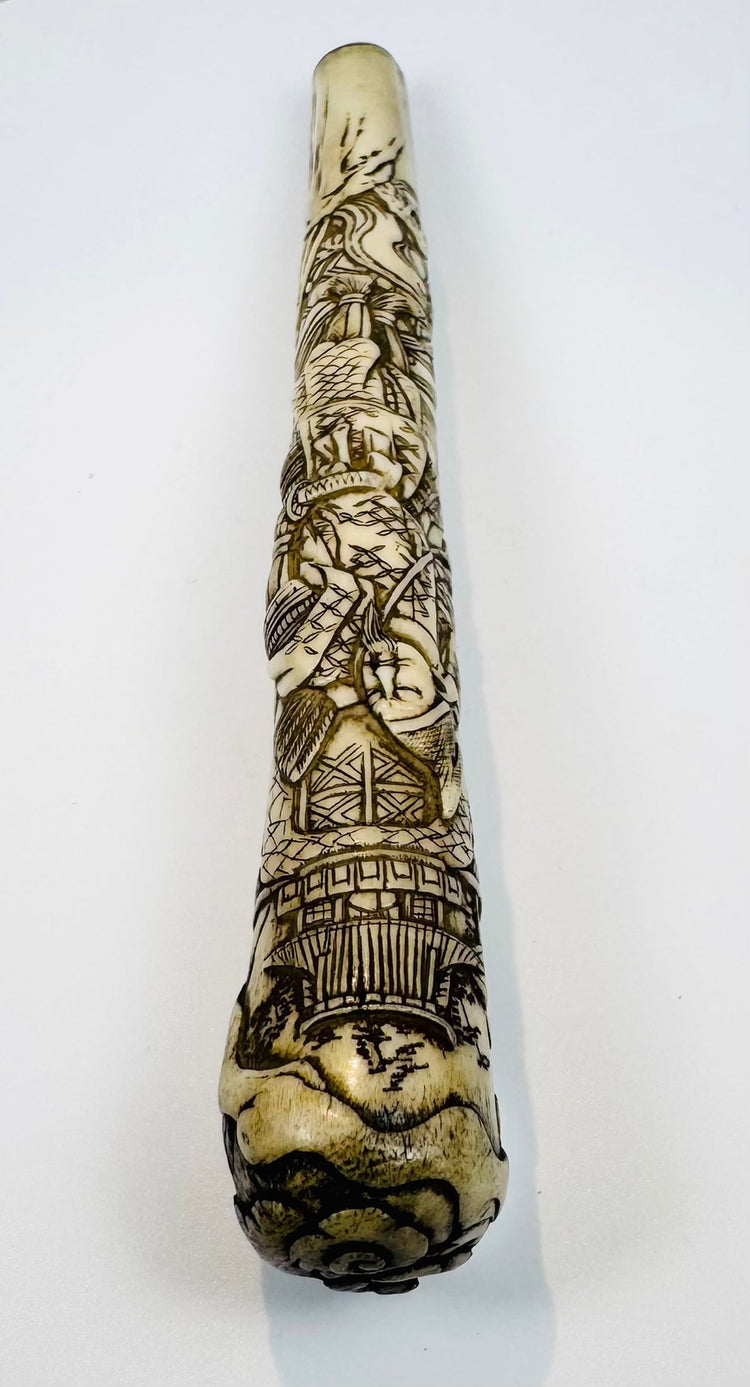
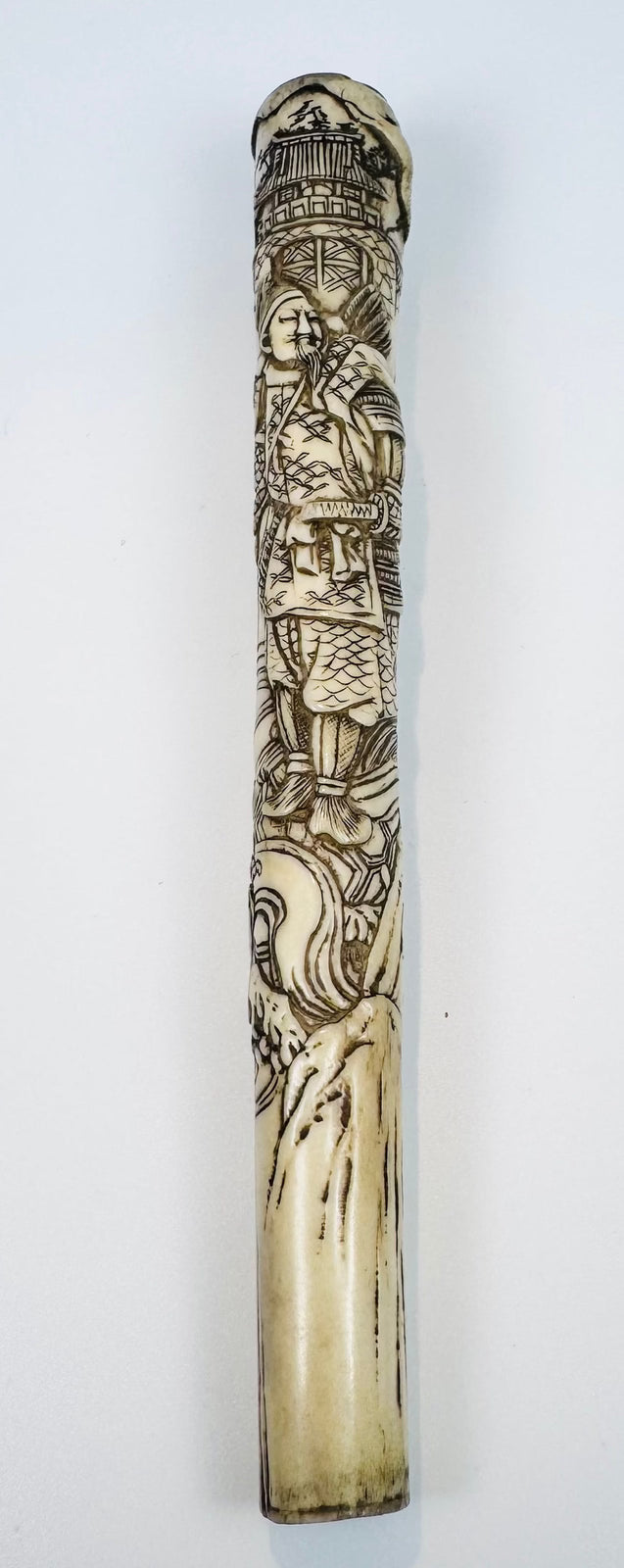
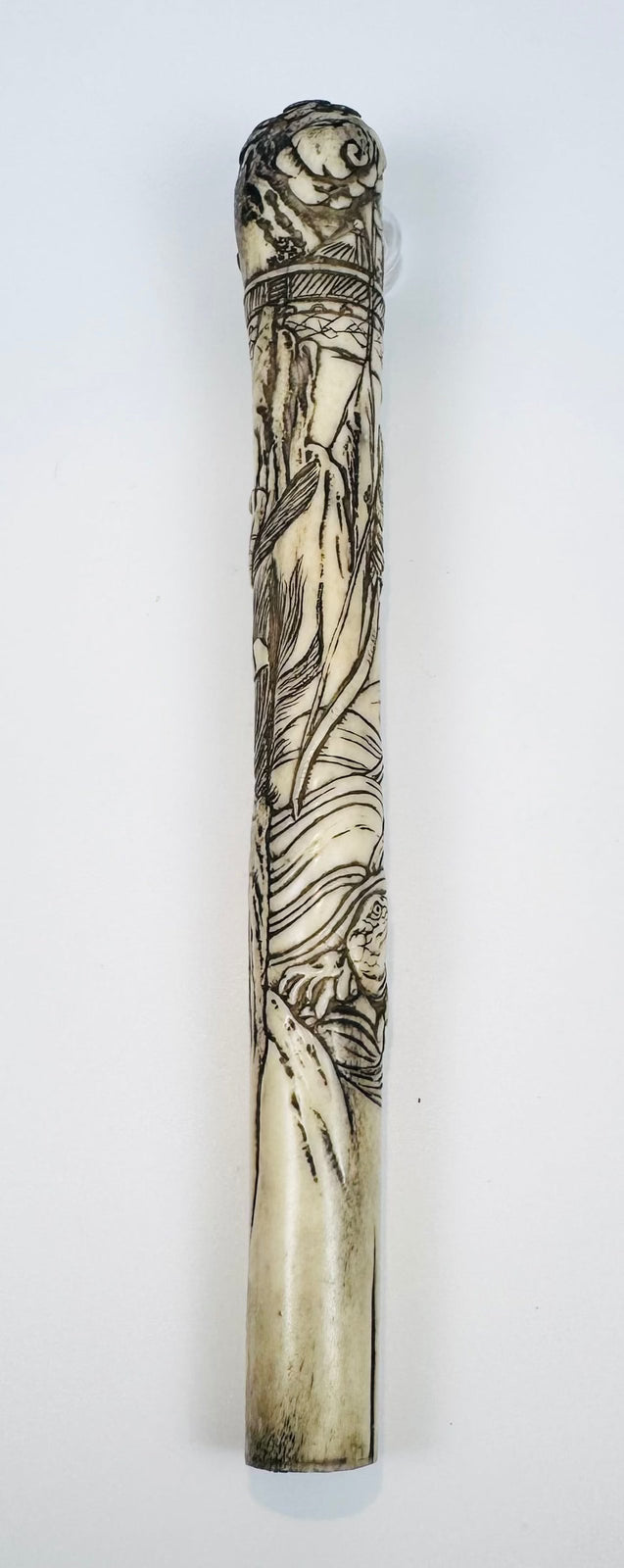
This finely carved Japanese bone handle or fitting is decorated with an elaborate continuous narrative scene featuring a samurai warrior surrounded by architectural and landscape elements. Dating most plausibly to the Meiji period, the piece reflects the extraordinary detail achieved by Japanese craftsmen working in bone and related materials during the late 19th and early 20th centuries.
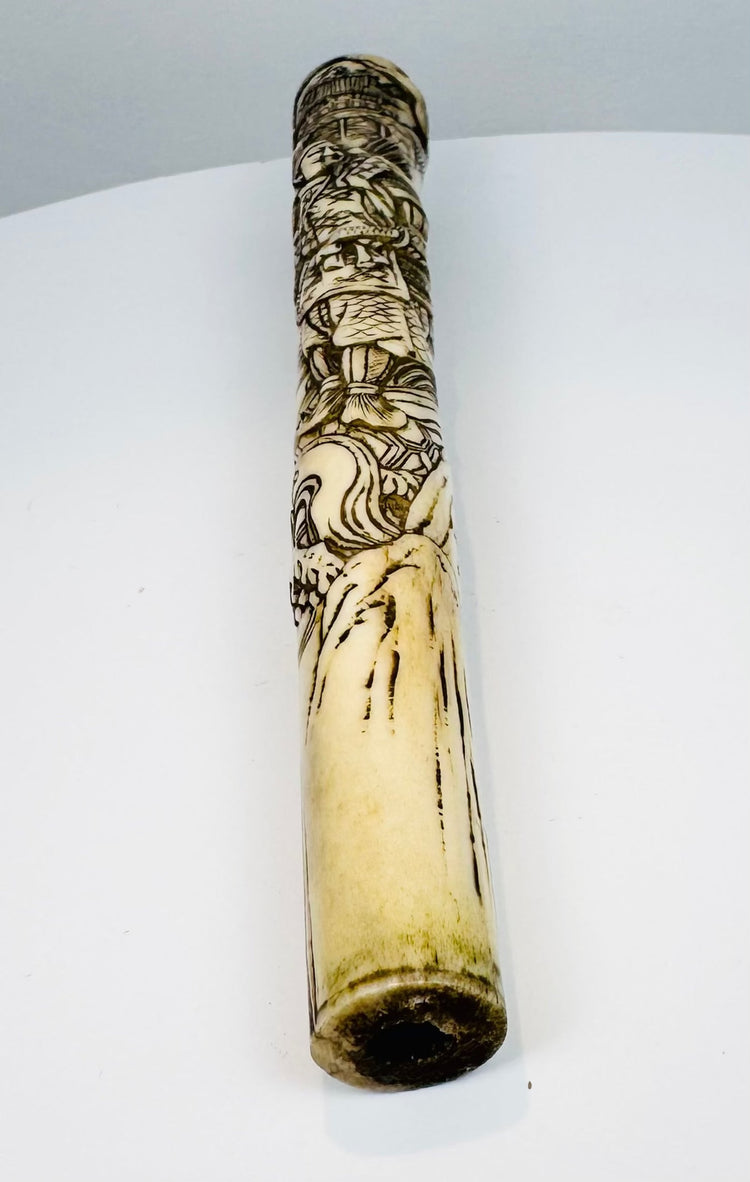
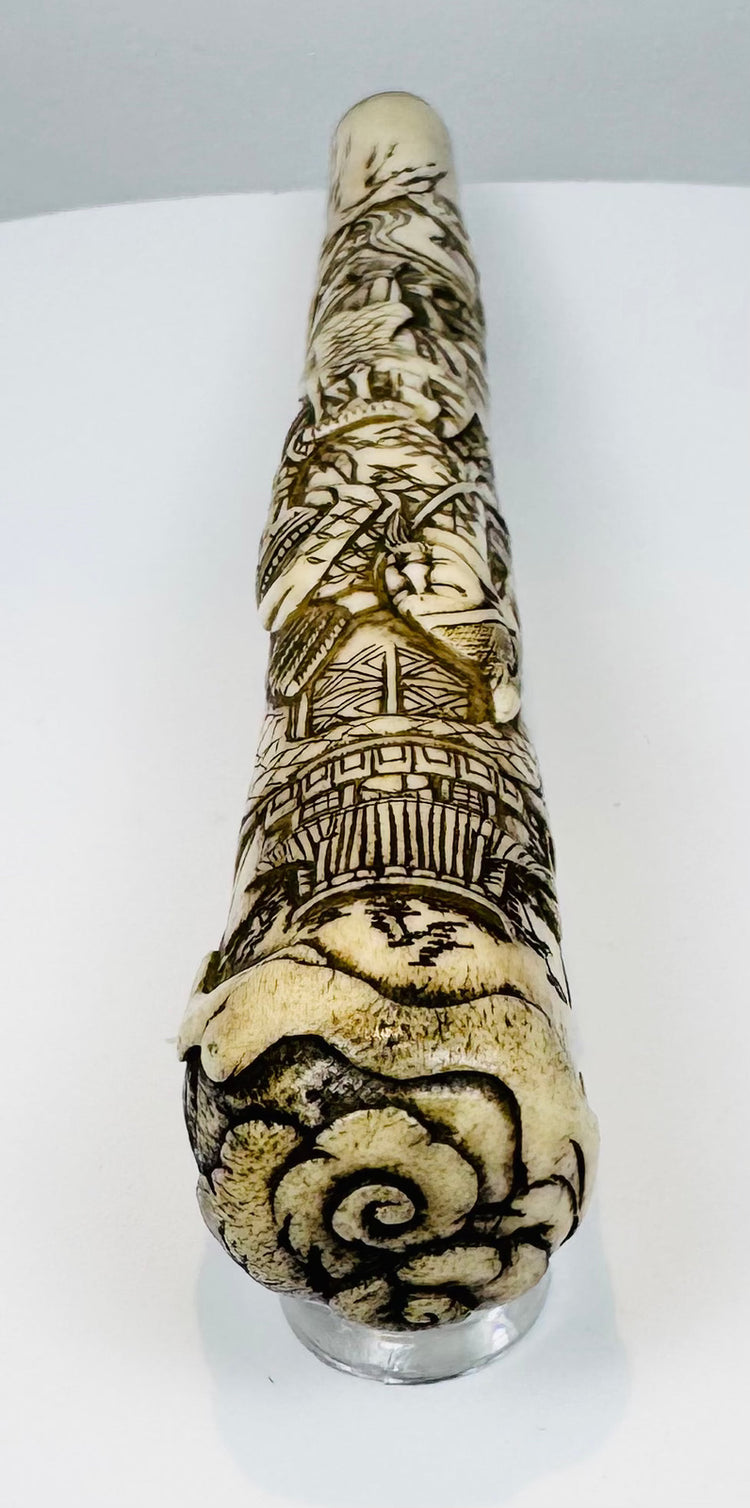
The principal figure is shown wearing layered traditional clothing and armour, with a sword positioned at the waist. Surrounding imagery includes stylized architecture, vegetation, rockwork, swirling forms and additional figural details that wrap around the cylindrical surface. The design combines shallow relief carving with finely incised lines, many of which have been darkened to enhance the contrast and make the imagery particularly legible.
The lower portion gradually transitions into a comparatively undecorated section terminating in an open socket, indicating that the piece was originally fitted over a separate element. Its precise original function remains uncertain. It may have served as the handle of a parasol, umbrella or slender walking stick; however, closely comparable Meiji-period bone-mounted tanto and wakizashi incorporate similarly carved cylindrical grips, meaning that a detached sword or dagger hilt cannot be excluded.
Features
- Prominent samurai warrior in traditional dress and armour
- Sword visible at the warrior's waist
- Continuous figural and landscape composition
- Architectural elements incorporated into the carving
- Fine engraved and incised surface detailing
- Darkened lines creating strong visual contrast
- Cylindrical, gently tapering form
- Open socket at one end for attachment to a separate element
- Possibly made for a parasol, umbrella, walking stick or decorative sword fitting
- Attractive naturally aged cream and amber coloration
Cultural Significance
During the Meiji period, Japanese decorative arts were produced at an exceptionally high technical level for both domestic use and the rapidly expanding international market. Carved bone and ivory objects—including parasol handles, cane fittings, small sculptures and decorative bone-mounted tanto and wakizashi—frequently incorporated warriors, historical figures, animals and elaborate landscape scenes.
Surviving Meiji-period parasol handles and decorative sword fittings demonstrate closely related elongated forms, narrative relief carving and darkened incised decoration. Because these techniques were employed across several types of objects, the precise original function of an isolated fitting can be difficult to determine without its original shaft, blade or accompanying components.
The samurai imagery seen here reflects the enduring cultural significance of Japan's warrior class during a period in which the country itself was undergoing dramatic political and social modernization. Such imagery remained highly recognizable and visually appealing even after the formal abolition of the samurai class.
Condition
Good antique condition with wear consistent with age and handling. The bone displays natural surface coloration, minor staining, small scratches and areas of darker patination within the carving. Some localized wear and minor age-related imperfections are present. The incised decoration remains exceptionally clear and visually striking. The original shaft, tang, blade or object to which the fitting was once attached is no longer present.
Dimensions (Approximate)
Length: 6.75 in
Diameter: 0.75 in
Age (Approximate)
116–156 years old
Provenance
Formerly held in a private collection in Richmond, Virginia, United States.
Subsequently handled by Quinn’s Auction Galleries, Falls Church, Virginia, an established auction house specializing in fine art, antiques, decorative arts, and significant estate and private collections.
Later acquired by a private collection in Toronto, Ontario, Canada.
Learn More
Discover a related Meiji-period Japanese carved handle in the collection of the Cleveland Museum of Art
Explore our Collection of Eastern Antiquities and Cultural Relics
Description
Historical Context & Origin
Region: Japan
Material: Carved and engraved bone with darkened incised decoration
Period: Meiji Period, circa 1870–1910
Description
This finely carved Japanese bone handle or fitting is decorated with an elaborate continuous narrative scene featuring a samurai warrior surrounded by architectural and landscape elements. Dating most plausibly to the Meiji period, the piece reflects the extraordinary detail achieved by Japanese craftsmen working in bone and related materials during the late 19th and early 20th centuries.
The principal figure is shown wearing layered traditional clothing and armour, with a sword positioned at the waist. Surrounding imagery includes stylized architecture, vegetation, rockwork, swirling forms and additional figural details that wrap around the cylindrical surface. The design combines shallow relief carving with finely incised lines, many of which have been darkened to enhance the contrast and make the imagery particularly legible.
The lower portion gradually transitions into a comparatively undecorated section terminating in an open socket, indicating that the piece was originally fitted over a separate element. Its precise original function remains uncertain. It may have served as the handle of a parasol, umbrella or slender walking stick; however, closely comparable Meiji-period bone-mounted tanto and wakizashi incorporate similarly carved cylindrical grips, meaning that a detached sword or dagger hilt cannot be excluded.
Features
- Prominent samurai warrior in traditional dress and armour
- Sword visible at the warrior's waist
- Continuous figural and landscape composition
- Architectural elements incorporated into the carving
- Fine engraved and incised surface detailing
- Darkened lines creating strong visual contrast
- Cylindrical, gently tapering form
- Open socket at one end for attachment to a separate element
- Possibly made for a parasol, umbrella, walking stick or decorative sword fitting
- Attractive naturally aged cream and amber coloration
Cultural Significance
During the Meiji period, Japanese decorative arts were produced at an exceptionally high technical level for both domestic use and the rapidly expanding international market. Carved bone and ivory objects—including parasol handles, cane fittings, small sculptures and decorative bone-mounted tanto and wakizashi—frequently incorporated warriors, historical figures, animals and elaborate landscape scenes.
Surviving Meiji-period parasol handles and decorative sword fittings demonstrate closely related elongated forms, narrative relief carving and darkened incised decoration. Because these techniques were employed across several types of objects, the precise original function of an isolated fitting can be difficult to determine without its original shaft, blade or accompanying components.
The samurai imagery seen here reflects the enduring cultural significance of Japan's warrior class during a period in which the country itself was undergoing dramatic political and social modernization. Such imagery remained highly recognizable and visually appealing even after the formal abolition of the samurai class.
Condition
Good antique condition with wear consistent with age and handling. The bone displays natural surface coloration, minor staining, small scratches and areas of darker patination within the carving. Some localized wear and minor age-related imperfections are present. The incised decoration remains exceptionally clear and visually striking. The original shaft, tang, blade or object to which the fitting was once attached is no longer present.
Dimensions (Approximate)
Length: 6.75 in
Diameter: 0.75 in
Age (Approximate)
116–156 years old
Provenance
Formerly held in a private collection in Richmond, Virginia, United States.
Subsequently handled by Quinn’s Auction Galleries, Falls Church, Virginia, an established auction house specializing in fine art, antiques, decorative arts, and significant estate and private collections.
Later acquired by a private collection in Toronto, Ontario, Canada.
Learn More
Discover a related Meiji-period Japanese carved handle in the collection of the Cleveland Museum of Art
Explore our Collection of Eastern Antiquities and Cultural Relics
You May Also Like
