

Konyak Naga Warrior Necklace with Brass Pendant, Teeth, & Trade Beads | Circa 1900
Couldn't load pickup availability


Konyak Naga Warrior Necklace with Brass Pendant, Teeth, & Trade Beads | Circa 1900
Description
More
Less
Historical Context & Origin
Region: Nagaland, Northeast India / Indo-Myanmar borderlands
Material: Brass, old glass trade beads, animal teeth (possibly tiger), and fibre cord
Period: Late 19th–Early 20th Century, circa 1900
Description
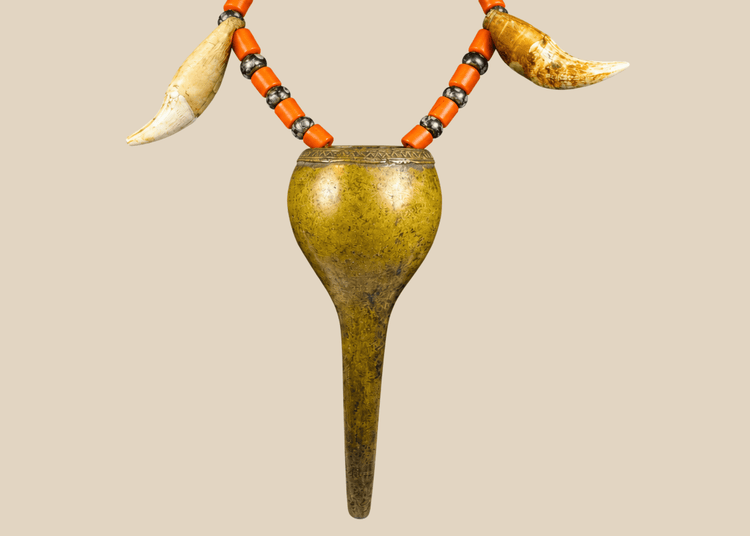
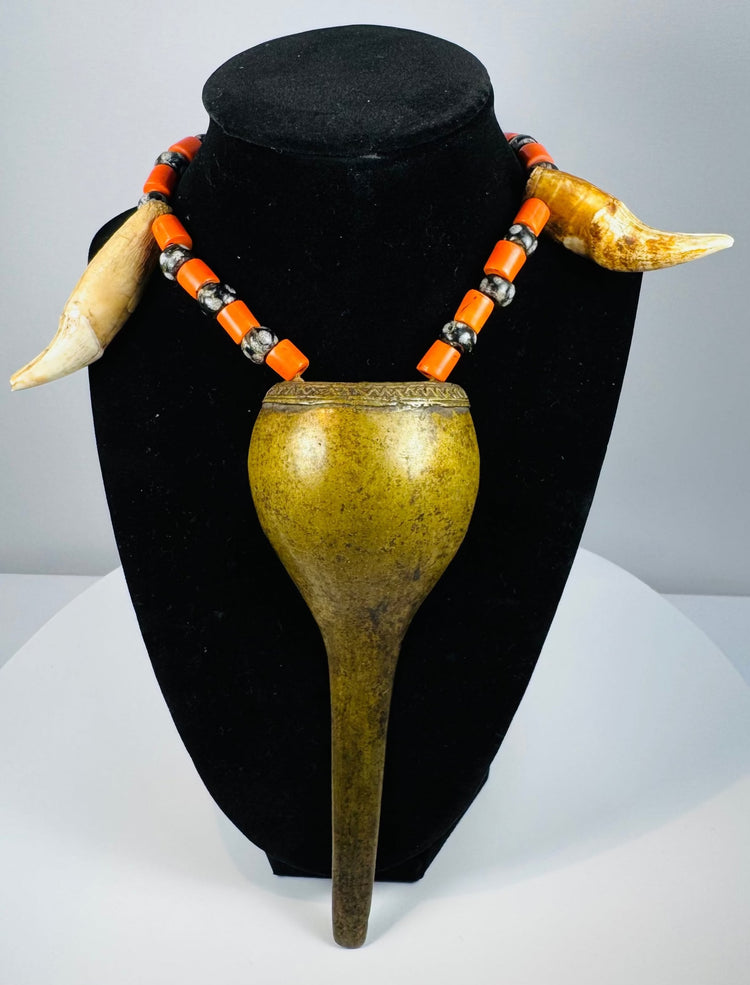
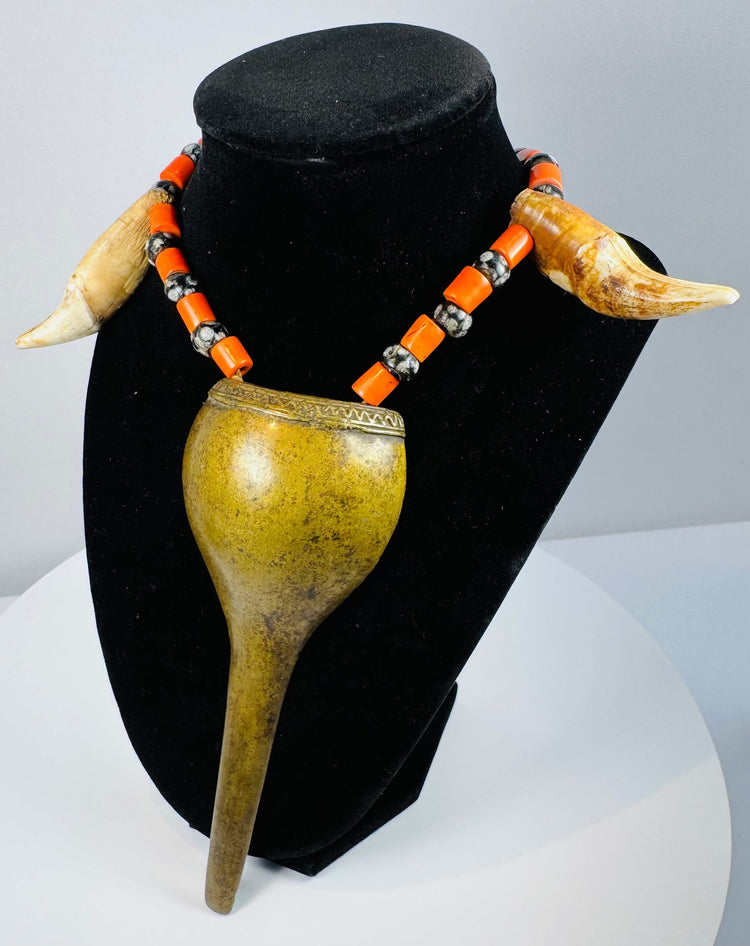
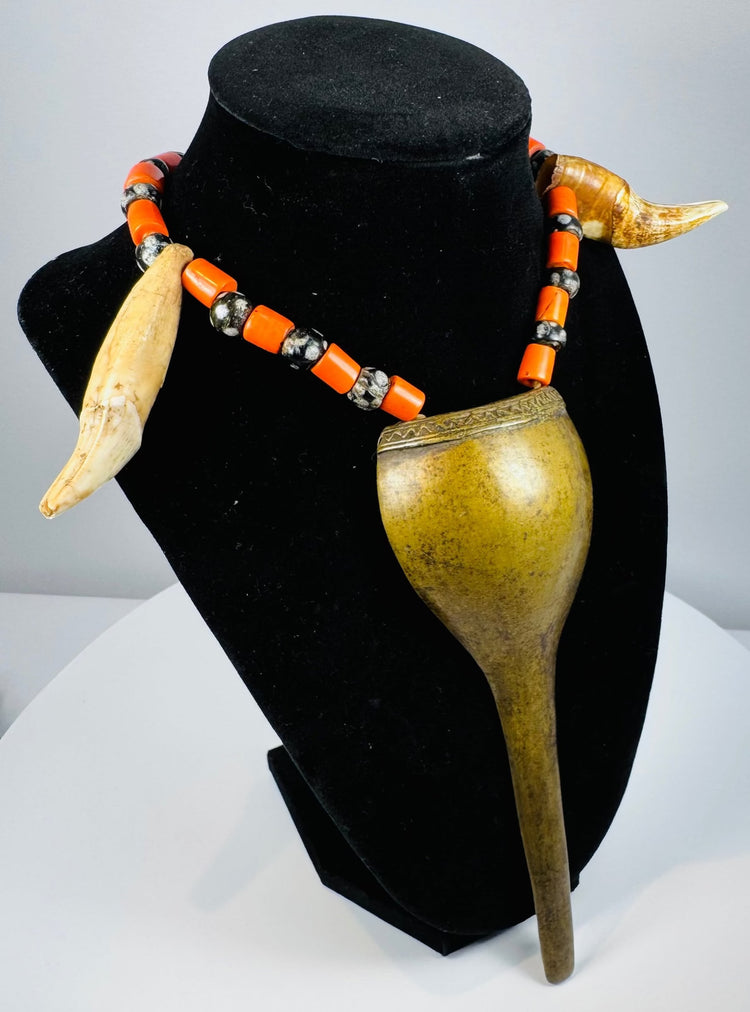
An exceptional Konyak Naga warrior’s prestige necklace composed of old glass trade beads, a monumental stylized brass pendant, and two large animal teeth (possibly tiger) positioned symmetrically along the upper strand.
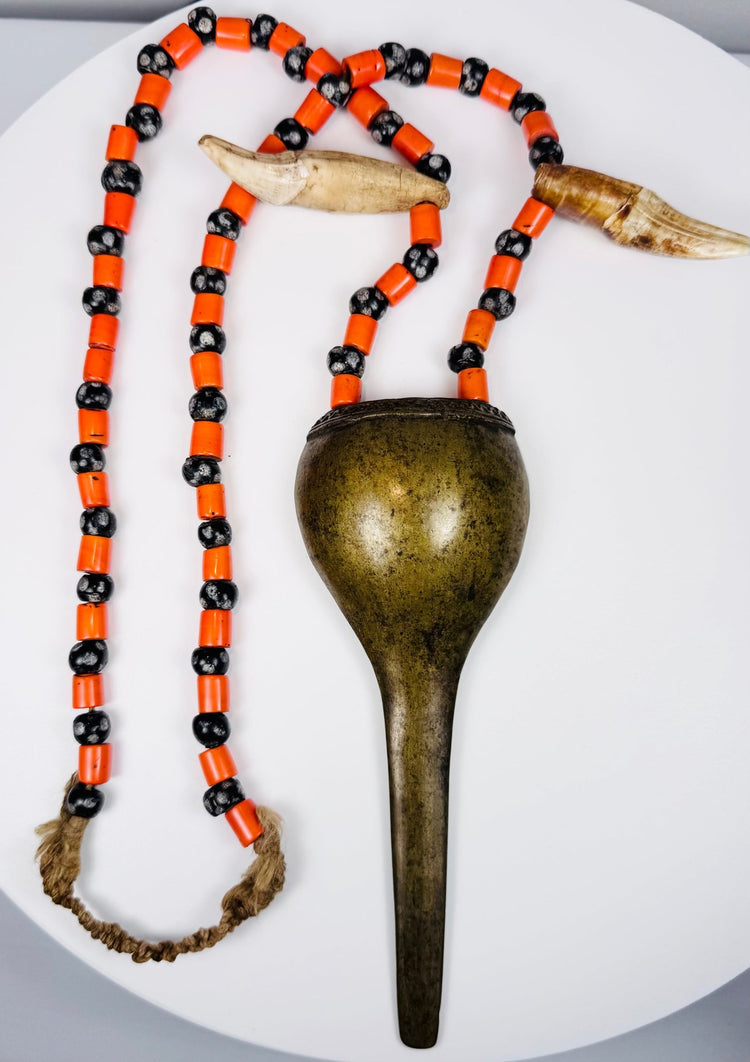
The necklace is strung primarily with vivid orange-red cylindrical glass beads alternating with rounded black beads decorated with pale spotted or eye-like markings. Similar historic Konyak necklaces incorporated imported glass beads alongside locally produced brass ornaments, with the resulting necklaces functioning not only as personal adornment but also as visible expressions of wealth, status, and identity.
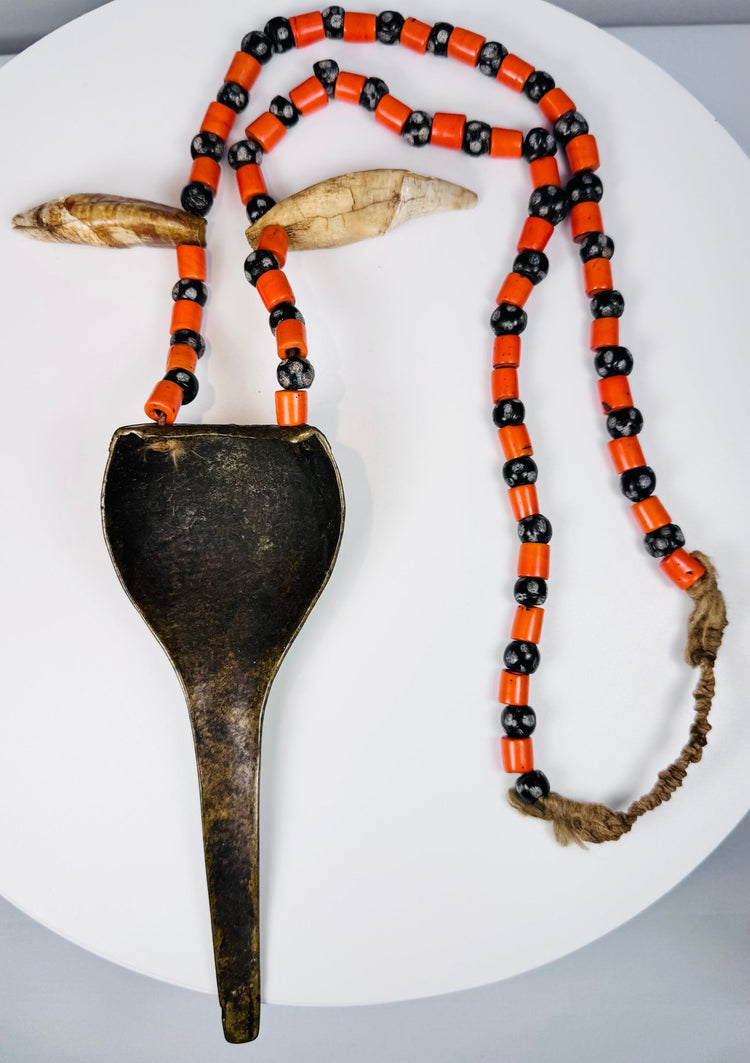
At the centre hangs an unusually large cast-brass pendant with a broad rounded upper body tapering dramatically into a long narrow extension. A finely worked geometric border encircles the upper edge. The form was described in its previous auction cataloguing as a stylized shell-form brass pendant.
Flanking the necklace are two substantial curved (possibly tiger) teeth exhibiting natural cream, ochre, and brown coloration.
The beads and components terminate in an older fibre closure at the rear, retaining the necklace’s distinctly hand-assembled ethnographic character.
Features
- Large cast-brass central pendant in a stylized shell form
- Decorative geometric band around the pendant rim
- Old orange-red cylindrical glass trade beads
- Black glass beads with contrasting pale spotted decoration
- Two large animal teeth positioned symmetrically along the necklace
- Teeth historically catalogued as tiger teeth
- Traditional fibre stringing and rear fastening
- Substantial overall size and dramatic ceremonial presentation
- Strong natural patination to the brass and wear consistent with age
Cultural Significance
Jewellery played an important role in traditional Konyak society, communicating status, wealth, identity, and achievement. Konyak men historically wore elaborate combinations of beads, brass ornaments, animal teeth, and other prestige materials, while tiger-tooth pendants are specifically documented in association with male warrior adornment.
Imported glass beads were particularly valued and could be combined with locally cast brass components that were retained as heirlooms. Comparable Konyak necklaces dating to around 1900 and the early 20th century incorporate glass trade beads and substantial brass pendants, illustrating the mixture of imported materials and indigenous metalworking characteristic of Naga prestige jewellery.
The imposing scale of the central pendant, brightly coloured beads, and paired teeth would have created a powerful visual display when worn, making this an especially evocative example of historic Naga personal adornment.
Condition
Good condition for age. The brass pendant displays extensive natural oxidation, surface darkening, rubbing, and patination consistent with prolonged age and use. The glass beads retain strong colour with scattered surface wear and minor imperfections. Both teeth exhibit natural staining, age lines, abrasions, and minor surface losses. The fibre stringing and closure show visible age and wear but presently retain the necklace as a complete assemblage.
Dimensions (Approximate)
Length: 22 in
Width: 4.5 in
Age (Approximate)
100–140 years old
Provenance
Formerly held in a private collection in Philadelphia, Pennsylvania, United States, comprising ethnographic, tribal, and culturally significant objects.
Learn More
Discover a related late 19th–early 20th-century Naga necklace in the collection of The Metropolitan Museum of Art
Explore our Collection of Tribal and Indigenous Artifacts
Description
Historical Context & Origin
Region: Nagaland, Northeast India / Indo-Myanmar borderlands
Material: Brass, old glass trade beads, animal teeth (possibly tiger), and fibre cord
Period: Late 19th–Early 20th Century, circa 1900
Description
An exceptional Konyak Naga warrior’s prestige necklace composed of old glass trade beads, a monumental stylized brass pendant, and two large animal teeth (possibly tiger) positioned symmetrically along the upper strand.
The necklace is strung primarily with vivid orange-red cylindrical glass beads alternating with rounded black beads decorated with pale spotted or eye-like markings. Similar historic Konyak necklaces incorporated imported glass beads alongside locally produced brass ornaments, with the resulting necklaces functioning not only as personal adornment but also as visible expressions of wealth, status, and identity.
At the centre hangs an unusually large cast-brass pendant with a broad rounded upper body tapering dramatically into a long narrow extension. A finely worked geometric border encircles the upper edge. The form was described in its previous auction cataloguing as a stylized shell-form brass pendant.
Flanking the necklace are two substantial curved (possibly tiger) teeth exhibiting natural cream, ochre, and brown coloration.
The beads and components terminate in an older fibre closure at the rear, retaining the necklace’s distinctly hand-assembled ethnographic character.
Features
- Large cast-brass central pendant in a stylized shell form
- Decorative geometric band around the pendant rim
- Old orange-red cylindrical glass trade beads
- Black glass beads with contrasting pale spotted decoration
- Two large animal teeth positioned symmetrically along the necklace
- Teeth historically catalogued as tiger teeth
- Traditional fibre stringing and rear fastening
- Substantial overall size and dramatic ceremonial presentation
- Strong natural patination to the brass and wear consistent with age
Cultural Significance
Jewellery played an important role in traditional Konyak society, communicating status, wealth, identity, and achievement. Konyak men historically wore elaborate combinations of beads, brass ornaments, animal teeth, and other prestige materials, while tiger-tooth pendants are specifically documented in association with male warrior adornment.
Imported glass beads were particularly valued and could be combined with locally cast brass components that were retained as heirlooms. Comparable Konyak necklaces dating to around 1900 and the early 20th century incorporate glass trade beads and substantial brass pendants, illustrating the mixture of imported materials and indigenous metalworking characteristic of Naga prestige jewellery.
The imposing scale of the central pendant, brightly coloured beads, and paired teeth would have created a powerful visual display when worn, making this an especially evocative example of historic Naga personal adornment.
Condition
Good condition for age. The brass pendant displays extensive natural oxidation, surface darkening, rubbing, and patination consistent with prolonged age and use. The glass beads retain strong colour with scattered surface wear and minor imperfections. Both teeth exhibit natural staining, age lines, abrasions, and minor surface losses. The fibre stringing and closure show visible age and wear but presently retain the necklace as a complete assemblage.
Dimensions (Approximate)
Length: 22 in
Width: 4.5 in
Age (Approximate)
100–140 years old
Provenance
Formerly held in a private collection in Philadelphia, Pennsylvania, United States, comprising ethnographic, tribal, and culturally significant objects.
Learn More
Discover a related late 19th–early 20th-century Naga necklace in the collection of The Metropolitan Museum of Art
Explore our Collection of Tribal and Indigenous Artifacts
You May Also Like
