

Northern Thai Lan Na Bronze Seated Buddha in Earth-Touching Mudra | Circa 15th – 16th Century
Couldn't load pickup availability


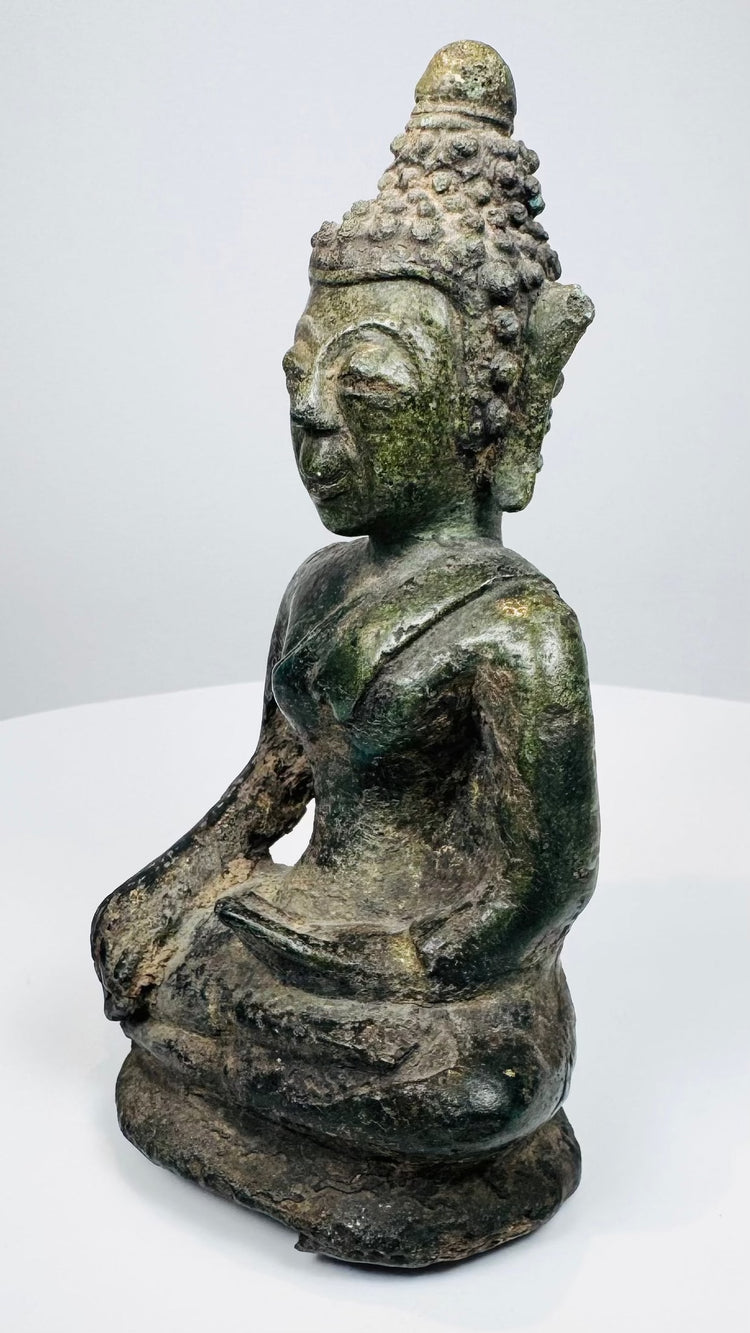
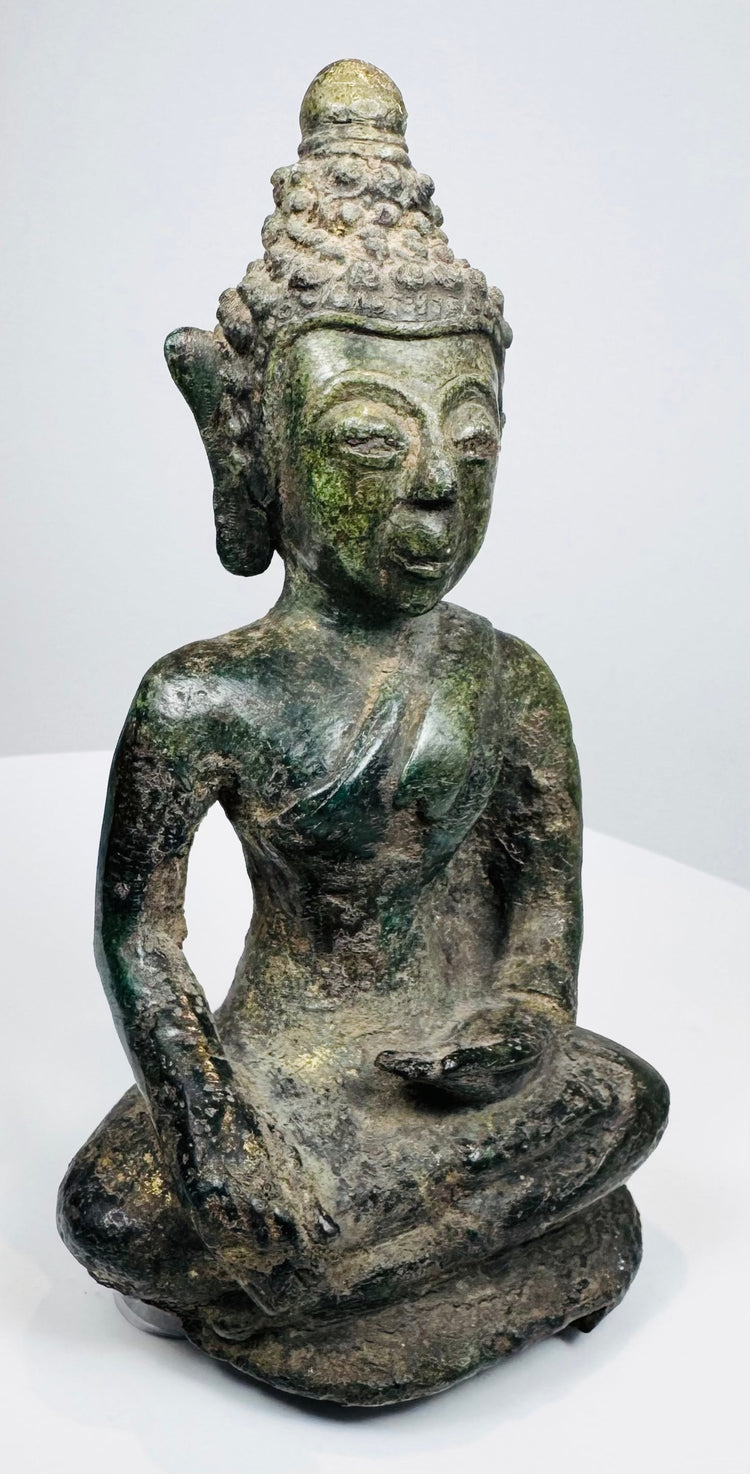
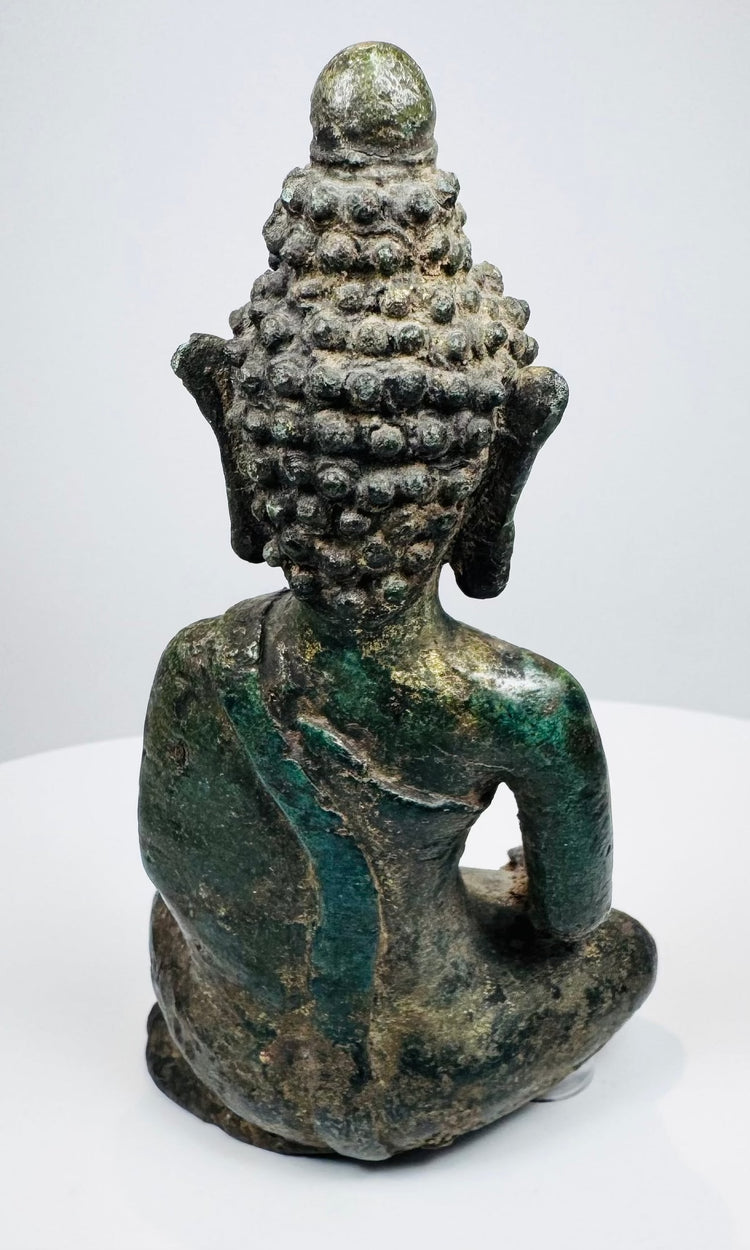
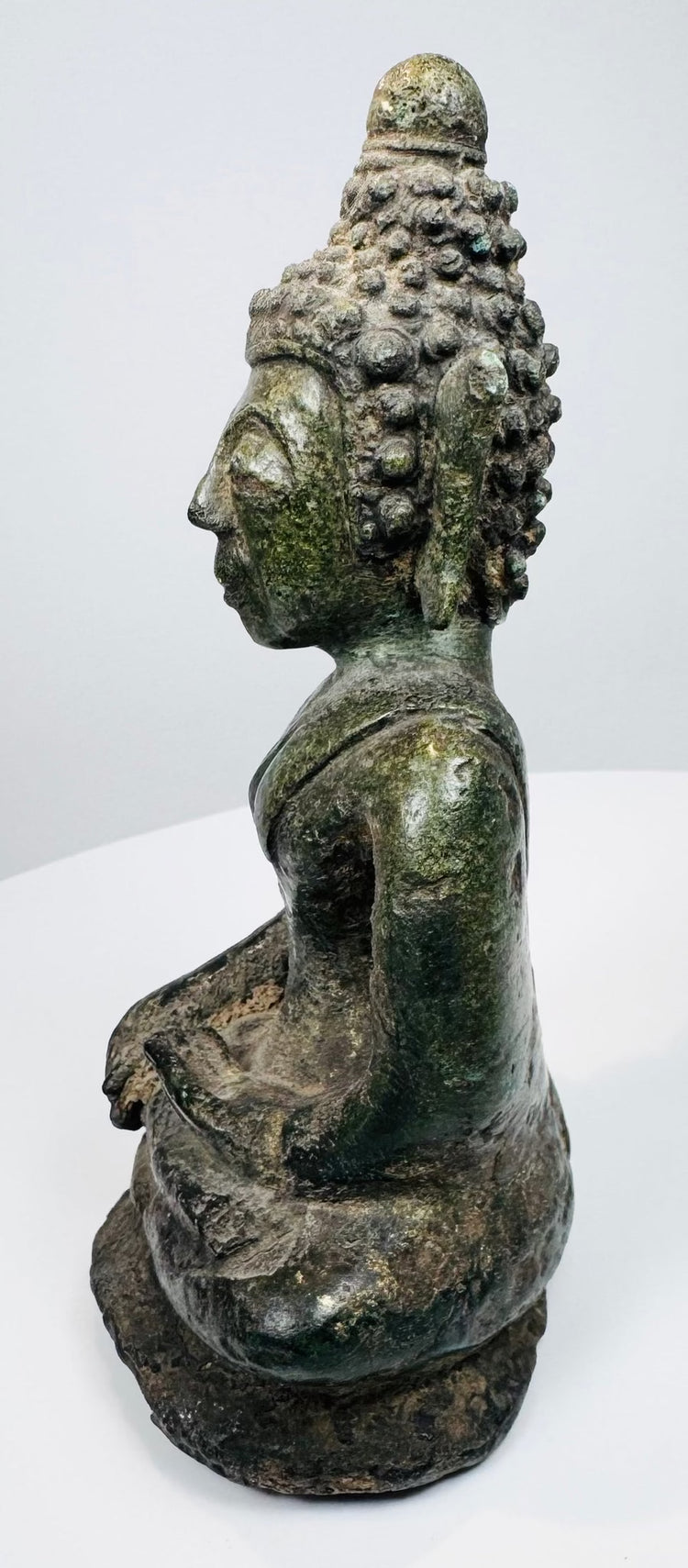
Northern Thai Lan Na Bronze Seated Buddha in Earth-Touching Mudra | Circa 15th – 16th Century
Description
More
Less
Historical Context & Origin
Region: Northern Thailand, Lan Na cultural sphere
Material: Lost-wax cast bronze or copper alloy with naturally developed brown and green patina
Period: Attributed to the Lan Na period, circa 15th–16th century
Description
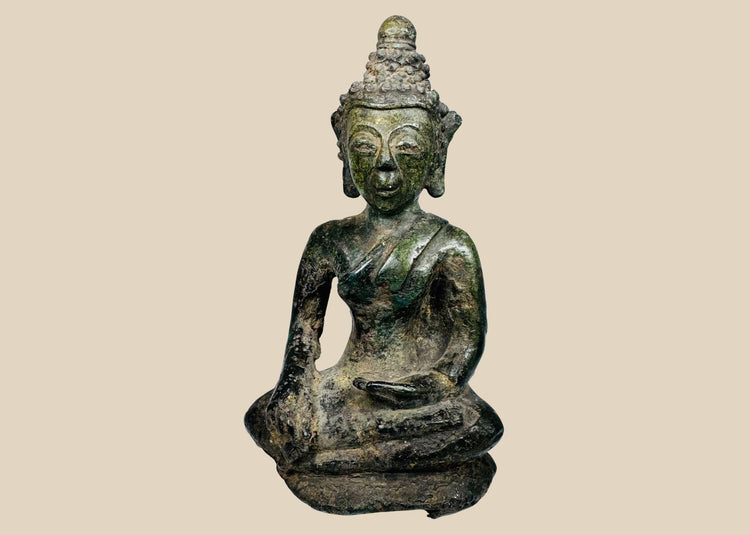
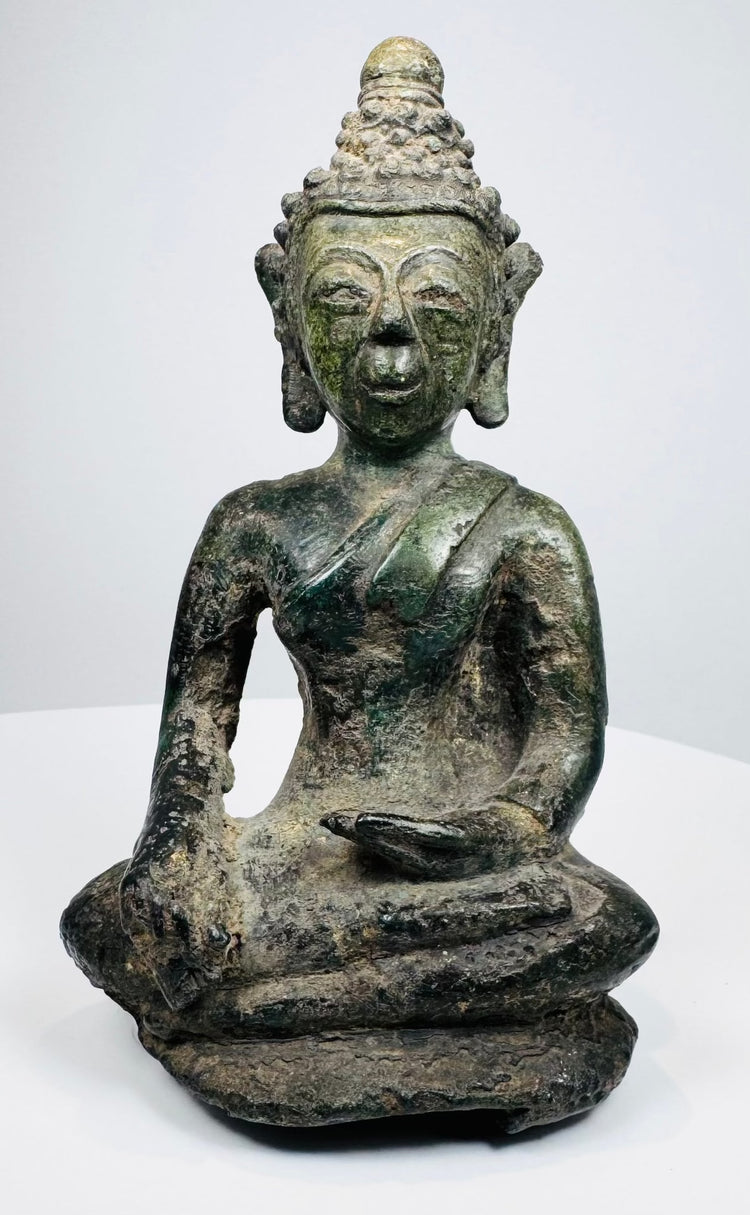
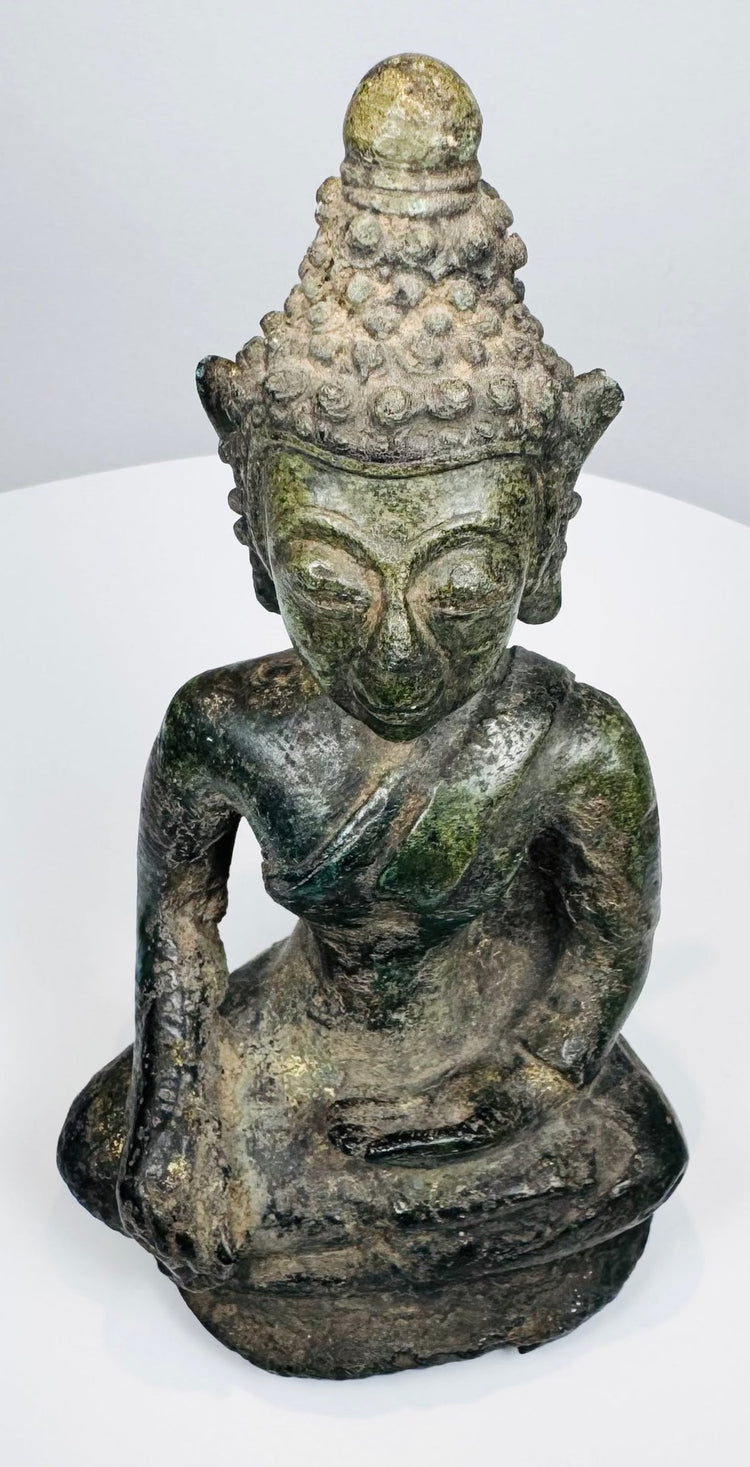
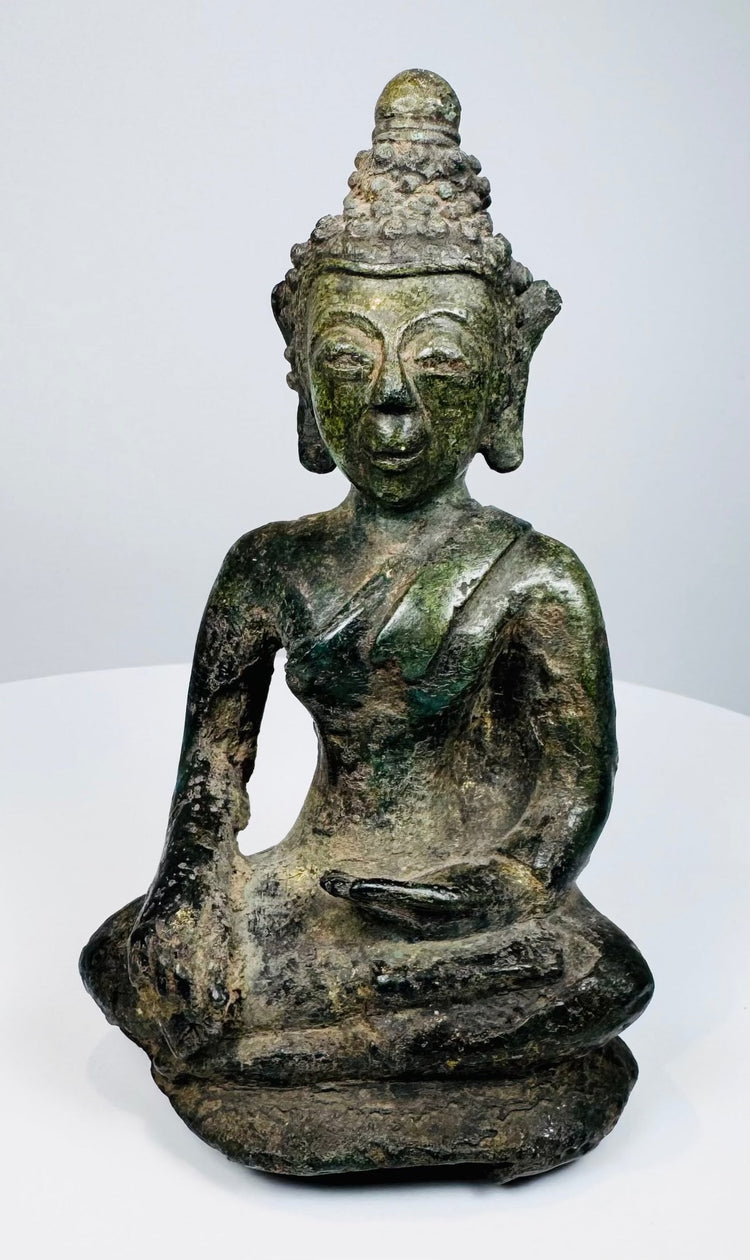
A finely proportioned Northern Thai bronze devotional figure representing Shakyamuni Buddha seated in maravijaya, the posture commemorating his victory over Mara and attainment of enlightenment.
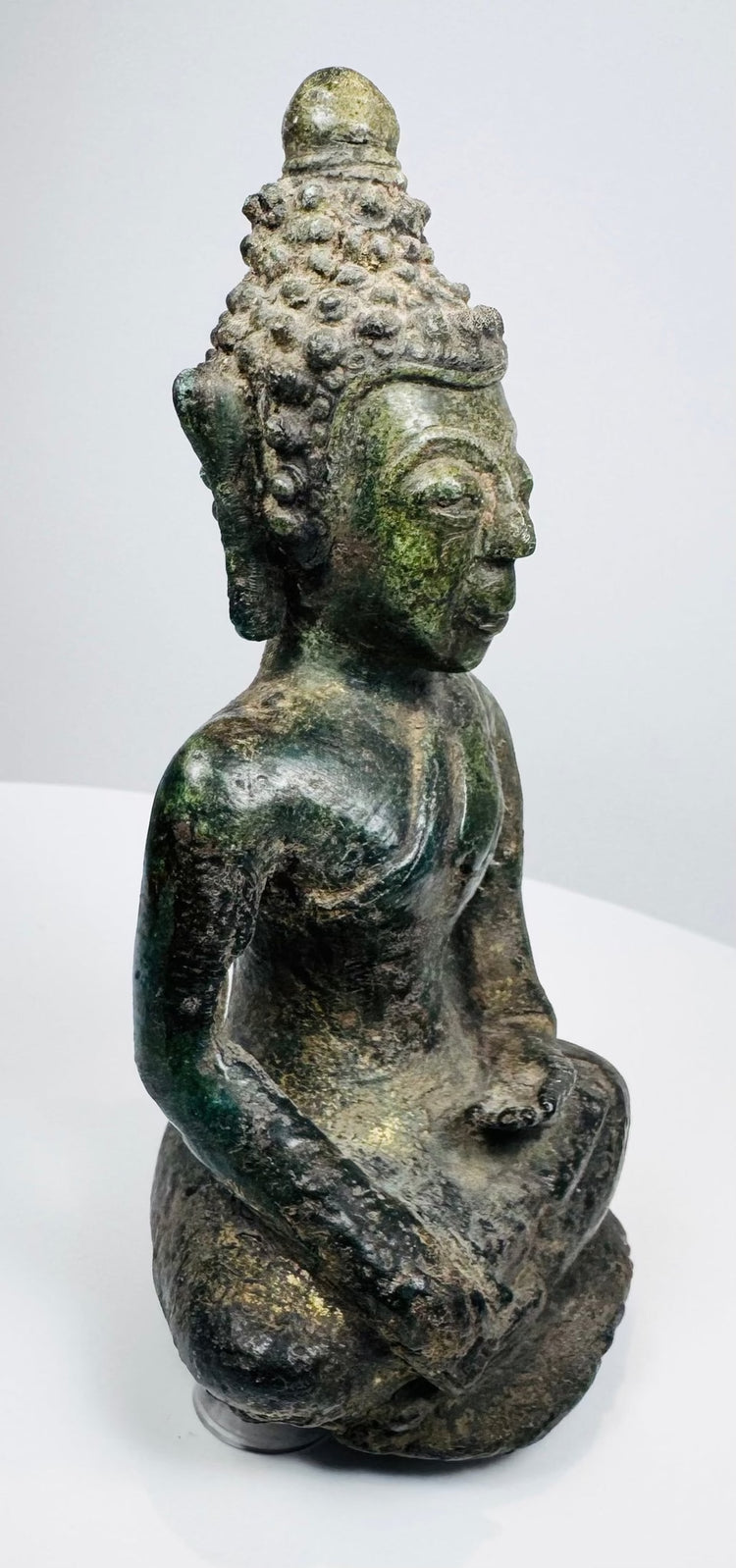
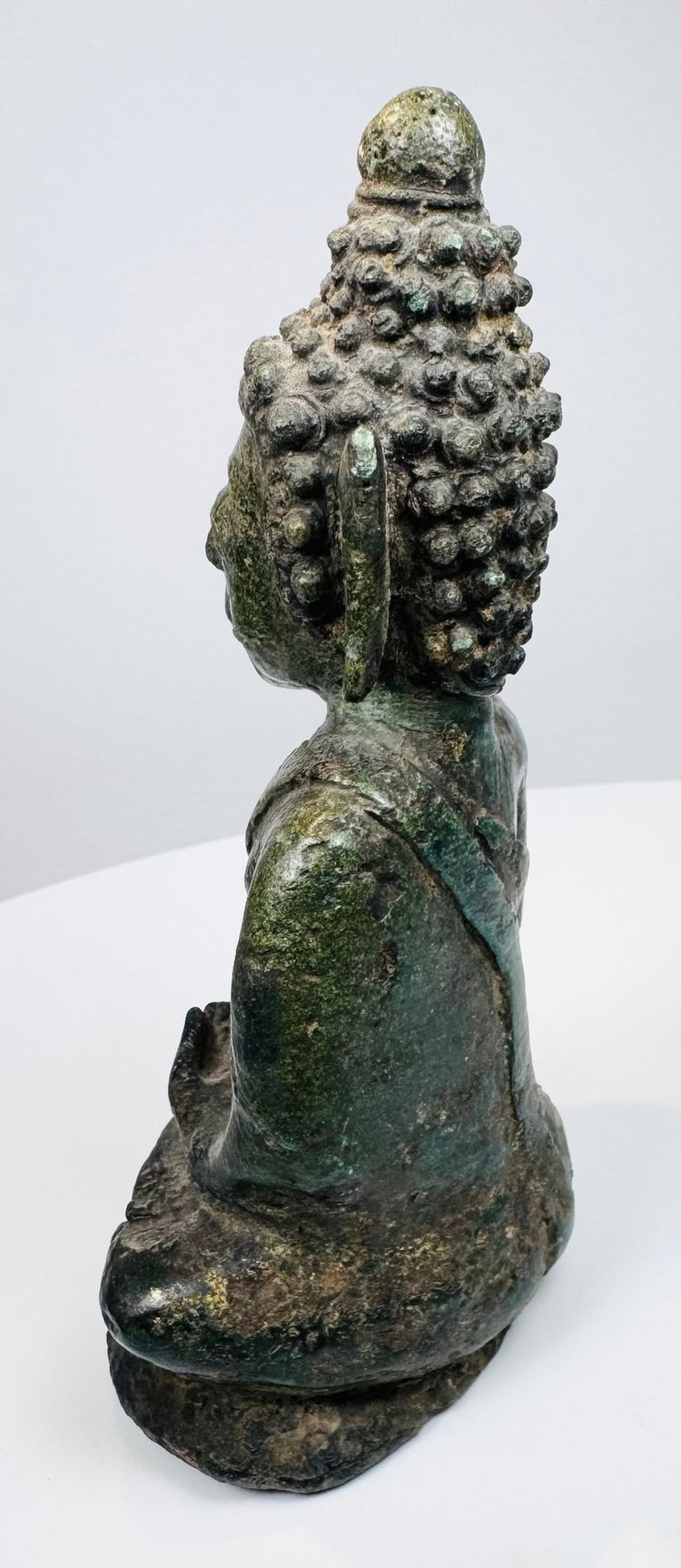
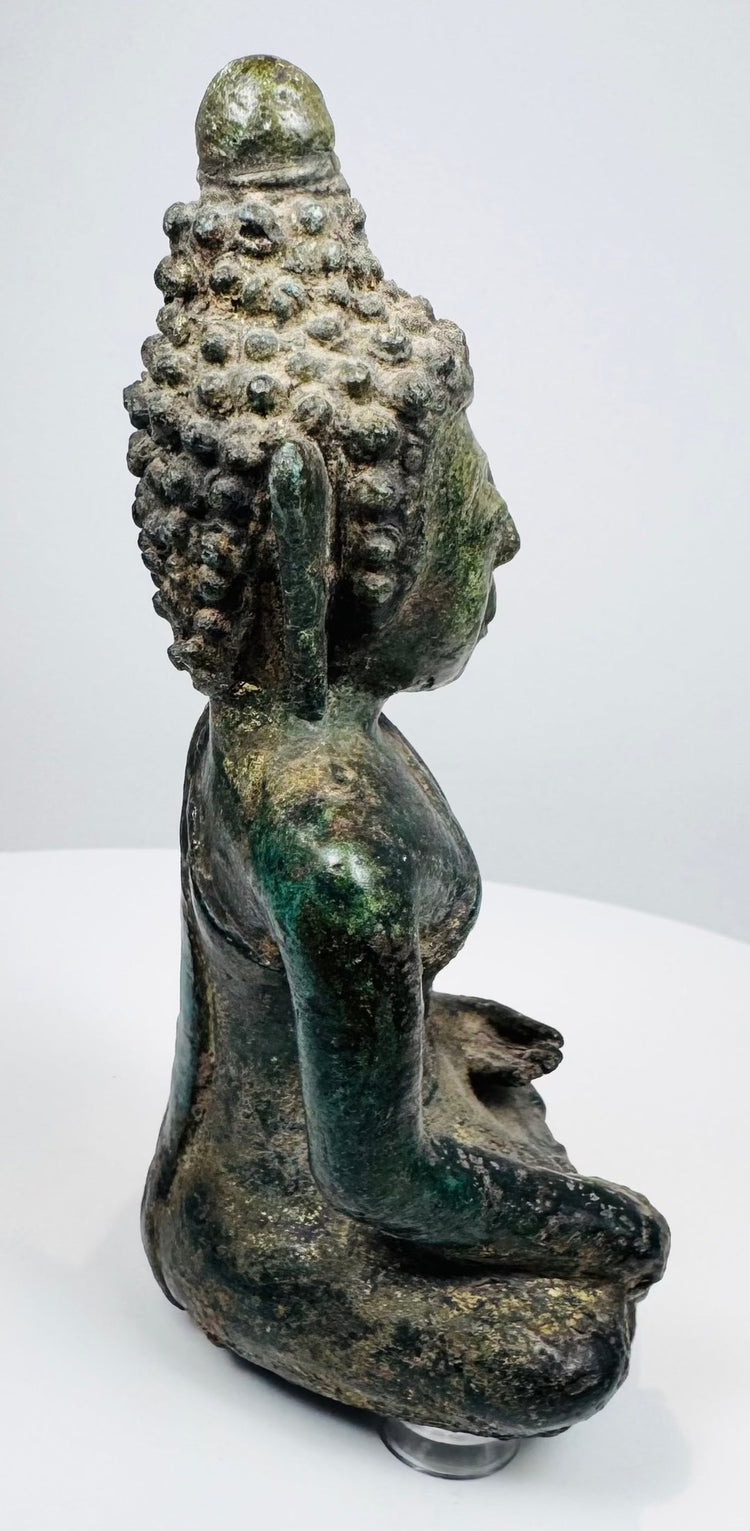
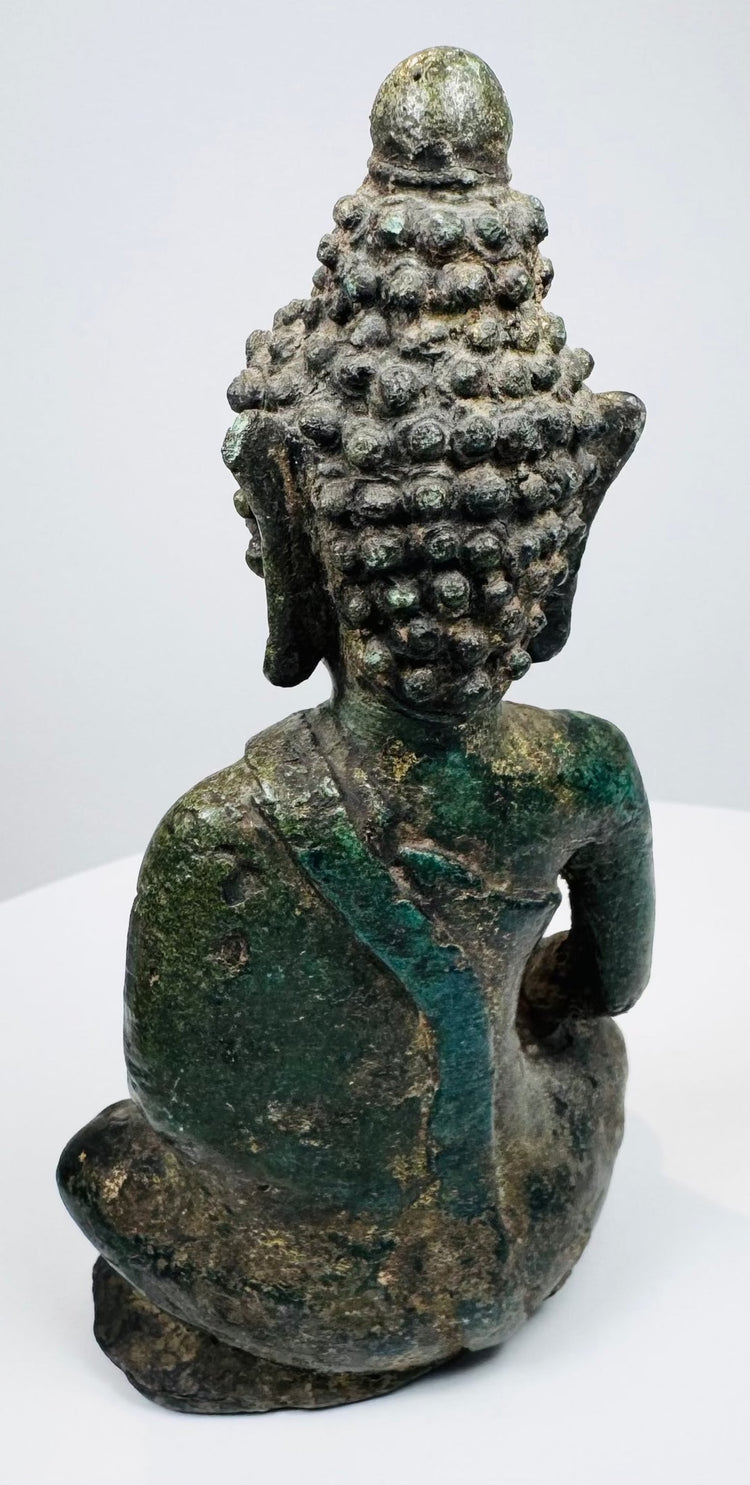
The Buddha sits cross-legged upon a low integral base. His right hand descends over the knee in bhumisparsha mudra, the earth-touching gesture, while his left hand rests palm upward within his lap in the gesture of meditation. The close-fitting monastic robe passes diagonally across the torso and covers the left shoulder while leaving the right shoulder exposed.
The face is modeled with gently downcast eyes, high curving eyebrows, a broad nose, softly defined lips, and an expression of composed introspection. Elongated earlobes recall the heavy royal ornaments relinquished by Siddhartha when he abandoned palace life.
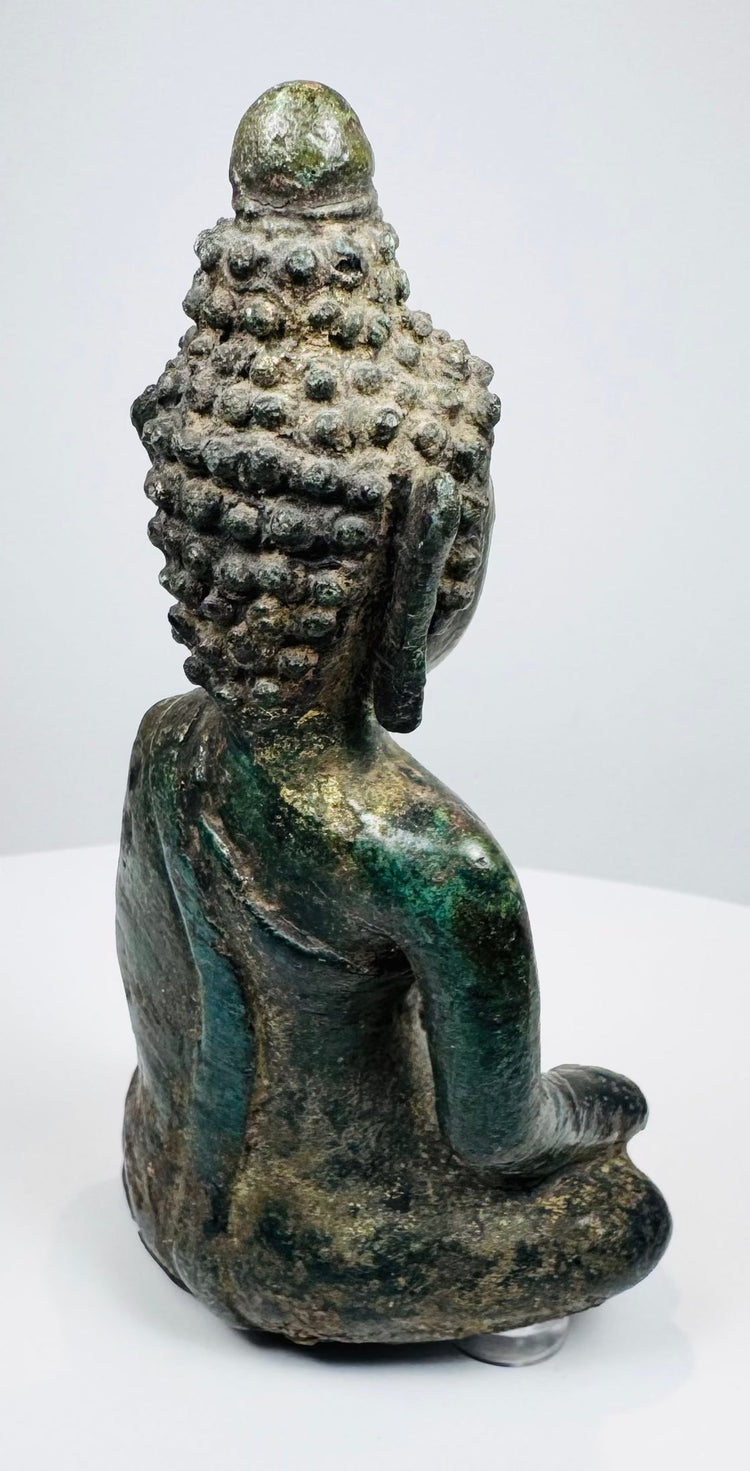
Particularly distinctive is the elaborate treatment of the Buddha’s head. Large snail-shell curls rise in pronounced tiers toward a rounded, orb-like finial. This is not a royal crown, but a highly stylized representation of the Buddha’s curled hair and ushnisha—the cranial protuberance symbolizing transcendent wisdom. Oversized curls, a rounded finial, a compact body, and the earth-touching posture are characteristic of early Chiang Saen and Lan Na sculptural traditions.
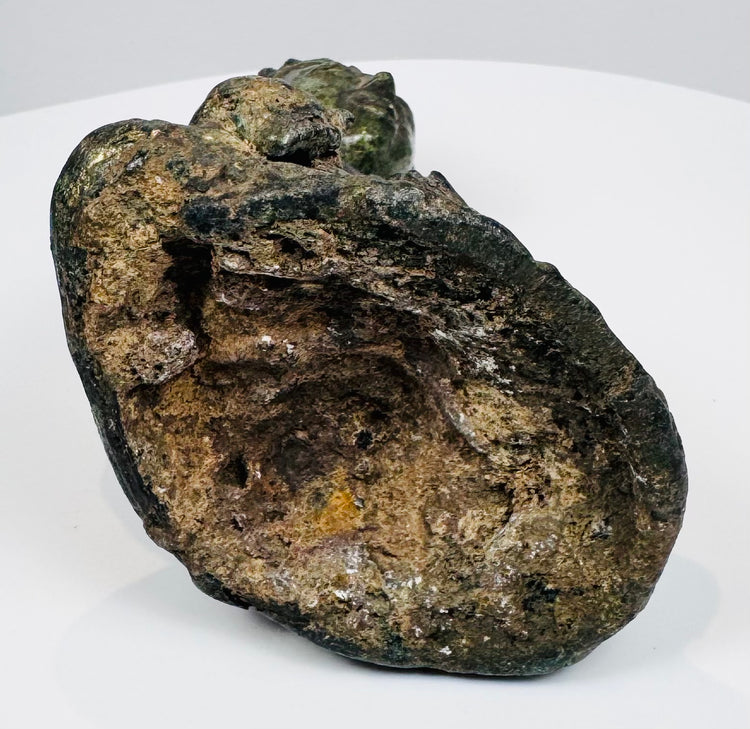
The figure was hollow cast, probably through the lost-wax process. The open underside retains accretions and possible remnants associated with the casting core. Its richly mottled surface displays deep brown and green patination, areas of verdigris, and pale mineral deposits accumulated over an extended period.
Features
- Representation of Shakyamuni Buddha
- Traditional maravijaya seated posture
- Right hand in earth-touching bhumisparsha mudra
- Left hand resting in meditative dhyana mudra
- Large snail-shell curls arranged in tiered formation
- Rounded ushnisha finial
- Elongated earlobes
- Diagonally draped monastic robe
- Low integral seated base
- Hollow lost-wax cast construction
- Substantial brown-green patina and mineral accretions
Historical & Cultural Significance
The Lan Na Kingdom of northern Thailand became an important center of Theravada Buddhist scholarship, temple construction, and bronze casting. Workshops around Chiang Mai and Chiang Saen developed a distinctive interpretation of the Buddha characterized by powerful compact bodies, rounded facial features, prominent hair curls, and lotus-bud or orb-shaped finials.
The earth-touching gesture refers to the defining moment immediately before the Buddha’s enlightenment. When Mara challenged his spiritual authority, the Buddha extended his right hand toward the ground and called upon the earth to witness the accumulated merit of his previous lives. The earth responded, confirming his worthiness and defeating Mara’s forces.
Images portraying this event were installed within temples, placed upon household altars, or carried as personal devotional objects. Their presence encouraged meditation while serving as a visual reminder that perseverance, wisdom, and moral conduct can overcome illusion and suffering.
Condition
Good antique condition with extensive surface characteristics consistent with considerable age. The bronze displays a dark brown and green patina with pronounced verdigris, pale mineral deposits, oxidation, and areas of encrustation. Additional wear includes rubbing, scratches, pitting, casting irregularities, softened details, and minor losses or unevenness along the base and exposed high points.
The underside remains open and contains accretions and possible casting-core remnants.
Dimensions (Approximate)
Height: 5.25 in
Width: 3.5 in
Depth: 2.25 in
Age (Approximate)
425–625 years old
Provenance
Property from the Preiser Collection.
The collection is associated with Dr. Franklin M. Preiser (1937–2022) of Arizona, a long-standing collector of Asian art. Works from the collection subsequently passed by descent before its later dispersal.
Subsequently handled by Andrew Jones Auctions of Los Angeles, a full-service auction and appraisal firm specializing in fine art, antiques, and Asian works of art. The auction house is supported by specialists with extensive international experience and regularly presents diverse collections and estates spanning several centuries.
Learn More
View a related 15th-century Thai bronze seated Buddha in the collection of The Metropolitan Museum of Art
Explore our Collection of Buddhist & Hindu Relics and Sacred Statues
Description
Historical Context & Origin
Region: Northern Thailand, Lan Na cultural sphere
Material: Lost-wax cast bronze or copper alloy with naturally developed brown and green patina
Period: Attributed to the Lan Na period, circa 15th–16th century
Description
A finely proportioned Northern Thai bronze devotional figure representing Shakyamuni Buddha seated in maravijaya, the posture commemorating his victory over Mara and attainment of enlightenment.
The Buddha sits cross-legged upon a low integral base. His right hand descends over the knee in bhumisparsha mudra, the earth-touching gesture, while his left hand rests palm upward within his lap in the gesture of meditation. The close-fitting monastic robe passes diagonally across the torso and covers the left shoulder while leaving the right shoulder exposed.
The face is modeled with gently downcast eyes, high curving eyebrows, a broad nose, softly defined lips, and an expression of composed introspection. Elongated earlobes recall the heavy royal ornaments relinquished by Siddhartha when he abandoned palace life.
Particularly distinctive is the elaborate treatment of the Buddha’s head. Large snail-shell curls rise in pronounced tiers toward a rounded, orb-like finial. This is not a royal crown, but a highly stylized representation of the Buddha’s curled hair and ushnisha—the cranial protuberance symbolizing transcendent wisdom. Oversized curls, a rounded finial, a compact body, and the earth-touching posture are characteristic of early Chiang Saen and Lan Na sculptural traditions.
The figure was hollow cast, probably through the lost-wax process. The open underside retains accretions and possible remnants associated with the casting core. Its richly mottled surface displays deep brown and green patination, areas of verdigris, and pale mineral deposits accumulated over an extended period.
Features
- Representation of Shakyamuni Buddha
- Traditional maravijaya seated posture
- Right hand in earth-touching bhumisparsha mudra
- Left hand resting in meditative dhyana mudra
- Large snail-shell curls arranged in tiered formation
- Rounded ushnisha finial
- Elongated earlobes
- Diagonally draped monastic robe
- Low integral seated base
- Hollow lost-wax cast construction
- Substantial brown-green patina and mineral accretions
Historical & Cultural Significance
The Lan Na Kingdom of northern Thailand became an important center of Theravada Buddhist scholarship, temple construction, and bronze casting. Workshops around Chiang Mai and Chiang Saen developed a distinctive interpretation of the Buddha characterized by powerful compact bodies, rounded facial features, prominent hair curls, and lotus-bud or orb-shaped finials.
The earth-touching gesture refers to the defining moment immediately before the Buddha’s enlightenment. When Mara challenged his spiritual authority, the Buddha extended his right hand toward the ground and called upon the earth to witness the accumulated merit of his previous lives. The earth responded, confirming his worthiness and defeating Mara’s forces.
Images portraying this event were installed within temples, placed upon household altars, or carried as personal devotional objects. Their presence encouraged meditation while serving as a visual reminder that perseverance, wisdom, and moral conduct can overcome illusion and suffering.
Condition
Good antique condition with extensive surface characteristics consistent with considerable age. The bronze displays a dark brown and green patina with pronounced verdigris, pale mineral deposits, oxidation, and areas of encrustation. Additional wear includes rubbing, scratches, pitting, casting irregularities, softened details, and minor losses or unevenness along the base and exposed high points.
The underside remains open and contains accretions and possible casting-core remnants.
Dimensions (Approximate)
Height: 5.25 in
Width: 3.5 in
Depth: 2.25 in
Age (Approximate)
425–625 years old
Provenance
Property from the Preiser Collection.
The collection is associated with Dr. Franklin M. Preiser (1937–2022) of Arizona, a long-standing collector of Asian art. Works from the collection subsequently passed by descent before its later dispersal.
Subsequently handled by Andrew Jones Auctions of Los Angeles, a full-service auction and appraisal firm specializing in fine art, antiques, and Asian works of art. The auction house is supported by specialists with extensive international experience and regularly presents diverse collections and estates spanning several centuries.
Learn More
View a related 15th-century Thai bronze seated Buddha in the collection of The Metropolitan Museum of Art
Explore our Collection of Buddhist & Hindu Relics and Sacred Statues
You May Also Like
