


Antique European | Wrought Iron Multi-Hasp Door Lock | Circa 18th Century
Couldn't load pickup availability






Antique European | Wrought Iron Multi-Hasp Door Lock | Circa 18th Century
Description
More
Less
Historical Context & Origin
Region: Europe
Material: Hand-forged wrought iron
Period: 18th Century, circa 1700–1800
Description
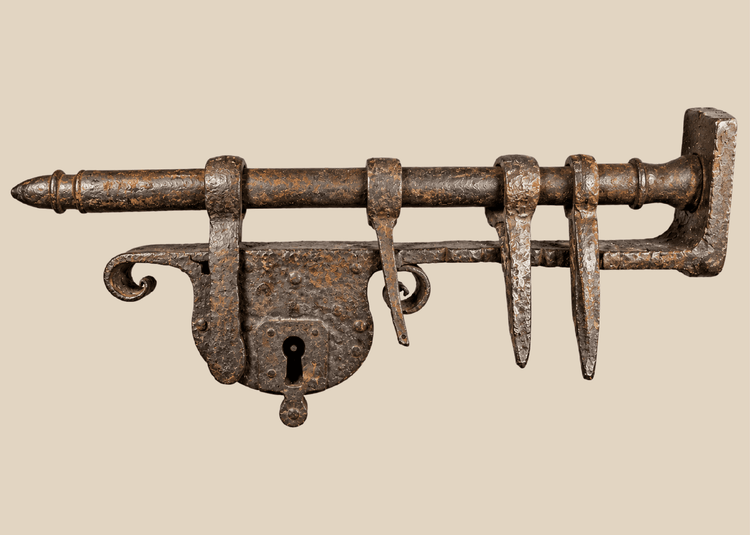
This substantial antique wrought iron locking mechanism is an exceptionally large example of a sliding hasp gate lock, a form of architectural security hardware used throughout Europe during the 17th and 18th centuries. Comparable documented examples dating to approximately the mid-18th century employ a long horizontal sliding bar combined with a suspended lock body and movable hasps or retainers.
Measuring approximately 18 inches in overall length, the present example is considerably larger and more elaborate than many surviving domestic locks and was likely intended for a substantial gate.
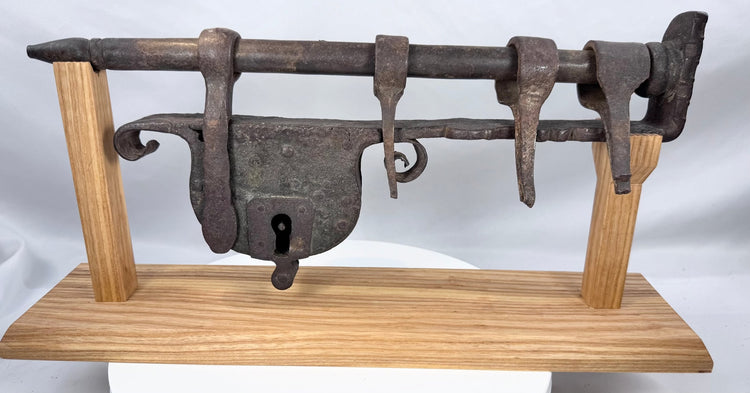
The construction is dominated by a massive cylindrical horizontal iron bar terminating at one end in a pointed finial and at the opposite end in a broad flattened stop. Multiple individually forged iron loops and descending hasps travel along the bar, creating a complex mechanical arrangement that would originally have engaged staples or eyes fixed to the door and surrounding structure.
Suspended beneath the bar is a large riveted lock case with a traditional keyhole escutcheon. The casing displays unmistakable hand-worked construction, including irregular hammering, individually set rivets, forged seams, and substantial iron straps. Particularly attractive are the scrolling terminals incorporated into the lower structural bar, adding a decorative element to an otherwise highly functional piece of early architectural ironwork.
Unlike later standardized locks produced during the Industrial Revolution, each component of this mechanism was individually formed by a blacksmith. Variations in thickness, shaping, rivet placement, and surface texture remain clearly visible throughout.
The lock is presented on a custom-made wooden display stand.
Features
- Massive cylindrical sliding security bar
- Multiple independently forged sliding hasps and retaining loops
- Riveted iron lock body
- Decorative scrolling iron terminals
- Pointed forged terminal to the horizontal bar
- Broad forged stop plate at opposite end
- Extensive visible hammering and blacksmith workmanship
- Complex multi-component mechanical construction
- Naturally developed oxidation and aged iron surface
- Custom wooden display stand included
- Particularly impressive architectural scale
Cultural Significance
Before standardized factory-produced locks became widespread, securing large gates and doors required hardware individually created by skilled blacksmiths. Locks of this scale represented both practical security devices and sophisticated examples of mechanical craftsmanship.
The sliding hasp system allowed a substantial horizontal iron bar to pass through or engage several fixed points associated with a door, gate, or adjoining architectural structure. Once positioned correctly, the central lock mechanism prevented the assembly from being withdrawn, effectively combining the strength of a heavy structural bar with the controlled access provided by a keyed lock.
This example is particularly visually compelling because much of its mechanical construction remains exposed, allowing the viewer to immediately understand the relationship between the lock body, horizontal bar, forged loops, and retaining elements.
Condition
The lock remains in substantial antique condition with extensive oxidation, surface pitting, discoloration, accumulated patina, abrasions, scratches, irregularities, and general wear consistent with prolonged age and historic use.
The hand-forged components display expected variations in shape and surface texture. There are localized areas of corrosion, minor edge losses, old marks, and deformation to several projecting components. The lock mechanism has not been represented as presently operational, and a corresponding key is not included.
Dimensions (Approximate)
Length: 18 in
Height: 8.75 in
Width / Depth: 4 in
Custom display stand included.
Age (Approximate)
225–325 years old
Provenance
From a private collection in Dallas, Texas, USA, assembled with a particular focus on antique and early locking mechanisms, keys, and historical security devices.
Learn More
Study a related mid-18th-century wrought-iron lock preserved by the Science Museum Group.
Browse our Collection of Functional Tools, Ancient Implements and Craft.
Description
Historical Context & Origin
Region: Europe
Material: Hand-forged wrought iron
Period: 18th Century, circa 1700–1800
Description
This substantial antique wrought iron locking mechanism is an exceptionally large example of a sliding hasp gate lock, a form of architectural security hardware used throughout Europe during the 17th and 18th centuries. Comparable documented examples dating to approximately the mid-18th century employ a long horizontal sliding bar combined with a suspended lock body and movable hasps or retainers.
Measuring approximately 18 inches in overall length, the present example is considerably larger and more elaborate than many surviving domestic locks and was likely intended for a substantial gate.
The construction is dominated by a massive cylindrical horizontal iron bar terminating at one end in a pointed finial and at the opposite end in a broad flattened stop. Multiple individually forged iron loops and descending hasps travel along the bar, creating a complex mechanical arrangement that would originally have engaged staples or eyes fixed to the door and surrounding structure.
Suspended beneath the bar is a large riveted lock case with a traditional keyhole escutcheon. The casing displays unmistakable hand-worked construction, including irregular hammering, individually set rivets, forged seams, and substantial iron straps. Particularly attractive are the scrolling terminals incorporated into the lower structural bar, adding a decorative element to an otherwise highly functional piece of early architectural ironwork.
Unlike later standardized locks produced during the Industrial Revolution, each component of this mechanism was individually formed by a blacksmith. Variations in thickness, shaping, rivet placement, and surface texture remain clearly visible throughout.
The lock is presented on a custom-made wooden display stand.
Features
- Massive cylindrical sliding security bar
- Multiple independently forged sliding hasps and retaining loops
- Riveted iron lock body
- Decorative scrolling iron terminals
- Pointed forged terminal to the horizontal bar
- Broad forged stop plate at opposite end
- Extensive visible hammering and blacksmith workmanship
- Complex multi-component mechanical construction
- Naturally developed oxidation and aged iron surface
- Custom wooden display stand included
- Particularly impressive architectural scale
Cultural Significance
Before standardized factory-produced locks became widespread, securing large gates and doors required hardware individually created by skilled blacksmiths. Locks of this scale represented both practical security devices and sophisticated examples of mechanical craftsmanship.
The sliding hasp system allowed a substantial horizontal iron bar to pass through or engage several fixed points associated with a door, gate, or adjoining architectural structure. Once positioned correctly, the central lock mechanism prevented the assembly from being withdrawn, effectively combining the strength of a heavy structural bar with the controlled access provided by a keyed lock.
This example is particularly visually compelling because much of its mechanical construction remains exposed, allowing the viewer to immediately understand the relationship between the lock body, horizontal bar, forged loops, and retaining elements.
Condition
The lock remains in substantial antique condition with extensive oxidation, surface pitting, discoloration, accumulated patina, abrasions, scratches, irregularities, and general wear consistent with prolonged age and historic use.
The hand-forged components display expected variations in shape and surface texture. There are localized areas of corrosion, minor edge losses, old marks, and deformation to several projecting components. The lock mechanism has not been represented as presently operational, and a corresponding key is not included.
Dimensions (Approximate)
Length: 18 in
Height: 8.75 in
Width / Depth: 4 in
Custom display stand included.
Age (Approximate)
225–325 years old
Provenance
From a private collection in Dallas, Texas, USA, assembled with a particular focus on antique and early locking mechanisms, keys, and historical security devices.
Learn More
Study a related mid-18th-century wrought-iron lock preserved by the Science Museum Group.
Browse our Collection of Functional Tools, Ancient Implements and Craft.
You May Also Like
