

Late Antique Terracotta Oil Lamp | Eastern Mediterranean | Circa 6th – 8th Century CE
Couldn't load pickup availability


Late Antique Terracotta Oil Lamp | Eastern Mediterranean | Circa 6th – 8th Century CE
Description
More
Less
Historical Context & Origin
Region: Eastern Mediterranean / Levant
Material: Mould-made terracotta
Period: Late Antique to Early Islamic Period, circa 6th–8th Century CE
Description
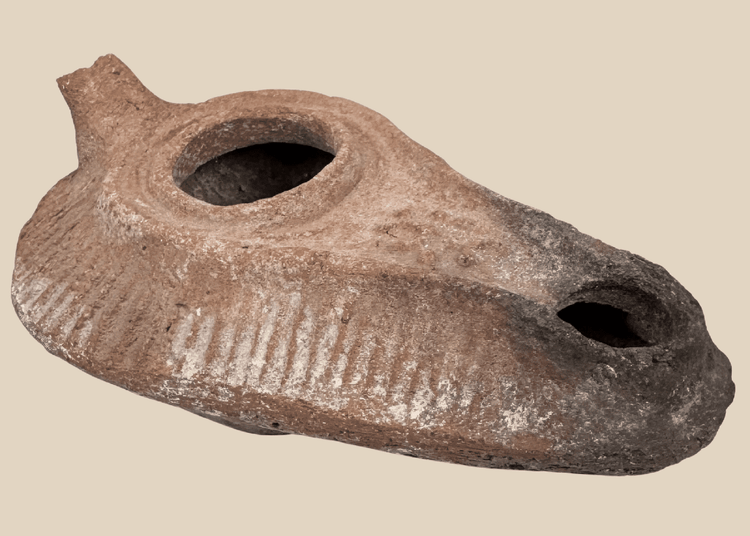
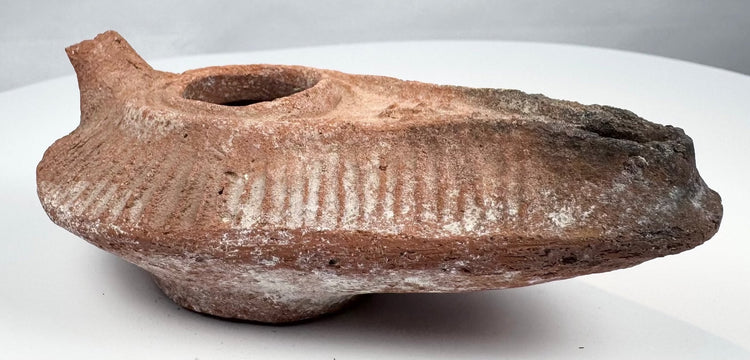
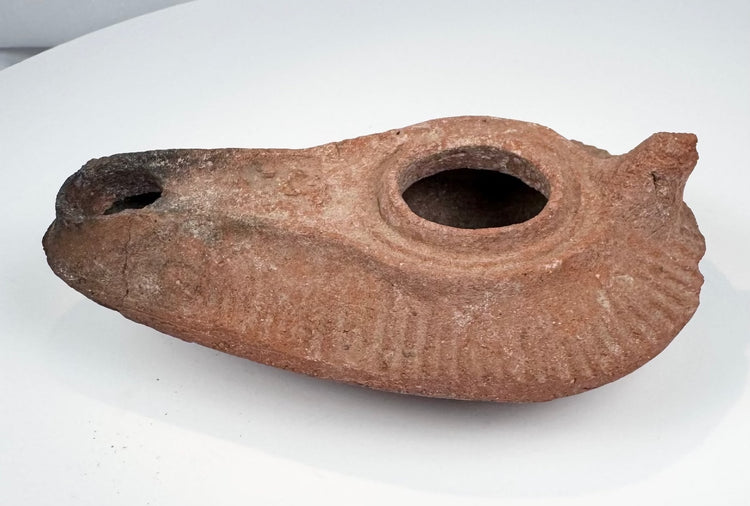
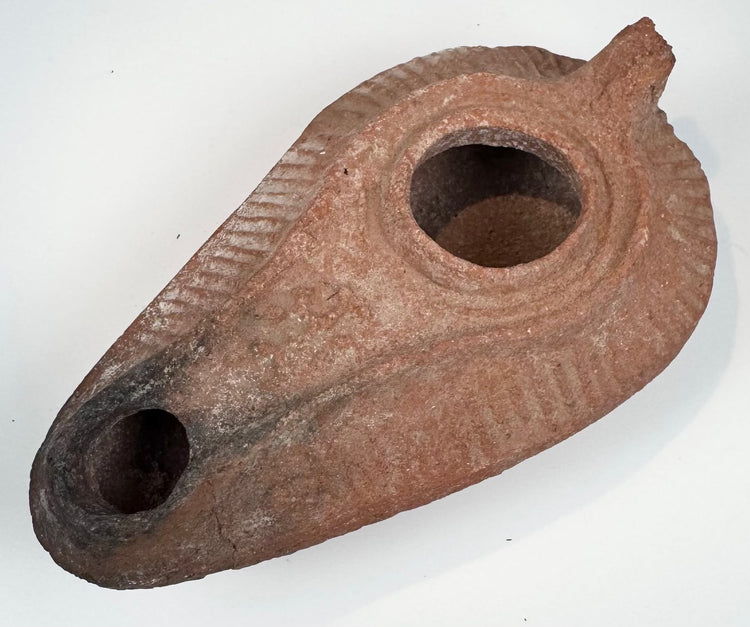
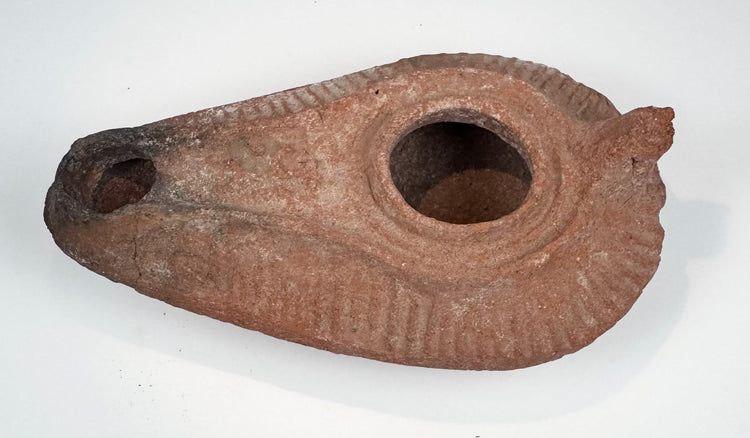
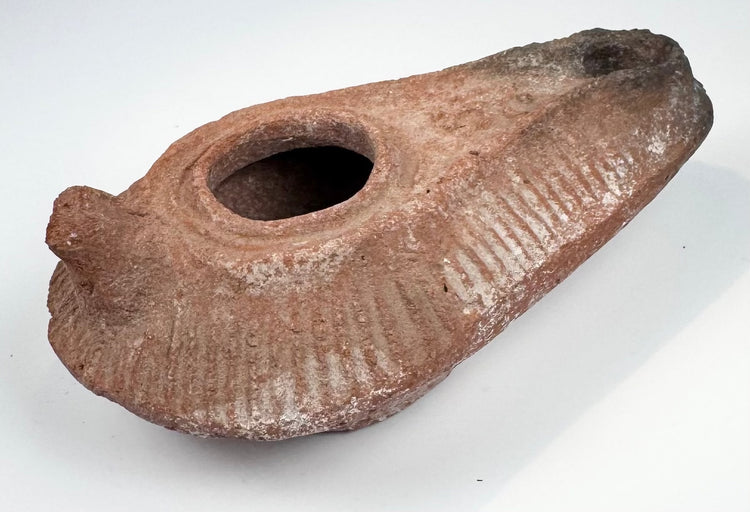
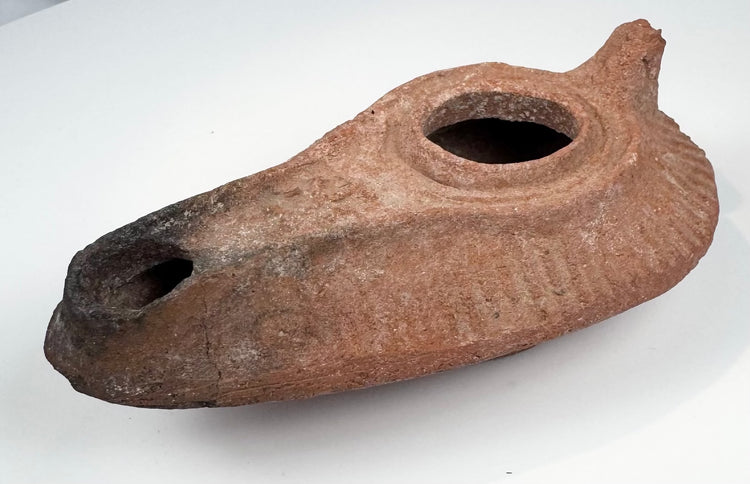
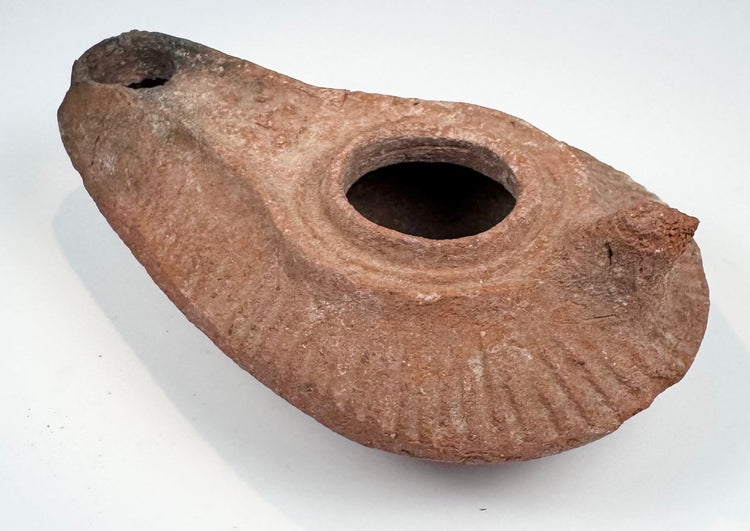
This elongated terracotta oil lamp represents a practical form of household lighting produced throughout the Eastern Mediterranean and Levant during the transition from the Byzantine to the Early Islamic period. Its streamlined, slipper-shaped body incorporates a broad central filling aperture, an extended nozzle with a circular wick opening, and the remains of a raised handle at the rear.
The upper surface is decorated with moulded linear and radiating grooves extending along the shoulders and sides of the lamp. Concentric ridges surround the filling hole, while the elongated channel leading toward the nozzle helped visually organize the lamp’s functional elements. Dark soot staining around the wick opening indicates historic use, providing tangible evidence that the lamp was once burned rather than retained solely as a decorative or funerary object.
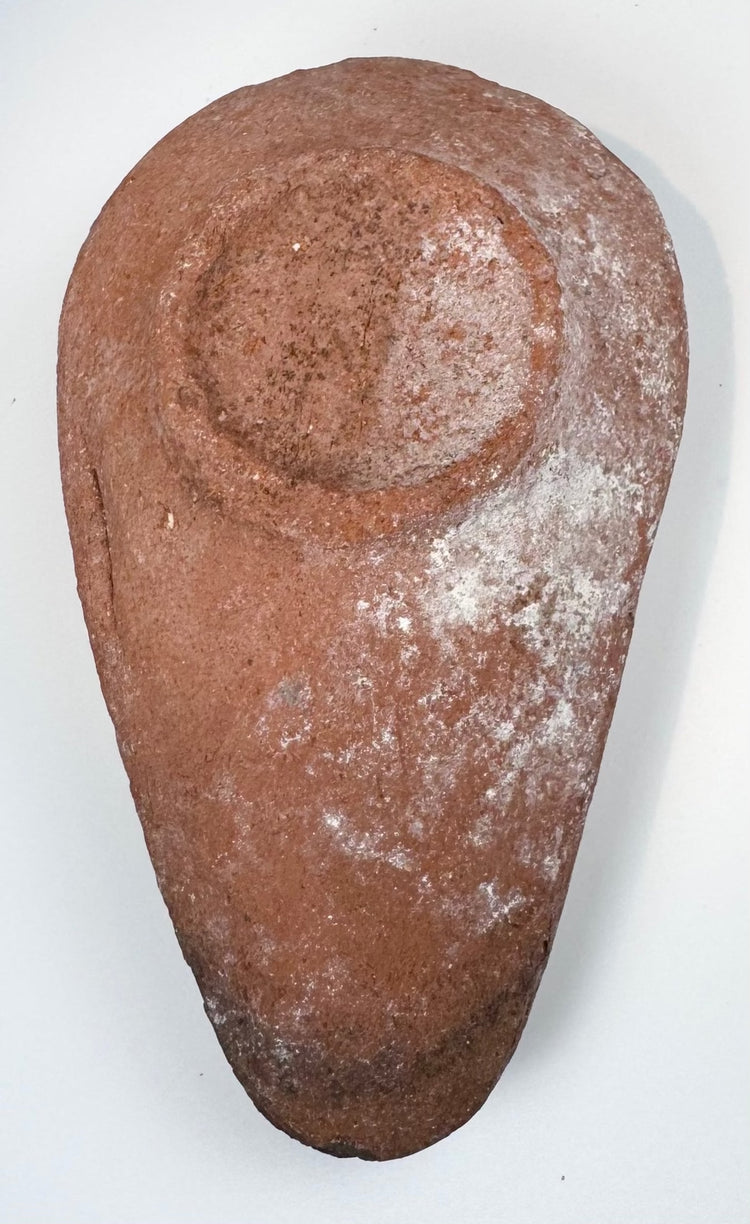
The lamp was originally filled with olive oil or another combustible oil through the central aperture. A fibre wick would have extended through the smaller opening at the nozzle, producing a modest but dependable flame. The underside is comparatively plain and features a circular recessed base that allowed the vessel to rest securely on a flat surface.
Features
- Eastern Mediterranean or Levantine origin
- Elongated slipper-shaped body
- Large central oil-filling aperture
- Extended nozzle with circular wick opening
- Concentric moulded bands surrounding the filling hole
- Radiating linear decoration across the shoulders
- Historic soot staining around the nozzle
- Circular recessed underside
- Remains of the original rear handle
- Evidence of functional use in antiquity
Cultural Significance
Oil lamps were essential objects in homes, workshops, religious buildings, and burial environments throughout the ancient Mediterranean and Near East. Their simple construction provided portable illumination using readily available fuels such as olive oil. Because lamps were required in nearly every household, they were manufactured in substantial quantities using two-part moulds that allowed decorative patterns and standardized forms to be reproduced efficiently.
This example belongs to a period of significant political and cultural transition, during which older Roman and Byzantine ceramic traditions continued after the emergence of Islamic rule. The survival of familiar lamp forms demonstrates that changes in government and religion did not immediately replace established technologies or domestic customs.
Condition
The lamp remains substantially intact and displays extensive age-related surface wear, mineral deposits, abrasion, and scattered discoloration. The raised rear handle is partially lost, leaving an irregular break at its upper extremity. Minor chips, edge wear, surface pitting, and small firing imperfections are present throughout. Dark soot staining is visible around the wick opening and forward nozzle, consistent with ancient use.
Dimensions (Approximate)
Length: 4.75 in
Width: 2.75 in
Height: 1.75 in
Age (Approximate)
1,200–1,500 years old
Provenance
Formerly held in a private collection in Rhode Island, USA, assembled by a collector with a longstanding interest in ancient Mediterranean artifacts and early ceramics.
Learn More
Discover the form, function, and historical use of Roman oil lamps through the Arizona State Museum
Browse our curated Collection of Functional Tools, Ancient Implements & Historic Craft
Description
Historical Context & Origin
Region: Eastern Mediterranean / Levant
Material: Mould-made terracotta
Period: Late Antique to Early Islamic Period, circa 6th–8th Century CE
Description
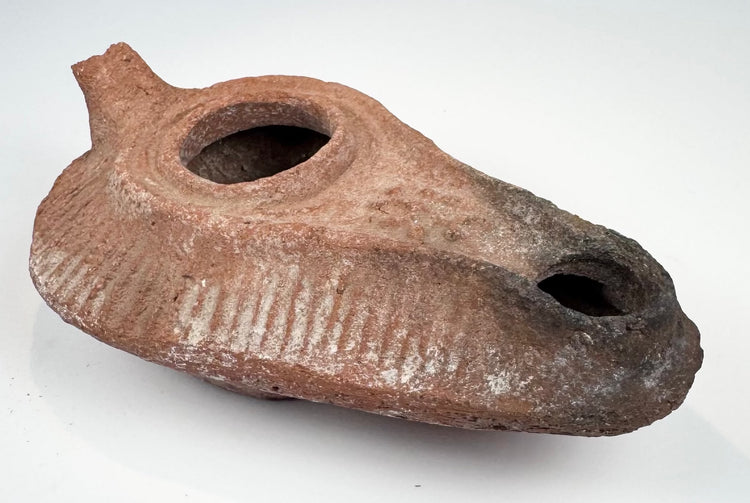
This elongated terracotta oil lamp represents a practical form of household lighting produced throughout the Eastern Mediterranean and Levant during the transition from the Byzantine to the Early Islamic period. Its streamlined, slipper-shaped body incorporates a broad central filling aperture, an extended nozzle with a circular wick opening, and the remains of a raised handle at the rear.
The upper surface is decorated with moulded linear and radiating grooves extending along the shoulders and sides of the lamp. Concentric ridges surround the filling hole, while the elongated channel leading toward the nozzle helped visually organize the lamp’s functional elements. Dark soot staining around the wick opening indicates historic use, providing tangible evidence that the lamp was once burned rather than retained solely as a decorative or funerary object.
The lamp was originally filled with olive oil or another combustible oil through the central aperture. A fibre wick would have extended through the smaller opening at the nozzle, producing a modest but dependable flame. The underside is comparatively plain and features a circular recessed base that allowed the vessel to rest securely on a flat surface.
Features
- Eastern Mediterranean or Levantine origin
- Elongated slipper-shaped body
- Large central oil-filling aperture
- Extended nozzle with circular wick opening
- Concentric moulded bands surrounding the filling hole
- Radiating linear decoration across the shoulders
- Historic soot staining around the nozzle
- Circular recessed underside
- Remains of the original rear handle
- Evidence of functional use in antiquity
Cultural Significance
Oil lamps were essential objects in homes, workshops, religious buildings, and burial environments throughout the ancient Mediterranean and Near East. Their simple construction provided portable illumination using readily available fuels such as olive oil. Because lamps were required in nearly every household, they were manufactured in substantial quantities using two-part moulds that allowed decorative patterns and standardized forms to be reproduced efficiently.
This example belongs to a period of significant political and cultural transition, during which older Roman and Byzantine ceramic traditions continued after the emergence of Islamic rule. The survival of familiar lamp forms demonstrates that changes in government and religion did not immediately replace established technologies or domestic customs.
Condition
The lamp remains substantially intact and displays extensive age-related surface wear, mineral deposits, abrasion, and scattered discoloration. The raised rear handle is partially lost, leaving an irregular break at its upper extremity. Minor chips, edge wear, surface pitting, and small firing imperfections are present throughout. Dark soot staining is visible around the wick opening and forward nozzle, consistent with ancient use.
Dimensions (Approximate)
Length: 4.75 in
Width: 2.75 in
Height: 1.75 in
Age (Approximate)
1,200–1,500 years old
Provenance
Formerly held in a private collection in Rhode Island, USA, assembled by a collector with a longstanding interest in ancient Mediterranean artifacts and early ceramics.
Learn More
Discover the form, function, and historical use of Roman oil lamps through the Arizona State Museum
Browse our curated Collection of Functional Tools, Ancient Implements & Historic Craft
You May Also Like
