




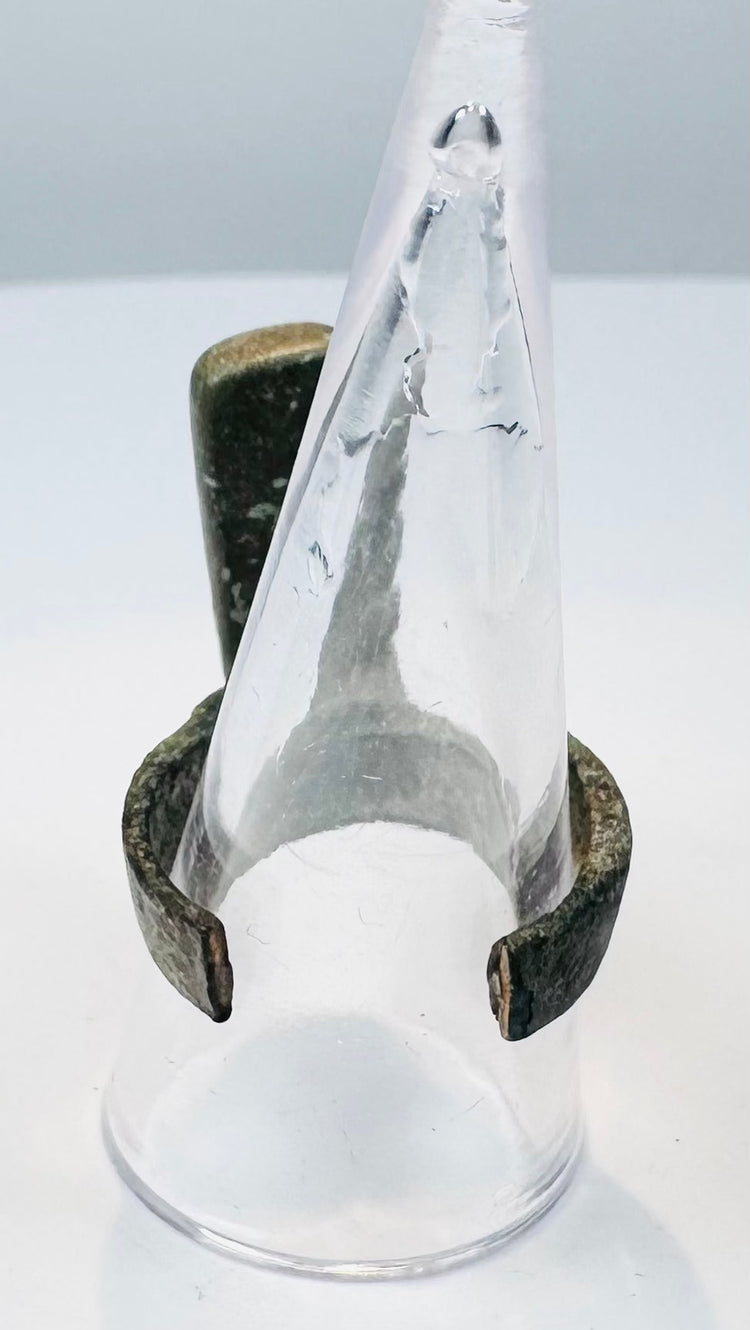
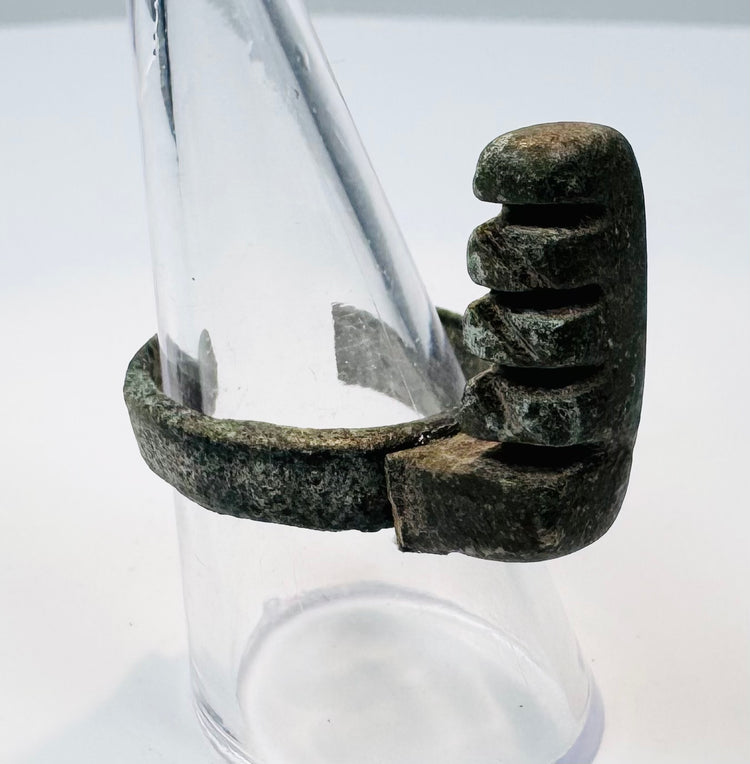
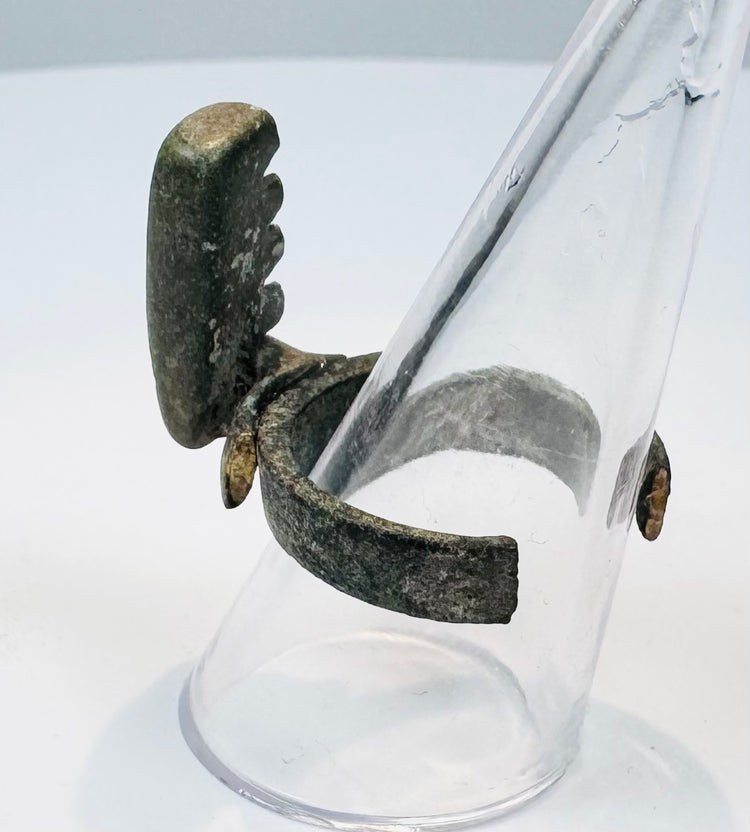
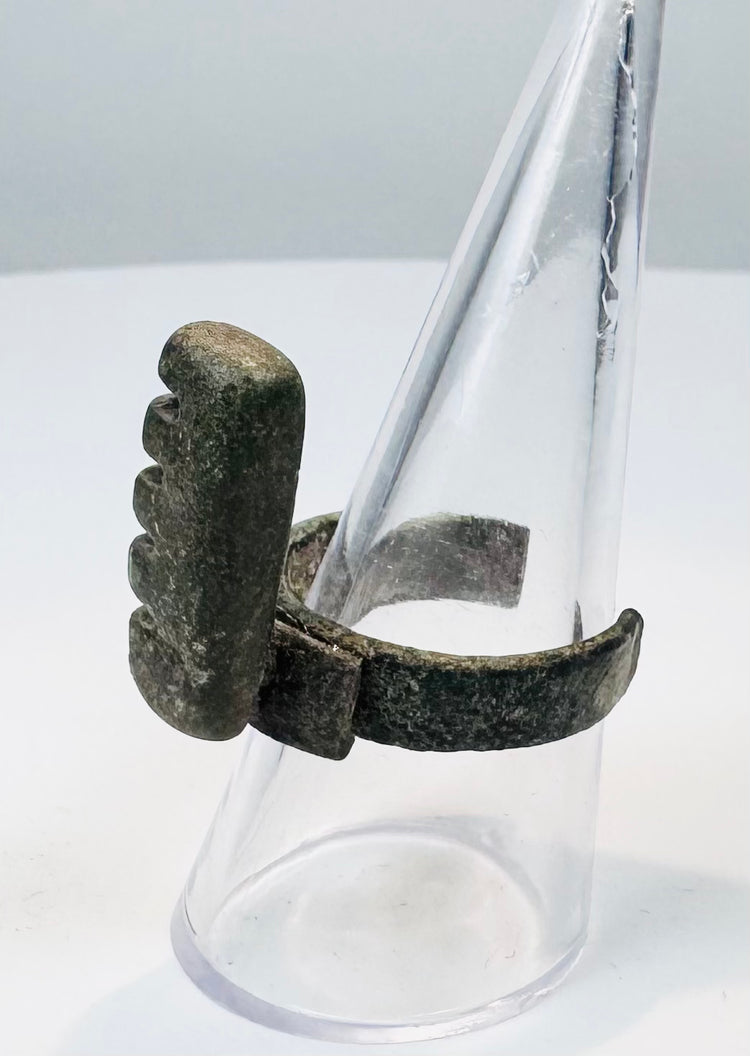

Late Roman Bronze Key Ring with Four-Tooth Bit | Circa 3rd – 4th Century CE
Description
More
Less
Historical Context & Origin
Region: Roman Empire
Material: Cast bronze / copper alloy
Period: Late Roman / Late Imperial Period, circa 3rd–4th century CE
Description
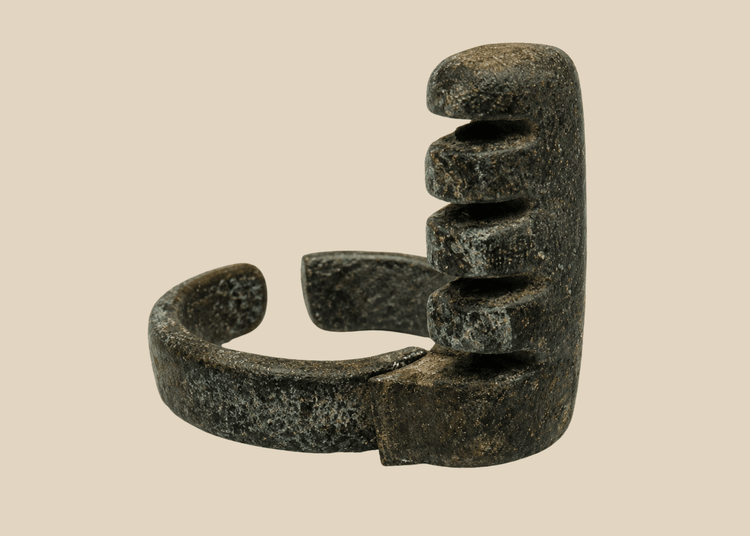
This unusual bronze finger ring is characteristic of a class of compact Roman ring keys produced during the later Imperial period. Rather than carrying a separate key, the wearer could incorporate the functional locking element directly into a ring, creating an object that was simultaneously personal, practical, and highly distinctive.
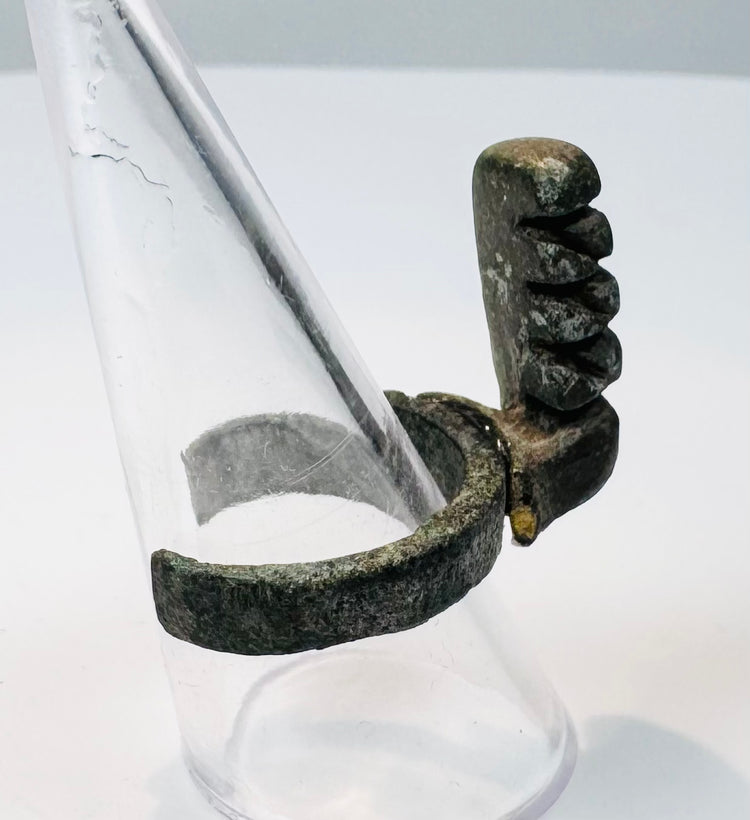
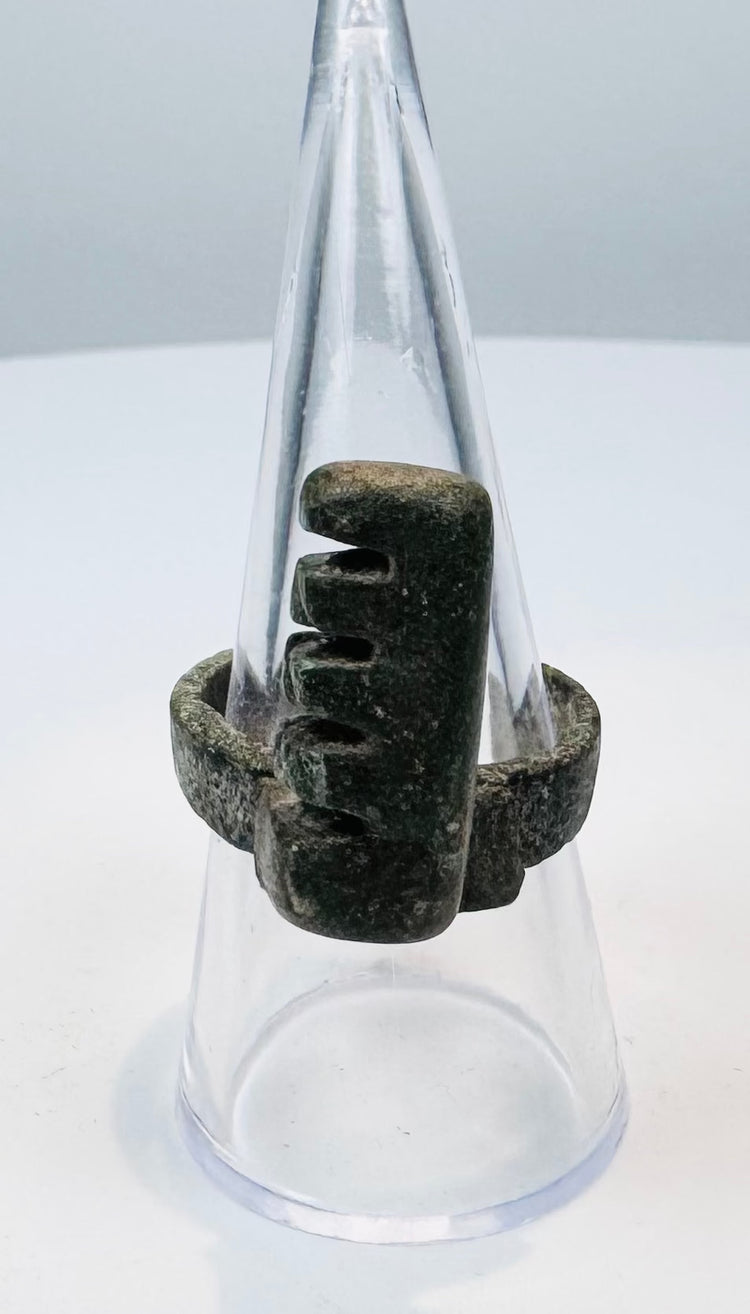
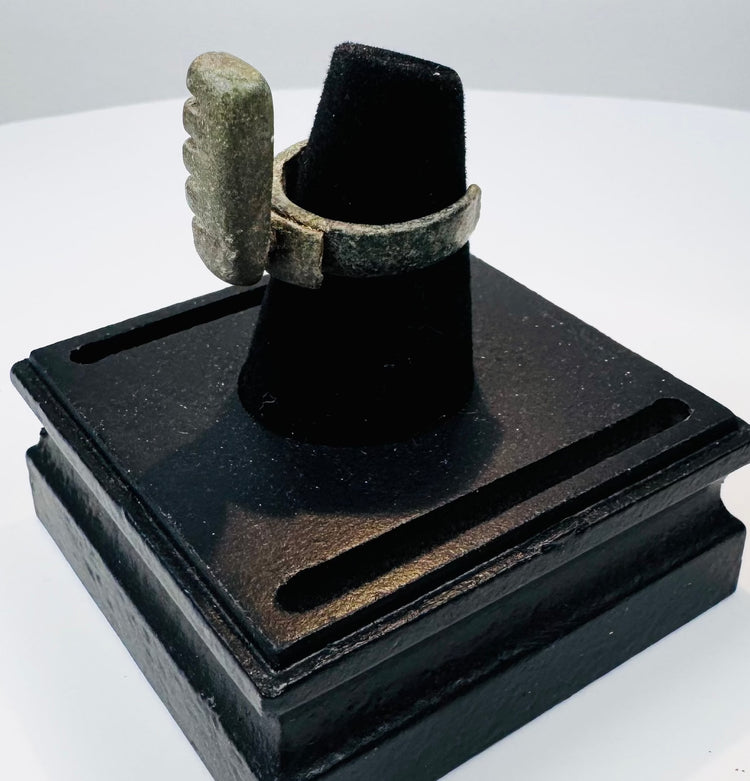
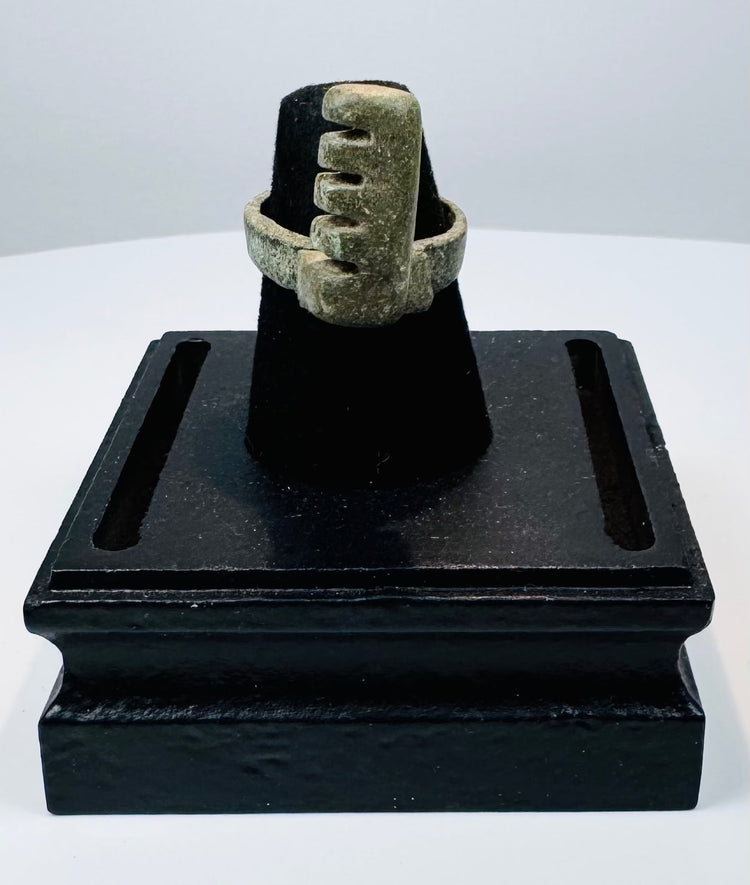
The ring carries a substantial projecting rectangular key bit positioned perpendicular to the finger band. Four deeply divided projecting teeth form the working edge, creating the stepped profile that would originally have corresponded with the internal mechanism of a small lock. Comparable Roman bronze ring keys preserved in museum collections employ short shafts and arrangements of multiple teeth designed to engage relatively small locking mechanisms. The Metropolitan Museum of Art dates several related bronze ring keys to the 3rd–4th century CE.
The bronze has developed a dark green to nearly black archaeological patina with lighter green and earthy surface deposits throughout. Rounded edges, surface pitting, and wear to the projecting teeth give the piece a distinctly archaeological appearance.
Importantly, close inspection indicates that the ring has undergone an older repair or alteration. The projecting key component appears to have been mounted or reattached to an older bronze finger ring rather than surviving as an entirely untouched single construction. The junction between the key element and shank shows visible attachment work, including irregular metal at the shoulders and a small surviving attachment or rivet-like element. This modification appears old and has itself developed patination.
Features
- Large projecting rectangular key bit
- Four distinct stepped locking teeth
- Heavy cast bronze / copper-alloy construction
- Dark green and black archaeological patination
- Surface mineralization and age-related deposits
- Older repair or remounting of the key element onto an older ring shank
- Visible historical attachment work at the junction
- Open-ended ring band
Cultural Significance
Ring keys represent a particularly fascinating aspect of Roman everyday life. They combined personal adornment with a practical means of controlling access to locked possessions. Small locks were used on boxes, caskets, containers, cabinets, and other personal storage objects, making compact keys useful items for individuals responsible for valuables or household goods.
Museum examples demonstrate that bronze ring keys with multiple working teeth were produced during the later Roman period, particularly during the 3rd and 4th centuries CE.
Condition
Ancient condition with substantial age-related wear, patination, oxidation, surface pitting, mineral deposits, and softened edges throughout.
Of particular importance, the projecting key element appears to have undergone an older repair and to have been mounted or reattached onto an older bronze ring shank. The junction between the key component and ring shows clearly visible historic attachment work, including irregularities in the metal and a small attachment or rivet-like element. The repair itself displays age and patination.
The ring band is open at the rear and exhibits irregularity and wear along its terminals. The projecting locking teeth remain substantially intact but show rounding and surface loss consistent with considerable age.
Dimensions (Approximate)
Ring Size: US 9
Age (Approximate)
1,600–1,800 years old
Provenance
Formerly in a private California collection, acquired in Germany approximately 25 years ago.
Subsequently handled by Palmyra Heritage Gallery, New York. Established in New York in 1995, Palmyra Heritage specializes in ancient coins and antiquities, including material from the Greek, Roman, Byzantine, Egyptian, Pre-Columbian, and Islamic worlds.
Learn More
Discover a related Roman bronze ring key dating to the 3rd–4th century CE in the collection of The Metropolitan Museum of Art
Explore our Collection of Roman and Greek Artifacts
Description
Historical Context & Origin
Region: Roman Empire
Material: Cast bronze / copper alloy
Period: Late Roman / Late Imperial Period, circa 3rd–4th century CE
Description
This unusual bronze finger ring is characteristic of a class of compact Roman ring keys produced during the later Imperial period. Rather than carrying a separate key, the wearer could incorporate the functional locking element directly into a ring, creating an object that was simultaneously personal, practical, and highly distinctive.
The ring carries a substantial projecting rectangular key bit positioned perpendicular to the finger band. Four deeply divided projecting teeth form the working edge, creating the stepped profile that would originally have corresponded with the internal mechanism of a small lock. Comparable Roman bronze ring keys preserved in museum collections employ short shafts and arrangements of multiple teeth designed to engage relatively small locking mechanisms. The Metropolitan Museum of Art dates several related bronze ring keys to the 3rd–4th century CE.
The bronze has developed a dark green to nearly black archaeological patina with lighter green and earthy surface deposits throughout. Rounded edges, surface pitting, and wear to the projecting teeth give the piece a distinctly archaeological appearance.
Importantly, close inspection indicates that the ring has undergone an older repair or alteration. The projecting key component appears to have been mounted or reattached to an older bronze finger ring rather than surviving as an entirely untouched single construction. The junction between the key element and shank shows visible attachment work, including irregular metal at the shoulders and a small surviving attachment or rivet-like element. This modification appears old and has itself developed patination.
Features
- Large projecting rectangular key bit
- Four distinct stepped locking teeth
- Heavy cast bronze / copper-alloy construction
- Dark green and black archaeological patination
- Surface mineralization and age-related deposits
- Older repair or remounting of the key element onto an older ring shank
- Visible historical attachment work at the junction
- Open-ended ring band
Cultural Significance
Ring keys represent a particularly fascinating aspect of Roman everyday life. They combined personal adornment with a practical means of controlling access to locked possessions. Small locks were used on boxes, caskets, containers, cabinets, and other personal storage objects, making compact keys useful items for individuals responsible for valuables or household goods.
Museum examples demonstrate that bronze ring keys with multiple working teeth were produced during the later Roman period, particularly during the 3rd and 4th centuries CE.
Condition
Ancient condition with substantial age-related wear, patination, oxidation, surface pitting, mineral deposits, and softened edges throughout.
Of particular importance, the projecting key element appears to have undergone an older repair and to have been mounted or reattached onto an older bronze ring shank. The junction between the key component and ring shows clearly visible historic attachment work, including irregularities in the metal and a small attachment or rivet-like element. The repair itself displays age and patination.
The ring band is open at the rear and exhibits irregularity and wear along its terminals. The projecting locking teeth remain substantially intact but show rounding and surface loss consistent with considerable age.
Dimensions (Approximate)
Ring Size: US 9
Age (Approximate)
1,600–1,800 years old
Provenance
Formerly in a private California collection, acquired in Germany approximately 25 years ago.
Subsequently handled by Palmyra Heritage Gallery, New York. Established in New York in 1995, Palmyra Heritage specializes in ancient coins and antiquities, including material from the Greek, Roman, Byzantine, Egyptian, Pre-Columbian, and Islamic worlds.
Learn More
Discover a related Roman bronze ring key dating to the 3rd–4th century CE in the collection of The Metropolitan Museum of Art
Explore our Collection of Roman and Greek Artifacts
You May Also Like
