

Late Roman–Early Byzantine Bronze Ring with Incised Linear Bezel | Circa 4th–6th Century CE
Couldn't load pickup availability


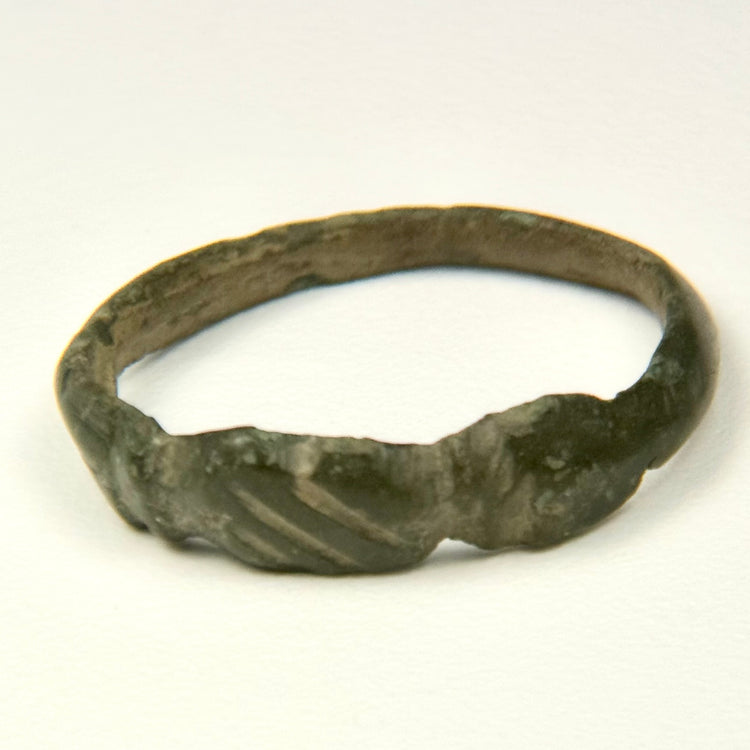
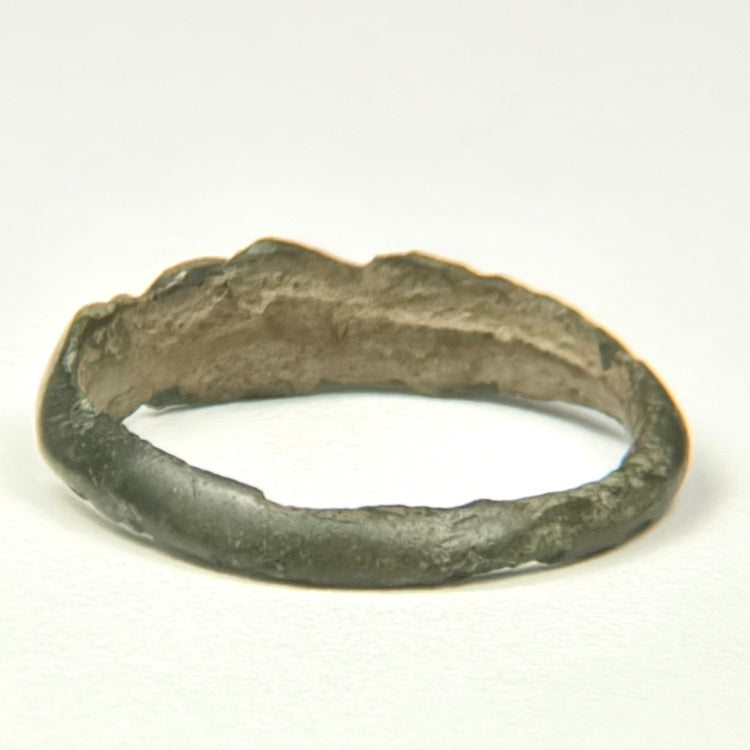
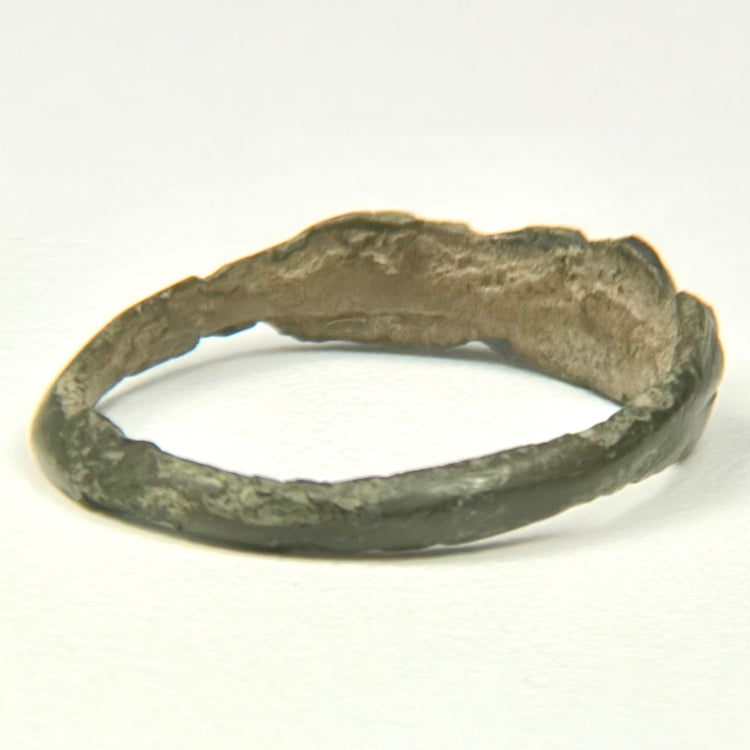
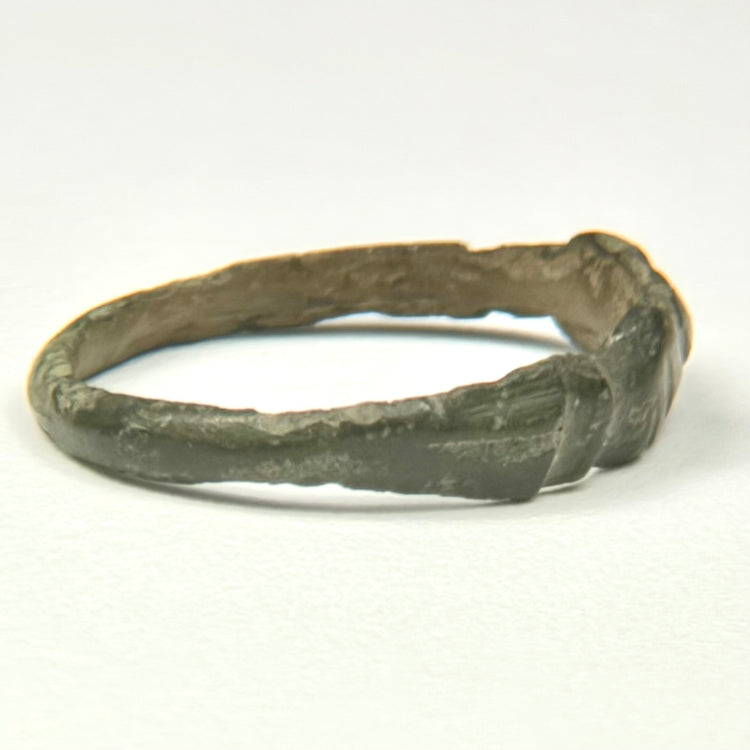
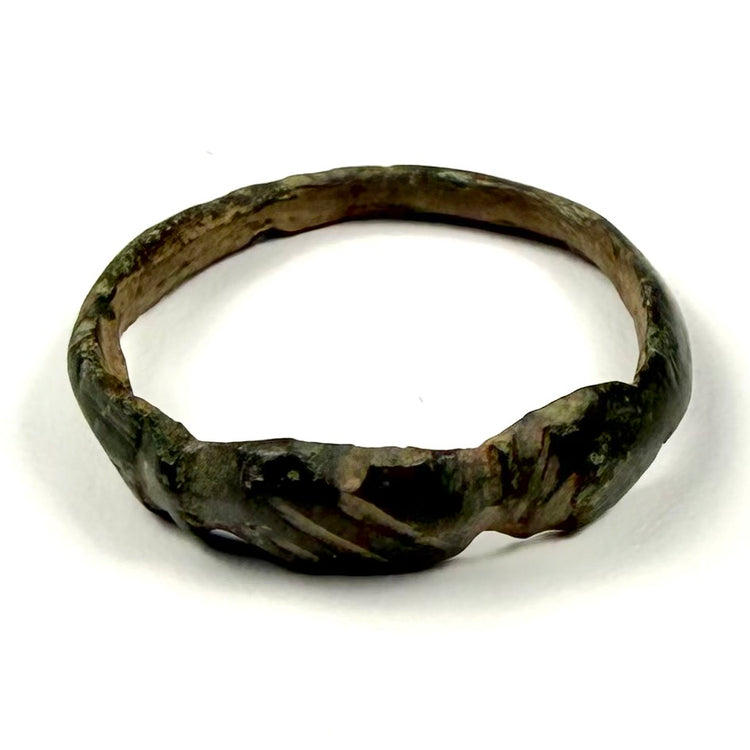
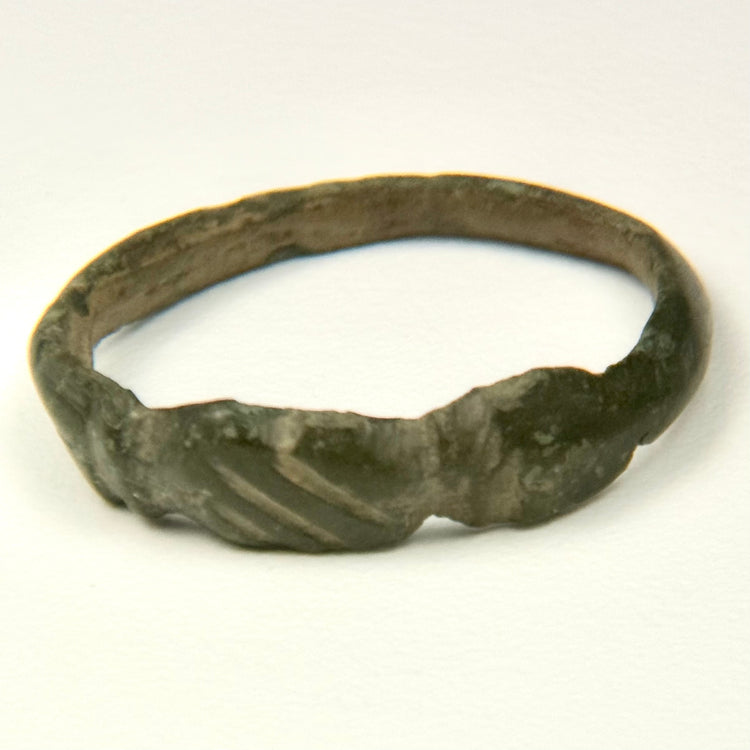
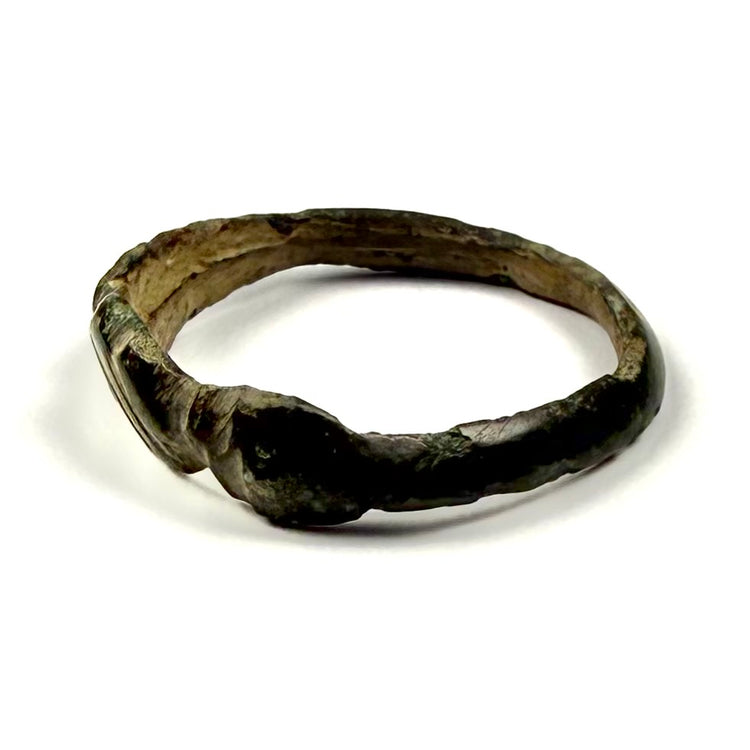
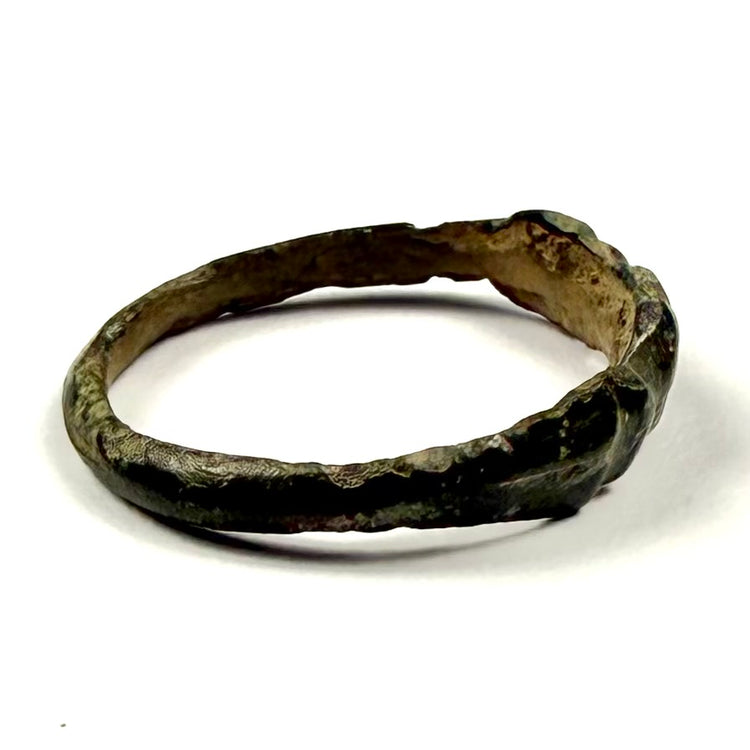
Late Roman–Early Byzantine Bronze Ring with Incised Linear Bezel | Circa 4th–6th Century CE
Description
More
Less
Historical Context & Origin
Region: Eastern Mediterranean
Material: Bronze (copper alloy)
Period: Late Roman to Early Byzantine Period, circa 4th–6th century CE
Description
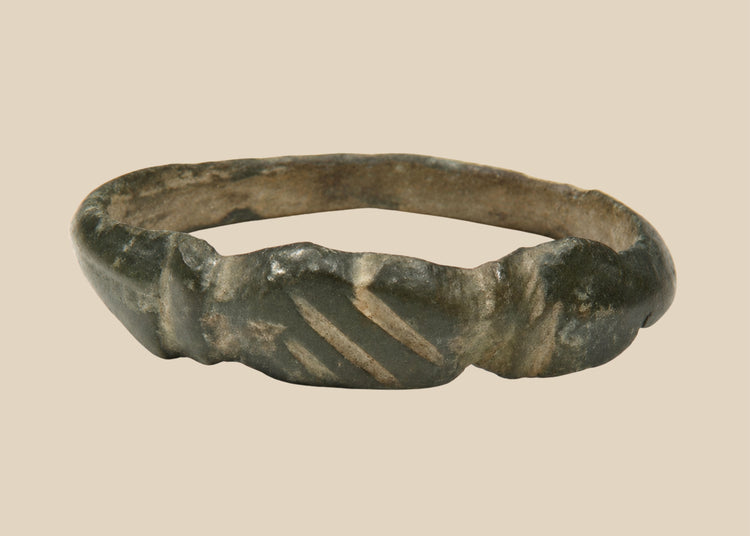
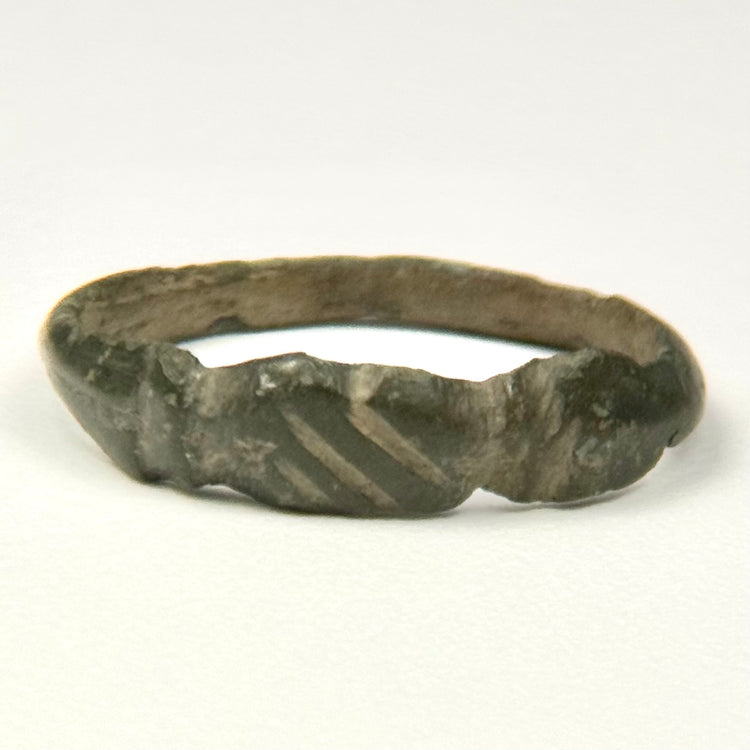
An ancient bronze finger ring dating to the transitional Late Roman and Early Byzantine period, distinguished by a broad flattened face decorated with a simple but deliberate arrangement of deeply incised linear ornament.
The solid cast hoop gradually expands toward the front, forming an integral oval-to-rectangular bezel area rather than a separately mounted setting. Across this flattened face are three prominent parallel diagonal grooves, creating a restrained geometric design. Additional short transverse and vertical incisions survive along the shoulders, visually separating the decorated front from the narrower portion of the hoop.
The engraved lines appear intentionally ornamental rather than forming a securely recognizable inscription or religious symbol. Simple geometric decoration of this type was widely employed on bronze personal ornaments during Late Antiquity, when cast copper-alloy rings offered durable and accessible alternatives to more elaborate examples produced in silver and gold.
The ring retains a heavily aged archaeological surface in dark olive, brown, and charcoal tones with areas of lighter mineralization and exposed bronze coloration. Centuries of wear and burial have softened the original edges and produced an irregular profile, particularly around the bezel and shoulders, while the principal diagonal decoration remains clearly visible.
Features
- Broad flattened integral bezel or decorated face
- Three deeply incised parallel diagonal grooves
- Additional linear and transverse decoration along the shoulders
- Solid one-piece cast bronze construction
- Hoop gradually expanding toward the decorated front
- Dark olive-brown and charcoal archaeological patina
- Natural oxidation, mineralization, and burial deposits
- Strong age-related surface texture and irregular ancient profile
- Complete surviving hoop
Cultural Significance
Finger rings remained an important form of personal adornment throughout the later Roman Empire and into the Early Byzantine world. Bronze examples were produced in large numbers and could incorporate engraved geometric ornament, inscriptions, monograms, crosses, or other personal devices.
Geometrically decorated rings represent a particularly direct form of Late Antique personal material culture. Rather than relying on precious stones or elaborate settings, their visual character was created through the shape of the cast metal itself and a limited vocabulary of hand-cut lines, grooves, and geometric patterns.
The simple diagonal design preserved on this example demonstrates how even relatively modest bronze jewelry could be individually ornamented. Because the surviving lines do not form a securely identifiable inscription or symbol, they are best interpreted conservatively as geometric decoration rather than assigned a specific religious or signet function.
Condition
Ancient archaeological condition with substantial age-related wear, oxidation, mineralization, surface pitting, and localized encrustation throughout. The bezel and shoulder edges are irregular and softened from prolonged wear and burial. The three principal diagonal incisions remain clearly visible, while portions of the secondary shoulder decoration are worn. The bronze displays dark olive, brown, and charcoal patination with lighter exposed and mineralized areas. The hoop remains complete, with no major open break visible in the photographs.
Dimensions (Approximate)
Ring Size: US 8.75
Age (Approximate)
1,400–1,600 years old
Provenance
Acquired in London during the 1970s. The artifact later entered the collection of Dr. Arnold Saslow, a noted numismatist and antiquarian who handled ancient coins, antiquities, and other historic objects over several decades, and was associated with Ye Olde Curiosity Shoppe in New Jersey. It was subsequently handled by Artemis Fine Arts, a U.S.-based gallery specializing in ancient, Classical, Pre-Columbian, and ethnographic art.
Learn More
Explore a related Early Byzantine bronze finger ring with engraved geometric decoration in the collection of the British Museum
Browse our collection of Roman & Greek artifacts
Description
Historical Context & Origin
Region: Eastern Mediterranean
Material: Bronze (copper alloy)
Period: Late Roman to Early Byzantine Period, circa 4th–6th century CE
Description
An ancient bronze finger ring dating to the transitional Late Roman and Early Byzantine period, distinguished by a broad flattened face decorated with a simple but deliberate arrangement of deeply incised linear ornament.
The solid cast hoop gradually expands toward the front, forming an integral oval-to-rectangular bezel area rather than a separately mounted setting. Across this flattened face are three prominent parallel diagonal grooves, creating a restrained geometric design. Additional short transverse and vertical incisions survive along the shoulders, visually separating the decorated front from the narrower portion of the hoop.
The engraved lines appear intentionally ornamental rather than forming a securely recognizable inscription or religious symbol. Simple geometric decoration of this type was widely employed on bronze personal ornaments during Late Antiquity, when cast copper-alloy rings offered durable and accessible alternatives to more elaborate examples produced in silver and gold.
The ring retains a heavily aged archaeological surface in dark olive, brown, and charcoal tones with areas of lighter mineralization and exposed bronze coloration. Centuries of wear and burial have softened the original edges and produced an irregular profile, particularly around the bezel and shoulders, while the principal diagonal decoration remains clearly visible.
Features
- Broad flattened integral bezel or decorated face
- Three deeply incised parallel diagonal grooves
- Additional linear and transverse decoration along the shoulders
- Solid one-piece cast bronze construction
- Hoop gradually expanding toward the decorated front
- Dark olive-brown and charcoal archaeological patina
- Natural oxidation, mineralization, and burial deposits
- Strong age-related surface texture and irregular ancient profile
- Complete surviving hoop
Cultural Significance
Finger rings remained an important form of personal adornment throughout the later Roman Empire and into the Early Byzantine world. Bronze examples were produced in large numbers and could incorporate engraved geometric ornament, inscriptions, monograms, crosses, or other personal devices.
Geometrically decorated rings represent a particularly direct form of Late Antique personal material culture. Rather than relying on precious stones or elaborate settings, their visual character was created through the shape of the cast metal itself and a limited vocabulary of hand-cut lines, grooves, and geometric patterns.
The simple diagonal design preserved on this example demonstrates how even relatively modest bronze jewelry could be individually ornamented. Because the surviving lines do not form a securely identifiable inscription or symbol, they are best interpreted conservatively as geometric decoration rather than assigned a specific religious or signet function.
Condition
Ancient archaeological condition with substantial age-related wear, oxidation, mineralization, surface pitting, and localized encrustation throughout. The bezel and shoulder edges are irregular and softened from prolonged wear and burial. The three principal diagonal incisions remain clearly visible, while portions of the secondary shoulder decoration are worn. The bronze displays dark olive, brown, and charcoal patination with lighter exposed and mineralized areas. The hoop remains complete, with no major open break visible in the photographs.
Dimensions (Approximate)
Ring Size: US 8.75
Age (Approximate)
1,400–1,600 years old
Provenance
Acquired in London during the 1970s. The artifact later entered the collection of Dr. Arnold Saslow, a noted numismatist and antiquarian who handled ancient coins, antiquities, and other historic objects over several decades, and was associated with Ye Olde Curiosity Shoppe in New Jersey. It was subsequently handled by Artemis Fine Arts, a U.S.-based gallery specializing in ancient, Classical, Pre-Columbian, and ethnographic art.
Learn More
Explore a related Early Byzantine bronze finger ring with engraved geometric decoration in the collection of the British Museum
Browse our collection of Roman & Greek artifacts
You May Also Like
