



Western European Iron Ring-Pommel Dagger | Medieval Spadino | 14th Century CE
Couldn't load pickup availability


Western European Iron Ring-Pommel Dagger | Medieval Spadino | 14th Century CE
Description
More
Less
Historical Context & Origin
Region: Western Europe
Material: Iron
Period: 14th Century CE
Description
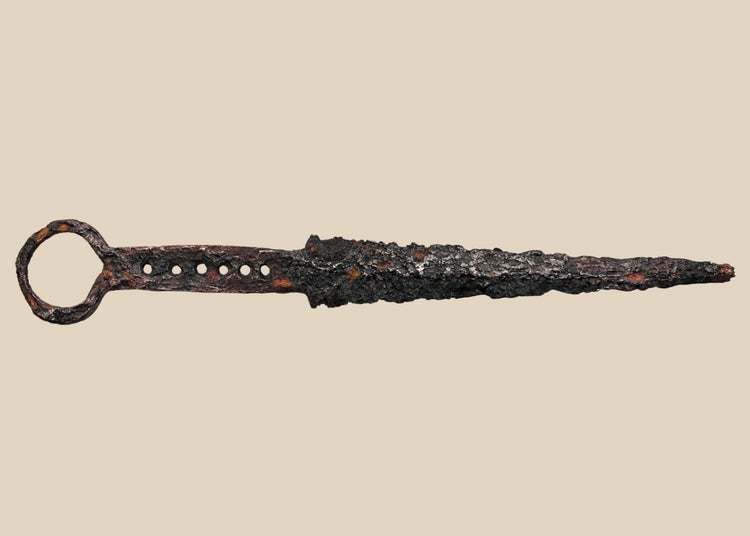
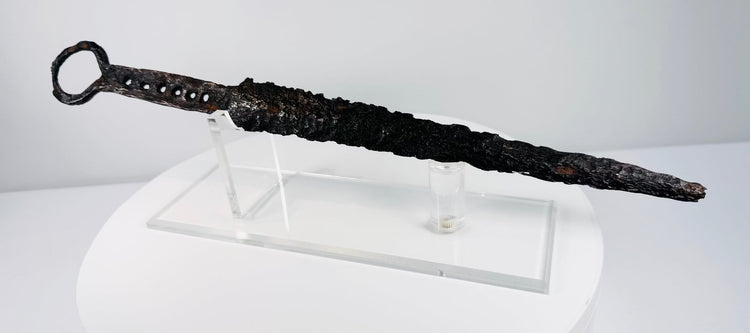
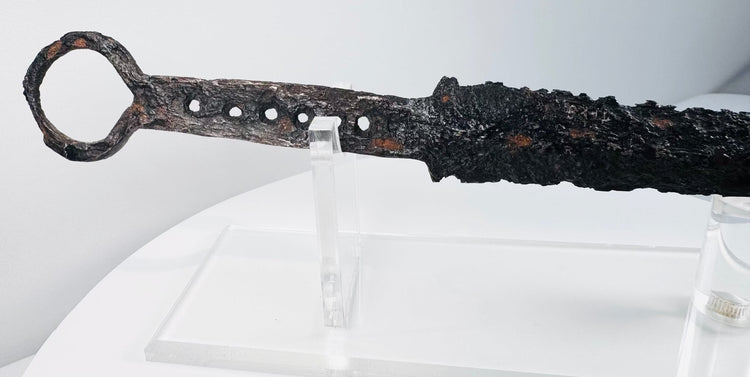
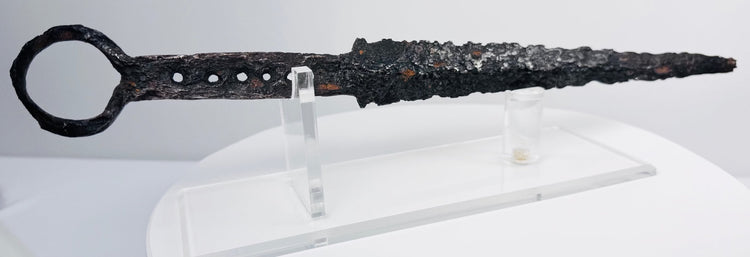
This medieval iron ring-pommel dagger, attributed to Western Europe and dating to the 14th century CE, represents a distinctive form of small medieval sidearm characterized by its closed ring pommel and narrow tapering blade.
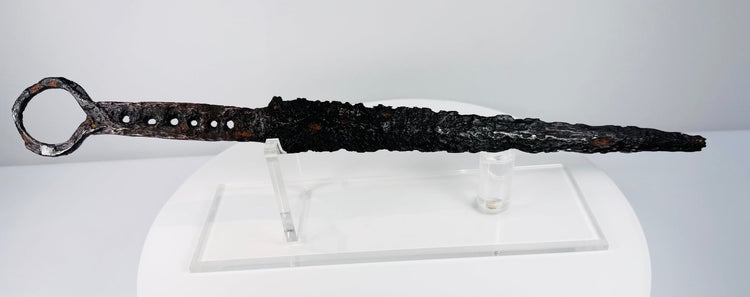
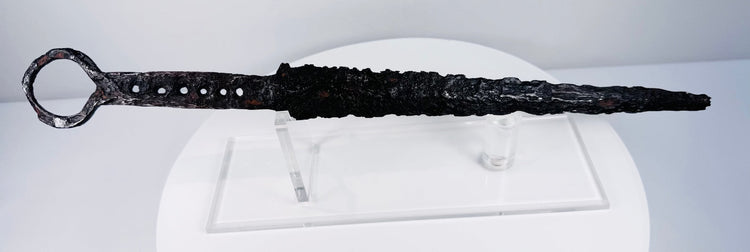
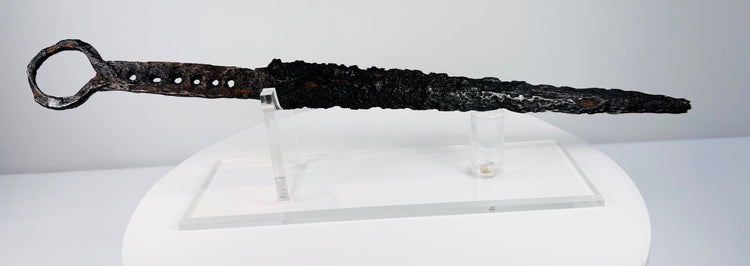
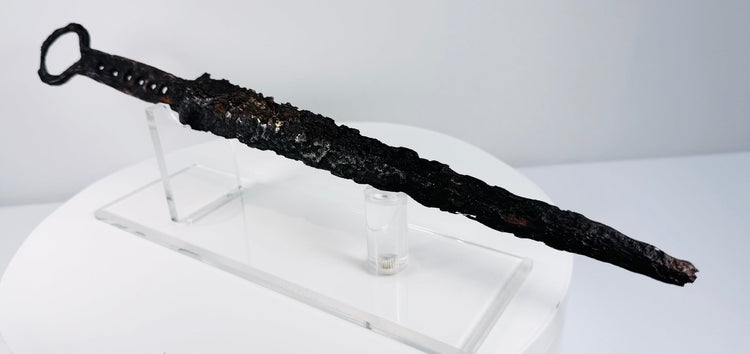
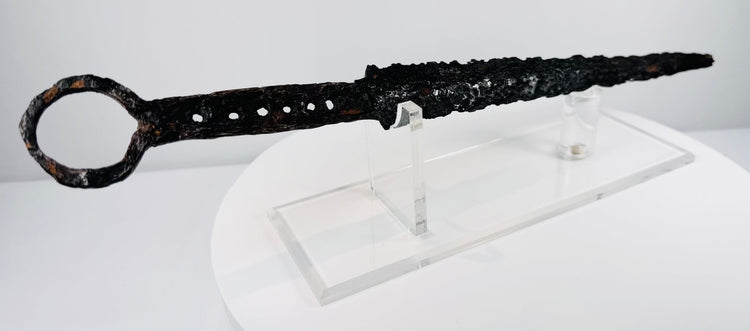
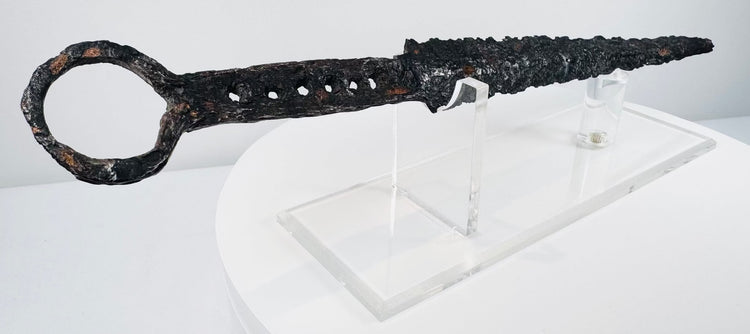
The dagger features a closed ring pommel forged in one piece with the flat tang. The tang is pierced by six holes, originally intended for the rivets that secured now-lost grip plates. A small projecting feature is present at the junction of the tang and blade, another characteristic associated with this medieval dagger type.
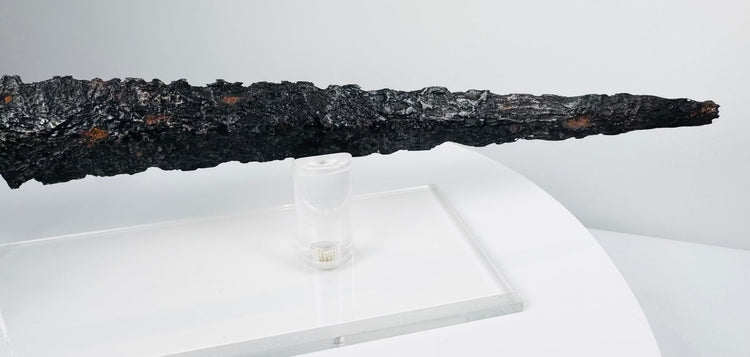
The long, narrow blade tapers toward the tip, which is now broken. Based on its overall form, proportions, ring pommel, perforated tang, and construction, specialist examination attributes the dagger to Western Europe and dates it to the 14th century. Comparable examples are documented from the 13th–14th centuries.
Features
- Dating to the 14th century CE
- Distinctive closed ring pommel
- Ring pommel and flat tang forged as a single construction
- Tang pierced with six rivet holes for original grip plates
- Small protuberance at the junction of tang and blade
- Long, narrow blade tapering toward the point
- Comparable to medieval dagger types known as spadini
Cultural Significance
Ring-pommel daggers represent a recognizable form of medieval European sidearm with a long history of use. Similar small iron daggers are documented archaeologically during the central Middle Ages, including examples dated to the 13th and 14th centuries.
The ring pommel, perforated tang, distinctive blade-to-tang junction, and overall proportions of this example support its identification within this medieval European dagger tradition. The specialist dates the present example to the 14th century, while noting that the form itself existed over a broader chronological period.
Condition
Ancient condition with extensive age-related corrosion. The blade is covered by a thick dark corrosion crust with reddish areas and occasional exposed patches of metal. The ring pommel and tang are comparatively better preserved. The original grip plates and securing rivets are no longer present, and the tip of the blade is broken. Surface wear and oxidation are consistent with the object's considerable age.
Dimensions (Approximate)
Length: 15.5 in
Age (Approximate)
650–700 years old
Provenance
Formerly held in a private collection in Beverly Hills, California, USA.
The piece was later examined by Luca Salvaggio, an Italian archaeologist with expertise in Greek, Roman, Near Eastern, and European archaeological material. He holds a Postgraduate Diploma from the Italian Archaeological School at Athens (IASA) and is accredited for preventive archaeology by the Italian Ministry of Culture (MiC). Salvaggio attributed the dagger to Western Europe and dated it to the 14th century CE, identifying its closed ring pommel, perforated tang, blade form, and overall proportions as characteristic of this medieval dagger type. His signed specialist report accompanies the piece and is included with the purchase.
Published Reference
For a comparable example, see Harold L. Peterson, Daggers and Fighting Knives of the Western World: From the Stone Age to 1900, illustration no. 24, which depicts a late 14th-century quillon dagger with a ring pommel, then held in the Schweizerisches Landesmuseum, Zurich, Switzerland.
Learn More
Read about medieval quillon daggers at Quillon Dagger – 12th–17th Century
Browse Our Collection of Historical Warfare Artifacts
Description
Historical Context & Origin
Region: Western Europe
Material: Iron
Period: 14th Century CE
Description
This medieval iron ring-pommel dagger, attributed to Western Europe and dating to the 14th century CE, represents a distinctive form of small medieval sidearm characterized by its closed ring pommel and narrow tapering blade.
The dagger features a closed ring pommel forged in one piece with the flat tang. The tang is pierced by six holes, originally intended for the rivets that secured now-lost grip plates. A small projecting feature is present at the junction of the tang and blade, another characteristic associated with this medieval dagger type.
The long, narrow blade tapers toward the tip, which is now broken. Based on its overall form, proportions, ring pommel, perforated tang, and construction, specialist examination attributes the dagger to Western Europe and dates it to the 14th century. Comparable examples are documented from the 13th–14th centuries.
Features
- Dating to the 14th century CE
- Distinctive closed ring pommel
- Ring pommel and flat tang forged as a single construction
- Tang pierced with six rivet holes for original grip plates
- Small protuberance at the junction of tang and blade
- Long, narrow blade tapering toward the point
- Comparable to medieval dagger types known as spadini
Cultural Significance
Ring-pommel daggers represent a recognizable form of medieval European sidearm with a long history of use. Similar small iron daggers are documented archaeologically during the central Middle Ages, including examples dated to the 13th and 14th centuries.
The ring pommel, perforated tang, distinctive blade-to-tang junction, and overall proportions of this example support its identification within this medieval European dagger tradition. The specialist dates the present example to the 14th century, while noting that the form itself existed over a broader chronological period.
Condition
Ancient condition with extensive age-related corrosion. The blade is covered by a thick dark corrosion crust with reddish areas and occasional exposed patches of metal. The ring pommel and tang are comparatively better preserved. The original grip plates and securing rivets are no longer present, and the tip of the blade is broken. Surface wear and oxidation are consistent with the object's considerable age.
Dimensions (Approximate)
Length: 15.5 in
Age (Approximate)
650–700 years old
Provenance
Formerly held in a private collection in Beverly Hills, California, USA.
The piece was later examined by Luca Salvaggio, an Italian archaeologist with expertise in Greek, Roman, Near Eastern, and European archaeological material. He holds a Postgraduate Diploma from the Italian Archaeological School at Athens (IASA) and is accredited for preventive archaeology by the Italian Ministry of Culture (MiC). Salvaggio attributed the dagger to Western Europe and dated it to the 14th century CE, identifying its closed ring pommel, perforated tang, blade form, and overall proportions as characteristic of this medieval dagger type. His signed specialist report accompanies the piece and is included with the purchase.
Published Reference
For a comparable example, see Harold L. Peterson, Daggers and Fighting Knives of the Western World: From the Stone Age to 1900, illustration no. 24, which depicts a late 14th-century quillon dagger with a ring pommel, then held in the Schweizerisches Landesmuseum, Zurich, Switzerland.
Learn More
Read about medieval quillon daggers at Quillon Dagger – 12th–17th Century
Browse Our Collection of Historical Warfare Artifacts
You May Also Like
